


Why Avoid Public NMT for Regulated Life Sciences

Public Neural Machine Translation often looks quick and convenient, yet for Compliance Directors in the Life Sciences sector across Northern Europe, its risks are rarely just technical. Sensitive regulatory documentation demands standards far stricter than most public NMT platforms can offer. Good Documentation Practices set specific expectations for data integrity, traceability, and confidentiality that public NMT cannot consistently guarantee. Understanding why these gaps matter will help you safeguard your organization from costly compliance missteps and regulatory scrutiny.
Table of Contents
Key Takeaways
Point | Details |
Public NMT Compliance Risks | Public Neural Machine Translation systems can jeopardize regulatory compliance due to inconsistent terminology and lack of quality control. |
Private Solutions Advantage | Tailored private translation services ensure better alignment with regulatory requirements and maintain stringent data security measures. |
Hybrid AI and Human Models | Combining AI with human oversight offers enhanced accuracy and contextual understanding for complex regulatory documentation. |
Proactive Risk Assessment | Implementing structured protocols for translation can mitigate potential compliance failures and protect sensitive regulatory documents. |
Public NMT Explained for Compliance Context
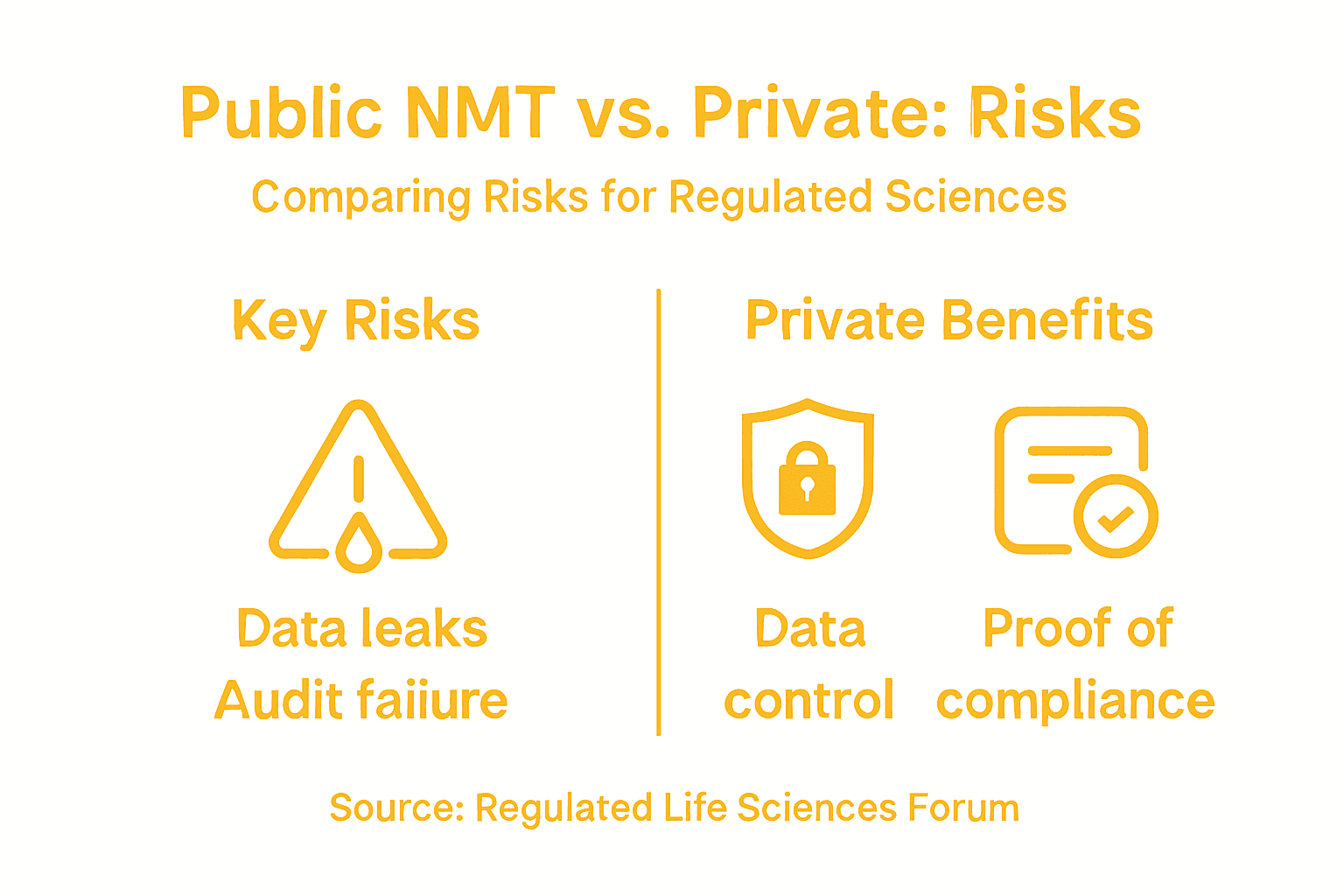
Public Neural Machine Translation (NMT) represents a baseline translation technology utilizing machine learning algorithms to convert text between languages. In regulated life sciences, these public translation systems pose significant compliance and documentation risks that demand rigorous evaluation.
NMT systems fundamentally differ from traditional translation approaches through their neural network-based architecture. Unlike rule-based or statistical machine translation, NMT learns language patterns by processing massive text datasets, generating translations that appear more contextually fluid but critically lack the precision required for regulatory documentation standards.
Key Characteristics of Public NMT Systems:
Generate translations using generalized machine learning models
Lack specialized domain-specific training in medical/scientific terminology
Cannot guarantee consistent terminology control
Process translations without human oversight or quality verification
Store potentially sensitive data in uncontrolled cloud environments
The fundamental challenge with public NMT emerges from its inability to meet Good Documentation Practices (GDP) requirements. Regulatory frameworks demand documentation that is attributable, legible, contemporaneous, original, accurate, complete, and permanent - standards public translation systems inherently struggle to meet.
Compliance Risks in Public NMT:
Potential unauthorized data transmission
Inconsistent medical/technical terminology
Lack of audit trail for translation processes
Unpredictable translation accuracy in specialized domains
Potential violations of data sovereignty regulations
Pro tip: Always verify translation systems have explicit compliance certifications before processing regulated scientific documentation.
Variations: Public NMT Versus Private Solutions
Public Neural Machine Translation (NMT) and private translation solutions represent fundamentally different approaches to linguistic conversion, particularly in highly regulated industries like life sciences. While public NMT systems offer generalized, accessible translation capabilities, private solutions provide specialized, compliance-driven frameworks tailored to specific regulatory requirements.
Key Distinctions Between Public and Private Translation Solutions:
Compliance level and regulatory alignment
Data sovereignty and security protocols
Domain-specific terminology management
Quality assurance and oversight mechanisms
Customization and adaptability to industry standards
Private translation solutions, such as those developed for medical device quality management, offer structured frameworks that meet stringent regulatory standards. These solutions differ critically from public NMT by incorporating industry-specific knowledge, maintaining precise terminology control, and providing comprehensive audit trails.
Compliance Characteristics of Private Solutions:
Explicit regulatory framework alignment
Rigorous data protection and confidentiality measures
Subject matter expert involvement in translation processes
Customizable terminology management systems
Comprehensive documentation and traceability
The Pharmaceutical Compliance Forum highlights that private solutions focus on risk-based, company-specific strategies that address confidential content concerns more effectively than generalized public translation technologies.
Pro tip: Evaluate translation solutions based on their ability to demonstrate explicit compliance certifications and industry-specific expertise.
Key Risks for Sensitive Regulatory Documents
Sensitive regulatory documents in life sciences represent critical assets requiring meticulous protection and precise management. Public Neural Machine Translation (NMT) systems introduce significant risks that can compromise data integrity and documentation standards, potentially leading to catastrophic compliance failures.
Primary Risk Categories in Regulatory Documentation:
Unauthorized data exposure
Terminology inconsistency
Compromised confidentiality
Incomplete translation accuracy
Lack of verifiable audit trails
Potential regulatory non-compliance
Unauthorized access represents a fundamental threat to sensitive regulatory documents. Organizations must recognize that public NMT platforms lack the robust security protocols required for handling confidential medical and scientific information. These systems often store translated content in uncontrolled cloud environments, creating substantial risks of inadvertent data leakage or unauthorized third-party access.
Specific Documentation Vulnerability Zones:
Clinical trial reports
Patient consent documentation
Medical device specifications
Pharmacological research manuscripts
Regulatory submission materials
The consequences of translation errors extend beyond mere linguistic inaccuracies. Mistranslated regulatory documents can trigger serious regulatory investigations, compromise patient safety, and potentially result in significant financial penalties or product recalls.

Pro tip: Always implement a comprehensive translation risk assessment protocol that evaluates linguistic accuracy, data security, and regulatory compliance before processing sensitive documentation.
Legal, Security, and Audit Implications
Life sciences organizations face complex legal challenges when utilizing public Neural Machine Translation (NMT) systems for sensitive documentation. Cybersecurity regulations for medical devices mandate rigorous data protection protocols that most public translation platforms fundamentally cannot meet.
Critical Legal and Security Vulnerabilities:
Potential regulatory non-compliance
Uncontrolled data transmission risks
Lack of verifiable audit trails
Insufficient data sovereignty controls
Compromised intellectual property protection
Potential breach of patient confidentiality
Legal implications extend beyond immediate translation accuracy. Regulatory bodies like the FDA scrutinize every aspect of documentation management, including translation processes. Public NMT systems create significant liability by introducing unpredictable variables into critical documentation workflows, potentially triggering regulatory investigations, financial penalties, or product recalls.
Audit Vulnerability Zones:
Clinical trial documentation
Regulatory submission materials
Medical device specifications
Patient consent forms
Research protocol translations
The fundamental risk stems from the inability to demonstrate comprehensive data governance. Auditors require transparent, traceable, and controllable translation processes that public NMT systems cannot consistently provide. Each translation represents a potential point of legal and regulatory vulnerability.
Pro tip: Develop a formal translation risk assessment framework that explicitly documents security protocols, data handling procedures, and compliance validation mechanisms.
When AI+Human Hybrid Is Best Fit
Life sciences organizations require translation solutions that combine technological efficiency with human expertise. Hybrid intelligence systems provide the most robust approach for handling complex regulatory documentation, balancing AI’s computational power with human critical reasoning.
Strategic Alignment Criteria for AI+Human Hybrid Translation:
Regulatory compliance requirements
Technical complexity of source material
Need for contextual understanding
Risk of potential mistranslation
Domain-specific terminology precision
Intellectual property protection
In regulated environments, AI capabilities excel at rapid data processing and initial translation generation, while human experts provide critical oversight for nuanced interpretation, ethical considerations, and precise terminology validation. This collaborative model mitigates risks inherent in fully automated translation approaches.
Optimal Hybrid Translation Scenarios:
Clinical trial documentation
Pharmaceutical research protocols
Medical device specification translations
Regulatory submission materials
Patient consent documentation
The key advantage of AI+Human hybrid systems lies in their ability to leverage machine efficiency while maintaining human accountability. Subject matter experts can review, refine, and validate translations, ensuring accuracy, compliance, and contextual appropriateness that pure machine translation cannot achieve.
Pro tip: Implement a structured review workflow that defines clear roles for AI and human experts, with explicit quality checkpoints and accountability mechanisms.
Here’s a summary of risk mitigation strategies for translation of regulated documents:
Strategy | Primary Benefit | Example Application |
Compliance certifications | Reduces legal exposure risks | Medical device submissions |
Human expert review | Ensures accurate terminology | Clinical trial protocols |
Controlled data environments | Protects sensitive information | Patient consent documentation |
Structured translation workflow | Enhances audit traceability | Regulatory research reports |
The following table compares public NMT, private solutions, and AI+Human hybrid approaches for regulated life sciences translation:
Approach | Regulatory Fit | Data Security Level | Terminology Precision |
Public NMT | Low, lacks GDP compliance | Uncontrolled cloud storage | General, often inconsistent |
Private Solutions | High, tailored to regulation | Secure, controlled access | Maintains domain accuracy |
AI+Human Hybrid | Highest, human oversight | Configurable and auditable | Expert-validated accuracy |
Elevate Your Regulated Life Sciences Translations with AD VERBUM
Navigating the complex compliance and data security challenges highlighted in “Why Avoid Public NMT for Regulated Life Sciences” requires more than public neural machine translation. To protect sensitive regulatory documents from unauthorized exposure, inconsistent terminology, and audit vulnerabilities, your translation process must align with stringent standards like GDP, GDPR, HIPAA, and MDR.
AD VERBUM offers a tailored alternative through our Specialized AI Translation service. Leveraging a proprietary LLM-based AI combined with 100 percent human subject-matter expert oversight, we deliver precise, context-rich translations backed by ISO-certified quality assurance and hosted exclusively on secure EU servers ensuring full data sovereignty. Our four-step AI+HUMAN hybrid translation workflow integrates your Translation Memories and Term Bases to maintain terminology governance and regulatory accuracy across 150+ languages. This collaborative approach mitigates the risks public NMT systems cannot handle reliably in the life sciences domain.
Experience translation solutions designed specifically for regulated industries and demanding audit requirements. Learn more about how our robust framework contrasts with public NMT by visiting our contact page today.
Don’t compromise on compliance or quality. Connect with AD VERBUM now and secure your regulatory documentation with precision and trust. Visit AD VERBUM Contact to get started.
Frequently Asked Questions
What is Public Neural Machine Translation (NMT)?
Public Neural Machine Translation (NMT) is a technology that utilizes machine learning algorithms to translate text between languages. It differs from traditional methods by using neural networks to learn language patterns from large datasets.
Why is Public NMT not recommended for regulated life sciences?
Public NMT is not recommended for regulated life sciences due to its inability to meet Good Documentation Practices (GDP) requirements, leading to significant compliance risks, including unauthorized data exposure, inconsistent terminology, and lack of audit trails.
What are the risks associated with using Public NMT for regulatory documents?
The risks include unauthorized data transmission, terminology inconsistency, compromised confidentiality, incomplete translation accuracy, and potential regulatory non-compliance.
How do private translation solutions differ from Public NMT?
Private translation solutions are tailored to comply with rigorous regulatory standards, offering better data security, precise terminology management, and comprehensive documentation capabilities that public NMT systems lack.
Recommended