


Role of LLMs in Translation: Ensuring Precision and Compliance

Precision and compliance are not optional when translating technical documentation for Northern European pharmaceutical firms. As regulatory pressures rise and documents become more complex, standard translation tools often fall short in capturing subtle terminology and legal nuance. Integrating Large Language Models (LLMs) with advanced contextual comprehension offers a way to produce accurate, adaptable translations while maintaining the strict standards your industry demands. This guide highlights the critical differences LLMs bring and outlines practical steps for secure, compliant adoption.
Table of Contents
Key Takeaways
Point | Details |
LLMs Transform Translation | Large Language Models enhance translation workflows with improved contextual understanding and semantic precision, surpassing traditional methods. |
Hybrid Workflows Essential | Organizations should implement hybrid approaches combining LLMs with human expertise to ensure accuracy and compliance in translations. |
Compliance and Security Vital | Rigorous frameworks for data privacy and compliance are necessary when using AI-driven translation solutions to manage risks effectively. |
Evaluate Solutions Thoroughly | A comprehensive risk assessment framework is crucial for selecting LLM solutions, focusing on security, compliance, and performance metrics. |
How LLMs Revolutionize Translation Workflows
Large Language Models (LLMs) are fundamentally transforming translation workflows by introducing unprecedented levels of contextual understanding and precision. These advanced AI systems leverage sophisticated transformer architecture and training mechanisms to handle complex linguistic nuances that traditional machine translation methods could not effectively process.
The revolutionary impact of LLMs on translation workflows becomes evident through several key capabilities:
Contextual Comprehension: Unlike previous translation technologies, LLMs can interpret semantic subtleties and maintain document-level coherence
Multilingual Adaptability: Advanced models support translation across 100+ language pairs with improved accuracy
Prompt-Based Customization: Translation outputs can be dynamically refined through targeted instructions and style guidance
Domain-Specific Precision: LLMs can be fine-tuned for specialized sectors like medical, legal, and technical documentation
Despite significant advancements, current research indicates ongoing limitations. Recent studies examining literary translations reveal that while LLMs dramatically improve translation volume, they still produce more literal translations compared to professional human translators, particularly in capturing nuanced literary expressions.
To maximize LLM translation effectiveness, organizations must implement robust hybrid workflows that combine AI generation with expert human refinement. This approach ensures linguistic accuracy, regulatory compliance, and contextual fidelity across complex translation projects.
Pro tip: Implement a comprehensive quality assurance framework that includes subject-matter expert review and systematic terminology validation to mitigate potential LLM translation inconsistencies.
Technical Differences: MT, NMT, and LLM Approaches
Translation technologies have evolved dramatically, with Machine Translation (MT), Neural Machine Translation (NMT), and Large Language Models (LLMs) representing distinct technological paradigms. Comparative studies reveal significant qualitative differences in how these approaches process and generate translations, fundamentally transforming linguistic conversion strategies.
The primary technical distinctions between these translation methodologies include:
Machine Translation (MT): - Rule-based systems with limited contextual understanding - Relies on predefined linguistic rules and dictionaries - Limited adaptability across different language pairs
Neural Machine Translation (NMT):
Uses encoder-decoder neural network architectures
Improved contextual processing compared to traditional MT
Better handling of grammatical structures and idiomatic expressions
Large Language Models (LLMs):
Leverage extensive pre-training on diverse linguistic datasets
Can interpret complex semantic nuances
Provide instruction-following capabilities beyond traditional translation
Computational Performance Characteristics:
Speed: MT (Fastest) → NMT → LLMs (Slowest)
Contextual Understanding: MT (Limited) → NMT → LLMs (Most Advanced)
Resource Requirements: MT (Lowest) → NMT → LLMs (Highest)
Hybrid translation workflows demonstrate promising integration strategies where NMT provides base translations and LLMs handle complex linguistic scenarios. This approach optimizes translation quality while managing computational overhead.
Advanced translation strategies now require sophisticated technological integration, moving beyond linear translation models toward more adaptive, context-aware systems.

Here’s a side-by-side comparison of translation technology paradigms and their ideal use cases:
Approach | Strengths | Limitations | Best Use Cases |
MT | Fast, low resource | Limited context, rigid output | Simple phrase lookup, technical glossaries |
NMT | Handles idioms, moderate context | Sometimes struggles with nuance | General business, casual content |
LLMs | Deep context, instruction follow | Slow, resource-intensive | Legal contracts, medical records, creative text |
Pro tip: Implement incremental technology adoption, starting with hybrid models that combine NMT and LLM capabilities to balance performance and computational efficiency.
AI+Human Hybrid Workflow for Regulated Sectors
Regulated sectors demand extraordinary precision in translation, requiring sophisticated approaches that leverage both artificial intelligence and human expertise. Human-centered machine translation strategies prioritize ethical and accurate linguistic conversion, particularly critical for complex documentation in industries like pharmaceuticals, medical devices, and legal services.
The AI+Human hybrid workflow typically encompasses several key stages:
Initial AI Processing:
Rapid first-draft translation generation
Initial context understanding and terminology alignment
Preservation of source document structure
Human Expert Intervention:
Comprehensive linguistic and technical review
Contextual accuracy verification
Regulatory compliance validation
Cultural and nuanced interpretation
Final Quality Assurance:
Comprehensive cross-referencing
Terminology consistency check
Compliance documentation
Workflow Decomposition Principles:
Task Allocation: Assign specific roles to AI and human experts
Compliance Monitoring: Continuous verification of regulatory standards
Dynamic Role Adaptation: Flexible task redistribution based on complexity
Autonomous management agents now facilitate complex human-AI collaboration, enabling more sophisticated task decomposition and dynamic workflow optimization. These systems can monitor progress, allocate roles, and ensure consistent quality across different translation projects.
Successful hybrid workflows require robust technological infrastructure, clear governance protocols, and continuous training for both AI systems and human translators to maintain high standards of precision and regulatory compliance.
The table below clarifies roles in an AI+human hybrid translation workflow for regulated industries:
Workflow Stage | AI Responsibilities | Human Expert Role | Business Benefit |
Initial Processing | Draft translation, structure | Terminology verification | Rapid first-pass output |
Expert Review | Suggest refinements | Contextual, compliance check | Regulatory assurance |
Quality Assurance | Automated checks, logs | Final approval, consistency | Audit-ready documentation |
Pro tip: Develop a comprehensive taxonomy of translation tasks, clearly defining AI and human roles to maximize efficiency and maintain rigorous quality control.
Compliance, Data Security, and Quality Standards
Translation processes involving Large Language Models (LLMs) demand rigorous compliance frameworks to manage complex technological risks. Cybersecurity frameworks like NIST and ISO provide critical guidance for assessing and mitigating potential vulnerabilities in AI-driven translation workflows.
Key compliance and security considerations include:
Data Privacy Protection:
Anonymization of sensitive information
Encryption of translation assets
Restricted access controls
Comprehensive audit trails
Regulatory Compliance Requirements:
GDPR data handling standards
HIPAA medical information protocols
Industry-specific documentation requirements
Cross-border data transfer regulations
Quality Assurance Mechanisms:
Continuous model monitoring
Bias detection and mitigation
Performance consistency tracking
Explainability and transparency protocols
Defense strategies for maintaining translation data security involve multiple layers of technological and procedural safeguards. Advanced defense techniques like adversarial training and reinforcement learning help protect against potential security breaches and maintain the integrity of translation processes.
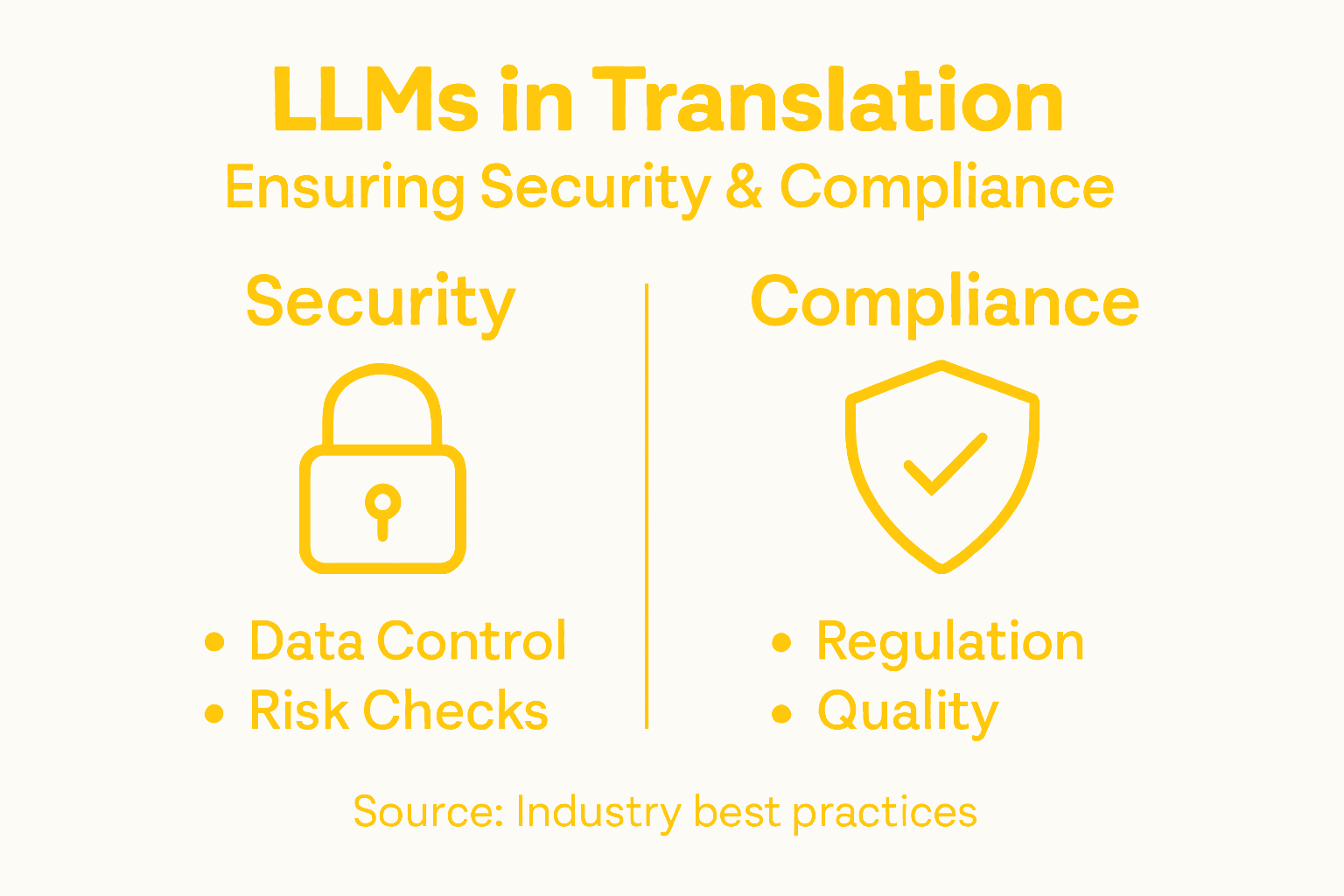
Successful implementation requires a holistic approach that balances technological capabilities with robust governance frameworks, ensuring both operational efficiency and regulatory compliance.
Pro tip: Develop a comprehensive risk assessment matrix that systematically evaluates potential vulnerabilities in your LLM translation workflow, updating protocols continuously based on emerging security insights.
Choosing the Right Solution for Sensitive Content
Selecting an appropriate Large Language Model (LLM) solution for sensitive content translation requires a comprehensive risk assessment strategy. Responsible deployment practices involve sophisticated risk management techniques that go beyond traditional translation workflow considerations.
Key evaluation criteria for sensitive content translation solutions include:
Security Capabilities:
Advanced adversarial attack defenses
Synthetic data training mechanisms
Privacy breach prevention protocols
Comprehensive access control systems
Compliance Requirements:
GDPR data handling standards
Sector-specific regulatory alignment
Transparent data processing documentation
Comprehensive audit trail capabilities
Technical Performance Metrics:
Bias detection and mitigation
Domain-specific accuracy rates
Contextual understanding depth
Explainability of translation decisions
Detection performance and operational efficiency are critical considerations when evaluating LLM solutions for handling sensitive translation workflows. Organizations must balance technological capabilities with strict regulatory compliance requirements.
Successful implementation demands a multifaceted approach that integrates technological robustness, regulatory adherence, and continuous monitoring of translation processes.
Pro tip: Develop a comprehensive vendor assessment framework that systematically scores potential LLM translation solutions across security, compliance, and performance dimensions.
Enhance Translation Precision and Compliance with AD VERBUM’s AI+Human Hybrid Workflow
The article highlights challenges in achieving accuracy, regulatory compliance, and sensitive data protection when using Large Language Models for translation in regulated sectors. If you need reliable terminology governance, strong contextual understanding, and rigorous quality assurance aligned to ISO standards, AD VERBUM is the solution tailored for your needs. Our proprietary LLM-based AI operates within a secure EU-hosted infrastructure, ensuring full data sovereignty and HIPAA, GDPR, and MDR compliance.
Our unique AI+HUMAN hybrid translation workflow starts with integrating your Translation Memories and Term Bases to maintain consistency. Then our in-house AI generates context-sensitive translations followed by expert subject-matter linguists’ refinement for technical accuracy and compliance. Finally, quality assurance aligned with ISO 17100 and ISO 18587 guarantees document-level precision. This approach bridges advanced AI capabilities with human expertise to meet the high-stakes demands of Life Sciences, Legal, and Medical sectors.
Discover how AD VERBUM’s proprietary technology and expert network can address your complex translation challenges now. Reach out for a personalized consultation and elevate your compliance and quality standards at Contact AD VERBUM.
Take the next step with AD VERBUM to secure precise and compliant translations that meet your sector’s strict requirements. Connect with our team today at Contact AD VERBUM and explore our Specialized AI Translation services built for regulated content and sensitive data protection.
Frequently Asked Questions
What are Large Language Models (LLMs) in translation?
LLMs are advanced AI systems that leverage transformer architecture to handle complex linguistic nuances, improving translation workflows with contextual understanding and precision.
How do LLMs ensure compliance in translation workflows?
LLMs contribute to compliance by enabling organizations to implement robust quality assurance frameworks and provide documentation that aligns with regulatory requirements, such as GDPR and HIPAA.
What are the limitations of using LLMs for translation?
While LLMs significantly improve translation accuracy and contextual coherence, they may still produce literal translations that lack the nuance captured by professional human translators, especially in literary contexts.
How can organizations maximize the effectiveness of LLMs in translation?
Organizations can maximize LLM effectiveness by integrating hybrid workflows that combine AI-generated translations with expert human refinement to ensure linguistic accuracy and contextual fidelity.
Recommended

