


What EUDAMED Vigilance Requires From Translated Reports

Many vigilance managers assume that what EUDAMED vigilance requires from translated reports is straightforward linguistic conversion. It is not. The EUDAMED Vigilance module, mandatory from May 28, 2026, demands structured, terminology-controlled, multilingual submissions covering serious incident reports, Field Safety Corrective Actions (FSCAs), and trend notifications. Translating these documents involves regulatory precision at the level of clinical terminology, device identifiers, and corrective action language. This article provides vigilance managers with a concrete account of those requirements and the translation controls needed to meet them.
Table of Contents
Key Takeaways
Point | Details |
Mandatory deadline: May 2026 | EUDAMED Vigilance module becomes fully operational May 28, 2026, requiring structured multilingual submissions. |
Three report types require translation | Serious incident reports, FSCA notifications, and trend reports must all meet EUDAMED translation standards. |
Terminology control is non-negotiable | Clinical terms, device identifiers, and corrective action descriptions must be translated with controlled vocabularies, not ad hoc language. |
National data harmonization is complex | Multilingual incident data from EU member states must be consolidated into EUDAMED using standardized formats and aligned terminology. |
ISO-aligned workflows reduce compliance risk | Translation providers certified to ISO 17100, ISO 13485, and ISO 27001 offer the audit trails and quality controls EUDAMED demands. |
What EUDAMED vigilance requires from translated reports
EUDAMED Vigilance is not a single reporting channel. It covers three distinct report types, each with its own submission timeline and data structure. Understanding what each requires from a translation standpoint is the first compliance step.
Serious incidents must be reported within defined deadlines and at the individual incident level. These are event-driven, time-sensitive submissions. FSCAs require prompt notification that includes the nature of the corrective action, the affected device population, and the risk justification. Trend reports aggregate recurring similar incidents and must present that pattern data coherently across markets and languages.
All three report types must be entered into EUDAMED using structured data fields. This is not a free-text environment. The EUDAMED structured data format mandates consistency in how clinical information, device identifiers, and action descriptions are recorded, which means your translated content must map precisely to those fields.
National language requirements add another layer. Notified Bodies may request PSURs and vigilance reports in specific official languages depending on member state rules. Manufacturers cannot assume English-only submission is universally sufficient. Checking NB language requirements per jurisdiction before submission prevents re-submission requests and delays.
The following obligations apply to all three report categories:
Submit within regulatory deadlines regardless of translation turnaround time
Use harmonized clinical and device terminology aligned with EUDAMED controlled vocabularies
Maintain document-level consistency between source and translated versions for audit purposes
Confirm language requirements with the relevant Notified Body or competent authority per member state
Pro Tip: Build translation timelines into your serious incident reporting procedure as a fixed workflow step. A 15-day reporting window disappears quickly when translation is treated as an afterthought.
Translation precision standards for clinical terminology
Translating a serious incident report is not the same as translating a product brochure. The regulatory consequences of imprecision are direct. Inaccurate or incomplete translations can result in regulatory non-compliance and jeopardize patient safety. Imprecise clinical terms or corrective action descriptions may cause misinterpretation by competent authorities, leading to delays or sanctions.
EUDAMED vigilance reports require terminology control at three levels:
Clinical terminology. Medical device incident descriptions involve anatomical terms, injury classifications, and device-tissue interaction language. These must be translated using recognized clinical vocabularies such as MedDRA, SNOMED CT, or device-specific coding systems. A translated term that does not map to the same coding node as the source term introduces a data integrity failure at the EU consolidation level.
Device identifiers. UDI-DI codes, SRN references, and model designations must remain consistent and untranslated where required. These are system-resolved identifiers. Any modification during the translation process, even typographical, can break the link between the incident record and the device registration in EUDAMED.
Corrective action descriptions. FSCA language must be precise enough that the competent authority can assess whether the action taken matches the risk identified. Vague or softened translations of corrective action scope create compliance ambiguity that survives submission review.
The standards that govern this work are ISO 17100 for translation quality, ISO 13485 for medical device quality management systems, and ISO 27001 for information security during data processing. Each standard addresses a different failure mode: quality errors, process failures, and data breaches respectively.
Glossary governance sits at the center of precision translation. A single controlled terminology database, built from your existing regulatory documentation and updated with each EUDAMED submission cycle, prevents the terminology drift that accumulates across multiple translators, markets, and report cycles.

Pro Tip: Maintain a bilingual or multilingual term base aligned with your EUDAMED device registration records. Any term that appears in your UDI database should have an approved translation equivalent in every language you submit.
Consolidating multilingual incident data into EUDAMED
Moving from national vigilance data to a single EUDAMED submission is where most manufacturers encounter their most operationally complex translation challenge. National vigilance reports vary in language, requiring rigorous data harmonization before EU-wide reporting. Terminology choices made at the national level do not automatically align with EUDAMED’s structured fields.
The table below compares common approaches to multilingual data consolidation:
Approach | Terminology control | Audit trail | Speed | Regulatory risk |
Ad hoc translation per market | Inconsistent | Limited | Variable | High |
Centralized NMT (generic SaaS) | Weak | None | Fast | High in regulated context |
Certified AI+HUMAN hybrid translation | Enforced via TM and TB | Full, ISO-aligned | 3x to 5x faster than traditional | Low when standards-aligned |
Internal bilingual staff | Moderate | Informal | Slow at scale | Moderate |
The certified AI+HUMAN hybrid translation approach addresses the core problem that other options do not: terminology inconsistency across member states creates misaligned vigilance records that EUDAMED cannot aggregate cleanly. When your French market submits an incident using one clinical term and your German market submits the same event type using a different formulation, trend analysis breaks down at the system level.
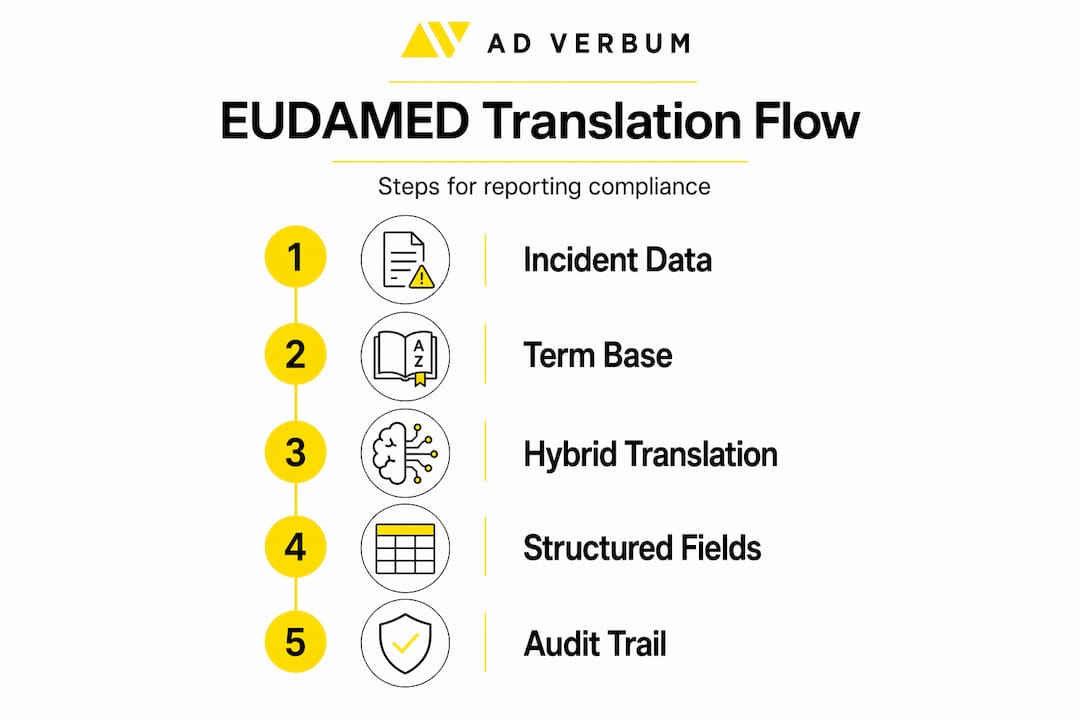
Standardized templates and controlled vocabularies solve this at the input stage. The translation layer must enforce those same controls on the output side. This is why legacy machine translation (MT) carries elevated risk in this context. Its literal, low-context output does not handle medical negation, conditional phrasing, or domain-specific terminology with sufficient reliability for regulated submission documents.
Common challenges and risks in vigilance report translation
The failure modes in EUDAMED vigilance report translation are well-documented and largely preventable. Knowing them in advance lets you build mitigations into your quality management system rather than discovering them during a regulatory inspection.
Terminology mismatches across submissions. When different translators or tools handle successive reports without a shared term base, the same device malfunction gets described differently across submissions. EUDAMED’s trend analysis function depends on terminology consistency to identify patterns. Inconsistency obscures signals that should trigger regulatory action.
Incomplete translations of technical sections. Corrective action descriptions, risk justifications, and scope-of-recall language are sometimes partially translated or left in the source language under the assumption that English is sufficient. This assumption breaks down in jurisdictions where the competent authority requests the official national language version.
Submission delays caused by translation bottlenecks. Serious incident reporting has fixed deadlines. Treating translation as a final step rather than a parallel workflow step is the most common cause of deadline risk. Submission timelines are non-negotiable and regulators do not accept translation delays as justification for late reporting.
Data security failures during translation. Vigilance reports contain patient data, device identifiers, and proprietary corrective action information. Using general-purpose translation tools without data processing agreements or access controls is a GDPR compliance failure. ISO 27001 certification at the translation provider level is the minimum control standard for this data class.
Absence of audit trails. Certified translation providers offer audit trails and traceability needed for regulatory inspections. A translation record that cannot demonstrate who reviewed it, what terminology source was used, and when approval occurred will not satisfy an MDR audit.
Mitigations map directly to these failure modes: a shared, governed term base eliminates terminology drift; standardized templates prevent incomplete submissions; parallel translation workflows remove deadline risk; ISO 27001-certified infrastructure protects data; and ISO 17100-aligned QA produces the audit trail regulators expect.
How AD VERBUM’s certified workflow aligns with EUDAMED vigilance
AD VERBUM holds certifications to ISO 17100 (translation quality), ISO 13485 (medical device quality management), and ISO 27001 (information security). In the context of EUDAMED Vigilance, these are not background credentials. They define the workflow controls that compliant vigilance report translation requires.
The AD VERBUM AI+HUMAN hybrid translation workflow operates in four steps: (1) client Translation Memories and Term Bases are ingested first, constraining all output to approved terminology; (2) the proprietary LLM-based LangOps System generates target-language output governed by those constraints; (3) a certified subject-matter expert reviews for technical accuracy, regulatory compliance, and contextual nuance; (4) QA is conducted to ISO 17100 and ISO 18587 standards, with MDR-specific checks applied where relevant.
This sequence addresses each EUDAMED vigilance translation requirement directly. Terminology governance is enforced at generation, not corrected after the fact. Human SME review covers the clinical and corrective action language that automated systems cannot validate reliably. The QA layer produces the audit documentation that regulatory inspections require.
“EUDAMED vigilance translation is not a one-time project. It is a recurring compliance process. The workflow must be repeatable, auditable, and terminology-stable across every report cycle. That is exactly what ISO-aligned AI+HUMAN hybrid translation is built to deliver.”
AD VERBUM’s infrastructure is hosted on EU servers with no reliance on public cloud processing for core operations, which satisfies the data sovereignty requirements that apply to patient-linked vigilance data under GDPR. For manufacturers submitting across multiple member states, the multilingual vigilance data consolidation problem is handled through a single, centralized workflow rather than fragmented per-market translation arrangements.
My perspective on getting vigilance translation right
In my experience working with regulatory documentation in high-stakes environments, the most persistent mistake I see is treating translation as a vendor task rather than a quality control. Vigilance managers who embed translation into their quality management system, with defined roles, approved terminology assets, and documented review steps, consistently outperform those who treat it as an outsourced afterthought.
The multilingual consolidation challenge under EUDAMED is genuinely difficult. You are taking incident data captured in 10 or more national languages, each with its own clinical vocabulary conventions, and aligning it into a single structured database that must support EU-wide trend analysis. That requires a translation process with the same rigor as your incident investigation process itself.
What I have found is that manufacturers who invest in this infrastructure before the May 2026 mandatory date are not just avoiding compliance penalties. They are building a vigilance data asset that produces cleaner trend signals, faster FSCA preparation, and stronger evidence during post-market surveillance reviews. The upfront investment in certified workflows and controlled terminology pays operational dividends that extend well beyond regulatory compliance.
My recommendation: select a translation partner whose certifications match the regulatory standards your reports are measured against. ISO 17100, ISO 13485, and ISO 27001 are the minimum. Then integrate that partner into your QMS, not just your procurement list.
— Viestarts
How AD VERBUM supports EUDAMED vigilance translation compliance
AD VERBUM’s medical device localization services are built specifically for the regulatory precision that EUDAMED vigilance reporting demands. With certifications to ISO 17100, ISO 13485, and ISO 27001, and infrastructure hosted entirely on EU servers, AD VERBUM handles serious incident reports, FSCA notifications, and trend data submissions across 150 or more languages with full audit traceability.
The AI+HUMAN hybrid translation workflow ingests your existing Translation Memories and Term Bases, applies LLM-based generation constrained by your approved terminology, and delivers certified SME review before ISO-aligned QA sign-off. Turnaround runs 3x to 5x faster than traditional translation workflows, which matters when your reporting deadlines are fixed.
If you are building or auditing your EUDAMED vigilance translation process ahead of the May 2026 deadline, AD VERBUM’s compliance translation approach provides the certified workflow, terminology governance, and data security controls that regulators expect. Contact AD VERBUM to discuss your specific multilingual vigilance reporting requirements.
FAQ
What report types require translation for EUDAMED vigilance?
Serious incident reports, Field Safety Corrective Action notifications, and trend reports all require translation for EUDAMED Vigilance submission. Each must meet structured data format requirements and use controlled clinical terminology.
Does EUDAMED require vigilance reports in all EU official languages?
EUDAMED does not mandate all official EU languages by default, but Notified Bodies may request vigilance reports in specific official national languages depending on member state rules. Manufacturers should confirm language requirements per jurisdiction before submission.
What translation standards apply to EUDAMED vigilance reports?
ISO 17100 governs translation quality, ISO 13485 covers medical device quality management, and ISO 27001 addresses data security for patient-linked vigilance data. All three standards are relevant to compliant vigilance report translation workflows.
What are the main risks of imprecise translations in vigilance reports?
Imprecise translations of clinical terminology or corrective action descriptions can cause misinterpretation by competent authorities, trigger re-submission requirements, or result in regulatory sanctions. Terminology inconsistency across submissions also degrades EUDAMED’s trend analysis capability.
How does AI translation differ from certified AI+HUMAN hybrid translation for vigilance reports?
Legacy machine translation produces literal output with weak context handling, creating elevated risk in safety-critical regulated text. Certified AI+HUMAN hybrid translation combines LLM-based generation with SME review and ISO-aligned QA, producing audit-traceable output governed by approved terminology assets.
Sources:
PSUR Under EU MDR Article 86 | MedDeviceGuide
EU MDR Post-Market Surveillance: PMS Plan, PSUR and PMCF Requirements
EUDAMED Fact Sheet Overview | European Commission
Medical Translation Requirements: Complete Guide to Compliance | AD VERBUM
Master post-market surveillance translation under EU MDR | AD VERBUM
Our Approach | AD VERBUM
Localization | AD VERBUM
Recommended