


Vendor Evaluation Criteria for High-Risk Translation

Choosing a translation vendor for high-stakes content is never a routine task when patient safety, market approval, or regulatory compliance are at risk. For European compliance managers in the Pharmaceutical and Medical Device sectors, a single mistranslation could threaten organizational reputation and introduce critical legal exposure. This guide outlines the key criteria for evaluating translation vendors that can protect sensitive documentation and uphold stringent international standards, helping you mitigate risk and secure clarity across every communication channel.
Table of Contents
Key Takeaways
Point | Details |
High-Risk Content Translation | Requires a strategic approach, focusing on cultural context, technical expertise, and regulatory compliance to mitigate risks. |
Translation Workflow Models | Different models, like sequential and collaborative, must be evaluated based on organizational needs, processing speed, and quality assurance. |
Adherence to Quality Standards | Compliance with international standards such as ISO 17100 ensures precision and security in translation processes. |
Vendor Selection Criteria | Choosing the right translation vendor demands a systematic assessment of technical competence, compliance, and quality assurance capabilities. |
Defining High-Risk Content Translation Needs
High-risk content translation requires a strategic approach to managing complex communication challenges across linguistic and cultural boundaries. Risk management in translation involves understanding critical uncertainties inherent in translating sensitive documentation.
Several key sectors demonstrate heightened translation risk requirements:
Medical devices where mistranslation could compromise patient safety
Pharmaceutical regulatory submissions with strict compliance mandates
Legal contracts involving cross-border agreements
Financial documents with significant monetary implications
Technical engineering specifications where precision is paramount
Effective high-risk translation management demands comprehensive evaluation across multiple dimensions. Organizations must assess potential communication risks by examining:
Cultural context interpretation accuracy
Technical domain expertise of translators
Terminology consistency
Regulatory compliance alignment
Information security protocols
Contextual complexity significantly increases translation risk. Translators must navigate nuanced linguistic challenges while maintaining absolute fidelity to source material meaning. Professional translation requires more than word-for-word conversion - it demands deep understanding of underlying communication intent.
High-risk translation is not about translating words, but transferring precise meaning across complex communication landscapes.
Key evaluation criteria for high-risk translation providers include:
Demonstrable subject matter expertise
Robust quality assurance processes
Compliance with international standards
Secure translation infrastructure
Proven track record in specialized domains
Pro tip: Develop a comprehensive risk assessment matrix that scores potential translation providers across technical competence, domain knowledge, and compliance capabilities.
Types of Translation Workflows Compared
Translation workflows vary significantly across different sectors, with each approach designed to address unique communication challenges. Organizations can select from multiple workflow models depending on their specific translation compliance requirements.
Four primary translation workflow models emerge as critical for high-risk content management:
Sequential Workflow
Linear progression through translation stages
Rigid quality control checkpoints
Suitable for standard documentation
Limited flexibility
Parallel Workflow
Multiple translation streams processed simultaneously
Faster turnaround times
Complex coordination requirements
Higher initial investment
Hybrid Workflow
Combines machine translation with human expert review
Balances speed and accuracy
Dynamic resource allocation
Adaptable to varying complexity levels
Collaborative Workflow
Real-time multi-stakeholder engagement
Continuous feedback mechanisms
Enhanced contextual understanding
Higher communication transparency
Translation workflows are not one-size-fits-all solutions but strategic approaches tailored to specific organizational needs.
Key differentiators between these workflows include processing speed, quality assurance mechanisms, cost efficiency, and adaptability to complex regulatory environments. Organizations must carefully assess their specific documentation requirements, compliance mandates, and technological infrastructure when selecting an appropriate translation approach.

Successful workflow selection demands comprehensive evaluation of:
Here’s a comparison of high-risk translation workflow models and their business impact:
Workflow Model | Ideal Use Case | Key Business Benefit |
Sequential | Standard documentation | Ensures process reliability |
Parallel | Large, time-sensitive projects | Accelerates delivery |
Hybrid | Complex, technical documents | Balances accuracy and speed |
Collaborative | Regulatory or legal content | Enhances transparency and alignment |
Technical complexity of source materials
Regulatory compliance requirements
Budget constraints
Turnaround time expectations
Subject matter expertise availability
Pro tip: Develop a systematic evaluation framework that scores potential translation workflows across multiple performance dimensions to identify the most suitable approach for your organization’s unique needs.
Key Quality and Security Standards Required
Navigating the complex landscape of translation quality and security demands rigorous adherence to internationally recognized standards. Translation quality standards provide critical frameworks for ensuring precision, confidentiality, and reliable communication across high-stakes sectors.
Key international standards organizations establish comprehensive guidelines for translation processes:
ISO 17100
Defines translator qualification requirements
Establishes quality assurance protocols
Specifies project management standards
Mandates confidentiality and data handling procedures
ISO 18587
Focuses on machine translation post-editing
Establishes human review guidelines
Sets quality control mechanisms
Ensures consistent output validation
ISO 20771
Specialized standard for legal translations
Emphasizes precision and confidentiality
Defines professional competence requirements
Creates stringent accuracy benchmarks
ISO 13485
Medical device translation requirements
Addresses regulatory documentation standards
Ensures technical accuracy and compliance
Specifies risk management protocols
Translation standards are not bureaucratic checklists, but strategic frameworks protecting organizational integrity and communication effectiveness.
Critical evaluation dimensions for translation quality standards include:
Translator qualifications and expertise
Quality assurance methodologies
Data protection and confidentiality measures
Technological infrastructure security
Compliance with sector-specific regulatory requirements
Security considerations extend beyond mere documentation, encompassing comprehensive risk management strategies that protect sensitive information throughout the translation lifecycle.
The table below summarizes major international translation standards and their main objectives:
Standard | Primary Sector | Core Focus |
ISO 17100 | General | Translator qualifications |
ISO 18587 | Machine Translation | Human review and validation |
ISO 20771 | Legal | Legal accuracy and integrity |
ISO 13485 | Medical Devices | Regulatory and technical compliance |
Pro tip: Develop a comprehensive audit checklist that maps vendor capabilities against multiple international quality and security standards to ensure holistic compliance.
Critical Compliance Obligations for Vendors
Translation vendors operating in high-stakes regulatory environments must adhere to comprehensive professional standards that extend far beyond linguistic competence. Translation industry business practices establish critical ethical and professional guidelines that protect client interests and ensure reliable communication.
Fundamental compliance obligations for translation vendors encompass multiple critical domains:
Ethical Business Conduct
Transparent contractual agreements
Fair pricing structures
Honest representation of capabilities
Consistent professional communication
Legal and Intellectual Property Compliance
Strict confidentiality protocols
Robust data protection measures
Intellectual property rights preservation
Compliance with international privacy regulations
Professional Competence Requirements
Documented translator qualifications
Ongoing professional development
Technical domain expertise verification
Continuous skills enhancement
Quality Assurance Mechanisms
Systematic error detection processes
Independent quality review protocols
Performance measurement standards
Continuous improvement frameworks
Compliance is not a destination, but a continuous journey of professional accountability and risk management.
Vendors must demonstrate comprehensive capabilities across several key evaluation dimensions:
Technical translation infrastructure
Information security protocols
Regulatory compliance documentation
Professional certification verification
Risk management strategies
Technological infrastructure plays a critical role in ensuring compliance, requiring vendors to implement robust security measures that protect sensitive information throughout the translation process.
Pro tip: Develop a comprehensive vendor assessment matrix that systematically scores potential translation partners across ethical, legal, technical, and quality dimensions to ensure holistic compliance.
Top Risks in High-Stakes Translation Projects
High-stakes translation demands meticulous risk management to prevent potentially catastrophic communication failures. Risk management in translation requires systematic identification and mitigation of complex communication uncertainties.
Critical risks in translation projects span multiple critical domains:
Technical Misinterpretation Risks
Complex terminology mistranslation
Loss of technical precision
Domain-specific contextual errors
Incomplete technical understanding
Regulatory Compliance Risks
Failure to meet industry standards
Incomplete documentation translation
Inaccurate regulatory interpretation
Non-compliance with legal requirements
Cultural Communication Risks
Misunderstanding cultural nuances
Inappropriate linguistic adaptations
Contextual meaning distortion
Unintended offensive translations
Technological Infrastructure Risks
Inadequate security protocols
Data privacy vulnerabilities
Inconsistent machine translation outputs
Insufficient quality control mechanisms
Translation risks are not random events, but predictable challenges that require systematic management and proactive mitigation strategies.
Key risk evaluation dimensions include:
Translator subject matter expertise
Quality assurance infrastructure
Technological translation capabilities
Compliance verification processes
Cultural adaptation competencies
Technological complexity significantly amplifies translation risks, requiring sophisticated approaches that balance human expertise with advanced technological capabilities.
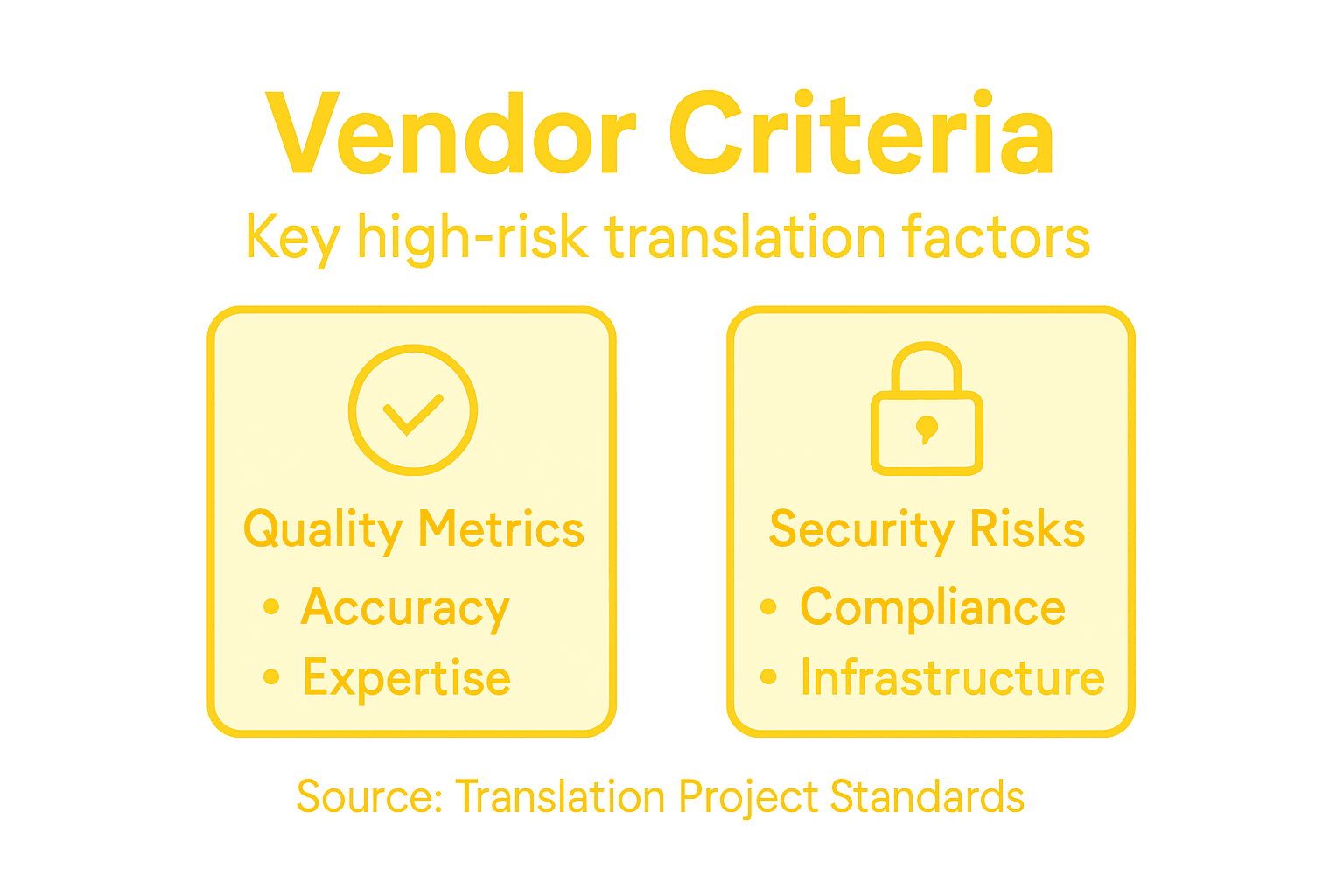
Pro tip: Develop a comprehensive risk assessment framework that systematically scores potential translation vulnerabilities across technical, regulatory, and cultural dimensions.
Comparing Vendor Capabilities and Decision Factors
Selecting the right translation vendor requires comprehensive evaluation across multiple strategic dimensions. How to Choose the Best Translation Providers demands a systematic approach that goes beyond surface-level capabilities.
Key evaluation criteria for translation vendors encompass several critical domains:
Technical Competence
Subject matter expertise
Domain-specific linguistic capabilities
Advanced technological infrastructure
Specialized translation toolkit
Compliance and Security
ISO certification standards
Data protection protocols
Regulatory compliance frameworks
Information security infrastructure
Quality Assurance
Multi-stage review processes
Independent quality verification
Performance tracking mechanisms
Continuous improvement strategies
Operational Capabilities
Scalability of translation resources
Turnaround time performance
Pricing flexibility
Project management sophistication
Vendor selection is not about finding the cheapest option, but identifying the most comprehensive translation partner.
Critical decision factors organizations must consider include:
Depth of linguistic expertise
Technological translation capabilities
Information security robustness
Regulatory compliance alignment
Cultural adaptation competence
Technological infrastructure represents a pivotal differentiator, determining a vendor’s ability to handle complex, high-stakes translation requirements with precision and reliability.
Pro tip: Create a weighted scoring matrix that objectively evaluates potential translation vendors across multiple performance dimensions, ensuring a comprehensive and data-driven selection process.
Master High-Risk Translation Vendor Evaluation with AD VERBUM
Navigating complex high-risk translation projects requires a partner that understands the critical challenges of compliance, terminology governance, and data security discussed in the article “Vendor Evaluation Criteria for High-Risk Translation.” If your goal is to avoid costly misinterpretations and meet strict regulatory audit requirements, you need more than just a translator. AD VERBUM offers a proven AI+HUMAN hybrid translation workflow that integrates client Translation Memories and Term Bases first, followed by proprietary, EU-hosted LLM-based AI for context-sensitive output, and subject-matter expert refinement aligned with ISO standards like ISO 17100 and ISO 18587.
Why AD VERBUM fits your high-risk content needs
25+ years of Northern European language service expertise
3500+ certified linguists including medical, legal, and engineering experts
Full compliance with GDPR, HIPAA, MDR plus ISO 27001 security
3x to 5x faster turnaround compared to traditional workflows
If you want to ensure your vendor meets the key compliance obligations and quality benchmarks outlined in the article, explore how AD VERBUM’s specialized AI translation service can transform your regulatory and technical content management.
Looking for a tailored solution that aligns with your high-risk translation criteria? Start the discussion today.
Contact us now at AD VERBUM Contact to request a personalized vendor evaluation. Learn how our hybrid approach safeguards your sensitive data and meets the most stringent quality standards. Visit AD VERBUM Contact and secure your translation success with trusted expertise.
Frequently Asked Questions
What are the key factors to consider when evaluating a translation vendor for high-risk content?
When evaluating a translation vendor for high-risk content, consider technical expertise, compliance and security measures, quality assurance processes, and operational capabilities. These dimensions ensure that the vendor can handle complex documentation accurately and securely.
How can organizations assess a vendor’s subject matter expertise?
Organizations can assess a vendor’s subject matter expertise by reviewing qualifications, certifications, and the experience of their translators in relevant fields. It’s also beneficial to inquire about past projects and request references from similar industries.
What quality assurance processes should translation vendors implement?
Translation vendors should implement multi-stage review processes, independent quality verification, and performance tracking mechanisms. These processes help to ensure that translations meet the required accuracy and compliance standards.
Why is compliance with international standards important in high-risk translation projects?
Compliance with international standards, such as ISO certifications, is essential in high-risk translation projects as it ensures adherence to quality control, data protection, and regulatory compliance, thereby protecting both the organization and its clients.
Recommended

