Terminology Enforcement Workflow for Translation: 2026 Guide

A terminology enforcement workflow for translation is a structured process that guarantees consistent use of approved terms across all multilingual content, from initial glossary ingestion through final quality assurance sign-off. In regulated industries, a single inconsistent term in a medical device manual or a legal contract can trigger a compliance failure or a product recall. This guide covers the core assets, automation steps, governance structures, and QA checks that localization professionals and project managers need to build a workflow that holds up under audit. Standards such as ISO 17100, ISO 18587, and sector-specific frameworks like MDR set the baseline; the workflow you build around them determines whether those standards are met in practice.
What are the essential components of a terminology enforcement workflow?
A terminology enforcement workflow rests on three distinct asset types: the glossary, the termbase, and the forbidden term list. Each serves a different function, and conflating them is one of the most common causes of terminology drift in regulated localization projects.
A glossary is a flat list of approved source terms paired with their target equivalents. A termbase is a structured database that adds metadata to each entry: part of speech, grammatical gender, usage context, regulatory status, and approval date. That metadata is what makes a termbase enforceable rather than merely advisory. A forbidden term list, sometimes called a negative glossary, explicitly catalogs prohibited terms and their approved replacements. Explicitly tracking forbidden terms via a negative glossary prevents terminology drift more effectively than providing only approved terms alone. The practical implication is that translators and AI engines need to know what not to use, not just what to use.
Asset | Primary function | Key metadata |
Glossary | Approved source-to-target term pairs | Target equivalent, domain |
Termbase | Structured term database with full context | Part of speech, status, usage notes, approval date |
Forbidden term list | Prohibited terms with approved replacements | Reason for prohibition, replacement term |
All three assets must be treated as living, version-controlled documents. Glossaries synchronized via API into the translation environment perform better than static documents shared by email. Version control also creates the audit trail that regulated industries require when a regulator asks why a specific term was used in a submission dated six months ago.

Pro Tip: Add a “context note” field to every termbase entry. A term like “indication” means something specific in a pharmaceutical label and something entirely different in a legal brief. Without a context note, even experienced translators will apply the wrong register.
How can automation and AI be integrated to enforce terminology consistently?
Automation does not replace human judgment in regulated translation. It filters the volume of content so that subject-matter experts spend their time on the segments that actually need them. Automated quality scoring evaluates content against predefined thresholds; only segments failing those checks are routed to human reviewers. That routing logic is the core of a scalable terminology enforcement workflow.
A well-designed automated workflow follows this sequence:
Asset integration. Ingest the client’s Translation Memories ™ and Term Bases (TB) before any translation begins. This step constrains the AI engine from the first segment.
LLM generation. A context-sensitive AI system produces target language output constrained by client terminology and style guidance. Legacy Machine Translation (MT) produces literal output with weak context handling, which creates unacceptable risk in safety-critical text. Standard Neural Machine Translation (NMT) engines available as consumer SaaS products offer inconsistent terminology control and limited governance for regulated documentation. A proprietary LLM-based system with explicit instruction following and terminology governance is the appropriate choice for regulated content.
Automated terminology QA. The system checks every segment against the approved termbase and the forbidden term list. Segments with critical violations are flagged before they reach a human reviewer.
Subject-matter expert review. A certified linguist with domain expertise reviews flagged segments for technical accuracy, regulatory compliance, and contextual nuance.
Final QA pass. QA is aligned to ISO 17100 and ISO 18587 and, where relevant, sector requirements such as MDR.
The routing rules matter as much as the checks themselves. A segment containing a forbidden term should be blocked from submission entirely. Automated validation tools can block submission of translations containing critical glossary violations before final delivery. A segment with a low-confidence terminology match should be routed to a linguist, not rejected outright. Calibrating those thresholds by content type and risk level is the work of the project manager, not the tool.
Pro Tip: Run a dry-pass of your termbase against a sample of legacy translated content before going live with automated enforcement. You will almost always find that 10–20% of your approved terms were previously translated inconsistently. Fix the termbase first, or your automated checks will generate false positives from day one.
What are best practices for terminology approval and maintenance?
Governance is the part of terminology management that most teams skip until something goes wrong. A structured term approval workflow with clear roles, review steps, and timelines reduces terminology conflicts and maintains glossary accuracy for compliance purposes.
The core roles in a governance structure are:
Terminology manager. Owns the termbase, manages version control, and coordinates review cycles.
Subject-matter expert linguists. Propose new terms, flag ambiguous entries, and validate domain accuracy.
Regulatory or legal reviewers. Approve terms that carry compliance implications.
Product or marketing stakeholders. Provide input on brand-specific terminology and regional variants.
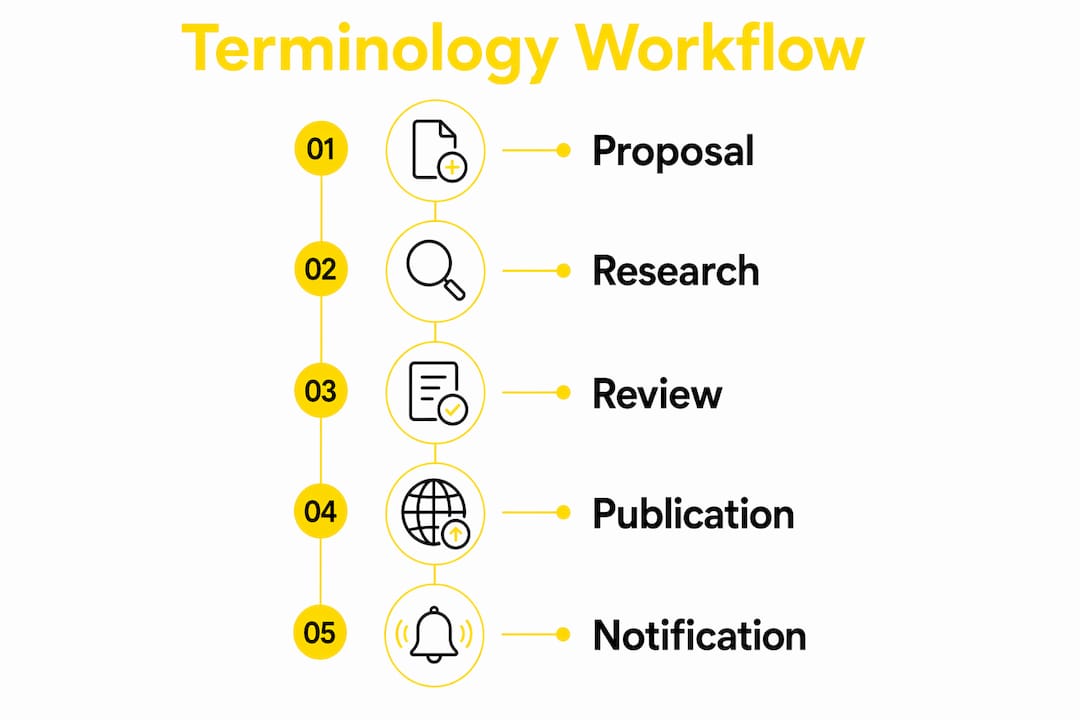
The approval process for a new term follows five steps: proposal, research, review, publication, and notification. A translator or project manager submits a term proposal with a source context sentence. The terminology manager researches existing usage across the TM and any regulatory references. The relevant reviewers approve or reject the proposal with documented rationale. The approved term is published to the termbase with full metadata. All affected teams receive notification of the update.
Review cadence is equally important. Reviewing glossaries on a monthly or quarterly cadence to incorporate new products or market-specific feedback costs far less than correcting terminology errors after publication across multiple channels. Monthly reviews suit fast-moving product lines; quarterly reviews are appropriate for stable regulatory documentation. The key is that the cadence is scheduled, not reactive.
Disagreements between reviewers should be documented and resolved by a designated decision authority, typically the terminology manager in consultation with the regulatory reviewer. That documentation becomes part of the audit trail. Inconsistency is often worse than imperfect terminology; once a term is published, enforce it strictly until a formal update is communicated.
What QA checks ensure terminology enforcement in regulated industries?
Quality assurance in translation for regulated sectors requires a dedicated terminology QA pass that goes beyond what computer-assisted translation (CAT) tool flagging catches during translation. A post-translation terminology QA pass is recommended for regulated industries to check for correct grammatical form and consistent use, because in-process flagging is often insufficient.
A terminology-specific QA scorecard covers the following checks:
Term accuracy. Is the approved target term used, not a synonym or a legacy equivalent?
Grammatical form. Is the term in the correct case, number, and gender for the target language?
Forbidden term compliance. Does the segment contain any term from the forbidden list?
Contextual appropriateness. Is the term used in the correct domain context, as defined by the termbase usage note?
Consistency across segments. Does the same source term map to the same target term throughout the document?
Terminology consistency requires a feedback loop that includes clear contextual usage notes, not just a list of approved terms. That feedback loop connects the QA pass back to the termbase: every error caught in QA should trigger a review of the relevant termbase entry to determine whether the entry itself is ambiguous.
Tracking errors by project, language pair, and translator identifies systemic problems. A translator who consistently misapplies a specific term in German medical device documentation needs targeted feedback, not a generic quality review. For regulated submissions, pre-submission validation that blocks documents containing critical terminology violations protects both the client and the language service provider from compliance exposure.
Pro Tip: Build a terminology error log that captures the source segment, the incorrect term used, the correct term, and the translator ID. After three projects, you will have enough data to identify whether errors cluster around specific term categories, language pairs, or individual linguists. That data drives targeted training, not guesswork.
A practical example: a medical device manufacturer submitting Instructions for Use (IFU) documents under MDR requires that every safety-critical term match the approved termbase exactly. The QA workflow runs an automated check against the termbase, flags any deviation, routes the flagged segment to a certified medical translator for correction, and logs the error before generating a compliance report for the submission package. That report is the audit artifact the regulatory body expects to see.
For teams building technical translation compliance processes from scratch, the QA scorecard is the most practical starting point. It defines what “correct” means before the first segment is translated.
Key Takeaways
A terminology enforcement workflow succeeds when glossary assets, automated QA, governance roles, and post-translation checks operate as a single integrated system rather than separate steps.
Point | Details |
Use all three asset types | Maintain a glossary, a structured termbase, and a forbidden term list for complete enforcement coverage. |
Automate routing, not judgment | Use automated scoring to route only high-risk segments to subject-matter experts, not every segment. |
Enforce governance cadence | Schedule monthly or quarterly termbase reviews; reactive updates cost more in corrections than prevention. |
Run a dedicated QA pass | A post-translation terminology QA check catches grammatical form errors that in-process CAT flagging misses. |
Document every decision | Version-controlled termbases and error logs create the audit trail regulated industries require. |
Why most terminology workflows fail before the first translation is delivered
The failure mode I see most often is not a bad glossary. It is a good glossary that nobody connected to anything. Teams spend weeks building a termbase with careful metadata, then share it as a PDF attachment in a project kickoff email. By the time the first translation comes back, three translators have used three different equivalents for the same source term, and the termbase has not been updated since the product launched.
The second failure mode is treating terminology governance as a one-time setup task. Regulated industries change. Regulatory bodies update their preferred terminology. Products are revised. A glossary that was accurate at launch becomes a liability eighteen months later if nobody owns the update cycle.
What I have found actually works is assigning a named terminology manager with a defined review calendar, connecting the termbase to the translation environment via API so updates propagate automatically, and running the forbidden term list through every project before translation begins, not after. The forbidden list catches more errors than the approved list, because translators and AI engines default to familiar terms when they are uncertain.
AD VERBUM’s AI+HUMAN hybrid translation workflow addresses these failure modes directly. Asset integration happens first: client TMs and TBs are ingested before the LLM generates a single segment. The proprietary LangOps System enforces terminology at the generation stage, not just at QA. Certified subject-matter experts, including medical professionals, engineers, and legal scholars, review output for contextual accuracy. QA is aligned to ISO 17100 and ISO 18587. For organizations operating under GDPR, HIPAA, or MDR, the EU-hosted private infrastructure means terminology assets never pass through public cloud tooling. That combination of automated enforcement and human oversight is what regulated content actually requires.
— Eric Brown
AD VERBUM’s approach to regulated terminology enforcement
Regulated localization projects carry real compliance risk when terminology is inconsistent. AD VERBUM’s localization services are built around the exact workflow this article describes: termbase and TM ingestion before translation begins, LLM-based generation constrained by client terminology, certified SME review, and ISO 17100 and ISO 18587 aligned QA.
AD VERBUM supports 150+ languages, including regional variants, and serves Life Sciences, Legal, Finance, Defense, and Manufacturing clients. The private EU-hosted infrastructure meets GDPR, HIPAA, and MDR requirements. For organizations that need regulatory compliance guidance alongside translation, AD VERBUM’s workflow integrates with existing quality audit processes. Contact AD VERBUM to discuss how terminology governance can be built into your next localization project from day one.
FAQ
What is a terminology enforcement workflow in translation?
A terminology enforcement workflow is a structured process that ensures approved terms are used consistently across all translated content, from glossary ingestion through final QA. It combines termbase management, automated validation, human review, and post-translation checks.
Why is a forbidden term list more effective than an approved glossary alone?
A forbidden term list explicitly blocks prohibited terms, which prevents both AI engines and human translators from defaulting to familiar but incorrect equivalents. Approved term lists tell translators what to use; forbidden lists tell them what to avoid, which addresses a different failure mode.
How often should a translation termbase be reviewed?
Monthly reviews suit fast-moving product lines; quarterly reviews are appropriate for stable regulatory documentation. Reactive updates made only after errors appear cost significantly more in correction work than scheduled maintenance.
What QA checks are required for regulated industry translation?
A dedicated post-translation terminology QA pass is required, covering term accuracy, grammatical form, forbidden term compliance, contextual appropriateness, and cross-document consistency. Automated CAT tool flagging during translation is not sufficient for regulated submissions.
When does AD VERBUM’s AI+HUMAN hybrid translation fit a terminology enforcement workflow?
AD VERBUM is the appropriate fit when content is regulated, audit trails are required, terminology governance must be enforced at the generation stage, and data sovereignty constraints prohibit public cloud processing. The workflow ingests client TMs and TBs first, then applies LLM generation, SME review, and ISO-aligned QA in sequence.
Recommended