


Multilingual Blog SEO Fundamentals: 2026 Guide

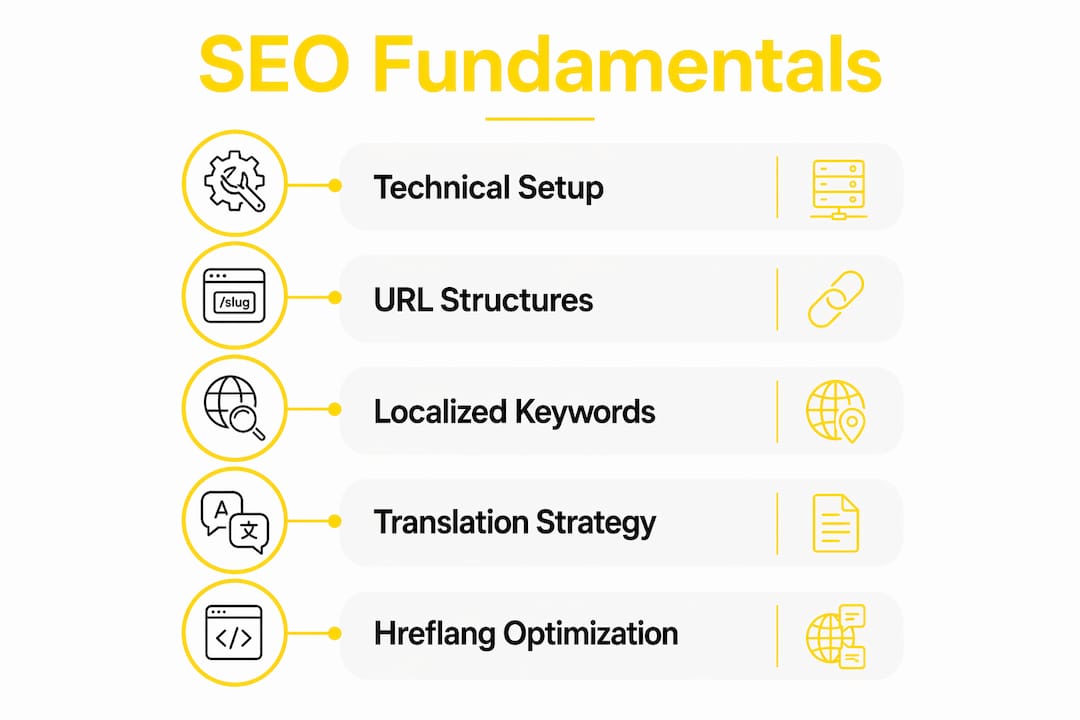
Multilingual blog SEO fundamentals consist of three core disciplines: technical configuration, localized keyword research, and strategic content adaptation. Together, they determine whether search engines serve the right language version of your blog to the right reader. The industry term for this practice is international SEO, and it covers everything from hreflang tag implementation to URL architecture decisions. Getting these foundations right is not optional. Multilingual SEO success requires approximately 70% of your effort on technical infrastructure and 30% on content translation and localization. That ratio surprises most content creators who assume translation is the hard part.
What are the multilingual blog SEO fundamentals?
Multilingual blog SEO is defined as the practice of configuring a blog so that search engines index, rank, and serve each language version to users in the correct locale. The three non-negotiable technical pillars are hreflang tags, URL structure, and locale-specific metadata. Miss any one of them and your international traffic fragments across multiple unranked pages.
The 70/30 rule is the most useful mental model for planning your workload. Technical hygiene, including correct URL structures, hreflang reciprocity, and localized keyword research, consistently outweighs pure content quality in determining rankings. A perfectly translated French blog post sitting behind a broken hreflang setup will not rank in France. The technical layer must come first.

Metadata is part of the technical layer, not an afterthought. Fully translated metadata per locale, including titles, descriptions, and schema data, is required to avoid mixed-language signals. Auto-generated or untranslated metadata tells search engines your localization is incomplete, and rankings reflect that judgment.
How does hreflang implementation affect multilingual blog SEO performance?
Hreflang is an HTML attribute that tells search engines which language and regional version of a page to serve to which user. Without it, Google guesses, and it guesses wrong often enough to cost you significant traffic. Between 65% and 75% of multilingual websites fail to implement hreflang tags correctly. That failure rate means most international blogs are leaving rankings on the table through a fixable technical error.
The reciprocity rule
Reciprocity is the single most critical hreflang requirement. A French page pointing to an English version must be reciprocated by the English page pointing back to the French version. If that two-way signal is missing, Google ignores all hreflang tags on both pages. The entire international SEO structure collapses from one missing line of code.
The x-default tag
The x-default hreflang tag serves as a fallback for users whose language does not match any targeted locale. Without x-default, users outside your targeted languages may land on a random language version of your blog, which increases bounce rates and confuses search engines about which page to rank. Set x-default to point to a language selector page or your primary language version.
Hreflang implementation checklist
Include hreflang tags in the <head> section of every language variant, not just the primary page.
Use ISO 639-1 language codes combined with ISO 3166-1 country codes where needed (for example, en-US, fr-FR, pt-BR).
Confirm every language variant links to all other variants, including itself.
Add the x-default tag to handle unmatched locales.
Audit hreflang tags after every site migration or CMS update.
Pro Tip: Run a dedicated hreflang audit using Google Search Console’s International Targeting report after any structural site change. Hreflang errors introduced during migrations are the leading cause of sudden international ranking drops.
What are the recommended URL structures for multilingual blogs?
URL structure is a foundational decision that affects domain authority, geotargeting signals, and long-term SEO management. Three options exist: subdirectories, subdomains, and country-code top-level domains (ccTLDs). Each carries different trade-offs.
Most SEO professionals recommend subdirectories over subdomains or ccTLDs for blogs. Subdirectories consolidate all language versions under one domain, which means every piece of content you publish in any language contributes to a single domain authority score. That consolidation is a significant ranking advantage.
Structure | Example | Domain authority | Geotargeting | Management complexity |
Subdirectory | Consolidated | Moderate | Low | |
Subdomain | Diluted | Moderate | Medium | |
ccTLD | Separate | Strong | High |
Subdomains split your domain authority across multiple entities. Search engines treat fr.example.com as a distinct site from example.com, which means your French content starts ranking from a weaker authority baseline. For most blogs, that trade-off is not worth the marginal geotargeting benefit.
ccTLDs deliver the strongest geotargeting signal and work well for large enterprises with dedicated country teams and separate marketing budgets. For content creators and marketers running a blog across 5–10 languages, ccTLDs create management overhead that rarely pays off in ranking gains. Subdirectories remain the practical default for global multilingual content.
Why is localized keyword research crucial for multilingual blog optimization?
Localized keyword research is the practice of identifying the exact search terms native speakers use in each target market, rather than translating English keywords word for word. Direct translation produces keywords that are grammatically correct but commercially useless. Native speakers search differently, and search engines rank for actual search behavior, not translated approximations.
The gap between translated and localized keywords is widest in Asian markets. Native tools like Baidu Index for Chinese markets and Naver for Korean markets reveal search volumes and intent patterns that global keyword tools miss entirely. A keyword that drives 50,000 monthly searches in English may have no direct equivalent in Japanese, while a culturally specific phrase in Japanese captures the same intent with entirely different vocabulary.
How to conduct localized keyword research
Use Google Keyword Planner with the target country and language set to the local market, not the global default.
Supplement with market-specific tools: Baidu Index for Simplified Chinese, Naver Keyword Tool for Korean, and Yandex Wordstat for Russian.
Interview native speakers or work with in-market linguists to validate that high-volume keywords match actual user intent.
Analyze local competitor blogs in each language to identify keyword gaps your translated content misses.
Map each localized keyword to a specific blog post rather than targeting the same keyword across multiple language versions.
Content adaptation with market-specific keyword targeting consistently outperforms literal translation for multilingual blog SEO. The reason is simple: search engines reward content that matches the way real users in a specific locale phrase their queries. Translation gets the language right. Localization gets the intent right.
Pro Tip: Build a separate keyword spreadsheet for each target locale from scratch. Starting with your English keyword list and translating it creates a cognitive bias toward English search patterns. Native-first research produces better keyword sets.
What translation strategies maximize SEO impact for multilingual blogs?
Translation strategy determines both content quality and ranking potential. The two primary approaches are human translation and machine translation post-editing (MTPE). Neither is universally superior. The right choice depends on the page’s commercial importance and traffic potential.
Human translation belongs on your highest-value pages: pillar posts, landing pages linked from your blog, and any content targeting competitive keywords. These pages drive conversions and anchor your domain’s topical authority in each language. Cutting costs on them with unreviewed machine output is a false economy.
MTPE works for volume blog content where speed and cost matter more than perfection. A tiered investment approach, focusing human translation on your top 30–50 pages and MTPE for broader blog content, balances quality and budget across a multilingual expansion. Human translation costs range from €15–€50 per page, while MTPE costs €5–€15 per page, making the tiered model practical for blogs expanding into 10 or more languages.
Raw machine translation output requires one non-negotiable control: mark unreviewed MT pages as noindex until a qualified reviewer has validated them. Unedited machine translation pages damage domain authority and user experience simultaneously. They also signal poor localization quality to search engines, which can suppress rankings across your entire multilingual property.
AD VERBUM’s AI+HUMAN hybrid translation workflow addresses this risk directly. The process begins with ingesting client Translation Memories and Term Bases, then the proprietary LLM-based LangOps System generates output constrained by client terminology. A certified subject-matter expert then reviews for accuracy and contextual nuance. QA follows, aligned to ISO 17100 and ISO 18587. That four-step process produces reviewed, terminology-consistent output without the ranking risk of raw machine translation. For translation accuracy in high-stakes content, the human review layer is what separates publishable output from noindex content.
Internal linking also carries SEO weight in multilingual blogs. Each language version needs its own internal link structure pointing to other pages in the same language. Linking a French post to an English page breaks the language signal and reduces the French version’s ranking potential. Consistent internal linking practices within each locale reinforce topical authority and keep users in the correct language experience.
Key Takeaways
Multilingual blog SEO requires correct hreflang implementation, subdirectory URL structure, localized keyword research, and tiered translation investment to rank effectively across language markets.
Point | Details |
Technical work dominates | Spend 70% of your effort on hreflang, URL structure, and metadata before translating content. |
Hreflang reciprocity is mandatory | Every language variant must link to all others; one missing link causes Google to ignore all hreflang signals. |
Subdirectories consolidate authority | Use /fr/, /de/ URL paths to keep all language versions under one domain authority score. |
Localize keywords, don’t translate them | Use native market tools like Baidu Index or Naver to find how local users actually search. |
Noindex unreviewed machine translation | Publish raw MT output only after human review to protect domain authority and rankings. |
Why most multilingual blogs fail before they publish a single post
I have reviewed dozens of multilingual blog setups over the years, and the pattern is consistent: teams spend months on translation and almost no time on technical configuration. They launch with beautiful French and German content, no hreflang tags, and a subdomain structure that splits their domain authority three ways. Then they wonder why the international traffic never arrives.
The uncomfortable truth is that hreflang errors are invisible to the naked eye. Your blog looks correct in a browser. It reads well. But search engines are seeing a broken signal set and defaulting to your English version for every market. The fix takes hours. The cost of not fixing it compounds for months.
My other consistent observation: teams treat all blog posts as equally worth translating. They are not. Your top 10 posts drive the majority of your organic traffic. Translate those with human review first. Use MTPE for the long tail. Mark everything machine-generated as noindex until it clears review. That sequencing alone separates blogs that rank internationally from blogs that publish in multiple languages without gaining international visibility.
The 70/30 rule is not a guideline. It is a description of where ranking outcomes actually come from. Technical infrastructure is the multiplier. Content quality is the input. A high-quality input with a broken multiplier produces zero output.
— Eric Brown
AD VERBUM’s multilingual localization services for content teams
Content teams that need to scale across languages without sacrificing ranking quality have a specific problem: volume and accuracy must coexist. AD VERBUM’s multilingual SEO and localization services are built for that constraint.
AD VERBUM supports 150+ languages, including regional variants, through its AI+HUMAN hybrid translation workflow. Every output goes through certified subject-matter expert review and QA aligned to ISO 17100 and ISO 18587. Turnaround runs 3x to 5x faster than traditional translation workflows, which matters when you are publishing across 10 or more locales simultaneously. For content teams managing multilingual blogs at scale, AD VERBUM’s professional translation services deliver reviewed, terminology-consistent output that is ready to publish and safe to index.
FAQ
What is the most common hreflang mistake on multilingual blogs?
Failing the reciprocity rule is the most critical hreflang error. If a French page points to an English version but the English page does not point back, Google ignores all hreflang tags on both pages.
Should multilingual blogs use subdirectories or subdomains?
Subdirectories (example.com/fr/) are the recommended structure for most blogs because they consolidate domain authority under one domain, which strengthens rankings across all language versions.
What does x-default hreflang do?
The x-default tag designates a fallback page for users whose language does not match any targeted locale. Without it, users may land on a random language version, increasing bounce rates and creating ranking confusion.
Is machine translation safe to publish on a multilingual blog?
Raw machine translation output should be marked noindex until a qualified human reviewer has validated it. Unreviewed MT pages damage domain authority and signal poor localization quality to search engines.
How is localized keyword research different from keyword translation?
Localized keyword research identifies how native speakers in a specific market actually phrase their queries, using tools like Baidu Index or Naver. Translating English keywords produces grammatically correct terms that often miss local search intent entirely.
Recommended

