Secure Translation Workflows for Regulated Industries

Secure translation workflows are structured systems that protect sensitive documents from unauthorized access while delivering accurate multilingual content across every stage of upload, processing, and delivery. In regulated industries, these workflows must satisfy overlapping requirements from GDPR, ISO 27001, HIPAA, and sector-specific frameworks such as MDR. The term “Language Operations” (LangOps) is increasingly used to describe the formal discipline behind these systems, covering encryption controls, access governance, quality assurance, and audit readiness. Getting this architecture right is not optional. A single uncontrolled handoff or unencrypted intermediate file can expose privileged legal content, clinical trial data, or defense specifications to unauthorized parties.
What are secure translation workflows and why do they matter?
Secure translation workflows are end-to-end processes that govern how sensitive content moves from source document to final translated output without exposing that content to unauthorized access, data sprawl, or quality failure. The three core properties are confidentiality, integrity, and accuracy. Each one maps directly to a compliance obligation.
Confidentiality requires that only authorized parties can read source and target content at any point in the pipeline. Integrity means the translated document preserves the structure, meaning, and metadata of the original. Accuracy demands that technical terminology, regulatory language, and safety-critical instructions carry over correctly into the target language. Regulated teams in Life Sciences, Legal, Finance, and Defense cannot treat any of these as secondary concerns.
The translation risk management challenge is that most data breaches in translation pipelines do not come from external attacks. They come from internal process failures: unencrypted email handoffs, shared cloud folders with broad permissions, and translation memories stored without access controls. A compliant workflow closes those gaps by design, not by policy alone.
Core components of a secure translation workflow
A production-grade secure workflow combines technical controls with procedural governance. The following components are non-negotiable for regulated content.
Encryption in transit and at rest. TLS 1.3 encryption is the current standard for protecting data moving between systems, and files stored on any server must be encrypted at rest. These two controls together prevent interception during upload and unauthorized reads during processing.
Role-based access controls (RBAC) and audit trails. Platforms certified to ISO 27001 use RBAC to limit who can view, edit, or export any document. Audit logs record every access event, giving compliance teams the evidence trail required for regulatory review. Without these logs, you cannot demonstrate control to an auditor.

Isolated processing environments. Source files should never pass through shared or public cloud infrastructure during core processing. An isolated, private environment prevents co-mingling of client data and eliminates a class of exposure risk that shared SaaS platforms cannot fully mitigate.
Secondary linguistic asset controls. Translation Memories ™ and Term Bases (TB) contain sensitive terminology extracted from client documents. Data sprawl in translation pipelines risks exposing these assets if they are left unencrypted or retained beyond project completion. Secondary assets require the same encryption and deletion policies as source documents.
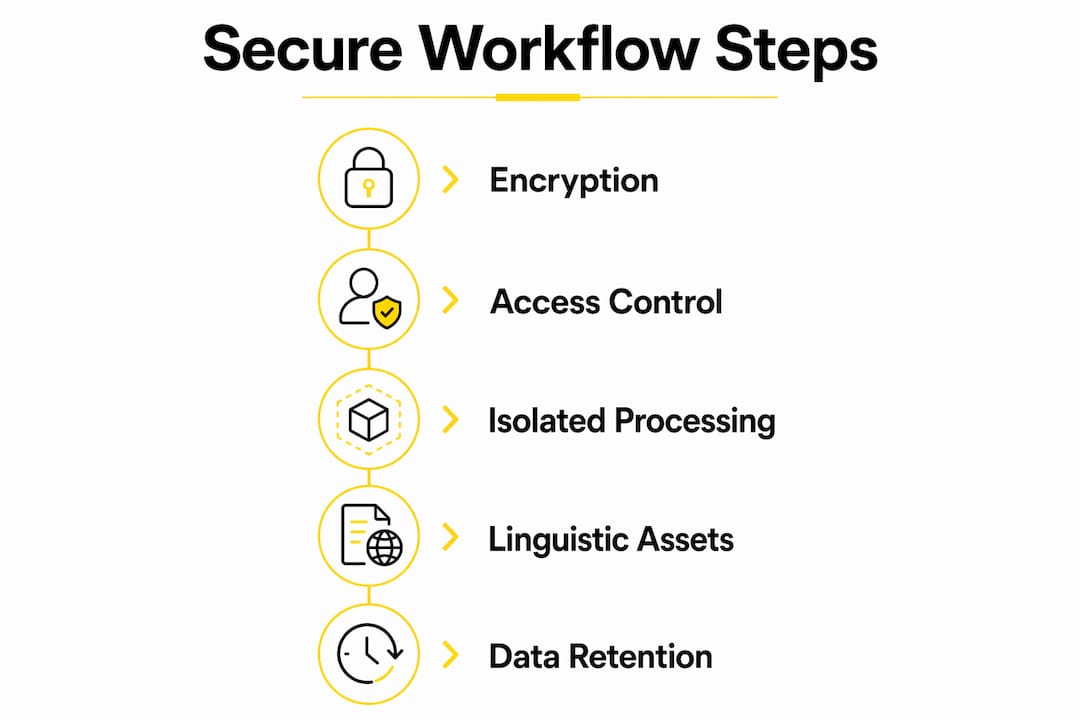
Deletion and zero-retention policies. Some platforms implement zero data retention practices, translating content in real time and deleting all copies immediately after delivery. This approach eliminates lingering exposure risk and supports GDPR’s storage limitation principle.
Pro Tip: Treat your TM and TB files as primary data assets, not administrative byproducts. Require your provider to document encryption status and deletion timelines for every linguistic asset, not just source files.
How do secure workflows maintain translation quality and document integrity?
Quality assurance and security are not separate concerns in regulated translation. They are interdependent. A workflow that protects data but produces inaccurate output fails the compliance test just as surely as one that leaks content.
The following sequence describes how a compliant, quality-controlled workflow operates in practice.
Asset integration. Client Translation Memories and Term Bases are ingested first. This step anchors all subsequent output to approved terminology and style, reducing the risk of inconsistent or non-compliant language in the final document.
LLM-based generation with terminology governance. A proprietary LLM-based system produces target language output constrained by client terminology. This differs from legacy Machine Translation (MT), which produces literal output with weak context handling, and from broadly available Neural Machine Translation (NMT) engines, which carry inconsistent terminology control and governance limitations for regulated documentation. Context-sensitive generation with explicit instruction following is the distinguishing characteristic of a governed AI translation approach.
Subject-matter expert review. A certified specialist, whether a medical professional, engineer, or legal scholar, reviews the output for technical accuracy, regulatory compliance, and contextual nuance. AI+HUMAN hybrid translation combines automation efficiency with human expertise to maintain both accuracy and confidentiality within the workflow.
QA aligned to ISO 17100 and ISO 18587. Automated quality control checks and customized review workflows verify terminology governance, client approvals, and regulatory adherence before any document is released.
Pro Tip: Ask your provider which QA standard governs post-editing review. ISO 18587 specifically covers human post-editing of machine translation output. If your provider cannot name the standard, the process is likely informal.
Layout preservation is a security factor, not just a formatting preference. Processing at the structural layer retains tables, charts, and metadata within a single controlled environment. Flat-text extraction, which strips formatting before translation, creates intermediate files that can leak data and require manual reformatting that introduces additional exposure points. Structure-aware processing eliminates both risks.
What compliance requirements govern secure translation workflows?
Regulated teams must address four compliance dimensions when selecting or auditing a translation workflow.
GDPR data minimization and storage limitation. Under GDPR, personal data processed during translation must be limited to what is necessary and deleted when no longer needed. Providers must document retention periods for all files, including TMs and TBs. GDPR-compliant translation requires explicit data processing agreements that specify these obligations.
Data Processing Agreements (DPAs). Any provider acting as a data processor under GDPR must sign a DPA before work begins. The DPA defines the scope of processing, sub-processor chains, security measures, and breach notification timelines. Executing a DPA is a legal requirement, not a best practice.
Legal privilege and confidentiality. Legal documents translated outside a controlled, privileged environment may lose attorney-client privilege in some jurisdictions. Workflows must maintain a documented chain of custody from upload through delivery to preserve that protection.
Auditability and transparency. Certifications such as SOC 2, HIPAA alignment, and ISO 27001:2022 provide the auditability and trust that regulated industries require. Access logs, user tracking, and version histories must be available on demand for internal audits and regulatory inspections.
Choosing a provider that holds current translation standards certification is the fastest way to verify that compliance controls are independently verified rather than self-declared.
Common failure modes and how to mitigate them
Most security failures in translation workflows follow predictable patterns. Identifying them in advance is the most effective form of risk management.
Failure mode | Root cause | Mitigation |
Unsecured file handoffs | Email or shared drives used for document transfer | Enforce encrypted upload portals with access controls |
Unencrypted secondary assets | TMs and TBs stored without encryption policies | Apply identical encryption and deletion rules to all linguistic assets |
Intermediate file exposure | Flat-text extraction creates uncontrolled copies | Use structure-aware processing that keeps files in one environment |
Access control gaps | Broad permissions assigned to translators or reviewers | Implement RBAC with least-privilege principles and log all access |
Retention policy failures | Files retained after project completion | Require documented deletion confirmation for all project assets |
Deletion policies for intermediate files are the most frequently overlooked control. Temporary files created during format conversion, pre-processing, or quality review accumulate silently and represent a persistent exposure risk if not actively managed. A compliant workflow defines and enforces deletion timelines for every file type, not just the final deliverable.
Centralized, controlled processing environments reduce exposure by eliminating the need to move files between systems. When all steps, from ingestion through QA, occur within a single private infrastructure, the attack surface shrinks to a single perimeter rather than a chain of handoff points.
Key Takeaways
Secure translation workflows require encryption at every stage, access controls tied to audit logs, and quality assurance aligned to ISO 17100 and ISO 18587 to meet regulated industry standards.
Point | Details |
Encrypt all assets, not just source files | Apply TLS 1.3 in transit and encryption at rest to TMs, TBs, and intermediate files. |
Enforce RBAC and audit trails | Limit document access by role and log every access event for regulatory review. |
Use structure-aware processing | Structural-level translation prevents flat-text extraction and reduces data leakage risk. |
Execute a DPA before work begins | A signed Data Processing Agreement is a legal requirement under GDPR, not optional. |
Require documented deletion policies | Confirm that all project files, including secondary assets, are deleted after delivery. |
What I’ve learned about secure translation that most guides skip
The compliance checklists for translation security are well documented. What gets less attention is the gap between what a provider certifies and what actually happens at the file level.
I have reviewed workflows where the provider held ISO 27001 certification but routed documents through a sub-processor with no DPA in place. The certification covered the primary platform. The sub-processor was outside its scope entirely. That is the kind of gap that only surfaces when you ask specifically about sub-processor chains, not when you accept a certification summary at face value.
Secondary linguistic assets are the other blind spot. Most regulated teams scrutinize source document handling carefully. They rarely ask the same questions about TMs and TBs. Those files contain extracted terminology from every document the provider has ever processed for you. If they are retained unencrypted after project completion, they represent a standing exposure risk that grows with every project.
The 7-step data security checklist approach is useful precisely because it forces teams to ask about every asset type, not just the obvious ones. The providers worth working with in regulated sectors are the ones who answer those questions with documented policies, not verbal reassurances.
AI+HUMAN hybrid translation is the right architecture for regulated content, but only when the AI component operates within a governed, private infrastructure. Consumer-grade NMT engines may produce fluent output, but they lack the terminology governance and data sovereignty controls that Life Sciences, Legal, and Defense content requires. The combination of a private LLM, subject-matter expert review, and ISO-aligned QA is what makes the output both accurate and auditable.
— Eric Brown
AD VERBUM’s approach to secure, compliant translation
AD VERBUM’s secure translation services are built for regulated industries where data protection and document accuracy are both non-negotiable.
AD VERBUM holds ISO 27001 certification and operates a proprietary LangOps System on private EU-hosted infrastructure, with no reliance on outsourced public cloud tooling for core processing. Every project follows the AI+HUMAN hybrid translation workflow: TM and TB integration, LLM-based generation with terminology governance, certified subject-matter expert review, and QA aligned to ISO 17100 and ISO 18587. Compliance alignment covers GDPR, HIPAA, and MDR. With 3,500+ subject-matter expert linguists across Life Sciences, Legal, Finance, Defense, and Manufacturing, AD VERBUM delivers translation that is 3x to 5x faster than traditional workflows without reducing auditability or accuracy.
FAQ
What is a secure translation workflow?
A secure translation workflow is an end-to-end process that protects sensitive documents through encryption, access controls, and audit trails from upload through final delivery. It ensures confidentiality, structural integrity, and translation accuracy in compliance with standards such as GDPR and ISO 27001.
What encryption standards apply to secure document translation?
TLS 1.3 is the current standard for protecting data in transit, paired with encryption at rest for all stored files, including translation memories and term bases.
Is a Data Processing Agreement required for translation providers?
Under GDPR, any translation provider acting as a data processor must sign a DPA before processing begins. The DPA must specify retention periods, security measures, sub-processor chains, and breach notification timelines.
How does AI+HUMAN hybrid translation support compliance?
AI+HUMAN hybrid translation combines LLM-based generation with certified subject-matter expert review and ISO-aligned QA, producing output that is both accurate and auditable for regulated documentation.
What certifications should a secure translation platform hold?
Platforms serving regulated industries should hold ISO 27001 for information security, ISO 17100 for translation process quality, and where applicable, HIPAA alignment and MDR compliance. These certifications confirm that security and quality controls are independently verified.
Recommended