


Why Choose Proprietary LLM Translation for Regulated Industries

Proprietary LLM translation is defined as AI-based language conversion built on a controlled, organization-specific large language model deployed within a private infrastructure. For localization heads and compliance managers in regulated industries, the question of why choose proprietary LLM translation comes down to three non-negotiable requirements: terminology governance, data sovereignty, and auditability. Public cloud translation engines and open-source models serve general content well, but they introduce version drift, data exposure, and inconsistent terminology control that regulated documentation cannot tolerate. Standards such as ISO 17100, ISO 27001, GDPR, and HIPAA require controls that only a proprietary deployment can reliably provide.
Why choose proprietary LLM translation over cloud and open-source models?
The core technical distinction separates three generations of machine translation. Legacy Machine Translation (MT) produces literal output with weak context handling, creating a high risk of meaning errors in safety-critical text. Neural Machine Translation (NMT), the standard behind most consumer and broadly available SaaS translation engines, improves fluency but still struggles with inconsistent terminology control, variable handling of negation, and governance gaps in regulated documentation. Proprietary LLM-based AI operates differently. It generates context-sensitive output with explicit instruction following and enforces client terminology through integrated Translation Memories ™ and Term Bases (TB).
Document-level contextual translation maintains consistent terminology and brand voice across an entire document, which sentence-level NMT cannot reliably achieve. That distinction matters most in technical manuals, clinical trial protocols, and legal contracts where a single inconsistent term can create a compliance gap.
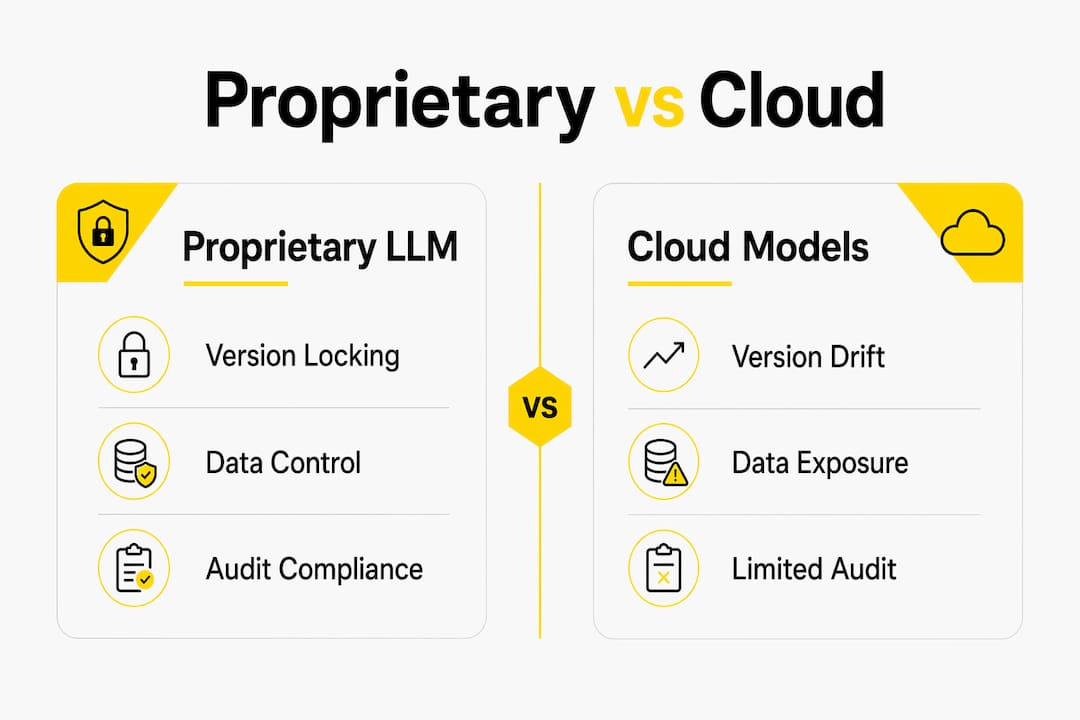
Cloud-based LLM providers may update models without prior notice, creating what the industry calls version drift. Version drift risks compliance breakdown because a validated translation workflow can produce different outputs after an unannounced model update. Proprietary deployments allow version locking, which is the foundation of auditability in regulated environments.
Characteristic | Cloud or open-source models | Proprietary LLM deployment |
Terminology control | Variable, depends on prompt engineering | Enforced via integrated TM and TB |
Version stability | Subject to unannounced updates | Version-locked for auditability |
Data routing | Data transits third-party infrastructure | Processed within private infrastructure |
Regulatory alignment | Requires additional enterprise controls | Built-in GDPR, HIPAA, MDR alignment |
SME review integration | Manual add-on | Embedded in workflow |

Pro Tip: Before selecting any translation architecture, request a written data processing agreement that specifies where model inference occurs. If the vendor cannot confirm that your content never leaves a defined jurisdiction, the architecture is not suitable for GDPR-regulated content.
How does proprietary LLM translation improve accuracy and compliance?
Accuracy in regulated translation is not a quality-of-life improvement. It is a risk control measure. Specialized proprietary models minimize risk through internal filtering and subject-matter expert (SME) validation workflows that general-purpose models cannot replicate. A clinical device instruction translated with inconsistent negation handling is not a translation error. It is a patient safety event.
The compliance-critical features that proprietary LLM translation enables include:
Terminology governance: Client-specific Term Bases enforce approved vocabulary across every output, preventing unapproved synonyms from entering regulated documents.
Document-level context: The model processes full documents rather than isolated sentences, preserving cross-reference accuracy and definitional consistency.
Auditability: Version-locked models produce reproducible outputs that can be validated and re-validated against the same baseline.
SME-in-the-loop review: Certified subject-matter experts, including medical professionals, engineers, and legal scholars, review output for technical accuracy and regulatory compliance.
ISO-aligned QA: Quality assurance processes aligned to ISO 17100 and ISO 18587 provide a documented quality record for regulatory submissions.
Data sovereignty: Processing within a defined jurisdiction satisfies GDPR Article 44 transfer restrictions and HIPAA’s technical safeguard requirements.
Pre-trained proprietary LLMs carry advanced reasoning and linguistic knowledge that is critical for compliance-sensitive translations. That pre-training depth is what allows the model to handle negation, conditional clauses, and domain-specific syntax correctly, rather than defaulting to statistically probable but contextually wrong output.
For life sciences teams, AI translation in life sciences requires alignment with MDR and FDA submission standards. For legal teams, legal translation data security requires that privileged content never transits uncontrolled infrastructure. Both requirements point to the same architecture: a private, version-locked, SME-reviewed proprietary LLM deployment.
Pro Tip: Map your document types to their regulatory submission requirements before selecting a translation vendor. Clinical summaries, legal opinions, and defense specifications each carry different QA obligations. A vendor that cannot show ISO 17100 or ISO 18587 alignment for those document types is not audit-ready.
What are the economic and operational benefits of proprietary LLM translation?
The economic case for proprietary LLM translation is stronger than most localization managers expect. Organizations adopting AI-native translation platforms reduce translation spend by 80–90% compared to fragmented legacy workflows, according to Nucleus Research. That figure reflects the elimination of per-word agency fees, redundant review cycles, and inconsistent TM utilization.
Locally hosted proprietary translation also removes usage-based API fees. Marginal cost savings in repeated translation cycles accumulate significantly when regulated document review workflows require multiple translation iterations. Each revision cycle costs near zero within a private infrastructure, compared to per-character or per-token billing in cloud models. That cost structure makes proprietary deployment economically superior for high-volume, high-revision workflows.
The operational advantages compound over time:
Predictable budgeting. Fixed infrastructure costs replace variable API billing, enabling accurate annual localization budgets.
Faster iteration. AD VERBUM’s proprietary LangOps System delivers turnaround 3x to 5x faster than traditional translation workflows, according to AD VERBUM’s stated figures.
Reduced rework. Terminology enforcement at the generation stage reduces post-editing volume and SME review time.
No vendor lock-in on model versions. The organization controls when and how the model updates, eliminating compliance re-validation triggered by third-party changes.
Scalability without proportional cost increase. Adding languages or document types does not multiply per-unit costs the way agency or cloud API models do.
The AI benefits in legal services context illustrates this well. Legal teams that translate high volumes of contracts, filings, and correspondence find that proprietary deployment pays back infrastructure investment within the first year of operation at enterprise scale.
When should you choose proprietary LLM translation?
Local LLM translation is preferable when confidentiality and offline availability are critical requirements. That finding applies directly to regulated industries where content sensitivity, regulatory mandates, and audit requirements converge. The decision criteria for selecting proprietary LLM translation include:
Content sensitivity: Documents containing personal health information, privileged legal communications, defense specifications, or financial data require processing within a controlled environment.
Regulatory mandates: GDPR, HIPAA, MDR, and AQAP 2110 each impose data processing controls that cloud-based translation cannot satisfy without additional contractual and technical safeguards.
Audit requirements: Regulatory submissions require reproducible translation outputs. Version-locked proprietary models provide that reproducibility. Cloud models do not.
Terminology governance: Organizations with established glossaries, brand voice standards, or regulatory-approved terminology need enforcement at the model level, not as a post-processing check.
Translation volume and frequency: High-volume workflows with frequent revision cycles favor proprietary deployment on cost and speed grounds.
Human review integration: Workflows that require certified SME sign-off benefit from a system where AI generation and human review are embedded in a single, documented process.
Organizations that translate low volumes of non-sensitive general content may find cloud or open-source models adequate. The threshold for proprietary deployment is defined by the intersection of content sensitivity, regulatory obligation, and revision frequency.
Practical applications and failure modes in regulated workflows
The AI+HUMAN hybrid translation workflow that AD VERBUM operates illustrates how proprietary LLM translation functions in practice. The sequence is fixed: first, the system ingests client Translation Memories and Term Bases. Second, the proprietary LLM-based LangOps System generates target language output constrained by that terminology and style guidance. Third, a certified subject-matter expert reviews for technical accuracy, regulatory compliance, and contextual nuance. Fourth, QA is applied in alignment with ISO 17100 and ISO 18587, and with sector requirements such as MDR where relevant.
That sequence addresses the two most common failure modes in AI translation for regulated industries. The first is terminology inconsistency, where an unapproved synonym enters a regulatory submission. The TM and TB ingestion at step one prevents this at the generation stage. The second is overreliance on automation, where AI output is submitted without expert review. The mandatory SME review at step three prevents this structurally, not just as a policy recommendation.
The benefits of AI+HUMAN translation for compliance leaders extend beyond accuracy. The documented review chain creates an audit trail that satisfies regulatory inspectors and internal quality teams. For life sciences organizations preparing MDR technical files or FDA submissions, that audit trail is not optional. For legal teams handling cross-border litigation, it is the difference between admissible and inadmissible translated evidence.
Model drift is a real risk even in proprietary deployments if update governance is absent. The mitigation is a formal change control process for model updates, equivalent to the software validation protocols that regulated industries already apply to quality management systems under ISO 9001 and ISO 13485.
Key Takeaways
Proprietary LLM translation is the correct architecture for regulated industries because it combines version-locked auditability, terminology governance, and data sovereignty within a single controlled deployment.
Point | Details |
Version locking prevents compliance failure | Proprietary deployments freeze model versions, ensuring reproducible outputs for regulatory audits. |
Terminology governance starts at generation | Integrated TM and TB enforce approved vocabulary before human review, reducing rework. |
Data sovereignty satisfies GDPR and HIPAA | Private EU-hosted infrastructure keeps sensitive content within jurisdictional boundaries. |
AI+HUMAN hybrid translation reduces risk | SME review embedded in the workflow catches errors that automation alone cannot prevent. |
Cost reduction reaches 80–90% at scale | AI-native platforms eliminate per-word fees and reduce revision cycle costs significantly. |
The case for proprietary LLM translation is stronger than most teams realize
Working with localization teams in regulated industries over many years, I have seen the same pattern repeat. A compliance manager approves a cloud-based translation tool because it is fast and the per-word cost looks attractive. Six months later, the vendor updates the underlying model. The terminology that was consistent in January produces different outputs in July. A regulatory submission gets flagged. The re-translation and re-review cost exceeds the entire first-year savings.
The fundamental problem is that cloud translation is priced as a commodity and governed as a utility. Regulated translation is neither. It is a controlled process with documented inputs, defined outputs, and a traceable review chain. Those requirements are structurally incompatible with a model that can change without notice.
The 80–90% cost reduction figure from Nucleus Research is real, but it requires the right architecture to capture. Organizations that deploy proprietary LLMs within controlled infrastructure capture that saving while maintaining compliance. Organizations that use cloud APIs capture some speed benefit but absorb ongoing compliance overhead that erodes the economic case.
The compliant AI translation guide I recommend to every localization manager starts with a simple question: can you reproduce the exact translation output from six months ago using the same model? If the answer is no, your current architecture is not audit-ready. Proprietary deployment is the only architecture where the answer is reliably yes.
Regulatory scrutiny of AI-generated content is increasing, not decreasing. The organizations that build proprietary translation infrastructure now will not need to retrofit compliance controls later. That is the practical case for early adoption, and it is stronger than any cost projection.
— Eric Brown
AD VERBUM’s proprietary LLM translation for regulated industries
AD VERBUM’s specialized AI translation services are built on a proprietary LangOps System hosted on EU servers, with ISO 27001 certification and full GDPR, HIPAA, and MDR alignment. Every translation follows the AI+HUMAN hybrid translation workflow: TM and TB integration, proprietary LLM generation, certified SME review, and ISO 17100 and ISO 18587 aligned QA.
AD VERBUM supports 150+ languages across Life Sciences, Legal, Finance, Defense, and Manufacturing. The network includes 3,500+ subject-matter expert linguists, covering medical professionals, engineers, and legal scholars. For localization heads and compliance managers who need a translation architecture that holds up under regulatory inspection, AD VERBUM provides the infrastructure, the expertise, and the documented quality record to support it.
FAQ
What is proprietary LLM translation?
Proprietary LLM translation is AI-based language conversion built on a privately controlled large language model, deployed within an organization’s own or dedicated infrastructure. It differs from cloud translation by providing version locking, data sovereignty, and enforced terminology governance.
Why use proprietary LLMs instead of cloud translation APIs?
Proprietary LLMs allow version locking for auditability, keep sensitive data within jurisdictional boundaries, and enforce client terminology at the generation stage. Cloud APIs introduce version drift and data routing risks that regulated industries cannot accept without additional controls.
How does proprietary LLM translation support GDPR compliance?
Proprietary LLMs deployed on EU-based infrastructure process data within jurisdictional boundaries, satisfying GDPR Article 44 transfer restrictions. No content transits third-party servers, eliminating the data processing agreement complexity that cloud models require.
What is the cost advantage of proprietary LLM translation at scale?
Organizations adopting AI-native translation platforms reduce translation spend by 80–90% compared to fragmented legacy workflows, according to Nucleus Research. Locally hosted models eliminate per-token API fees, making repeated revision cycles near zero in marginal cost.
When is proprietary LLM translation the right choice?
Proprietary LLM translation is the right choice when content is sensitive, regulatory mandates require controlled data processing, audit trails must be reproducible, and translation volume is high enough to justify infrastructure investment. Life sciences, legal, defense, and finance sectors meet all four criteria.
Recommended
