


Multilingual SEO Content Planning: 2026 Strategy Guide

Multilingual SEO content planning is the process of designing, creating, and maintaining localized content across multiple languages to maximize global search visibility. It goes far beyond translation. Effective planning requires market-specific keyword research, hreflang implementation, URL architecture decisions, and governance workflows that keep content accurate and fresh across every language version. The hreflang standard, ISO 17100 quality frameworks, and AI+HUMAN hybrid translation workflows are now foundational components of any credible international SEO strategy. Teams that treat multilingual content as a copy-paste exercise consistently underperform against those that plan it as a distinct discipline.
What is multilingual SEO content planning and why does it matter?
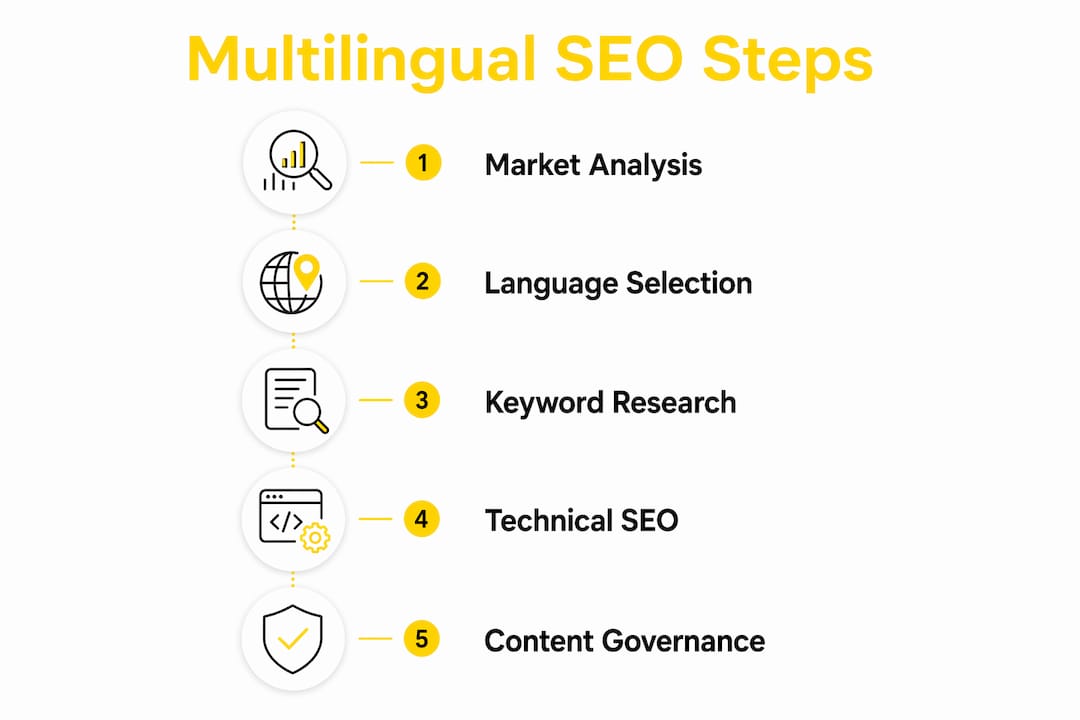
Multilingual SEO content planning is the structured process of selecting target languages, mapping localized keyword strategies, building the right technical infrastructure, and governing content quality at scale. Each of those four components fails independently when treated in isolation. A site with perfect hreflang tags but machine-translated copy will not rank. A site with excellent localized copy but no URL structure will confuse crawlers. The discipline exists because global search visibility requires all four layers to work together.
The business case is direct. Multilingual SEO for global reach consistently shows that companies reaching audiences in their native language generate higher engagement and conversion rates than those relying on English-only content. Search engines serve results in the user’s language and location. A brand that does not appear in those results does not compete in that market, regardless of product quality.

How to select target languages and prioritize markets
Market selection is the first decision in any global content strategy, and it is also the most commonly rushed. The correct approach starts with revenue and demand data, not assumptions about which languages seem important.
A structured prioritization process follows these steps:
Pull existing analytics data. Identify which countries already send organic traffic, even without localized pages. These markets have demonstrated demand.
Map revenue potential by region. Cross-reference traffic data with sales data to identify markets where localized content would convert existing interest into revenue.
Assess competitive density. In some markets, native-language competitors already dominate. Factor in the cost of building authority from zero.
Score languages by effort-to-return ratio. Spanish, French, German, Japanese, and Portuguese typically offer the highest return for English-first companies, but your data may differ.
Commit to 3–5 core languages first. Companies that launch too many languages simultaneously risk conversion rate drops of 60–70% from thin localization. That figure reflects what happens when content volume outpaces quality control capacity.
Thin localization means pages exist in a language but deliver a degraded experience: incomplete product descriptions, untranslated UI elements, or machine-translated copy with no human review. Search engines detect these quality signals. Users leave immediately.
Pro Tip: Run a 90-day pilot with one non-English market before committing to a full rollout. Measure organic impressions, click-through rate, and on-page engagement separately from your English baseline. The pilot data will tell you whether your localization workflow is production-ready.
How does market-specific keyword research differ from translation?
Keyword research for localized markets is not the same as translating your existing keyword list. Search intent and phrasing vary significantly across markets, even for the same language. Native speaker inputs and regional search data are the correct inputs for local keyword research, not a bilingual dictionary.
The practical differences are significant:
Search volume does not transfer. A keyword with 10,000 monthly searches in US English may have 200 searches in its direct Spanish translation and 4,000 searches in a different Spanish phrase that expresses the same concept differently.
Intent shifts by market. A query that signals purchase intent in Germany may signal informational intent in Brazil. Content mapped to the wrong intent stage will not convert.
Competitor sets change. The pages ranking for your target keyword in French are not the same pages ranking in English. Your content must compete against the actual local SERP, not the English one.
Regional variants matter. Spanish in Mexico differs from Spanish in Spain in vocabulary, formality, and search behavior. Treating them as one market produces content that feels foreign to both.
The research process for each market should include native speaker review of candidate keywords, analysis of local SERPs using region-specific search data, and mapping of keywords to content types that match local intent patterns. This work cannot be automated without human validation.
Pro Tip: Build a separate keyword database for each language-market combination, not just each language. A shared Spanish keyword list for all Spanish-speaking markets is one of the most common and costly errors in cross-cultural SEO planning.
What technical SEO foundations does a multilingual site require?
Technical infrastructure determines whether search engines can correctly identify, index, and serve your localized pages. Three decisions define the foundation: URL structure, hreflang implementation, and structured data.
URL structure options
Structure | Example | Best for |
Subfolders | Most sites; easiest to manage; shares domain authority | |
Subdomains | Justified when hosting infrastructure differs by region | |
Country-code TLDs | Strongest geo-signal; highest maintenance cost |
Subfolders are the default recommendation for most global companies. They consolidate link equity under one domain and simplify crawl management. Country-code top-level domains send the strongest geographic signal to search engines but require separate link-building programs for each domain.
Hreflang implementation
Correct hreflang implementation requires reciprocal references among all localized pages and an x-default tag for users whose language does not match any available version. Missing or non-reciprocal hreflang tags are the most common technical failure in multilingual SEO. Every localized page must reference every other localized version of that page, including itself. An x-default tag points to the page that serves users outside all defined language-region combinations, typically the English version or a language-selector page.
Multilingual sitemaps submitted to Google Search Console for each language version improve crawl efficiency and help search engines understand the geographic scope of each content set. Coordinated sitemap strategies reduce the risk of localized pages being missed during indexation.
Structured data and schema
Schema markup must be localized, not just translated. The inLanguage property in Schema.org markup signals content language to search engines. Organization and LocalBusiness schema should reflect local contact details, addresses, and currency where applicable. A French page with English-language schema sends conflicting signals that reduce ranking confidence.
Pro Tip: Validate hreflang implementation with Google Search Console’s International Targeting report after every major content update. Errors accumulate silently and are rarely caught until rankings drop.
How do you govern multilingual content quality at scale?
Quality control is the main barrier to international SEO growth. Scalable systems that treat multilingual quality as a data management problem, rather than a manual review problem, are the ones that succeed at volume. Factual accuracy, brand voice, and SEO alignment across dozens of language versions require structured governance, not periodic spot-checks.
Four practices define a functional governance workflow:
Establish glossaries and style guides before translation begins. Skipping this phase causes terminology drift across language versions, which harms brand authority and complicates AI-assisted updates later. A glossary locks in approved translations for product names, technical terms, and brand-specific language.
Set automated update triggers on a 12-month cycle. Content governance workflows should trigger translation reviews automatically when source content changes or reaches 12 months without an update. Freshness drift causes search engines to favor more recently updated localized competitors.
Apply a tiered localization model. High-revenue assets such as product pages, landing pages, and compliance documentation receive full human oversight. Lower-priority content such as blog posts and FAQs can use AI-assisted processes with lighter human review. This model maintains quality where it matters most while controlling cost.
Use cross-language quality checks for entity consistency. Cross-language entity coherence prevents semantic confusion in AI-mediated search. Brand names, product categories, and key concepts must be represented consistently across all language versions to avoid conflicting signals that reduce search visibility.
For teams managing translation accuracy at scale, the governance layer is where most programs fail. The content exists, the technical infrastructure is correct, but no process exists to catch drift, errors, or outdated information across 10 or 15 language versions simultaneously.
What I’ve learned about where multilingual SEO programs actually break down
After watching global SEO programs succeed and fail across regulated and commercial sectors, the pattern is consistent. Programs fail at governance, not at launch.
The launch phase gets attention and budget. Teams invest in keyword research, URL structure decisions, and hreflang configuration. The first wave of localized content goes live with reasonable quality. Then the source content changes. A product gets updated. A regulation shifts. A pricing page gets revised. And the localized versions sit unchanged for 18 months because no one owns the update workflow.
Local authority signals now drive international rankings more than traditional indexing and keyword density. That means a stale localized page is not just an accuracy problem. It is a ranking problem. Search engines increasingly favor pages that demonstrate active local engagement, in-market backlinks, and fresh content. A page that was excellent at launch but untouched for two years will lose ground to a native competitor that publishes consistently.
The second failure pattern is over-reliance on AI translation without terminology governance. Machine Translation and Neural Machine Translation tools produce output quickly, but without a locked glossary and style guide, terminology drifts across updates. The French version of your product documentation starts using three different translations of the same technical term. That inconsistency confuses users and weakens entity signals in search.
The fix is not to avoid AI tools. The fix is to embed AI within a governed workflow where Translation Memories, Term Bases, and human expert review constrain the output. That combination delivers speed without sacrificing consistency. The compliance practices for translation that regulated industries require are, in practice, the same practices that produce the most durable multilingual SEO results in any sector.
— Eric Brown
How AD VERBUM supports scalable multilingual content programs
Global SEO teams managing content across 10 or more languages face a specific operational problem: maintaining quality, consistency, and compliance simultaneously at volume.
AD VERBUM’s localization services address this through an AI+HUMAN hybrid translation workflow that begins with ingesting client Translation Memories and Term Bases, then applies a proprietary LLM-based LangOps System constrained by approved terminology, followed by certified subject-matter expert review and QA aligned to ISO 17100 and ISO 18587. The result is localized content that holds up under both search engine scrutiny and regulatory audit. With support for 150+ languages and a network of 3,500+ expert linguists, AD VERBUM serves teams where accuracy and governance are non-negotiable requirements.
FAQ
What is multilingual SEO content planning?
Multilingual SEO content planning is the process of designing, creating, and governing localized content across multiple languages to achieve strong search visibility in each target market. It includes language selection, market-specific keyword research, technical infrastructure, and quality control workflows.
How many languages should a company launch with?
Companies should start with 3–5 core languages based on revenue data and demonstrated organic demand. Launching too many languages at once risks conversion rate drops of 60–70% from thin localization.
What is hreflang and why does it matter for multilingual SEO?
Hreflang is an HTML attribute that tells search engines which language and region a page targets. Correct implementation requires reciprocal references among all localized versions and an x-default tag. Missing or incorrect hreflang tags are the most common technical failure in multilingual SEO programs.
Why is keyword translation not the same as localized keyword research?
Direct keyword translation ignores search volume differences, intent variation, and regional phrasing preferences. Local keyword research uses native speaker inputs and regional search data to identify how target audiences actually search, not how a bilingual dictionary would phrase the concept.
How often should localized content be updated?
Content governance workflows should trigger translation reviews at least every 12 months or whenever source content changes. Freshness drift causes search engines to favor more recently updated competitors in local markets.
Key takeaways
Effective multilingual SEO content planning requires structured governance across language selection, keyword research, technical infrastructure, and quality control, not just translation at scale.
Point | Details |
Start with 3–5 languages | Prioritize markets by revenue data and organic demand before expanding to additional languages. |
Research keywords per market | Conduct independent keyword research for each language-market pair using native speaker inputs and regional search data. |
Implement hreflang correctly | Every localized page must include reciprocal hreflang references and an x-default tag to avoid indexation errors. |
Govern content with glossaries | Establish Term Bases and style guides before translation begins to prevent terminology drift across language versions. |
Apply tiered localization | Assign full human oversight to high-revenue pages and AI-assisted workflows to lower-priority content to balance quality and cost. |
Recommended

