


Syncing EUDAMED Data With Translated Product Labels

When four EUDAMED modules become mandatory on May 28, 2026, any mismatch between your database entries and physical label translations stops being a documentation gap and starts being a market access risk. Knowing how do you sync EUDAMED data with translated product labels, the formal challenge of keeping UDI registration data and multilingual label content aligned, is now a core regulatory competency. This guide walks labeling managers and regulatory affairs teams through the exact workflow: what to prepare, how to execute, where systems break, and how to build governance that holds up under notified body scrutiny.
Table of Contents
Key Takeaways
Point | Details |
May 2026 mandate changes stakes | Four EUDAMED modules are mandatory from May 28, 2026; misaligned label data carries direct compliance risk. |
Manufacturers hold upload responsibility | Only manufacturers or their mandated agents may upload data; authorized representatives verify but cannot submit. |
XML validation must happen locally first | Validate against XSD schema v3.0.25 before any live submission to avoid mass rejection of uploaded device records. |
Change control links database to labels | Every EUDAMED data update must trigger a corresponding label revision review across all required languages. |
Certified translation governance reduces audit risk | ISO 17100, ISO 13485, and ISO 27001 certified translation processes provide auditable records regulators and notified bodies can assess. |
How to sync EUDAMED data with translated product labels: prerequisites
Before running a single XML validation, your team needs three things locked down: regulatory scope, role clarity, and a compliant translation infrastructure. Skipping this preparation stage is where most synchronization failures originate.
Regulatory scope under MDR and IVDR
Synchronization obligations differ depending on whether your device falls under MDR or IVDR. IVDR labeling requirements are more prescriptive on language coverage than MDR, so confirm which regulation governs each device in your portfolio before mapping label content to EUDAMED fields. Both frameworks require that the information supplied in EUDAMED matches what appears on the physical label or eIFU, in every language required for the member state where the device is placed on the market.
Role assignments and upload authority
Manufacturers retain legal responsibility for all EUDAMED data submissions. Authorized representatives may verify data accuracy but cannot upload on the manufacturer’s behalf. Third-party regulatory service providers can act as agents, but only under an explicit manufacturer mandate. Before your first upload cycle, document who holds upload rights, who approves translated label content, and who signs off on the alignment check between the two.
Tools and data inputs you need before starting
The following inputs must be in place before the synchronization workflow begins:
Master product data sheet containing all UDI-DI and UDI-PI attributes as they will appear in EUDAMED
Multilingual label content in all required EU member state languages, version-controlled and approved
EUDAMED XSD schema v3.0.25 downloaded locally for pre-submission validation
XML validator capable of running local schema and business-rule checks before sandbox submission
EUDAMED sandbox environment access for test uploads ahead of production submission
Certified translation management system with Translation Memory ™ and Term Base (TB) integration
Pro Tip: Set up your Term Base before any translation cycle starts. Inconsistent terminology across languages is one of the leading causes of notified body queries during post-market surveillance review.
The translation management component is not optional infrastructure. ISO 17100 governs the translation process itself, ISO 13485 applies to quality management in the medical device context, and ISO 27001 covers the security of data exchanged during translation. AD VERBUM’s certified services carry all three certifications, which matters when a notified body asks for evidence of your translation governance controls.

Step-by-step synchronization workflow
Translated product label synchronization with EUDAMED is a change-controlled process, not a one-time event. The following sequence applies to both initial registration and every subsequent label revision.
Establish a single source of truth. Create a master data record that links EUDAMED device attributes (Basic UDI-DI, UDI-DI, device description, intended purpose, clinical size attributes) to their corresponding label fields in each required language. This record is the reference document for every downstream step.
Generate and validate the EUDAMED submission XML. XML submissions are subject to strict formatting rules, including a maximum of 40 objects per submission file. Generate the XML from your master data record and validate it locally against the current XSD schema before touching the sandbox. Business-rule validation runs separately from schema validation; both must pass.
Run a pre-submission test in the EUDAMED sandbox. The sandbox environment allows full simulation of the bulk upload process without affecting your live registration data. Upload the validated XML, review the error report, and remediate before moving to production. This step catches grouping mismatches and UDI-DI formatting issues that schema validation alone does not surface.
Initiate the translation cycle against the validated data set. Once your EUDAMED data set is confirmed accurate, the same field values feed the translation workflow. AD VERBUM’s AI+HUMAN hybrid translation process runs in this sequence:
Asset integration: client TM and TB are ingested first, so all previously approved terminology is enforced from the start.
LLM generation: AD VERBUM’s proprietary LLM-based LangOps System produces target-language output constrained by the approved Term Base and style guidance.
Subject-matter expert review: a certified medical linguist reviews for technical accuracy, regulatory compliance, and contextual nuance specific to the target language.
QA: alignment to ISO 17100 and ISO 18587, with MDR-specific requirements applied where relevant.
Cross-check translated label content against EUDAMED fields. Regulatory affairs must compare each translated label attribute against the corresponding EUDAMED entry, field by field. Device description, intended purpose, contraindications, and storage conditions are the highest-risk fields for divergence. Document this comparison with version numbers and approver signatures.
Execute the live EUDAMED upload and record the submission confirmation. After successful sandbox testing and label cross-check sign-off, execute the production submission. Retain the EUDAMED system confirmation, the XML file, the validation report, and the label approval record as a linked document set.
Trigger label change control for every subsequent EUDAMED update. Any change to a EUDAMED-registered attribute must initiate a formal review of all translated labels carrying that attribute. The change control record must identify which language versions are affected, the timeline for revision, and the approval status before the updated device data goes live.
Pro Tip: Prepare device data in EUDAMED before finalizing print-ready label files. Locking the database entry first eliminates the most common source of field-level mismatches.
Common failure modes and how to fix them
Understanding the specific failure patterns that break translated product label synchronization is more useful than general warnings about compliance risk. The problems below recur across manufacturer portfolios and are entirely preventable.
XSD schema mismatches. These occur when the XML file does not conform to the structure defined in the current schema version. The fix is local validation against v3.0.25 before every submission, not after rejection. Teams that skip local validation and submit directly to the sandbox consistently generate higher error volumes.
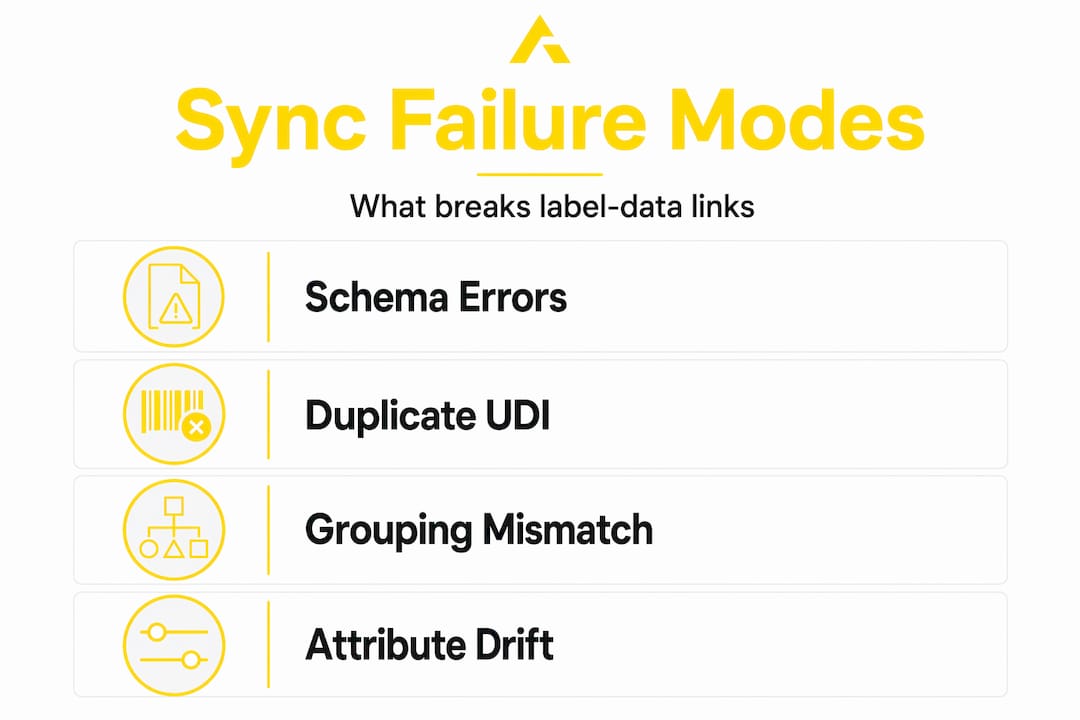
Duplicate Basic UDI-DI errors. Upload errors frequently include duplicate Basic UDI-DI submissions, grouping mismatches, and missing certificate references. These are not translation errors, but they often correlate with label translation discrepancies because both originate from inconsistent master data management.
Translation-related notified body queries. When the device description on the label in a specific language does not match the EUDAMED entry, notified bodies will raise a query. The correction process requires a documented explanation, a revised label where applicable, and updated EUDAMED data if the entry was at fault. This process takes time your clinical evaluation schedule may not accommodate.
Authorization and access errors. Teams sometimes discover mid-cycle that the person executing the upload lacks the correct EUDAMED role. Audit your role assignments and upload authorizations at the start of each registration cycle, not when the deadline is approaching.
Regulatory authorities expect manufacturers to demonstrate that translation governance is a controlled process, not a reactive one. Notified bodies reviewing post-market documentation have started requesting translation audit trails as part of technical file assessment. A certified process generates those records automatically.
Grouping and classification mismatches. A device grouped under one Basic UDI-DI in EUDAMED but labeled with attributes suggesting a different classification will fail validation and may require notified body clarification. Cross-referencing your EUDAMED grouping logic with your labeling hierarchy before submission prevents this class of error.
Verification and ongoing governance
A one-time synchronization pass is not sufficient. Regulatory guidance requires periodic cross-checks between physical labels and EUDAMED database entries, with documented verification steps. The governance structure below gives regulatory affairs teams the controls they need for long-term compliance.
Audit trail requirements: Every translation cycle must generate a record of who translated, who reviewed, what version was approved, and when. ISO 17100 and ISO 13485 certified processes produce these records as a workflow output, not a manual afterthought.
Scheduled database-to-label reconciliation: Set a calendar-based review cadence, at minimum tied to your post-market surveillance schedule, to compare current EUDAMED entries against approved label versions across all languages.
Change notification protocol: When EUDAMED data is updated by any team member, an automatic notification to the labeling function must be part of your internal process. Manual handoffs between regulatory and labeling teams are the most common single point of failure.
Data integrity controls: Restrict EUDAMED write access to named, trained individuals. Role-based access control reduces the risk of uncoordinated changes that create label-database divergence without triggering change control.
Pro Tip: Maintaining a translation audit trail aligned to ISO 17100 gives you immediate, organized evidence when a notified body or competent authority requests documentation of your multilingual label governance.
ISO-certified translation processes provide the layered quality and security controls that individual spreadsheet-based workflows cannot replicate. When a competent authority requests evidence that your label translations were produced under a controlled, auditable process, certification documentation is the answer.
What I’ve learned from watching synchronization fail in practice
I’ve reviewed enough post-incident regulatory correspondence to identify a consistent pattern: the teams that struggle most with EUDAMED and label synchronization are not the ones with weak translation skills. They’re the ones who treat labeling and regulatory data as separate workstreams managed by separate teams with separate tools.
The silo problem is structural. Regulatory affairs manages EUDAMED submissions. Labeling managers coordinate translation. Nobody owns the interface between the two. When a device attribute changes in EUDAMED, the information often reaches the labeling team late, informally, or not at all. By the time a notified body flags the divergence, the label has been printed in six languages and distributed to four markets.
I’ve seen manufacturers transform their compliance outcomes not by hiring more staff but by formalizing the handoff between regulatory data and translation governance. That means written change control procedures, shared version control systems, and translation providers who operate under certifications that regulators recognize. ISO 13485 alignment is not just a vendor credential. It is evidence that the translation process itself is treated as a medical device quality activity.
The May 2026 EUDAMED mandate has moved this from a best practice conversation to a compliance requirement conversation. Teams that built the governance infrastructure early are absorbing the change with minimal disruption. Teams that did not are now trying to build audit-ready processes under deadline pressure. That is a hard position to be in, and it is avoidable.
How AD VERBUM supports EUDAMED label synchronization
Regulatory affairs teams managing multi-language portfolios under the May 2026 EUDAMED mandate need a translation partner whose governance controls are verifiable, not self-declared. AD VERBUM holds ISO 17100, ISO 13485, and ISO 27001 certifications, operates an EU-hosted LangOps System with no reliance on public cloud processing, and applies AI+HUMAN hybrid translation with certified medical linguists on every regulated document.
The result is a translation audit trail that satisfies notified body requests, terminology governance enforced across 150+ languages, and turnaround speeds 3x to 5x faster than traditional translation workflows. For labeling managers who need certified label translation and regulatory affairs teams integrating multilingual data with EUDAMED submissions, AD VERBUM’s services are built for exactly this compliance context. Contact AD VERBUM to discuss your synchronization requirements.
FAQ
What triggers a label update when EUDAMED data changes?
Any modification to a EUDAMED-registered attribute, such as device description, intended purpose, or UDI-DI fields, must trigger a formal label change control review across all required languages before the updated data goes live.
Who is responsible for EUDAMED data accuracy?
Manufacturers hold legal responsibility for all uploaded data; authorized representatives can verify entries but cannot submit on the manufacturer’s behalf, though mandated third-party agents may upload under explicit authorization.
What schema version applies to EUDAMED bulk uploads in 2026?
XSD schema v3.0.25 is the current validation standard; manufacturers must validate XML locally against this schema before sandbox or production submission to avoid bulk rejection.
How does the EUDAMED sandbox reduce submission risk?
The sandbox allows full simulation of bulk XML uploads with detailed error reporting before the production submission, letting teams identify and fix grouping mismatches, duplicate UDI-DI issues, and formatting errors without affecting live device registration records.
What certifications should a translation partner hold for EUDAMED label work?
For regulated medical device label translation, look for ISO 17100 (translation process), ISO 13485 (medical device quality management), and ISO 27001 (information security), as these three certifications together cover process quality, sector-specific compliance, and data governance requirements.
Recommended