


What Does the EU AI Act Require From Financial Institutions

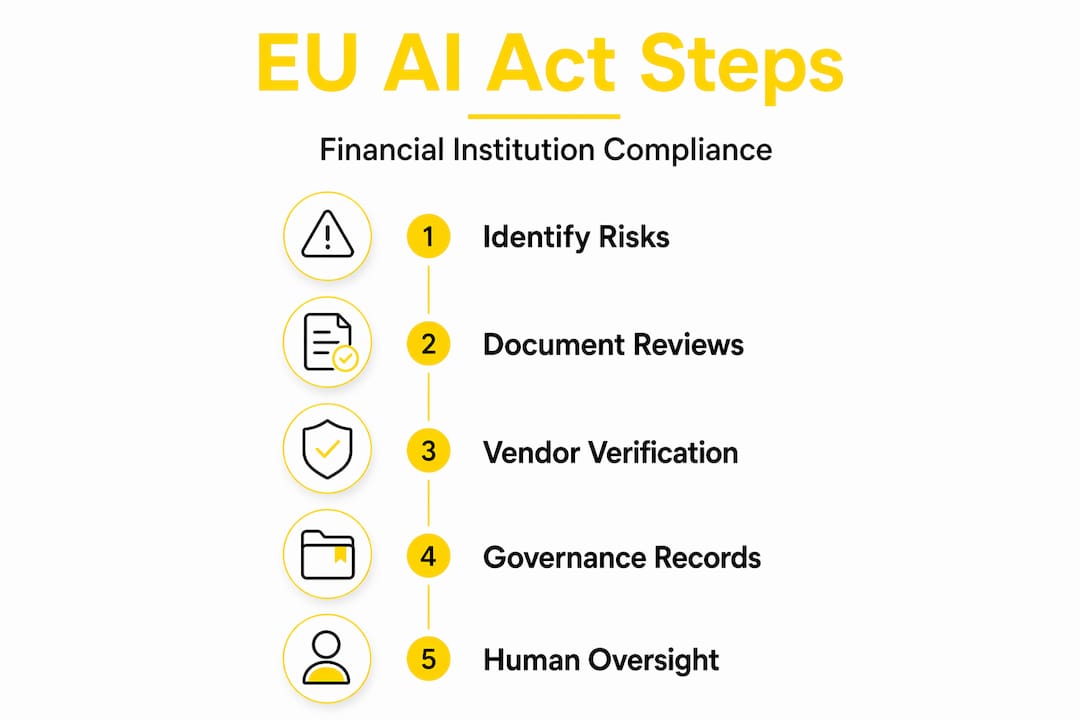
The EU AI Act (Regulation 2024/1689) imposes legally binding obligations on financial institutions deploying AI systems in credit scoring, insurance risk assessment, and customer-facing decisioning. What does the EU AI Act require from financial institutions, specifically? Starting August 2, 2026, institutions operating high-risk AI systems must demonstrate active risk management, evidentiary data governance, technical documentation, and meaningful human oversight — not just written policies, but operationalized controls that regulators can audit. This guide addresses each obligation in the sequence compliance professionals need: classification, core requirements, deployer duties, regulatory intersections, and implementation controls.
Table of Contents
Key Takeaways
Point | Details |
High-risk classification matters | Creditworthiness and insurance pricing AI are explicitly high-risk under Annex III; fraud detection generally is not. |
Evidence over policy | Article 10 requires timestamped, automated validation logs proving data representativeness, not just a data governance policy document. |
Deployer duties are independent | Article 26 places separate obligations on deployers, including fundamental rights impact assessments and anomaly reporting. |
Regulatory regimes do not overlap completely | GDPR, DORA, and the EU AI Act each require distinct compliance artifacts; unified audit trails reduce duplication. |
Human oversight must be technical | Article 14 requires system-enforced override capabilities, not procedural sign-off processes. |
What the EU AI Act requires from financial institutions
High-risk AI obligations under Articles 6 through 49 apply from August 2, 2026, covering risk management, data governance, technical documentation, human oversight, transparency, and logging for financial AI use cases including credit scoring and insurance risk assessment. These are not aspirational standards. They are enforceable requirements with potential fines reaching 3% of global annual turnover for non-compliance.
Financial institutions must first determine which AI systems fall inside the high-risk perimeter. Annex III explicitly classifies AI used for creditworthiness assessment, credit scoring, and insurance risk pricing as high-risk. Fraud detection systems are generally excluded from this classification. The complication arises with hybrid models that combine credit scoring logic and anomaly detection within the same pipeline. Hybrid AI may be partially high-risk if the credit scoring component is architecturally separable and constitutes a meaningful function of the system.
The provider versus deployer distinction is equally critical for EU AI compliance for banks. A bank that purchases a credit scoring model from a third-party vendor operates as a deployer, not a provider. This changes which obligations apply directly, but does not eliminate the bank’s compliance burden. Deployers must verify provider documentation, maintain their own controls, and independently satisfy several Article 26 obligations regardless of the vendor relationship.

Core obligations under Articles 9 through 15
The substantive compliance requirements for high-risk AI systems in finance are structured across seven articles. Each addresses a distinct control domain.
Article 9: Risk management system. Institutions must establish a continuous risk management system covering the entire AI lifecycle: identification of known and foreseeable risks, estimation of residual risk after mitigation, and ongoing post-deployment assessment. This is not a one-time risk assessment. It requires documented evidence of iterative reviews tied to model updates, data drift events, and operational incidents.
Article 10: Data governance. Training datasets must be representative and bias-assessed, supported by timestamped automated validation logs. The regulatory expectation is evidence of actual control execution, not just documented policy. This means data lineage records, bias check outputs, and dataset version histories must exist as operational artifacts, not retrospective reconstructions.
Article 11: Technical documentation. Institutions must maintain up-to-date, comprehensive technical documentation enabling regulators to assess conformity without requiring access to source code. This includes system architecture, training methodology, performance metrics, and known limitations. For multinational institutions, documentation across multiple languages must achieve the same technical precision as the source language version.
Article 12: Logging. Continuous automatic recording of system events and decisions is mandatory. Logs must capture inputs, outputs, operational context, and human oversight availability for at least six months. This is distinct from existing IT logging practices because the AI Act requires traceability at the decision level, not just the system level.
Article 13: Transparency. Deployers must receive documentation from providers on system capabilities, limitations, intended purpose, and performance characteristics. Customer-facing AI decisions in lending or insurance must be accompanied by meaningful explanations, which intersects directly with GDPR Article 22’s right to explanation for automated decisions.
Article 14: Human oversight. The obligation here is technical and operational, not procedural. Institutions must implement mechanisms allowing qualified persons to monitor outputs in real time, intervene, and stop the system. A workflow that requires a human to approve a batch output after the fact does not satisfy this requirement.
Article 15: Accuracy, robustness, and cybersecurity. High-risk AI systems must demonstrate consistent performance across their intended use cases, including under adversarial conditions. For financial institutions, this includes resilience against model manipulation and prompt injection in AI-assisted decisioning environments.
Pro Tip: Document your Article 9 risk management reviews with version-controlled records tied to specific model update events. Regulators will look for evidence that risk management is embedded in your model change control process, not conducted annually as a separate exercise.
Deployer-specific duties starting August 2026
Article 26 creates a distinct compliance layer for institutions acting as deployers of third-party AI systems. These obligations are independent of what the provider has already documented or certified.
Use within intended purpose. Deployers must use AI systems strictly within the scope defined by the provider’s technical documentation. Any extension of use, including applying a credit scoring model to a population segment outside its validated scope, may constitute a substantial modification that transfers provider obligations to the deployer.
Qualified human oversight persons. Institutions must assign personnel with sufficient technical competence to understand the AI system’s outputs, limitations, and failure modes. Assigning oversight responsibility to staff without model literacy is a compliance gap, not a mitigation.
Fundamental rights impact assessment (FRIA). Deployers must conduct a FRIA before deploying any high-risk AI system in finance. This assessment must identify affected populations, potential harms to fundamental rights including non-discrimination, and mitigation measures. This step is mandatory and must be completed before go-live, not after.
Incident and anomaly reporting. Deployers carry independent reporting obligations for serious incidents and unexpected behaviors. For financial institutions already subject to DORA, these reporting timelines and formats may differ. Both regimes must be satisfied in parallel.
Substantial modification risk. When a deployer modifies a high-risk AI system beyond what the provider’s instructions permit, the deployer assumes provider obligations including conformity assessment. This risk is particularly acute for institutions that fine-tune third-party models on proprietary data.
Pro Tip: Before signing any AI vendor contract, require the provider to supply their Article 11 technical documentation and confirm in writing the scope of intended use. Gaps in provider documentation become your compliance problem the moment you deploy.
Interaction with GDPR, DORA, and sectoral rules
The impact of EU AI Act on finance cannot be assessed in isolation. Three existing regulatory regimes interact with it directly, and none of them substitute for AI Act compliance.
Regulation | Overlap with EU AI Act | Key divergence |
GDPR Article 22 | Automated decision-making transparency; right to explanation | GDPR focuses on individual rights; AI Act focuses on systemic risk and conformity of the AI system itself |
DORA | ICT risk management; operational resilience; incident reporting | DORA governs ICT third-party risk broadly; AI Act obligations are specific to high-risk AI model governance |
Prudential rules (CRR/CRD) | Model risk management; internal audit | Prudential model validation does not address fundamental rights impact or bias mitigation at the AI Act’s level of specificity |
EU AI Act compliance operates alongside GDPR and DORA; existing prudential models and ICT controls do not automatically satisfy AI Act obligations. Compliance leads who assume that existing model validation satisfies Article 9, or that DORA incident logs satisfy Article 12, will face evidence gaps during supervisory review.
The practical opportunity lies in unified audit trails that capture incident logs and governance artifacts in a format that satisfies multiple regimes simultaneously. Mapping telemetry and control outputs into consistent datasets is a recognized best practice for institutions managing overlapping evidence requirements across DORA and the AI Act.
Practical implementation controls
Operationalizing EU guidelines for AI in banking under the AI Act requires more than policy updates. The controls must be technically enforced and evidentially traceable.
Human oversight workflows. Article 14 requires system logic that prevents workflow bypass. Every flagged decision must have a recorded approval from a qualified human reviewer. Mandatory reviewer signatures enforced at the system level, with technical prevention of un-reviewed operations proceeding, is the standard. Procedural checklists do not meet this bar.
Automated audit trails. Decision logs must be timestamped and automatically generated at the point of inference, not reconstructed from batch exports. For Article 10 evidentiary requirements, data validation logs must be machine-generated and tamper-evident. Manual log compilation introduces auditability risk that regulators will flag.
Vendor management. Deployers must verify providers’ technical documentation and translate it into deployer-level controls. This means reviewing Annex IV documentation from vendors, identifying gaps relative to your deployment context, and creating supplementary controls documentation where the provider’s records do not cover your specific use case.
Multilingual documentation. Financial institutions AI requirements extend to all documentation produced for regulatory submission, consumer disclosure, and internal governance. Technical documentation translated through legacy machine translation or public neural machine translation tools introduces terminology inconsistency and meaning drift that can invalidate compliance artifacts. Certified translation processes aligned to ISO 17100 and ISO 18587 are the appropriate baseline for documents that regulators will scrutinize.
For translation of regulated documentation, the distinction between MT, NMT, and certified AI+HUMAN hybrid translation is consequential. Legacy MT produces literal output with weak context handling. Public NMT engines offer inconsistent terminology control across technical and legal registers. When compliance documents require exact terminology governance, document-level context handling, and a traceable QA record, the technical and process requirements exceed what generic translation tooling provides.
Pro Tip: Build your Article 11 technical documentation in a version-controlled repository from day one. Retroactive documentation assembly before a supervisory review is the single most avoidable compliance emergency in AI governance, and it is extremely common.
My perspective on compliance pitfalls in practice
In my experience reviewing AI governance programs at regulated institutions, the most persistent gap is not ignorance of the rules. It is the assumption that existing compliance infrastructure transfers automatically to the AI Act’s requirements.
I have seen institutions arrive at pre-deployment reviews with prudential model validation reports, DORA ICT risk assessments, and GDPR data protection impact assessments, believing the combination constitutes AI Act compliance. It does not. The fundamental rights lens in the AI Act is distinct. Bias mitigation evidence, FRIA outcomes, and human oversight technical enforcement are not artifacts that existing risk frameworks produce as a byproduct.
What actually works is cross-functional ownership: legal, compliance, data science, and IT working from a shared evidence register, not separate workstreams that converge at reporting time. The institutions that have operationalized this early are already treating the FRIA as a living document tied to the model lifecycle, not a deployment gate to pass once.
The second pitfall I have observed is nominal oversight. Assigning a senior person to “review” AI outputs without giving them the tools, access, and authority to intervene or stop the system is a paper control. Regulators will test whether that capability actually exists.
How AD VERBUM supports AI Act compliance for financial institutions
Financial institutions operating across multiple EU jurisdictions face a specific documentation challenge: every technical document, transparency notice, human oversight procedure, and consumer-facing disclosure must be translated to the same precision standard as the source. Terminology inconsistency in regulatory artifacts is not a translation quality issue. It is a compliance risk.

AD VERBUM’s AI+HUMAN hybrid translation workflow addresses this directly. The process begins with ingestion of client Translation Memories and Term Bases to enforce institutional terminology from the first output. The proprietary LLM-based LangOps System generates target language content constrained by those controls. A certified subject-matter expert then reviews for technical accuracy, regulatory compliance, and contextual precision. QA is aligned to ISO 17100 and ISO 18587, with the full workflow hosted on private EU infrastructure under ISO 27001 certification. For institutions requiring certified translation services for Annex IV technical documentation, transparency notices, and audit trail records across 150+ languages, AD VERBUM’s standards-aligned process provides the evidentiary baseline that regulatory review demands. No public cloud processing. No terminology drift. Full traceability from source to final output.
FAQ
Which AI systems in finance are high-risk under the EU AI Act?
Annex III explicitly classifies AI used for creditworthiness assessment, credit scoring, and insurance risk pricing as high-risk. Financial fraud detection systems are generally excluded, though hybrid models combining both functions require individual scope assessment.
What is the EU AI Act compliance deadline for financial institutions?
High-risk AI obligations under Articles 6 through 49 apply from August 2, 2026. Institutions deploying high-risk AI in credit or insurance must have conformity controls operational by that date.
Does existing GDPR or DORA compliance satisfy the EU AI Act?
No. Parallel compliance programs are required. GDPR, DORA, and the EU AI Act each mandate distinct evidence artifacts; none of the three regimes substitutes for the others.
What does Article 14 require for human oversight in financial AI?
Article 14 requires technically enforced override capabilities, not procedural approval. Systems must prevent un-reviewed operations from proceeding, and qualified reviewers must have real-time monitoring and stop capabilities.
What is a fundamental rights impact assessment under the EU AI Act?
A FRIA is a mandatory pre-deployment assessment identifying populations affected by the AI system, potential harms to fundamental rights, and mitigation measures. Deployers of high-risk AI in financial services must complete this before go-live, independent of any provider documentation.
Recommended

