


Solve translation bottlenecks to speed generic drug EU registration
- Mar 21
- 8 min read

Translation delays account for up to 30 percent of generic drug registration timeline extensions in EU markets. While clinical equivalence studies and regulatory reviews receive most attention, the multilingual dossier preparation phase creates a hidden bottleneck that directly impacts your time to market. This guide shows regulatory affairs professionals how to identify translation risk points in CTD submissions, implement workflows that compress timelines, and select language service providers capable of maintaining terminological precision across 24 official EU languages without triggering Day 120 objections.
Table of Contents
Understanding the translation challenges in EU generic drug registration
How translation bottlenecks delay market entry and increase costs
Comparing translation approaches for efficient regulatory submissions
Strategies to overcome translation bottlenecks in EU generic drug registration
How AD VERBUM can help accelerate your generic drug registrations
Key Takeaways
Point | Details |
Translation bottlenecks delay | Translation delays can account for up to 30 percent of the timeline extensions for EU generic drug registrations. |
Precise multilingual terminology | Regulatory language across 24 EU languages requires exact alignment with the reference product to prevent regulatory objections. |
High volume translation | A typical generic dossier contains 200,000 to 300,000 words, and targeting 15 member states can require 3 to 4.5 million words of specialized text. |
Leverage expert services | Engaging specialist language providers and streamlined workflows reduce delays while preserving terminological precision and compliance. |
Understanding the translation challenges in EU generic drug registration
Generic pharmaceutical companies filing CTD dossiers face a regulatory landscape where multilingual regulations require precise and compliant translations for each EU member state. The European Medicines Agency coordinates centralized procedures, but national competent authorities maintain jurisdiction-specific linguistic requirements that go beyond simple translation.
Module 1 administrative documents, product information texts, and labeling components must demonstrate exact terminological alignment with the reference product while adapting to local regulatory language conventions. An SPC translated into German for BfArM review cannot deviate from EMA-approved terminology even when local linguistic preferences differ. This creates a precision requirement that standard translation workflows struggle to meet.
The volume challenge compounds the complexity issue. A typical generic dossier contains 200,000 to 300,000 words of technical content spanning pharmacology, toxicology, clinical data, and manufacturing specifications. When you multiply this by the number of target markets, a company filing in 15 EU member states faces translation of 3 to 4.5 million words of specialized pharmaceutical text.
Three factors make this particularly challenging:
Regulatory terminology databases vary by jurisdiction, requiring translators to navigate multiple controlled vocabularies simultaneously
Negation handling in safety-critical text demands subject matter expertise, as a misplaced modifier can reverse clinical meaning
Quality standards for medical translation compliance requirements mandate validation processes that extend timelines when not properly resourced
Errors or inconsistencies trigger requests for clarification that can add 60 to 90 days to your approval timeline. For generic companies where commercial success depends on first-to-file advantage, this represents direct revenue impact.
How translation bottlenecks delay market entry and increase costs
Delays in translation not only increase time to market but also inflate regulatory compliance costs and risk penalties. When your translation provider cannot deliver Module 1 documents within your submission window, the entire dossier filing shifts to the next regulatory cycle. In decentralized procedures, this can mean a three-month delay before you can resubmit.

The financial impact extends beyond direct translation costs. Each month of delay represents lost revenue in markets where generic pricing creates narrow profit windows. If your product faces competition from multiple generic applicants, being second to market can reduce your revenue potential by 40 to 50 percent in the first year.
Cost Category | Traditional Workflow | Optimized Workflow | Savings |
Translation timeline | 8-12 weeks | 3-4 weeks | 60% reduction |
Revision cycles | 2-3 rounds | 1 round | 50% fewer iterations |
Regulatory queries | 3-5 per submission | 0-1 per submission | 80% reduction |
Time to approval | 210+ days | 180-195 days | 15-30 days faster |
Non-compliant translations create a cascade of administrative burden. When a national competent authority issues a Day 120 list of questions highlighting terminology inconsistencies, your regulatory affairs team must coordinate corrections across multiple language versions while maintaining alignment with the reference product documentation. This consumes internal resources that could focus on new product development.
The EMA translation bottlenecks analysis shows that companies using generalist translation providers experience 3x higher rates of terminology-related queries compared to those using specialized pharmaceutical language services. The difference stems from subject matter expertise in pharmacovigilance terminology and regulatory writing conventions.
Pro Tip: Build translation timeline buffers into your regulatory project plans by starting linguistic preparation when you initiate Module 3 compilation, not after dossier finalization. This parallel processing approach can compress your overall timeline by 4 to 6 weeks.
Comparing translation approaches for efficient regulatory submissions
Three translation approaches dominate pharmaceutical regulatory workflows, each with distinct trade-offs for generic drug applications. Understanding when each method fits your compliance requirements and timeline constraints determines whether translation accelerates or delays your market entry.
Traditional human translation relies entirely on certified linguists with pharmaceutical expertise. This approach delivers high accuracy for complex regulatory text but typically requires 8 to 12 weeks for a complete generic dossier. The sequential workflow, where translation, editing, proofreading, and quality assurance happen in stages, creates timeline rigidity that conflicts with compressed generic development schedules.
Machine translation using neural networks can process large volumes quickly but introduces compliance risks in regulated documentation. Public NMT engines lack the terminology governance needed for pharmaceutical submissions. They handle general medical content adequately but struggle with the precise regulatory language required in SPCs and package leaflets. Without expert oversight, AI and human pharma translation shows that machine-only approaches generate terminology inconsistencies that trigger regulatory queries.
Hybrid AI+human workflows represent the current best practice for generic drug translations. These systems combine proprietary LLM-based translation with mandatory subject matter expert review. The AI component handles initial translation constrained by client-specific terminology databases and translation memories. Certified pharmaceutical linguists then validate technical accuracy, regulatory compliance, and contextual nuance.
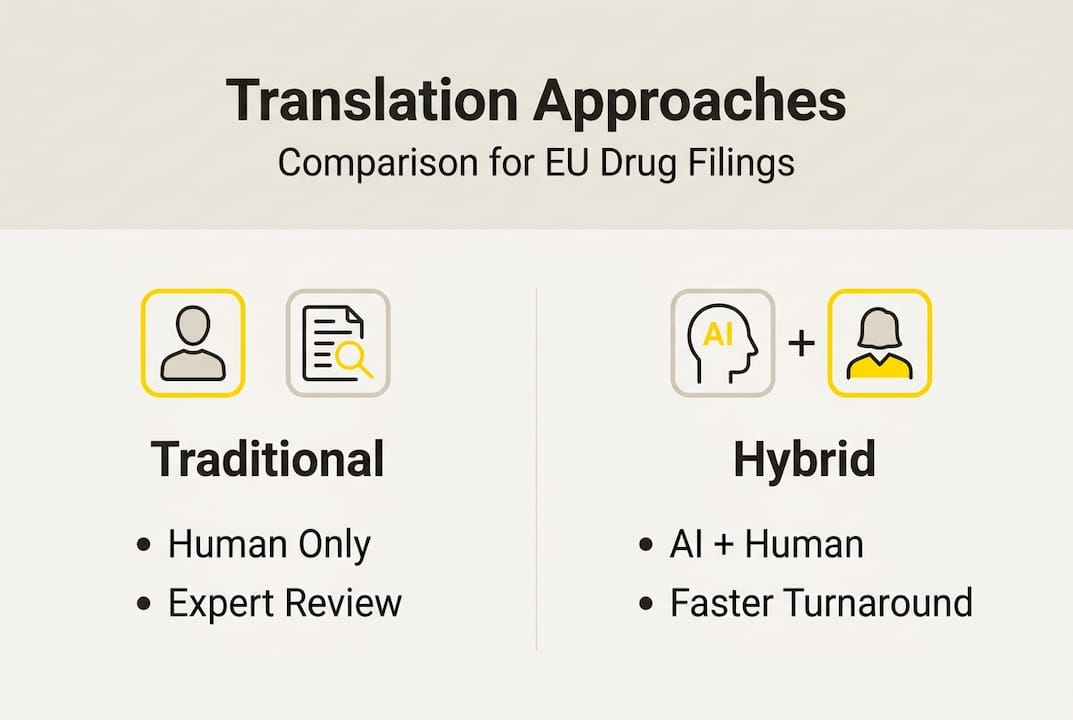
Approach | Speed | Accuracy | Compliance | Best For |
Traditional human | Slow (8-12 weeks) | High | High | Small volume, maximum precision |
Machine translation | Fast (1-2 weeks) | Variable | Low | Internal drafts, non-regulatory content |
Hybrid AI+human | Fast (3-4 weeks) | High | High | Regulatory submissions, scalable volume |
Generalist LSP | Medium (6-8 weeks) | Medium | Medium | Non-critical pharmaceutical content |
The decision framework for regulatory affairs teams should prioritize three factors:
Audit trail requirements: Can the provider demonstrate ISO 17100 and ISO 18587 compliance with documented quality processes?
Terminology governance: Does the workflow enforce client-approved term bases and maintain consistency across all language pairs?
Subject matter expertise: Are reviewers qualified medical professionals or pharmaceutical regulatory specialists?
Pro Tip: Request translation samples of SPC sections from your shortlisted providers. Evaluate how they handle drug-drug interaction terminology and contraindication statements, as these sections reveal translation quality more clearly than administrative text.
Combining AI with expert human review delivers the best balance of speed, quality, and compliance for pharma translations. The key differentiator lies in the AI system’s training. Proprietary pharmaceutical LLMs trained on regulatory corpora outperform general-purpose translation engines because they understand document-level context and regulatory writing conventions specific to CTD formats.
Strategies to overcome translation bottlenecks in EU generic drug registration
Implementing structured workflows and selecting the right language service partnerships can reduce your translation timeline by 50 percent while improving regulatory compliance. These five strategies address the most common bottleneck patterns in generic drug registrations.
Initiate translation planning during Module 3 compilation. Start identifying translatable content and building glossaries when you begin manufacturing documentation. This parallel processing eliminates the sequential bottleneck where translation cannot start until the entire dossier is complete. You gain 4 to 6 weeks of timeline compression.
Establish a master terminology database before translation begins. Work with your language service provider to create a controlled vocabulary that maps reference product terminology to target language equivalents across all filing jurisdictions. This upfront investment prevents the revision cycles that occur when translators make inconsistent terminology choices.
Select providers with pharmaceutical regulatory specialization and ISO-aligned quality processes. Verify that translators hold relevant scientific credentials and that the provider maintains ISO 17100, ISO 18587, and ISO 13485 certifications. Generic translation providers without pharmaceutical expertise cannot navigate the nuanced requirements of regulatory submissions.
Implement continuous quality assurance with regulatory vetting at each milestone. Rather than waiting for complete translation to begin QA, review Module 1 sections as they are completed. This iterative approach identifies issues early when corrections are less costly and time-consuming. Multilingual clinical trial translation management demonstrates how staged review reduces overall project risk.
Maintain direct communication channels between your regulatory team and the translation project manager. Establish protocols for rapid clarification of ambiguous source text and regulatory context. When translators can query your regulatory affairs specialists directly, they resolve uncertainties in hours rather than days, preventing translation holds that delay delivery.
Structured planning, expert partnerships, and technology integration can substantially mitigate translation delays. The most successful generic companies treat translation as a strategic regulatory function requiring the same rigor as clinical documentation, not an administrative task to outsource to the lowest bidder.
Your translation workflow should integrate with your overall regulatory project management. When translation milestones appear in your critical path analysis with appropriate dependencies and buffers, you can identify potential delays weeks before they impact submission deadlines. This visibility allows proactive resource allocation rather than reactive crisis management.
How AD VERBUM can help accelerate your generic drug registrations
AD VERBUM’s specialized pharmaceutical translation services address the specific bottlenecks that delay generic drug registrations across EU member states. Our proprietary AI+human hybrid workflow combines LLM-based translation with mandatory review by certified pharmaceutical linguists, delivering 3x to 5x faster turnaround than traditional translation while maintaining ISO 17100 and ISO 18587 quality standards.
Our Language Operations System integrates your translation memories and terminology databases before translation begins, ensuring consistent use of reference product terminology across all target languages. This upfront asset integration prevents the terminology misalignment issues that trigger Day 120 objections. With 25+ years serving regulated industries and a network of 3,500+ subject matter expert linguists including medical professionals, we understand the precision requirements of CTD Module 1 documentation. Our EU-hosted infrastructure maintains GDPR and MDR compliance while supporting professional pharma translation services across 150+ languages. Whether you need multilingual regulatory content services for decentralized procedures or localization services for pharma labeling, our ISO 27001 certified workflows compress your timeline without compromising regulatory compliance.
Frequently asked questions
How do translation bottlenecks specifically affect generic drug registration timelines?
Translation delays postpone submission of complete CTD dossiers, directly extending the time before regulatory review can begin. In decentralized procedures, missing translations for even one member state can delay the entire application by months. When translations contain terminology inconsistencies or compliance errors, national competent authorities issue requests for clarification that add 60 to 90 days to your approval timeline, pushing back market entry and revenue realization.
What are the main compliance risks associated with translation errors in pharma filings?
Incorrect translations of safety information, contraindications, or dosing instructions create patient safety risks that regulatory authorities treat as critical deficiencies. Terminology that deviates from EMA-approved reference product language triggers automatic rejection in many jurisdictions. Even minor inconsistencies between language versions of the same document can result in requests for complete retranslation, causing months of delay and requiring resubmission fees.
Can AI translation tools replace human expertise in pharma regulatory translations?
AI translation accelerates initial draft generation but cannot replace subject matter expert review for regulatory submissions. Machine translation systems lack the pharmaceutical knowledge to evaluate clinical context, interpret ambiguous terminology, or apply jurisdiction-specific regulatory writing conventions. The optimal approach combines AI speed with mandatory human validation by certified pharmaceutical linguists who verify technical accuracy and regulatory compliance before submission.
What practical steps can regulatory teams take to minimize delays from translation bottlenecks?
Start translation planning during Module 3 compilation rather than waiting for complete dossier finalization. Establish master terminology databases that map reference product terms to target languages before translation begins. Select specialized pharmaceutical language service providers with documented ISO compliance and subject matter expert networks. Implement staged quality assurance where Module 1 sections are reviewed as completed rather than waiting for full translation delivery. Maintain direct communication channels between regulatory affairs teams and translation project managers to resolve ambiguities rapidly.
Recommended