


Selling Defense Tech Abroad: The Documentation Factor

Contract delays or compliance failures can trace back to a single error in defense documentation. For European compliance officers, precise translation is not just about language—it is about maintaining trust and regulatory alignment with foreign buyers. Buyers rely on documentation consistency to verify capability claims, and any terminology confusion adds risk. This article offers practical strategies for achieving terminology control and documentation accuracy, strengthening your credibility in international procurement cycles.
Table of Contents
Key Takeaways
Point | Details |
Importance of Accurate Documentation | Errors in technical documentation can undermine buyer confidence and delay contract closure. Consistency is critical to maintain trust in defense procurement. |
Terminology Consistency | A unified term base is essential to prevent misinterpretation and regulatory issues across different markets and languages. A lack of governance can lead to significant documentation failures. |
Localization vs. Translation | Localization adapts documentation to meet specific regulatory and operational requirements, ensuring compliance and market readiness, unlike basic translation, which may overlook critical details. |
Comprehensive Audits | Conducting thorough audits of documentation ensures all technical specifications, safety data, and regulatory compliance statements are accurate before submission, mitigating reputational risks. |
Why Accurate Defense Documentation Matters
Defense buyers scrutinize technical documentation before committing to procurement. A single error—in specification, terminology, or capability claim—undermines buyer confidence and delays contract closure.
Inaccurate or inconsistent documentation creates friction at every stage. Foreign military procurement teams lack the informal relationships that domestic sales sometimes lean on. They depend entirely on written proof that your product meets stated requirements. When your capability brochure conflicts with your technical manual, or when translated documents use different terms for the same component, buyers ask why they should trust you with classified operations.
Cost of documentation failure:
Contract delays while legal teams reconcile conflicting claims
Rejection at compliance review if localized documents don’t match originals
Reputational damage in a relationship-driven market where word travels fast
Rework costs when you must re-translate or re-certify documentation midway through negotiation
Technical documentation management requires strict control to ensure consistency and reduce critical errors across defense projects. Poor documentation management directly increases project risk and procurement timeline uncertainty.
The Terminology Problem Across Your Documentation
Your sales team calls a component a “targeting acquisition module.” Your technical manual labels it a “fire control targeting system.” Your compliance document refers to it as a “targeting platform.” A foreign buyer’s procurement officer sees three different products, not one.

This fragmentation happens because different teams author different documents at different times. Marketing creates capability statements. Engineering writes technical specifications. Compliance generates regulatory submissions. No single person owns terminology consistency across all outputs.
When you translate these documents into Spanish, French, German, or Mandarin, the terminology chaos multiplies. A translator working only on the marketing brochure won’t know which term was chosen in the technical specs. The result: foreign buyers receive contradictory information across document sets.
Consequences of inconsistent terminology:
Buyers question whether you understand your own product
Compliance teams flag mismatches as potential concealment or deception
Translation becomes impossible without clarification—delaying delivery
Technical teams in buyer countries receive conflicting specifications for integration testing
Translation vs. Localization: Why the Difference Matters
Raw translation converts words from one language to another. Localization adapts technical content for a specific regulatory, operational, and market context. These are not the same thing.
A translator can render “target tracking algorithm” into French as “algorithme de suivi des cibles.” But a localized document also ensures that French military specifications for tracking accuracy, update frequency, and data format alignment are accurately reflected in the translated technical parameters.
Defense documentation localization requires SME linguists with defense domain knowledge, not general translators. A translator fluent in military terminology but unfamiliar with your specific system architecture will miss critical nuance. An engineer fluent in two languages but untrained in translation quality will introduce errors that feel technically accurate but violate regulatory requirements in the target market.
Securing defense localization with AI and human oversight ensures both technical accuracy and regulatory compliance across language versions.
Reputational Cost in Relationship-Driven Procurement
Defense procurement is personal. Buyers work with the same vendors for decades. A documentation error today becomes a reputation liability that follows you through five more bidding cycles. Foreign military procurement officers communicate with each other. A compliance failure in one country spreads to others.
When a buyer discovers that your translated technical manual contradicts the original English version—or worse, that you submitted different capability claims in different languages—trust evaporates. That buyer’s organization will flag your company as a documentation risk, and competing vendors will cite your error during their pitch.
Inaccurate localized documentation doesn’t just delay one contract; it damages your standing with an entire procurement ecosystem.
Your reputation in defense sales depends on absolute consistency across all language versions and all document types. One error in a technical manual seen by fifty buyer engineers spreads faster than you can respond.
Pro tip: Conduct a documentation audit before pursuing international contracts. Map every document you create—marketing, technical, compliance, regulatory—and identify which teams own terminology, update authority, and change control. Establish a single source of truth for capability claims before translation begins.
Terminology Consistency in Global Defense Sales
Defense procurement documents traverse multiple languages, multiple buyer organizations, and multiple technical teams. Every instance of a key term must mean exactly the same thing across every document, every language, and every context. Consistency is not a style choice—it is a compliance requirement and a trust marker.
When your English technical manual uses “fire control system” and your French localization uses “système de commande de tir,” a French buyer’s integration team expects both terms to refer to the same component with identical specifications. If your Spanish localization renders the same term as “plataforma de dirección de fuego,” Spanish procurement officers will question whether these are three different products or translation errors. Terminology consistency in translated corpora is crucial for professional domains like defense, improving information transfer and message understanding across technical translations.
Terminology fragmentation happens when no single authority governs how technical terms are defined, approved, and used. Marketing writes one term. Engineering uses another. Compliance submissions introduce a third variant. By the time translation occurs, the damage is already done.
Why Terminology Control Fails
Most defense organizations lack a term governance process. Teams create documents independently without checking what others have already published. A new engineer joins the project and coins a slightly different term without knowing an earlier team already standardized terminology for that concept.
Cross-functional collaboration breaks down further when teams use different authoring tools. One department uses Word. Another uses specialized technical documentation software. A third maintains a separate regulatory submission system. No shared terminology database connects these silos.
Internationalization amplifies the problem. Once you translate documents into multiple languages, terminology errors multiply by the number of target languages. A single inconsistency in English becomes three or five inconsistencies across Spanish, French, German, and Polish versions.
Sources of terminology fragmentation:
No single source of truth for technical term definitions
Teams authoring independently without cross-referencing earlier documents
Legacy terminology from previous products still appearing in new documents
Subject-matter experts using discipline-specific jargon that differs from sales terminology
Terminology introduced in regulations or standards but not adopted internally
Building Terminology Control Into Your Translation Workflow
Terminology consistency requires active management before translation begins. Start with a terminology audit across all existing documentation. Identify every technical term, how it appears in each document type, and which definition is authoritative.
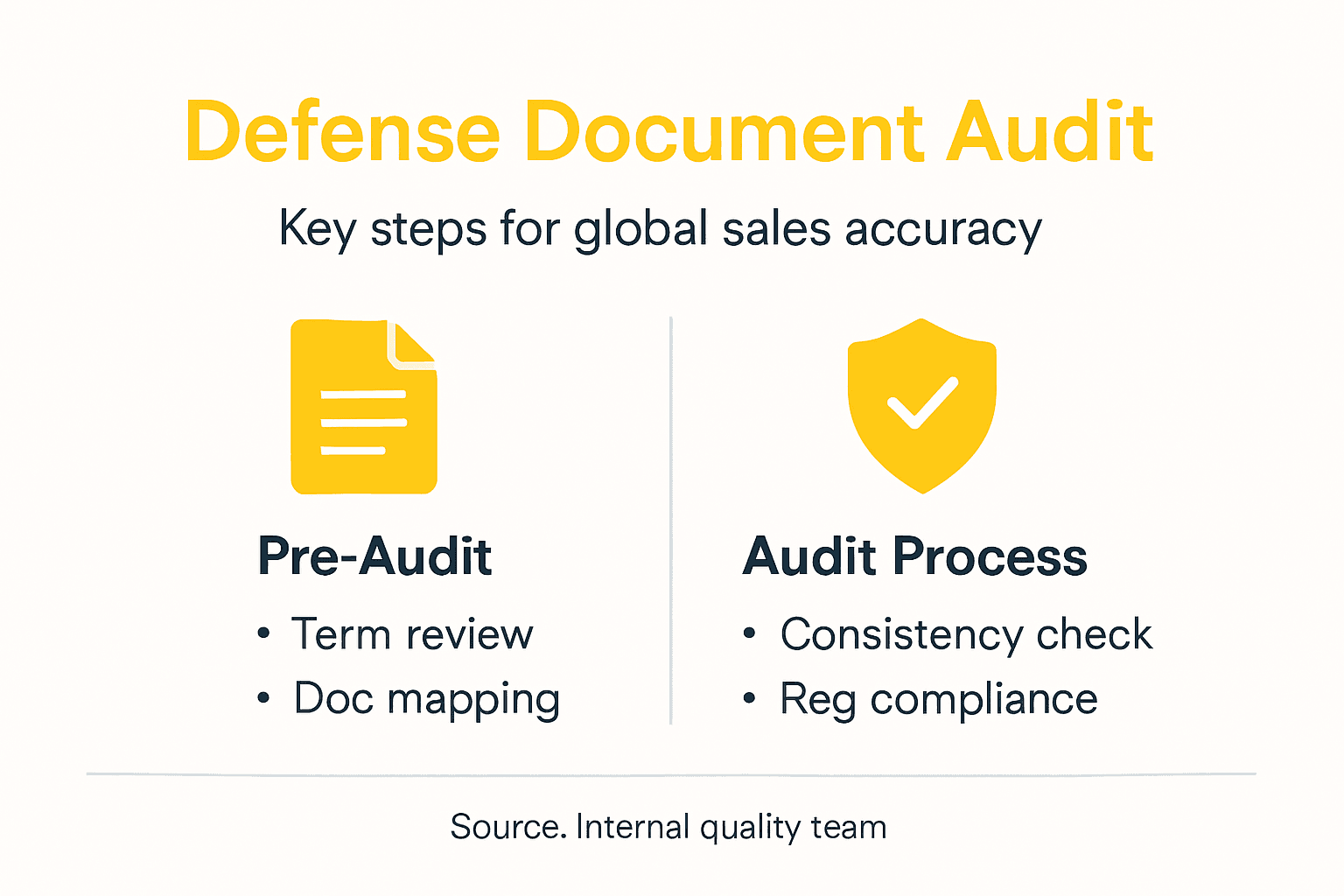
Create a term base—a controlled vocabulary specific to your product and your markets. Define each term in English first. Include acceptable variants. Specify which contexts use which term. Mark terms as mandatory or preferred. For defense products, document which regulatory authority defines each term (NATO standards, Department of Defense specifications, international agreements).
When translation occurs, translators use your term base as a binding constraint. The term base enforces consistency across all target languages. A translator cannot deviate from approved terminology without explicit written approval from your product team.
The language barrier between you and your first NATO contract often stems from terminology misalignment in localized documents. Proactive terminology governance eliminates this friction.
Steps to enforce terminology control:
Conduct terminology audit across all existing English documents
Create term base with definitions, regulatory sources, and approved variants
Review term base with engineering, marketing, compliance, and subject-matter experts
Publish term base to all teams authoring defense documentation
Require translators to use term base as binding constraint
Establish change control process for term base updates
Audit translated documents for term base adherence before delivery
The Cost of Getting Terminology Right
Terminology control delays product launch by weeks if you start from zero. But it accelerates international sales by months. A buyer reviewing consistent, terminology-aligned documentation moves toward contract signature faster. They do not flag terminology mismatches during compliance review. Their technical teams do not submit queries asking whether three different terms refer to three products or one product with inconsistent naming.
Consistent terminology usage in defense systems documentation enhances usability, reduces user confusion, and decreases cognitive load for foreign military end-users integrating your product into their operations.
Your compliance officer sees terminology inconsistencies as risk. Foreign procurement officers see them as proof you do not control your product documentation. Buyers see them as a reason to select a competing vendor whose documentation is consistent across all languages and all markets.
Terminology consistency is the foundation of trust in defense procurement. Inconsistency signals chaos internally and raises liability concerns externally.
Pro tip: Before pursuing any international defense contract, conduct a terminology audit across your English technical documents and create a written term base approved by your engineering and compliance teams. Provide this term base to your language service provider before translation begins, and require adherence as a quality acceptance criterion.
To clarify key factors that impact documentation quality, see this summary of terminology governance success factors:
Success Factor | Description | Business Value |
Centralized Term Base | Single approved glossary for all teams | Eliminates costly inconsistencies |
Cross-Team Collaboration | Regular reviews with all stakeholders | Aligns marketing and technical input |
Change Control | Updates tracked and authorized | Ensures ongoing compliance |
Pre-Translation Audit | Review terms before translation starts | Reduces errors in all markets |
Localization Versus Raw Translation in Defense Tech
Translation and localization are not the same thing, but many defense manufacturers treat them as interchangeable. This distinction costs contracts.
Translation converts words from English into a target language. A translator reads your technical manual and renders it into German or Japanese word-for-word. The output is readable in the target language. It is not necessarily correct for your buyer’s market.
Localization adapts your entire documentation package for a specific military, regulatory environment, and operational context. It includes translation, but goes far beyond it. Localization accounts for how foreign militaries actually use your equipment, what their regulations require, and what their procurement officers need to see to approve your product.
Localization in defense technology involves adapting technical documents linguistically, culturally, and technically to meet regional and operational requirements. It ensures greater precision, security, regulatory compliance, and operational safety than raw translation alone.
The Difference in Practice
Your English manual specifies that your fire control system operates between minus 40 degrees Celsius and plus 60 degrees Celsius. A translator converts this into target language. Correct translation: achieved.
But a Norwegian buyer’s military specification requires that all fire control systems operate between minus 50 degrees and plus 70 degrees. Your localized manual must either meet that requirement or explicitly document why your system cannot. A translator never checks regulatory requirements. A localization specialist does.
Your sales material claims your system integrates with NATO standard interfaces. Raw translation preserves that claim in French. But French military procurement policy requires documentation of compliance with European Union cyber-security standards that post-date your original English documentation. Localization identifies this gap and updates your documentation to include European Union compliance statements.
What translation alone covers:
Word-for-word language conversion
Grammatically correct output in target language
Preservation of original meaning
What localization adds:
Regulatory compliance verification for target market
Adaptation to local military specifications and standards
Removal of region-specific content irrelevant to buyer
Addition of market-specific certifications and approvals
Cultural and operational context alignment
Compliance with local data protection and security laws
Why Localization Matters for Compliance Officers
Your compliance team reviews all defense documentation before submission. You submit an English technical manual that meets Department of Defense specifications. You then submit a French-localized version to a French military buyer.
A raw translation preserves your English compliance claims without verification. If French military procurement law requires additional certification steps, a translator would not know. Your submitted documentation fails compliance review because it lacks required French-specific attestations.
A localized version includes a compliance audit specific to France. It identifies gaps between your product and French requirements. It documents what additional testing, certification, or regulatory approval your product needs. It provides your compliance officer with a clear risk map before submission.
Translation and localization differences extend to tailoring user experience and addressing context-specific requirements that pure translation does not handle. For defense tech, this means adapting manuals, training materials, and compliance documents to fit target markets’ norms and regulations.
Here is a practical comparison of translation and localization for defense documentation:
Aspect | Translation Only | Full Localization |
Regulatory Coverage | Does not check local compliance | Assesses and adapts for each market |
Market Acceptance | Often rejected for non-compliance | Increases approval chances |
Technical Accuracy | Literal term conversion | Aligns terms with exact requirements |
Contract Outcome | May delay or lose deals | Improves bid success rates |
Why this matters to your bottom line:
Raw translation fails compliance review in foreign markets
Resubmitting localized documentation delays contract closure by weeks
Competitors with localized documentation advance to procurement faster
Your reputation suffers when submissions are incomplete or non-compliant
Building Localization Into Your Process
Do not wait until you bid on an international contract to localize. Start with your core technical documentation in English. Ensure it reflects current, correct product specifications. Build a localization roadmap for your priority markets before pursuing sales in those regions.
For each target market, conduct a localization audit. Identify regulatory requirements, military standards, procurement processes, and operational environment specifics. Document gaps between your English documentation and local requirements. Plan localization work to close those gaps.
Work with language service providers that have defense domain expertise, not just translation fluency. They understand military procurement, regulatory frameworks, and operational context. They audit your English documentation against foreign regulations. They do not just translate; they verify compliance.
Localization is not luxury. It is the difference between a submitted proposal and an accepted contract.
Pro tip: Before pursuing any international defense contract, engage a localization specialist to audit regulatory requirements in your target market. Have them assess your English documentation against those requirements and identify gaps before translation begins. This identifies compliance risks early and prevents costly resubmissions.
Reputational and Regulatory Risks of Translation Errors
A single mistranslation in a defense product manual can trigger regulatory rejection, contract termination, and permanent reputational damage. This is not hyperbole. In defense procurement, translation errors are treated as control failures, not honest mistakes.
When a foreign military procurement officer discovers that your localized documentation contradicts your English original—or worse, makes false claims about your product’s capabilities—they assume intentional deception. They flag your company in their regulatory system. Other procurement teams receive notice that your documentation is unreliable. Future bids from your organization face heightened scrutiny.
The reputational damage spreads across the defense industry faster than you can respond. Procurement officers communicate. Word travels. Your company becomes known as the vendor with translation problems.
How Translation Errors Create Regulatory Risk
Defense buyers conduct compliance audits on all submitted documentation. They compare your English technical manual against your localized versions. Any discrepancy is flagged as a compliance issue.
A mistranslation that renders a safety-critical specification incorrectly can trigger rejection. Your document claims your system has a “mean time between failures” of 10,000 hours. A mistranslation in French renders this as 1,000 hours. The French buyer’s procurement team identifies the discrepancy. Your submission fails compliance review.
You then face a choice: resubmit corrected documentation, which delays contract closure by weeks, or withdraw your bid. Either path costs you. Competing vendors notice your withdrawal and cite it during their own pitch.
Translation errors in high-stakes domains pose significant safety and security risks. Strict review processes and domain expert involvement are essential to mitigate reputational and regulatory risks from mistranslations.
Types of translation errors that trigger regulatory rejection:
Safety specifications rendered inaccurately
Capability claims inconsistent across language versions
Compliance certifications missing or mistranslated
Security clearance requirements stated incorrectly
Operational constraints or limitations not conveyed
Regulatory approvals referenced but not included
Reputational Damage in a Relationship-Driven Market
Defense procurement is a small community. Procurement officers from multiple countries attend the same conferences, serve on joint committees, and share information. A reputation failure in one country creates doubt in others.
Your company makes a bid for a German military contract. Your documentation contains a translation error. The German procurement team rejects your submission for non-compliance. They report this to NATO standardization offices. When you later bid on a NATO-aligned contract in another country, procurement teams reference your prior rejection.
Your company becomes tagged as a documentation risk. Subsequent bids face additional scrutiny. Your cost of sale increases because you must undergo more intensive compliance reviews. Your win rate declines.
Reputational consequences of translation errors:
Flagging in buyer organizations’ vendor risk systems
Elevated scrutiny on future bids
Procurement teams sharing rejection information across allied nations
Loss of competitive advantage to vendors with clean compliance records
Difficulty recovering reputation once damaged
Protecting Yourself: Documentation Review Before Submission
Do not submit translated documentation without a compliance-focused review. Your language service provider must audit translations against your English originals and verify compliance with target-market regulatory requirements.
Every technical claim must be identical across all language versions. Every safety specification must be precisely conveyed. Every regulatory approval or limitation must be accurately stated. This requires subject-matter experts who understand both your product and the target market’s regulatory framework.
One translation error can cost you a contract and damage your reputation across an entire defense procurement ecosystem.
The cost of a compliance review before submission is trivial compared to the cost of rejection, resubmission delay, or reputational damage.
Pro tip: Assign a senior technical subject-matter expert to audit all localized defense documentation against your English originals and against target-market regulatory requirements before submission. This person should verify that every technical claim, safety specification, and compliance statement is accurate and consistent across all language versions.
A Practical Audit Framework for Defense Documentation
An audit framework is a structured process that verifies your defense documentation is accurate, consistent, compliant, and ready for foreign military buyers. It is not a one-time checklist. It is a repeatable governance system that catches errors before submission.
Your audit framework must answer four questions: Is every technical claim identical across all language versions? Does your documentation comply with target-market regulatory requirements? Are all safety specifications and operational constraints accurately conveyed? Is terminology consistent and approved?
Without a framework, audits are ad-hoc and incomplete. You miss errors. Buyers find inconsistencies. Your reputation suffers.
Define Your Audit Scope and Governance
Start by identifying which documents require auditing. Not every document is equal. A capability brochure matters less than a technical manual or compliance submission. Safety-critical specifications require more rigorous review than marketing claims.
Establish clear audit ownership. Assign a compliance officer or quality manager as the audit lead. They coordinate between engineering, marketing, localization, and subject-matter experts. They own the audit timeline and approval process.
Defense documentation audit frameworks include governance structures to oversee information management and processes to monitor document accuracy, security, and compliance with regulatory requirements.
Define audit decision criteria. What constitutes an error? What requires rework before submission? What is acceptable risk? Document these thresholds so audits are consistent and defensible.
Core governance elements:
Audit scope: which documents, which languages, which markets
Audit ownership: single point of accountability
Audit timing: when audits occur relative to submission
Approval authority: who signs off on audit results
Escalation process: what happens when errors are found
Documentation retention: how audit records are archived
The Audit Checklist: What to Verify
Your audit checklist should be comprehensive and specific to defense requirements. Generic translation checklists miss domain-specific risks.
Verify technical accuracy first. Compare every specification in your English manual against every localized version. Are numerical values identical? Are safety limits correctly conveyed? Are operational constraints accurately stated?
Verify terminology consistency. Use your approved term base to audit translated documents. Every key term should appear consistently. No variant terms should exist without documented approval.
Verify regulatory compliance. Cross-reference your localized documentation against target-market regulatory requirements. Does your French submission comply with French military standards? Does your German submission include required European Union certifications?
Verify cross-document consistency. Check that your technical manual, capability brochure, and compliance submission make identical claims. Contradictions between document types signal internal control failures.
Required audit checkpoints:
Technical specifications match across all language versions
Safety-critical data rendered accurately in all translations
Terminology aligns with approved term base
Regulatory compliance statements present and accurate
Operational constraints and limitations clearly conveyed
Cross-document claims consistent (manual vs. brochure vs. compliance submission)
Security clearance and classification markings correct
Certifications and approvals documented and dated
Contact information and support details accurate
Visual diagrams, labels, and captions correctly localized
Implementing Your Audit Before Submission
Do not audit after translation is complete. Audit during translation. Build audits into your localization workflow as a quality gate, not an afterthought.
Your language service provider should conduct the initial translation audit. They verify terminology adherence, technical accuracy, and consistency across documents. Then your internal compliance team conducts a second audit focused on regulatory requirements specific to your target market.
Defense audit procedures emphasize independence, quality control, and thorough evidence gathering to ensure audits cover all relevant programs and functions. This principle applies to your documentation audits: independent review by subject-matter experts, rigorous evidence collection, and documented findings.
Every audit finding must be recorded. Document what error was found, where it appeared, what correction was made, and who approved the fix. This audit trail proves you have controls in place. It protects you if a buyer questions your process.
A documented audit trail proves you have systematic controls. Without documentation, you have no evidence that quality reviews occurred.
Audit workflow sequence:
Translation completed by language service provider
Initial terminology and technical audit by LSP subject-matter expert
English-to-localized consistency verification
Regulatory compliance audit by your internal team
Cross-document consistency check
Final approval and sign-off
Audit findings documented and archived
Documentation submitted to buyer
Pro tip: Create a standardized audit checklist specific to your products and your priority markets. Make it a mandatory gate in your localization workflow before any translated documentation leaves your organization. Require both your language service provider and your internal compliance officer to sign off on audit completion before submission to foreign buyers.
Ensure Defense Documentation Accuracy with Expert AI+Human Translation
Selling defense technology abroad demands flawless documentation. The challenges outlined in the article such as inconsistent terminology, translation errors, and regulatory compliance risks can derail international contracts and damage your reputation. Precision and consistency across all document types and languages are non-negotiable in defense procurement where trust and compliance are paramount.
At AD VERBUM, we combine over 25 years of industry experience with a proprietary AI-driven Language Operations System and a network of 3,500+ subject-matter expert linguists focused on regulated sectors including defense. Our AI+HUMAN hybrid translation workflow integrates your Translation Memories and Term Bases, ensures strict terminology control, and enforces compliance with standards like ISO 17100, ISO 18587, and ISO 27001. This approach reduces costly errors, accelerates turnaround times by up to 5x, and maintains full data sovereignty on secure EU servers.
If your defense sales depend on reliable, audit-ready translated and localized documentation that meets strict regulatory and operational requirements, AD VERBUM is the partner you need. Explore how our solution addresses the exact pain points detailed in this article through robust terminology governance, certified SME review, and precise localization.
Contact AD VERBUM today to start your documentation audit and secure your position in global defense markets. Visit our contact page to connect with our experts and learn how our tailored solutions can make your international bids succeed.
Frequently Asked Questions
What is the importance of accurate defense documentation in international sales?
Accurate defense documentation is crucial as it builds buyer confidence and prevents contract delays. Errors in technical specifications or terminology can lead to rejected submissions and reputational damage.
How does terminology inconsistency impact defense procurement?
Terminology inconsistency can confuse buyers, who may perceive different terms as references to multiple products. This fragmentation can lead to compliance issues and a lack of trust in your documentation.
What is the difference between translation and localization in defense documentation?
Translation focuses on converting text from one language to another, while localization adapts content to meet the specific regulatory and operational needs of a target market, ensuring compliance and relevance.
How can I ensure compliance in my defense documentation for international contracts?
To ensure compliance, conduct a thorough audit of all documentation before submission, verify terminology consistency, and include a compliance review focused on the regulatory requirements of the target market.
Recommended

