


Risk of Public NMT in Regulated Documentation: 2026 Guide

The risk of public NMT, or public neural machine translation, is defined as the potential for data leakage, inaccurate translations, and unauthorized execution of privileged actions when publicly accessible NMT tools process regulated content. Public NMT differs from proprietary AI translation in one critical way: it operates as a goal-driven execution environment, not a static web form. Compliance officers in life sciences and technology sectors who treat public NMT endpoints as low-risk intake tools expose their organizations to prompt injection, compromised non-human identities, and terminology failures that directly undermine regulatory validity. Frameworks including the OWASP Top 10 for Agentic Applications 2026 and the NIST AI Risk Management Framework now require runtime risk evaluation for any AI system processing regulated content, including NMT workflows.
What are the specific security and compliance risks of public NMT?
The negative effects of public NMT fall into four distinct risk categories: data exposure, identity compromise, translation inaccuracy, and privilege escalation.
Data exposure through prompt injection is the most immediate threat. Prompt injection attacks cause unauthorized data access, tool misuse, and execution of privileged actions via public AI agents. Many security incidents are detected only after exploitation of chained system accesses initiated by public agents. In a regulated context, that means a single malicious input can trigger a cascade of unauthorized reads across clinical trial data, safety data sheets, or device labeling files.

Identity and access compromise compounds the problem at scale. 80% of identity breaches involve compromised non-human identities such as service accounts and API keys. Public NMT workflows amplify this risk because attackers can operate using the agent’s own authority without needing a password. A compliance officer reviewing a vendor’s NMT integration should ask directly: what non-human identities does this agent hold, and what can those identities access?
Translation inaccuracy in regulated content carries its own compliance liability. Inaccurate translations introduced by public NMT tools can jeopardize compliance and safety-critical documentation. Machine translation risks include loss of nuance and incorrect terminology affecting product labeling, instructions, and safety data sheets. A mistranslated contraindication or dosage instruction is not a quality defect. It is a regulatory violation.
Privilege escalation via agent misuse closes the risk picture. Public NMT agents that hold write permissions, API call authority, or database access can be manipulated to execute actions far beyond translation. The agent’s authority, not the user’s authentication level, determines the blast radius of any successful attack.
Data leakage through prompt injection and untrusted input
Compromised service accounts and API keys used without passwords
Terminology errors in product labeling, instructions, and safety data sheets
Privilege escalation through agent authority misuse
Regulatory invalidity of translated documentation containing material errors
Pro Tip: Before approving any public NMT integration, map every non-human identity the agent holds and document what systems those identities can access. That map is your actual attack surface, not the vendor’s marketing sheet.
How do system design flaws increase public NMT risk in regulated environments?
The most dangerous misconception in public NMT deployment is treating a public workflow as inherently read-only. Security frameworks such as OWASP Top 10 for Agentic Applications 2026 stress runtime policy evaluation over static assumptions about public endpoints. A public NMT surface that accepts document uploads, calls terminology APIs, and writes output to a shared repository is not read-only. It is a full execution environment with a public front door.
Four design failures consistently amplify risk in regulated NMT deployments:
Mis-scoped agent authority. Agents granted broad tool permissions to handle edge cases create permanent over-privilege. The correct design principle is to scope agent permissions to the minimum required for each specific task, not the maximum required for any conceivable task.
Absent input isolation. Public inputs must be validated and sanitized before reaching any internal agent or downstream system. Without isolation, an attacker controls the instruction set the agent receives.
Static secret management. Hardcoded API keys and long-lived credentials in public NMT configurations are a known failure pattern. Ephemeral credentials scoped to individual sessions reduce the window of exposure dramatically.
No runtime policy enforcement. Compliance frameworks increasingly require runtime risk assessment for AI and NMT systems rather than assuming safety of unauthenticated public endpoints. The NIST AI Risk Management Framework specifically emphasizes continuous risk evaluation during operation, not just at deployment.
A useful architectural distinction separates intake-only public surfaces from full execution endpoints. Public NMT workflows used for intake only, handing requests off to constrained internal agents with ephemeral credentials, reduce risk compared to fully public execution environments. Even intake-only surfaces require careful design to prevent data leakage at the handoff point.
Pro Tip: Design for the agent’s actual authority, not for the user’s authentication level. If the agent can write to a regulated document repository, the public surface that feeds it is a high-risk endpoint regardless of how the user logs in.
What controls mitigate the risk of public NMT in regulated documentation workflows?
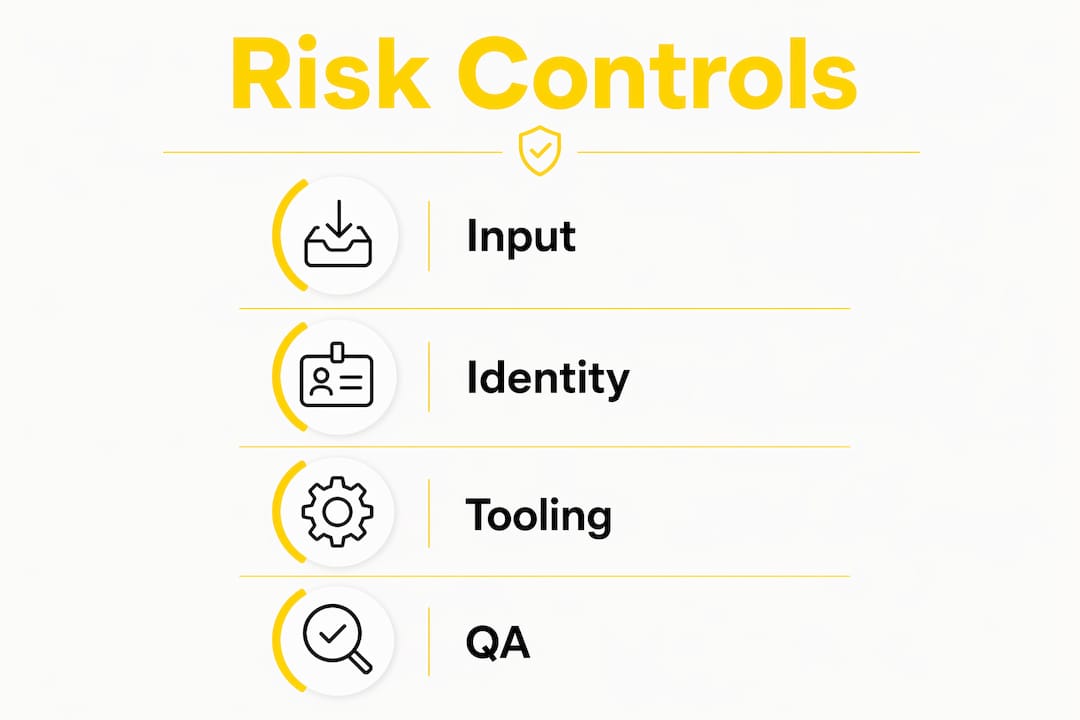
Effective mitigation requires controls at four layers: input, identity, tooling, and QA. No single control is sufficient. Compliance officers should evaluate vendor NMT integrations against all four layers before approving use on regulated content.
Input validation and strict tool permission scopes are the foundational technical controls. Security teams successfully reduce misuse by limiting agent toolsets and validating all inputs before execution. In practice, this means rejecting inputs that contain instruction-like syntax, enforcing payload size limits, and logging every input for audit review.
The table below maps risk categories to specific controls and the regulatory frameworks that require them.
Risk category | Control | Relevant framework |
Prompt injection | Input isolation and payload validation | OWASP Top 10 for Agentic Applications 2026 |
Identity compromise | Ephemeral credentials, no hardcoded secrets | NIST AI Risk Management Framework |
Terminology error | Terminology governance via Term Bases (TB) | ISO 17100, ISO 18587 |
Privilege escalation | Minimum-scope tool permissions per task | ISO 27001 |
Translation QA failure | Human expert review before document release | MDR, ISO 13485 |
Beyond technical controls, the AI+HUMAN hybrid translation model addresses the governance gap that public NMT cannot close alone. Public NMT produces output without terminology enforcement, without subject-matter expert review, and without QA alignment to ISO 17100 or ISO 18587. A hybrid model that combines a proprietary LLM with certified human reviewers catches both security failures and translation errors before they reach regulated documentation.
Compliance officers assessing vendor options should apply these decision criteria:
Does the translation system enforce client-specific Term Bases and Translation Memories before generating output?
Is the infrastructure hosted on private, auditable servers rather than shared public cloud endpoints?
Does the QA process align to ISO 17100, ISO 18587, and sector-specific requirements such as MDR or ISO 13485?
Can the vendor produce audit logs for every translation transaction?
Public NMT tools, including broadly available SaaS translation engines, typically cannot satisfy all four criteria. Enterprise-grade or proprietary systems with explicit governance controls are required for regulated documentation.
What are the failure modes when public NMT risks go unaddressed?
Failure to properly secure NMT workflows leads to regulatory breaches, reputation damage, and financial penalties in life sciences and technology sectors. Data leakage incidents have caused audit failures and loss of certification in regulated companies. These are not theoretical outcomes. They are documented consequences of treating public NMT as a low-stakes tool.
The failure modes that compliance officers encounter most often in regulated industries include:
Regulatory audit failure. A translated submission containing terminology inconsistencies or mistranslated safety claims triggers a deficiency finding. The organization must re-translate, re-submit, and defend its translation process under scrutiny.
Loss of certification. ISO 13485 and MDR audits assess the entire quality management system, including translation processes for device labeling and instructions for use. A public NMT tool with no documented QA process is an audit liability.
Data breach via prompt injection. An attacker submits a crafted document to a public NMT endpoint. The agent, operating under its own authority, retrieves and exposes confidential clinical data from a connected repository.
Intellectual property leakage. Proprietary formulations, device specifications, or trial protocols submitted to a public NMT endpoint may be retained, logged, or used for model training by the service provider.
Operational disruption from poor translation quality. A mistranslated instruction for use delays a product launch in a new market. The cost of re-translation, regulatory re-submission, and delayed revenue exceeds any efficiency gain from using a free public tool.
These failures compound in tightly regulated sectors because each one triggers downstream consequences. A single data breach can initiate a regulatory investigation, a certification review, and a customer notification obligation simultaneously.
Key Takeaways
Public NMT poses documented, multi-layer security and compliance risks in regulated documentation environments, and no single control eliminates all exposure without a governed AI+HUMAN hybrid translation workflow.
Point | Details |
Public NMT is a full execution environment | Treating public NMT as a static form creates security blind spots including prompt injection and privilege escalation. |
Identity risk is the largest attack vector | 80% of identity breaches involve non-human identities such as service accounts and API keys used by public agents. |
Terminology errors carry regulatory liability | Inaccurate translations in product labeling or safety data sheets constitute regulatory violations, not quality defects. |
Four controls are required at minimum | Input validation, ephemeral credentials, tool scoping, and ISO-aligned QA must all be present for regulated content. |
AI+HUMAN hybrid translation closes the governance gap | Proprietary LLM output combined with certified human review satisfies audit, terminology, and QA requirements that public NMT cannot meet. |
Why compliance officers can no longer afford static assumptions about public NMT
I have reviewed translation vendor assessments for regulated organizations across life sciences and technology for years, and the same pattern appears repeatedly. Compliance teams approve a public NMT integration based on a vendor’s security questionnaire, then discover during an audit that the agent held write access to a document management system the questionnaire never mentioned. The questionnaire asked about user authentication. Nobody asked about the agent’s authority.
The 2026 security environment has made that oversight untenable. The OWASP Top 10 for Agentic Applications 2026 and the NIST AI Risk Management Framework both shift the burden of proof. You can no longer assume a public endpoint is safe because it lacks a login screen. You must evaluate what the agent can do, what it can access, and what happens when its inputs are manipulated.
The practical lesson I draw from recent audit findings is this: the risk profile of public NMT in regulated documentation is not primarily a translation quality problem. It is an access control and governance problem. Translation quality is the visible failure. The underlying failure is that the agent was never designed with its actual authority in mind.
Compliance officers who want to get ahead of this need to stop evaluating NMT tools as translation tools and start evaluating them as execution environments. Ask your vendors for runtime policy documentation, not just SOC 2 reports. Require audit logs for every translation transaction. And if a vendor cannot tell you exactly what non-human identities their agent holds and what those identities can access, that is your answer.
— Eric Brown
AD VERBUM’s approach to secure translation for regulated industries
Regulated documentation cannot tolerate the governance gaps that public NMT introduces. AD VERBUM’s AI+HUMAN hybrid translation model was built specifically for compliance-critical environments in life sciences, legal, defense, and technology sectors.
AD VERBUM’s workflow begins with ingesting client Translation Memories and Term Bases, then generates output through a proprietary LLM-based LangOps System hosted on private EU servers under ISO 27001 certification. Every translation is reviewed by a certified subject-matter expert before QA alignment to ISO 17100, ISO 18587, and sector-specific requirements including MDR and ISO 13485. The system supports 150+ languages, delivers output 3x to 5x faster than traditional workflows, and produces full audit trails. No public cloud endpoints. No shared infrastructure. No unreviewed output reaching regulated documentation.
FAQ
What is the risk of public NMT in regulated documentation?
The risk of public NMT in regulated documentation includes data leakage through prompt injection, compromised non-human identities, inaccurate terminology in safety-critical content, and privilege escalation via agent misuse. These risks directly threaten regulatory compliance and audit readiness.
How does prompt injection affect public NMT workflows?
Prompt injection attacks manipulate the inputs a public NMT agent receives, causing it to execute unauthorized actions using its own system authority. Many incidents are detected only after chained system accesses have already exposed sensitive data.
Why is public NMT insufficient for life sciences documentation?
Public NMT tools lack terminology governance, certified human review, and ISO-aligned QA processes. Inaccurate translations in product labeling, instructions for use, or safety data sheets constitute regulatory violations under MDR and ISO 13485 requirements.
What controls are required to secure a public NMT workflow?
Effective controls include input isolation and payload validation, ephemeral credentials for all non-human identities, minimum-scope tool permissions per task, and runtime policy enforcement aligned to OWASP Top 10 for Agentic Applications 2026 and the NIST AI Risk Management Framework.
When is AI+HUMAN hybrid translation required instead of public NMT?
AI+HUMAN hybrid translation is required when documentation is subject to regulatory audit, when terminology consistency must be enforced across submissions, when data sovereignty constraints prohibit public cloud processing, or when a certified human review step is mandated by ISO 17100, ISO 18587, MDR, or equivalent frameworks.
Recommended
