


NMT vs LLM Translation: Key Differences Explained

The difference between NMT and LLM translation defines which technology fits your localization workflow. Neural machine translation (NMT) is a specialized neural network architecture trained on bilingual parallel corpora, optimized for speed, deterministic output, and cost-efficient high-volume processing. Large language models (LLMs) are general-purpose models trained on vast multilingual datasets that handle document-level context, tone, and style. Both technologies serve distinct purposes. Choosing the wrong one for regulated or high-stakes content carries real compliance and quality risk. AD VERBUM’s AI+HUMAN hybrid translation approach uses a proprietary LLM-based system with certified subject-matter expert review to address exactly that risk.
What is the difference between NMT and LLM translation?
NMT and LLM translation differ in architecture, training data, output behavior, and operational cost. NMT models are purpose-built for translation. LLMs are general reasoning engines that perform translation as one of many tasks.
NMT operates on aligned bilingual sentence pairs. It maps source segments to target segments through a transformer encoder-decoder architecture. The output is deterministic and consistent: the same input always produces the same output. That property is critical in regulated documentation where terminology must not vary across a 500-page technical manual.
LLMs process entire documents in a single pass. They preserve narrative flow, brand voice, and tonal register across paragraphs. That capability comes from training on trillions of tokens spanning literature, legal text, scientific papers, and web content, not just parallel translation corpora. The trade-off is non-determinism: without strict prompt controls, the same input can yield different outputs on successive runs.

The difference between MT, NMT, and LLM also matters here. Legacy machine translation (MT) uses rule-based or statistical methods with literal, context-free output. NMT replaced MT as the public standard by introducing neural context modeling at the sentence level. LLMs extend that to the document level and beyond.
How does NMT work, and where does it excel?
NMT models are trained on millions of aligned sentence pairs. The encoder reads the source sentence and produces a vector representation. The decoder generates the target sentence token by token from that representation. Fine-tuning on in-domain data, such as medical device manuals or legal contracts, significantly improves accuracy for specialized content.
NMT’s core operational strengths are:
Speed. NMT processes segments in 50–200ms, making it viable for real-time applications and bulk pipelines.
Cost. API costs run approximately $10–$20 per million characters. That makes NMT the default choice for high-volume content at scale.
Determinism. Repeated inputs produce identical outputs. Terminology consistency across large document sets is guaranteed when the model is properly fine-tuned.
Low-resource language coverage. NMT remains the standard for language pairs with limited training data, where LLMs often underperform due to sparse multilingual representation.
Compliance fit. Regulated sectors including medical devices, legal, and defense favor NMT’s predictable output for audit trails and QA workflows.
NMT’s limitations are equally well-defined. It processes text segment by segment, so it cannot resolve pronoun references, maintain tonal consistency across chapters, or adapt formality to document context. A clinical trial protocol translated segment by segment may be terminologically accurate but read as disjointed to a regulatory reviewer.
Pro Tip: Fine-tune NMT models with client-specific Translation Memories ™ and Term Bases (TB) before deploying on regulated content. In-domain fine-tuning reduces post-editing effort and improves terminology consistency without requiring LLM-level infrastructure.
How do LLMs handle translation differently?
LLMs approach translation as a reasoning task, not a mapping task. They read the full document, infer intent, and generate output that preserves style, tone, and cross-paragraph coherence. That makes them superior for creative, marketing, and user-facing content where cultural adaptation and fluency matter more than literal accuracy.
The key capabilities that distinguish LLM-based translation are:
Document-level context. LLMs process entire documents, enabling consistent brand terminology, style, and tone throughout the text. NMT cannot do this natively.
Instruction following. LLMs accept explicit instructions in the prompt: “Use formal register,” “Preserve the Oxford comma,” “Apply the attached glossary.” NMT models are largely black-box by comparison.
Transcreation. For marketing copy, UI strings, and localized campaigns, LLMs adapt meaning and cultural reference rather than translating word for word.
Retrieval-Augmented Generation (RAG). LLM workflows can pull from external terminology databases at inference time, reducing hallucination risk on technical content.
The operational challenges are significant. LLMs take 1–5 seconds per paragraph and cost 5–20 times more than NMT APIs. That cost differential is manageable for a 10-page marketing brochure. It becomes a serious budget problem for a 50,000-word regulatory submission. Non-determinism also requires governance: without constrained prompts and human review, the same document can produce inconsistent terminology across runs.
Pro Tip: Build a structured system prompt that includes your Term Base, tone guidelines, and target audience profile before running any LLM translation job. Unstructured prompts are the single largest source of terminology drift in LLM workflows.
NMT vs LLM translation: performance, cost, and quality compared
The practical difference between NMT and LLM translation becomes clearest when you compare them across the metrics that matter in production workflows.
Metric | NMT | LLM-based translation |
Speed | 50–200ms per segment | 1–5 seconds per paragraph |
Cost | ~$10–$20 per million characters | 5–20x higher than NMT |
Context capacity | Sentence level | Document level |
Output consistency | Deterministic | Non-deterministic without prompt controls |
Best use case | Bulk, regulated, real-time | Creative, marketing, transcreation |
Hallucination risk | Low | Moderate to high without governance |
Compliance fit | High | High only with human-in-the-loop controls |
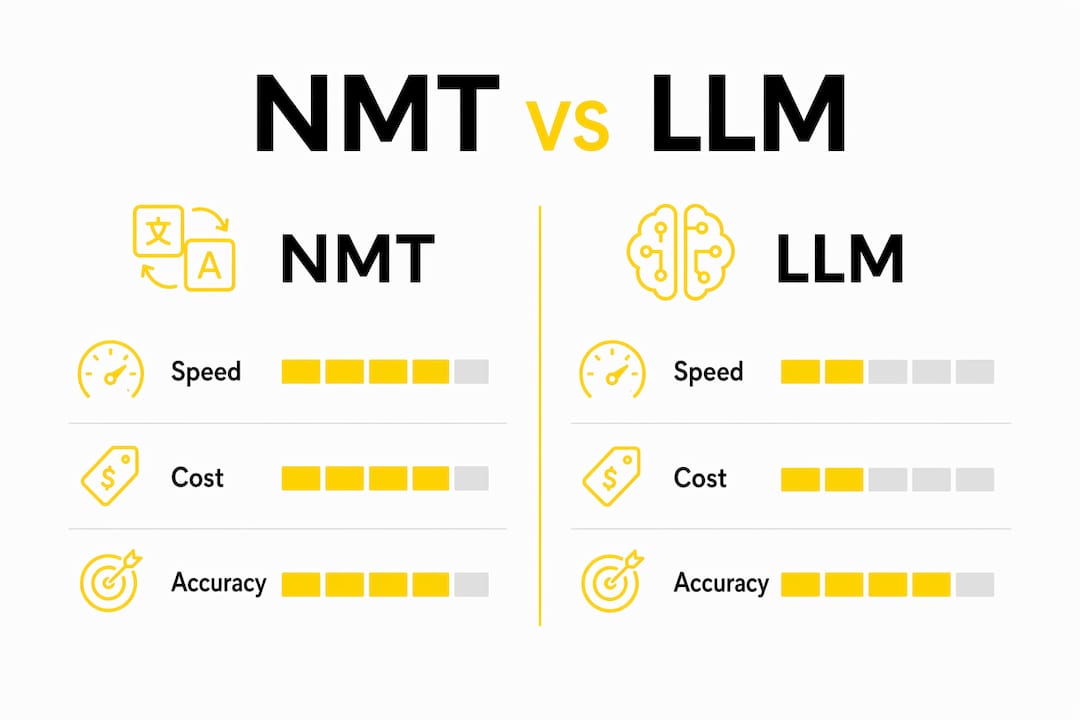
Organizations frequently underestimate the cost and latency impact of substituting LLMs directly for NMT in bulk or real-time scenarios. The result is performance bottlenecks and budget overruns that could have been avoided with a tiered workflow. NMT handles volume. LLMs handle nuance. The two are not interchangeable.
Quality assessment also differs by content type. NMT scores higher on technical accuracy metrics like BLEU for domain-specific text when fine-tuned correctly. LLMs score higher on human fluency evaluations for narrative and marketing content. Neither technology is universally superior. The right choice depends on content type, volume, regulatory context, and the governance controls in place.
How to integrate NMT and LLMs in a localization strategy
The most effective localization pipelines in 2026 use NMT and LLMs for different content tiers, not as competing alternatives. Post-editing in an LLM workflow focuses on document-level flow and consistency, not just segment corrections. That requires a different QA methodology than NMT workflows, where post-editing is segment-by-segment.
A practical decision framework for translation professionals:
Identify content type first. Regulatory submissions, technical manuals, and legal contracts favor NMT with fine-tuning and human review. Marketing copy, UI strings, and campaign localization favor LLM-based translation with structured prompts.
Assess volume and latency requirements. Real-time translation APIs and bulk document pipelines require NMT speed and cost profiles. High-value, low-volume content justifies LLM costs.
Map regulatory requirements. Content subject to ISO 13485, MDR, HIPAA, or GDPR requires deterministic output, audit trails, and certified reviewer sign-off. NMT with human-in-the-loop controls is the lower-risk path. LLMs require additional governance layers to meet the same standard.
Evaluate terminology governance needs. If your organization maintains a Term Base and Translation Memory, both technologies can consume them. NMT integrates TM natively. LLMs require RAG or prompt injection to enforce terminology at inference time.
Plan for human review regardless of engine. High-stakes content, whether translated by NMT or LLM, requires certified subject-matter expert review. Technology reduces effort. It does not eliminate the need for human accountability.
AD VERBUM’s AI+HUMAN hybrid translation workflow applies this logic directly. The process begins with asset integration, ingesting client TM and TB. The proprietary LLM-based LangOps System then generates output constrained by client terminology and style guidance. A certified subject-matter expert reviews for technical accuracy, regulatory compliance, and contextual nuance. QA is aligned to ISO 17100 and ISO 18587, with sector-specific requirements such as MDR applied where relevant. The result is regulated document translation that combines LLM contextual capability with the auditability that regulated industries require.
Pro Tip: Never deploy LLM translation for regulated content without a human-in-the-loop review step aligned to ISO 18587. The standard exists precisely because automated output, regardless of quality, requires human accountability for compliance purposes.
Common failure modes and how to control them
Translation technology failures follow predictable patterns. Knowing them in advance allows you to build controls before they become audit findings.
LLM hallucination on technical terms. LLMs occasionally generate plausible but incorrect translations for specialized terminology, particularly in medical, legal, and defense content. Mitigation: enforce Term Base via RAG or prompt injection, and require SME review on all technical passages.
NMT formality and register inconsistency. NMT models trained on general corpora may shift between formal and informal register within a document. Mitigation: fine-tune on in-domain data and apply post-editing guidelines that flag register shifts.
Terminology drift across LLM runs. Non-deterministic LLM output can produce different translations for the same term in different document sections. Mitigation: use constrained decoding parameters and enforce glossary compliance in the system prompt.
Cost overruns from LLM misapplication. Using LLMs for bulk content that NMT handles adequately multiplies costs without quality benefit. Mitigation: apply a content-tiering policy before selecting the translation engine.
Compliance gaps from missing audit trails. Regulated industries require documented evidence of who reviewed what and when. Mitigation: implement a translation compliance workflow that logs every review step, aligns to ISO 17100, and captures reviewer credentials.
AD VERBUM’s ISO 27001 certified, EU-hosted infrastructure addresses data sovereignty concerns that arise when using public cloud translation APIs for sensitive content. GDPR, HIPAA, and MDR alignment is built into the workflow, not added as an afterthought.
Key takeaways
NMT is the correct default for high-volume, regulated, and real-time translation; LLMs add value where document-level context, tone, and cultural nuance are the primary quality drivers.
Point | Details |
NMT is fast and deterministic | NMT processes segments in 50–200ms with consistent output, making it reliable for bulk and regulated content. |
LLMs excel at document-level context | LLMs preserve tone, style, and brand voice across an entire document, which NMT cannot do natively. |
Cost difference is significant | LLM translation costs 5–20x more than NMT; content tiering prevents unnecessary budget overruns. |
Human review is non-negotiable | ISO 18587 requires human accountability for machine-translated content in regulated industries, regardless of engine. |
Hybrid workflows outperform single-engine approaches | Combining NMT for volume and LLMs for nuance, with SME review, delivers the best quality-to-cost ratio. |
What I have learned from watching teams get this wrong
By Eric Brown
Translation teams that struggle most with NMT vs LLM decisions are not making technology errors. They are making scope errors. They pick one engine and apply it to everything, then wonder why quality is inconsistent or costs are out of control.
The teams that get it right treat NMT and LLMs as tools with specific jobs. NMT handles the volume. LLMs handle the judgment calls: the marketing headline that needs cultural resonance, the patient-facing label that needs plain language without losing clinical precision. The role of LLMs in compliance translation is real and growing, but it requires governance infrastructure that most organizations have not yet built.
The other mistake I see consistently is treating human review as a cost to minimize rather than a control to preserve. ISO 18587 exists because the industry recognized that no automated system, however capable, carries the accountability that a certified reviewer does. In regulated sectors, that accountability is the product. The translation is just the output.
My practical recommendation: map your content portfolio by volume, regulatory exposure, and quality sensitivity before you select any technology. That map will tell you where NMT is sufficient, where LLMs add genuine value, and where human expertise is the deciding factor. Technology choices made without that map tend to be expensive to reverse.
— Eric Brown
AD VERBUM’s AI+HUMAN hybrid translation for regulated localization
AD VERBUM’s localization services combine a proprietary LLM-based LangOps System with a network of 3,500+ certified subject-matter expert linguists across Life Sciences, Legal, Finance, Defense, and Manufacturing. The workflow integrates client TM and TB assets, applies LLM-based generation with terminology governance, and delivers SME-reviewed output aligned to ISO 17100, ISO 18587, and sector-specific standards including MDR and HIPAA. All processing runs on EU-hosted, ISO 27001 certified infrastructure with no reliance on public cloud tooling for core operations. For organizations that need translation technology guidance on where NMT ends and LLM-based translation begins, AD VERBUM’s 25+ years of regulated-sector experience provides a concrete starting point.
FAQ
What is the core difference between NMT and LLM translation?
NMT is a specialized neural network trained on bilingual sentence pairs that produces fast, deterministic, segment-level output. LLMs are general-purpose models that process full documents and generate contextually aware, fluent translations at higher cost and latency.
When should you use NMT instead of an LLM for translation?
NMT is the correct choice for high-volume, real-time, or regulated content where deterministic output, low cost, and audit-trail compatibility are required. Legal, medical, and technical documentation are primary NMT use cases.
What are the main LLM translation benefits over NMT?
LLMs provide document-level contextual awareness, superior fluency, and the ability to follow complex style and tone instructions. Those capabilities make LLMs the better fit for marketing, transcreation, and user-facing content.
How do you control hallucination risk in LLM translation?
Enforce terminology via RAG or structured system prompts that include your Term Base, and require certified SME review on all technical or regulated passages. Hallucination risk drops significantly when the model operates within constrained terminology parameters.
Does ISO 18587 apply to both NMT and LLM translation outputs?
ISO 18587 covers post-editing of machine translation output and applies to any MT system, including NMT and LLM-based engines. It requires a qualified human post-editor to review and accept responsibility for the final translation.
Recommended
