


Manage cross-border fund prospectus localization risk in EU

Asset managers distributing UCITS and AIF funds across EU member states face a prospectus localization challenge that combines regulatory precision with high commercial stakes. National competent authorities in each distribution jurisdiction review translated prospectuses for terminological accuracy and regulatory compliance, and a risk factor rendered with a different implication in a target language can trigger NCA queries, delay distribution approval, and create investor protection liability. For smaller asset managers and boutique fund houses without dedicated localization infrastructure, the prospectus translation process is a recurring regulatory risk event. This guide examines the prospectus sections most susceptible to translation risk, the NCA review patterns that identify terminology inconsistency, and how ISO-aligned translation workflows with financial SME review address the cross-border distribution standard.
Table of Contents
Understanding regulatory language risk in fund prospectus localization
Preparing for local regulatory requirements and language adaptations
Executing cross-border fund prospectus localization and translation workflows
Verifying compliance and managing ongoing localization risks
Enhance prospectus localization with expert multilingual solutions
Key Takeaways
Point | Details |
Dual NCA notifications | Notify home and host NCAs for each jurisdiction and ensure the prospectus is translated and compliant before distribution. |
Localization complexity | Localization must align with each host jurisdiction language and regulatory expectations to avoid queries and delays. |
Terminology inconsistency | Inconsistent terminology, shifted regulatory implications, and gaps in investor protection create misinterpretation and approval delays. |
Translation governance with ESMA | Adopt ISO aligned translation workflows with financial SME review and monitor ESMA guidance to manage divergences across EU markets. |
Understanding regulatory language risk in fund prospectus localization
Cross-border fund marketing under UCITS and AIFMD mandates notifications to both home and host NCAs, including the prospectus document. This dual notification structure creates the first layer of language risk because each host jurisdiction applies its own review standards to the translated prospectus. Host jurisdictions impose language requirements for prospectuses and summaries in languages accepted locally or customary in international finance such as English, German, or French.
The regulatory language risk stems from national divergences in implementing directives despite EU harmonization efforts. Each member state exercises discretion in areas like marketing communications, investor eligibility criteria, fee disclosure formats, and consumer protection requirements. When you translate a prospectus risk factor from English into Italian, for example, the Italian NCA reviews whether the translated term carries the same regulatory implication as the source text. A mistranslation of “liquidity risk” that suggests a different severity level can trigger regulatory queries and delay approval.
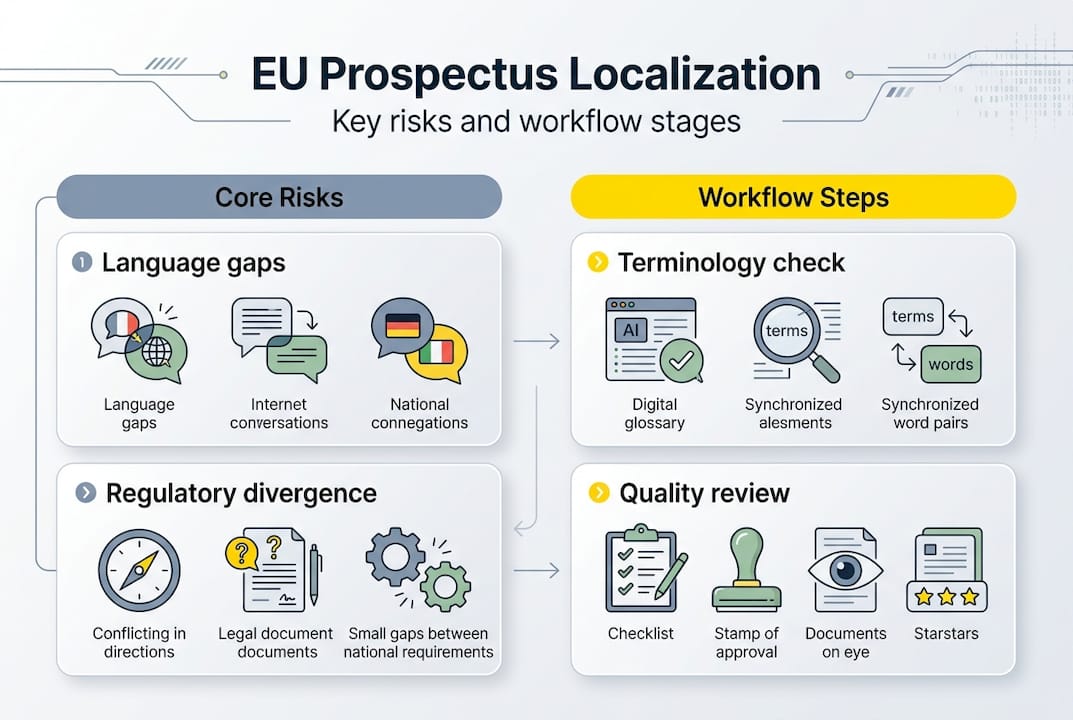
Three primary risk categories emerge in prospectus localization:
Terminology inconsistency: Using different terms for the same concept across prospectus sections or between the prospectus and marketing materials
Regulatory implication drift: Translated text that changes the legal or regulatory weight of a disclosure statement
Investor protection gaps: Localized content that fails to meet host jurisdiction consumer protection standards
“Managing regulatory language risk requires understanding that prospectus translation is not a linguistic exercise but a regulatory compliance activity where every term choice has potential legal consequences.”
Understanding these foundational risks positions you to develop robust preparation strategies that account for jurisdiction-specific requirements. For broader context on maintaining terminology consistency for compliance, consider how terminology governance frameworks apply across regulatory documents. Additional guidance on cross-border fund distribution rules provides regulatory context for notification procedures.
Preparing for local regulatory requirements and language adaptations
Effective preparation begins with comprehensive research into each host jurisdiction’s specific requirements. Localization adapts prospectuses to comply with host rules on marketing, investor eligibility, fees, and consumer protection despite EU harmonization. You need to document not just language requirements but also content adaptations mandated by local regulations.

Start by identifying the specific language requirements for each target jurisdiction. Some NCAs accept English for professional investor funds but require local language translations for retail offerings. Others mandate local language summaries even when the full prospectus may be in English. Document these requirements in a jurisdiction matrix that your localization team can reference throughout the translation workflow.
Next, research content adaptation requirements beyond pure translation:
Marketing communication rules that affect how you describe fund performance or investment strategies
Investor eligibility criteria that may require separate share classes or modified prospectus sections
Fee disclosure formats that differ from your home jurisdiction standard
Consumer protection disclosures mandated by host regulators but not required in your base prospectus
Pro Tip: Create a jurisdiction-specific checklist for each target market that covers language requirements, content adaptations, approval timelines, and contact information for local legal counsel. Update this checklist quarterly as regulations evolve.
Edge cases require specific approvals like Ireland Central Bank authorization for retail AIF marketing, Poland’s ban on non-EU AIFs, and Portugal’s CMVM approval process. These special cases demand early identification because they affect your distribution timeline and may require prospectus modifications beyond standard localization.
Follow this preparation sequence:
Identify all target distribution jurisdictions and confirm notification requirements
Research and document language requirements for prospectus, summary, and supplements
Map content adaptation requirements including investor eligibility and fee disclosure rules
Identify jurisdictions requiring prior approval or special authorization
Establish contact with local legal counsel in jurisdictions with complex requirements
Develop jurisdiction-specific prospectus supplements addressing local rules
Create a master timeline coordinating translation, legal review, and notification deadlines
This structured preparation reduces last-minute surprises and positions your localization workflow for efficient execution. For additional guidance on ensuring compliant translations, explore quality assurance frameworks designed for regulated documents. Detailed fund localization steps provide operational context for notification procedures.
Executing cross-border fund prospectus localization and translation workflows
Execution demands a documented workflow that maintains regulatory compliance while meeting tight notification deadlines. Your translation workflow must ensure consistency with ESMA guidelines requiring marketing materials to be fair, clear, and not misleading. Although the prospectus is not marketing material, it must comply with host state rules on content and language for cross-border use.
Implement this step-by-step execution workflow:
Terminology extraction and validation: Extract all financial, legal, and regulatory terms from the source prospectus. Validate these terms against your existing translation memory and create a jurisdiction-specific term base that includes approved translations for each target language.
Initial translation with terminology enforcement: Translate the prospectus using translators with financial services expertise who work from the validated term base. Use translation memory tools to maintain consistency across prospectus sections and with previously translated materials.
Legal and regulatory review: Engage local legal counsel or compliance specialists in each target jurisdiction to review translated prospectuses for regulatory accuracy. This review focuses on whether translated risk disclosures, fee structures, and investor protections meet local regulatory standards.
Linguistic quality assurance: Conduct a separate linguistic review by native speakers with financial translation expertise to ensure clarity, readability, and appropriate register for the target audience.
Jurisdiction-specific supplement preparation: Develop supplements addressing local marketing rules, investor eligibility criteria, fee disclosures, and consumer protections not covered in the base prospectus. These supplements must integrate seamlessly with the translated prospectus.
Cross-reference verification: Verify that all cross-references, defined terms, and section references remain accurate after translation. A reference to “Section 4.2” in English must point to the correct section in the translated version.
Final compliance sign-off: Obtain sign-off from your compliance team and local legal counsel confirming the translated prospectus meets all host jurisdiction requirements.
Pro Tip: Build buffer time into your workflow for NCA queries. Even well-executed translations may trigger regulator questions about terminology choices or disclosure phrasing. Plan for a two-week query response window in your notification timeline.
The table below shows typical timeline allocations for each workflow stage:
Workflow Stage | Duration | Critical Dependencies |
Terminology extraction | 3-5 days | Finalized source prospectus |
Initial translation | 10-15 days | Validated term base, translator availability |
Legal review | 7-10 days | Local counsel engagement |
Linguistic QA | 5-7 days | Completed legal review |
Supplement preparation | 5-7 days | Jurisdiction research completion |
Cross-reference verification | 3-5 days | Finalized translation |
Final compliance sign-off | 3-5 days | All reviews completed |
Total workflow duration typically ranges from 36 to 54 days depending on language complexity and jurisdiction count. For additional context on regulated document translation workflow, explore quality assurance frameworks for compliance-critical content. Detailed ESMA guidelines on marketing materials provide regulatory context for consistency requirements.
Verifying compliance and managing ongoing localization risks
Verification extends beyond initial translation to encompass ongoing monitoring and risk management. Persistent national differences require tailored versions or supplements per jurisdiction despite EU harmonization efforts. Your verification strategy must address both initial compliance and ongoing regulatory evolution.
Implement compliance audits comparing prospectuses across jurisdictions to detect inconsistencies or outdated language. These audits should occur quarterly or whenever you update the base prospectus. Focus audit attention on these high-risk areas:
Risk factor descriptions and their translated equivalents across languages
Fee disclosure formats and calculation methodologies
Investor eligibility criteria and suitability statements
Performance presentation and benchmark comparisons
Regulatory disclosures mandated by host jurisdictions
Monitor ESMA updates and national regulator changes continuously for evolving requirements. Empirical data shows Luxembourg and Ireland lead notifications, with top inbound markets including Germany, Italy, France, and Spain. These high-volume jurisdictions often drive regulatory interpretation that affects localization requirements across the EU.
Use technology tools for terminology management and change tracking to streamline updates. Translation memory systems integrated with term bases allow you to propagate terminology updates across all language versions simultaneously. Version control systems track changes to prospectuses over time, making it easier to identify what needs retranslation when you update the base document.
Pro Tip: Establish a regulatory intelligence feed that monitors NCA announcements, ESMA consultations, and industry association alerts for each jurisdiction where you distribute funds. Assign responsibility for reviewing these updates weekly and flagging items that affect prospectus localization.
Common pitfalls to avoid include:
Incomplete translations that omit jurisdiction-specific disclosures
Terminology drift where translators use different terms in updates than in the original prospectus
Missing supplements for jurisdictions with special requirements
Failure to update translations when the base prospectus changes
Inconsistent formatting between language versions that confuses cross-references
The comparison table below contrasts localization approaches:
Approach | Strengths | Limitations | Best For |
In-house translation team | Direct control, institutional knowledge | Limited language coverage, capacity constraints | Large asset managers with high-volume needs |
General translation agency | Broad language coverage, scalable capacity | Limited financial services expertise, variable quality | Non-regulated marketing materials |
Specialized financial localization provider | Financial expertise, regulatory knowledge, quality assurance | Higher cost, longer lead times | Regulated prospectuses and compliance documents |
Machine translation with post-editing | Fast turnaround, cost-effective | High risk for regulated content, terminology inconsistency | Internal drafts only, never final prospectuses |
For regulated prospectuses, specialized financial localization providers offer the expertise and quality assurance needed to manage regulatory language risk effectively. Consider how terminology error avoidance applies to prospectus localization, where a single term mistranslation can trigger regulatory delays. Review the ESMA cross-border fund distribution report for regulatory context on notification patterns and compliance trends.
Enhance prospectus localization with expert multilingual solutions
Managing prospectus localization across multiple EU jurisdictions demands specialized expertise that combines financial services knowledge with regulatory translation precision. AD VERBUM’s proprietary AI+HUMAN hybrid translation workflow addresses the terminology governance and compliance verification requirements that prospectus localization demands. Our network of 3,500+ subject-matter expert linguists includes financial services specialists familiar with UCITS, AIFMD, and jurisdiction-specific regulatory frameworks.
Our ISO 17100 and ISO 18587 aligned quality assurance process ensures translated prospectuses maintain regulatory accuracy across all target languages. The LangOps System integrates your existing translation memories and term bases, then applies proprietary LLM-based translation constrained by your approved terminology. Every output receives certified subject-matter expert review for technical accuracy and regulatory compliance before final delivery. With EU-hosted infrastructure and ISO 27001 certification, we address the data sovereignty concerns inherent in handling sensitive fund documentation. Explore our professional localization services designed for cross-border regulatory compliance, our regulated sector translation services for financial documentation, and our multilingual SEO and LLMO solutions to optimize fund marketing across jurisdictions.
Frequently asked questions
What languages are accepted for fund prospectuses in different EU countries?
Host NCAs accept languages specified by local regulations or customary international finance languages such as English, German, or French. Prospectus summaries often require translation into local languages to meet disclosure obligations, even when the full prospectus may be submitted in English for professional investor funds.
How do national divergences impact cross-border fund localization?
National discretions result in differing marketing rules, investor eligibility criteria, fee disclosure formats, and consumer protection requirements. This leads to customized prospectus supplements or multiple prospectus versions per jurisdiction, with each requiring localization that addresses specific regulatory requirements beyond pure translation.
What are best practices for managing translations and regulatory language risks?
Use consistent terminology with legal and linguistic review by experts familiar with local rules in each target jurisdiction. Implement structured translation workflows that include terminology validation, subject-matter expert review, and compliance sign-off, and maintain continuous monitoring of ESMA guidelines and national regulator updates.
Are there upcoming EU regulatory changes expected to ease localization burdens?
Initiatives like AIFMD II and the Marketing Information Service Portal aim to harmonize rules gradually and streamline cross-border notifications. However, minimum harmonization allows national rules to persist in areas like marketing communications and investor protection, so jurisdiction-specific localization remains important for regulatory compliance.
How long does prospectus localization typically take for multiple jurisdictions?
Complete localization workflows typically require 36 to 54 days depending on language complexity, jurisdiction count, and regulatory review requirements. This includes terminology validation, translation, legal review, linguistic quality assurance, supplement preparation, and final compliance sign-off, with additional buffer time for potential NCA queries.
Recommended

