


Machine Translation vs AI+HUMAN—Securing Compliance

Meeting European compliance standards in pharmaceutical documentation can be daunting when language accuracy is non-negotiable and one mistranslation may lead to costly regulatory setbacks. Pharmaceutical Regulatory Affairs Managers require solutions that go beyond basic algorithms to achieve flawless documentation. AI+HUMAN translation workflows combine advanced large language models with seasoned human experts, delivering the context, security, and technical accuracy vital for submitting compliant documents across European markets.
Table of Contents
Key Takeaways
Point | Details |
AI+HUMAN Integration | The combination of AI technology and human expertise significantly enhances translation accuracy and contextual understanding. |
Regulatory Compliance | AI+HUMAN workflows are essential in regulated industries to ensure legal and technical precision in translations. |
Technological Evolution | The transition from traditional machine translation to LLM-based AI marks a major advancement in addressing complex linguistic challenges. |
Data Security Practices | Implementing rigorous data security and terminology enforcement is critical for maintaining integrity in translated documents. |
Machine Translation vs AI+HUMAN—Core Concepts
Translation technologies have dramatically evolved, shifting from traditional machine translation to more sophisticated AI+HUMAN workflows that prioritize accuracy and context. Augmented translation approaches represent a critical advancement in linguistic processing, moving beyond simple word-for-word substitution to intelligent, context-aware translation strategies.
Traditional machine translation relies on direct algorithmic conversion of text between languages, often producing literal but contextually inappropriate translations. In contrast, AI+HUMAN translation integrates advanced language models with human expertise, creating a synergistic approach that addresses nuanced linguistic challenges. Comparative translation studies consistently demonstrate that human oversight significantly improves translation quality, particularly in complex technical and regulatory documentation.
The key differences between machine translation and AI+HUMAN workflows include:
Contextual understanding
Cultural nuance preservation
Technical accuracy
Compliance with industry-specific terminology
Real-time adaptive learning
By combining artificial intelligence’s processing power with human translators’ cognitive abilities, AD VERBUM creates a translation ecosystem that surpasses traditional limitations. This approach ensures not just linguistic accuracy, but also maintains the critical subtleties required in high-stakes industries like pharmaceuticals, legal services, and technical documentation.
Pro Tip: When evaluating translation services, always request sample translations that demonstrate both AI efficiency and human refinement to assess true quality and contextual understanding.
Legacy MT, NMT, and LLM-Based AI—Key Differences
Machine translation technologies have undergone significant transformations, evolving from rudimentary rule-based systems to sophisticated large language model architectures. Each technological generation represents a quantum leap in linguistic processing capabilities, fundamentally changing how translations are conceived and executed across global industries.

Traditional machine translation (MT) methods can be categorized into three primary generations. Rule-based MT relied on extensive linguistic programming, manually creating translation rules between language pairs. Statistical Machine Translation (SMT) introduced probabilistic models that could learn translation patterns from large bilingual corpora. Neural Machine Translation (NMT) represented a breakthrough, utilizing deep learning neural networks to produce more contextually relevant translations. The latest iteration, Large Language Model (LLM) based AI, transcends previous limitations by generating translations with unprecedented contextual understanding and nuanced linguistic comprehension.
Key technological distinctions between these translation approaches include:
Linguistic rule complexity
Contextual interpretation capabilities
Computational resource requirements
Adaptability to domain-specific terminology
Real-time learning potential
The shift towards LLM-powered translation systems marks a revolutionary approach in linguistic technology. AD VERBUM’s proprietary AI translation ecosystem leverages these advanced models, integrating human expertise to create a translation workflow that combines machine efficiency with human cognitive refinement. This approach ensures not just accurate linguistic conversion, but meaningful communication that preserves cultural and technical nuances.
Here’s a comparison of translation technology generations and their business impact:
Translation Approach | Core Method | Business Impact |
Rule-Based MT | Manual linguistic rules | High labor cost, rigid outputs |
Statistical MT | Probabilistic data models | Moderate quality, dependent on dataset scope |
Neural MT | Deep learning neural networks | Improved context, scalable quality |
LLM-Based AI | Large language model inference | Superior nuance handling, real-time adaptation |
AI+HUMAN Hybrid | AI plus human oversight | Regulatory compliance, top accuracy |
Pro Tip: When evaluating translation technologies, assess their ability to handle contextual complexity and domain-specific terminology beyond mere word-for-word conversion.
Risks in Regulated Sector Translation Workflows
Translation workflows in highly regulated industries like pharmaceuticals, medical devices, and legal services face significant challenges that extend far beyond linguistic accuracy. Professional translator concerns highlight critical risks associated with uncontrolled machine translation approaches, emphasizing the potential for catastrophic compliance failures.
Regulated sectors demand absolute precision, where a single mistranslation can trigger substantial legal, safety, and financial consequences. Machine translation vulnerabilities expose organizations to multiple critical risks:
Data privacy breaches
Inconsistent technical terminology
Potential regulatory non-compliance
Loss of critical contextual nuances
Compromised intellectual property protection
The fundamental challenge lies in the inherent limitations of automated translation systems. Machine translation tools lack the sophisticated contextual understanding required in technical documentation, particularly in domains like clinical research, medical device instructions, and regulatory filings. AD VERBUM’s AI+HUMAN approach directly addresses these vulnerabilities by integrating human subject matter experts who can validate and refine machine-generated translations, ensuring absolute accuracy and compliance.
Summary of how AI+HUMAN translation minimizes risks in regulated industries:
Risk Type | Machine Translation Exposure | AI+HUMAN Solution |
Data Privacy Breach | High risk due to automation | Secure access plus human review |
Technical Inaccuracy | Literal errors common | Subject expert validation |
Regulatory Non-Compliance | Missed legal nuances | Human compliance checks |
IP Leakage | Poor asset protection | Encrypted, verified workflows |
Pro Tip: Implement a rigorous translation validation process that includes multiple human touchpoints to catch potential errors before final document submission.
Data Security and Terminology Enforcement Standards
In the complex landscape of global translation, maintaining robust data security and precise terminology enforcement represents a critical challenge for regulated industries. Global data protection strategies underscore the paramount importance of implementing comprehensive security protocols that safeguard sensitive information while ensuring absolute linguistic precision.
AD VERBUM’s proprietary AI+HUMAN workflow addresses these challenges through multiple strategic layers:
Proprietary EU-based secure cloud infrastructure
Strict access controls for sensitive documentation
Real-time terminology validation mechanisms
Multi-stage human verification processes
Comprehensive encryption of translation assets
Global risk management frameworks emphasize that effective terminology enforcement goes beyond simple translation. It requires a sophisticated approach that combines advanced technological capabilities with human expertise. AD VERBUM integrates specialized subject matter experts who can validate complex technical terminology, ensuring that each translated document maintains precise meaning, regulatory compliance, and domain-specific linguistic accuracy.
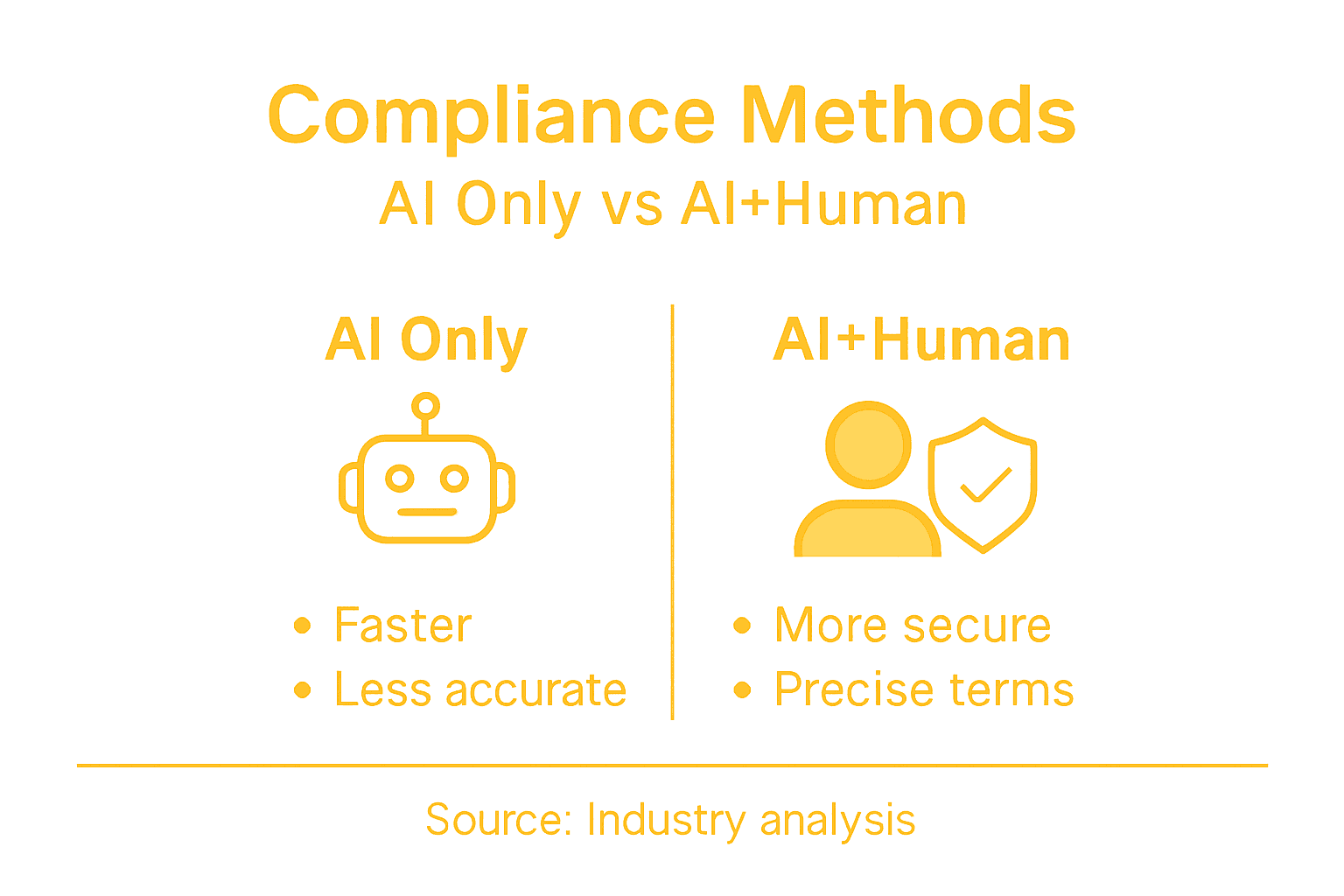
Pro Tip: Develop a centralized terminology management system that includes version tracking, expert validation, and continuous update mechanisms to maintain translation consistency across all organizational documents.
Why AI+HUMAN Is Essential for Compliance
Collaborative translation approaches have become critical for organizations navigating complex regulatory environments. Traditional machine translation falls short of meeting the intricate compliance requirements across industries like pharmaceuticals, legal services, and medical device manufacturing, where precision is not just important—it is mandatory.
The hybrid AI+HUMAN model addresses fundamental translation challenges through strategic integration:
High-speed processing capabilities of AI
Contextual understanding from human experts
Precise terminology enforcement
Cultural and regulatory nuance preservation
Real-time quality assurance mechanisms
Professional translator insights reveal that AI alone cannot guarantee regulatory compliance. Human intervention remains crucial for validating complex technical content, ensuring ethical standards, and maintaining accountability. AD VERBUM’s proprietary workflow combines advanced AI technologies with subject matter experts who understand the intricate linguistic and regulatory landscape, creating a translation process that goes beyond mere word conversion to deliver comprehensive, compliant documentation.
Pro Tip: Implement a rigorous validation protocol that includes multiple human touchpoints to catch potential compliance risks before final document submission.
Secure Compliance With AI+HUMAN Translation by AD VERBUM
The article highlights the critical challenges companies face when using traditional machine translation or public neural machine translation tools for regulated sector documents. Key pain points include risks of data privacy breaches, inconsistent terminology, and regulatory non-compliance that can lead to costly legal and safety consequences. The need for contextual understanding, strict terminology enforcement, and data security in highly regulated industries is vital. AD VERBUM’s proprietary AI+HUMAN workflow directly addresses these issues by combining a secure EU-based LLM platform with expert linguists specialized in Life Sciences, Legal, and Medical fields.
Unlike public MT or NMT solutions, AD VERBUM’s technology ensures zero data leakage, enforces precise terminology per client glossaries, and integrates multiple human reviews to deliver error-free, regulatory-compliant translations. This means your sensitive clinical, legal, or technical documents are handled with the highest standards of confidentiality and accuracy. Learn more about how our AI+HUMAN approach surpasses legacy translation methods by visiting our company overview and see why AD VERBUM is the safest choice for your compliance-critical projects.
Ready to eliminate translation risks and secure your regulatory compliance with true AI-powered precision and human expertise? Contact AD VERBUM now to discover how our specialized services can protect your sensitive data and ensure consistent terminology across your global documents. Don’t wait until a critical error costs your company time and money. Start the conversation today by reaching out through our dedicated contact page to get customized solutions tailored for your industry.
Frequently Asked Questions
What is the difference between machine translation and AI+HUMAN translation?
Machine translation relies on algorithms for direct text conversion, often at the cost of context and nuance. In contrast, AI+HUMAN translation combines AI efficiency with human expertise to ensure accuracy, cultural relevance, and compliance with industry-specific terminology.
Why is AI+HUMAN translation essential for regulated industries?
AI+HUMAN translation is crucial for regulated sectors like pharmaceuticals and legal services because it addresses complex compliance requirements. The hybrid model ensures not only accurate translations but also detailed validation by human experts, thus minimizing the risks associated with machine-only translations.
How does AD VERBUM ensure data security in translation workflows?
AD VERBUM employs a proprietary EU-based secure cloud infrastructure, strict access controls, and comprehensive encryption measures. These protocols protect sensitive data and ensure that all translations maintain linguistic precision and adherence to regulatory standards.
What role do human experts play in the AI+HUMAN translation process?
Human experts validate and refine machine-generated translations to ensure contextual understanding and technical accuracy. They play a critical role in preserving cultural nuances and enforcing precise terminology, which is vital for compliance in regulated industries.
Recommended

