


How to Ensure a Secure Translation Workflow

A secure translation workflow is a multi-layered system of technical, procedural, and contractual controls designed to protect sensitive data throughout the localization process. Knowing how to ensure a secure translation workflow is not optional for localization professionals and compliance officers in regulated industries. Every stage, from file transfer to post-delivery deletion, carries data exposure risk. Standards like ISO 27001, GDPR, and HIPAA define the minimum controls required. This guide covers the full framework: technology stack, policy requirements, step-by-step implementation, failure modes, and where AI+HUMAN hybrid translation fits into a compliant, audit-ready process.
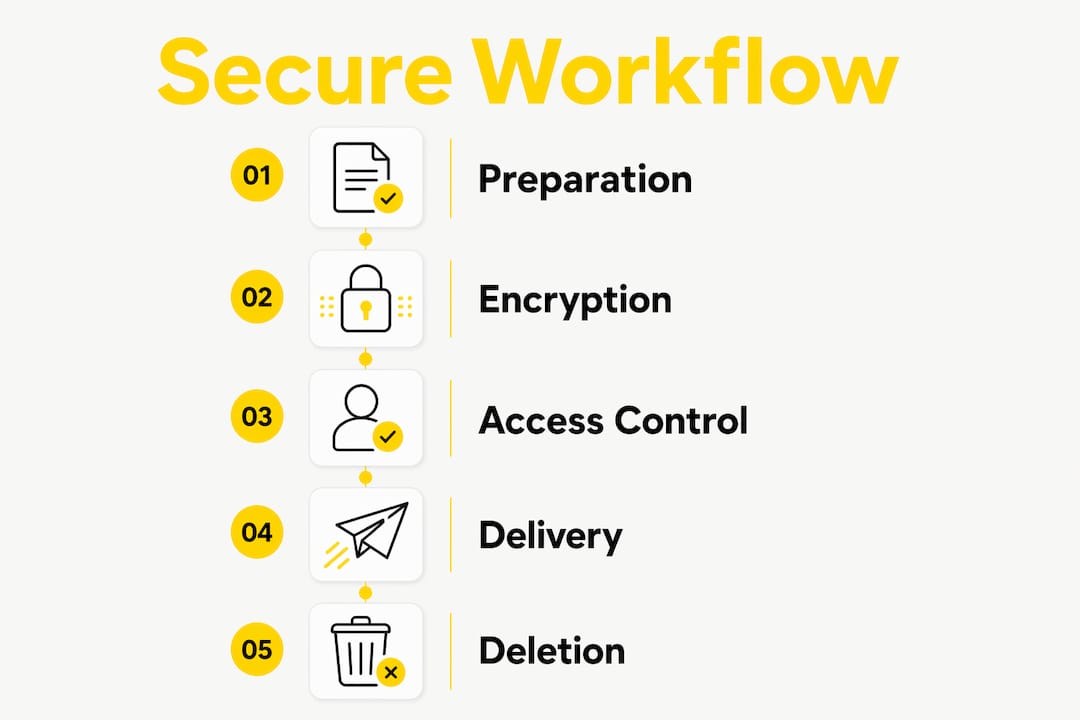
What foundational technologies support a secure translation workflow?
Secure document translation requires encryption in transit and at rest, access control, and audit logging as a baseline. These three controls are not optional enhancements. They are the minimum floor for any workflow handling personal data, legal content, or regulated documentation.
The core technology stack for a data-secure translation workflow includes:
Encrypted file transfer. Use SFTP or encrypted client portals. Plain email attachments are not acceptable for regulated content.
Endpoint authentication. Require multi-factor authentication for every user account. Hardware Passkeys or biometric 2FA are the current standard for linguists handling sensitive files.
Hybrid inference routing. A hybrid inference strategy directs sensitive data to on-premise systems and non-sensitive content to cloud-based LLMs. This approach meets data sovereignty requirements without sacrificing performance.
Storage controls. Use ephemeral storage for active processing and encrypted persistent storage for retained assets. Never store source files in unencrypted shared drives.
Audit trails. Log every file access, transfer, and modification. Logs must be tamper-resistant and retained long enough to support forensic review.
Control | Purpose | Minimum Standard |
Encryption in transit | Prevents interception during transfer | TLS 1.2 or higher, SFTP |
Encryption at rest | Protects stored files from unauthorized access | AES-256 |
Access control | Limits exposure per user role | Principle of Least Privilege |
Audit logging | Supports forensic review and compliance audits | Tamper-resistant, time-stamped logs |
Secure deletion | Removes data after retention period | Specialized wiping tools for SSDs |
Pro Tip: Never rely on a translation management system’s default settings for access control. Review and configure role permissions explicitly before onboarding any external linguist.
Which security policies and contractual frameworks ensure compliance?
Policies and contracts govern what technology alone cannot enforce. A secure translation process depends on clear legal agreements, defined access rules, and documented obligations for every party in the workflow.
The five policy pillars for a compliant workflow are:
Data Processing Agreements (DPAs). DPAs must clearly state processing purposes, data types, security measures, and obligations for all parties, including freelancers. A DPA without explicit security obligations is a compliance gap, not a safeguard. For more on structuring these agreements, the GDPR translation obligations for legal teams provide a practical reference.
Principle of Least Privilege. Access should be restricted to project-specific resources. Broad repository access is a direct security risk. If one account is compromised, least-privilege access limits the blast radius.
Retention and deletion policies. Define how long files are kept and who is responsible for deletion. Retention periods must align with GDPR and sector-specific rules.
Breach notification procedures. Document the steps for identifying, containing, and reporting a breach. GDPR requires notification to the relevant Data Protection Authority within 72 hours of discovery.
Training and confidentiality obligations. Every linguist and project manager must complete security training before accessing client data. Confidentiality agreements must be signed and renewed periodically.
Pro Tip: Treat freelance linguists the same as internal staff for DPA and training purposes. The vetting process for linguists in regulated contexts should include a documented security onboarding step, not just a signed NDA.
How do you implement and verify a secure translation workflow step by step?
A secure translation process follows a defined sequence. Each phase has specific controls that must be verified before moving to the next.
Phase 1: Pre-project setup
Execute DPAs with all vendors and freelancers before any file transfer.
Configure role-based access in the translation management system. Assign project-specific permissions only.
Verify that all endpoints meet authentication requirements (biometric 2FA or hardware Passkeys).
Document the data flow path from source file to delivery. Auditors require mapped data flow paths and operational evidence of controls, not just written policies.
Phase 2: Active project execution
Transfer source files only through encrypted portals or SFTP. Log every transfer with a timestamp and user ID.
Apply encryption at rest to all stored files immediately upon receipt.
Restrict linguist access to assigned project files. No access to other projects or client repositories.
Monitor audit logs in real time or on a defined review schedule.
Phase 3: Delivery and post-project deletion
Step | Action | Verification |
Delivery | Send translated files via encrypted portal with expiration links | Confirm receipt and log delivery timestamp |
Retention review | Apply retention policy (30–90 days post-delivery) | Document retention period in project record |
Secure deletion | Delete source and translated files using specialized tools | Automated deletion within 30–90 days is industry best practice |
SSD wiping | Use specialized wiping software for SSD storage | Standard deletion leaves recoverable fragments on SSDs |
Audit record | Archive logs, DPAs, and deletion confirmations | Retain for the period required by applicable regulation |

The 30–90 day retention window is the recognized industry standard. Retaining files beyond this window without a documented legal basis creates unnecessary compliance exposure.
What are the common failure modes in securing translation workflows?
Most security failures in localization workflows trace back to a small set of recurring gaps. Identifying them in advance is the most direct way to prevent a breach.
Weak authentication. Email-based 2FA is vulnerable for freelance linguists. Compromised email accounts bypass this control entirely. Biometric 2FA or hardware Passkeys close this gap.
Inadequate deletion. Standard file deletion on SSDs leaves recoverable fragments. Specialized wiping tools are required to irrecoverably delete sensitive translation memories and source files.
Privilege creep. Linguists accumulate access to projects beyond their current assignment over time. Without periodic access reviews, a single compromised account can expose a large volume of client data.
Incomplete audit logs. Logs that lack timestamps, user IDs, or file identifiers are not useful for forensic review. Auditors require operational evidence, not just policy documentation.
Missing or incomplete DPAs with freelancers. DPAs with explicit detail on processing and security obligations are a key compliance requirement that is frequently overlooked for independent contractors.
Audit readiness in localization is not achieved by having a security policy. It is achieved by maintaining records that prove the policy was followed: access logs, deletion confirmations, DPA signatures, and data flow maps that match actual practice.
The shared responsibility model clarifies that providers secure infrastructure while clients configure access and handle workflow safely. This means your organization carries direct accountability for access configuration, data routing decisions, and post-project deletion, regardless of which platform or provider you use.
How does AD VERBUM fit into regulated translation workflows?
AD VERBUM is built for the conditions that make secure translation workflows difficult: regulated content, audit requirements, terminology governance, and sensitive data constraints.
The AI+HUMAN hybrid translation workflow follows a defined four-step sequence. First, client Translation Memories ™ and Term Bases (TB) are ingested to enforce terminology from the start. Second, AD VERBUM’s proprietary LLM-based LangOps System generates target language output constrained by client terminology and style guidance. Third, a certified subject-matter expert reviews the output for technical accuracy, regulatory compliance, and contextual nuance. Fourth, QA is applied in alignment with ISO 17100 and ISO 18587, and where relevant, sector requirements such as MDR.
The infrastructure supporting this workflow is ISO 27001 certified and hosted on private EU servers. AD VERBUM does not rely on outsourced public cloud tooling for core processing. This posture directly addresses data sovereignty requirements under GDPR and supports HIPAA-aligned workflows for life sciences clients. The network of 3,500+ subject-matter expert linguists, including medical professionals, engineers, and legal scholars, means that SME review is not a checkbox. It is a domain-specific verification step.
For organizations in Life Sciences, Legal, Finance, Defense, or Manufacturing, the compliance best practices framework that AD VERBUM applies covers the full audit trail from asset ingestion to delivery.
Pro Tip: When evaluating any translation provider for regulated content, ask specifically for their data flow documentation and ISO 27001 certificate scope. A certificate that excludes translation processing infrastructure is not sufficient for GDPR or HIPAA compliance.
Key Takeaways
A secure translation workflow requires layered technical controls, enforceable contractual agreements, and documented operational evidence to satisfy audit requirements in regulated industries.
Point | Details |
Encryption is the baseline | Apply TLS in transit and AES-256 at rest for all source and translated files. |
DPAs cover freelancers too | Data Processing Agreements must include explicit security obligations for every linguist, not just vendors. |
Least Privilege limits breach scope | Restrict each linguist’s access to their assigned project only; review permissions after every project. |
SSD deletion requires specialized tools | Standard file deletion leaves recoverable fragments; use dedicated wiping software for all SSD storage. |
Audit readiness needs operational evidence | Maintain data flow maps, access logs, and deletion confirmations, not just written security policies. |
The compliance gap most localization teams still ignore
The security controls in this guide are well-documented. ISO 27001, GDPR, and HIPAA all point in the same direction. What I find consistently underestimated is the gap between having a policy and being able to prove it was followed.
Compliance officers in regulated industries spend significant effort drafting security policies for translation workflows. The policies are thorough. The DPAs are signed. The access control matrix looks correct on paper. Then an auditor asks for the deletion confirmation log from a project completed eight months ago, and the record does not exist. That is the actual failure mode. Not a breach. A documentation gap that creates the same legal exposure as a breach.
The shared responsibility model compounds this problem. Organizations assume their translation platform handles security. The platform assumes the client configured it correctly. Neither party has mapped the full data flow or tested the deletion procedure end to end. I have seen this pattern in legal, pharmaceutical, and defense localization contexts. The fix is not more policy. It is a quarterly operational review: run a test deletion, pull the audit log, verify the data flow map matches current practice, and document the result.
The other underestimated risk is freelancer authentication. Most localization teams apply strong controls to their internal systems and then send files to freelancers via email with standard 2FA. That is the weakest link in the chain. Hardware Passkeys and biometric 2FA are not expensive to require. They are just inconvenient to enforce. Enforce them anyway.
— Eric Brown
AD VERBUM’s approach to secure localization for regulated industries
Regulated industries cannot afford a translation provider that treats security as a feature rather than a foundation.
AD VERBUM’s localization services are built on ISO 27001 certified infrastructure hosted on private EU servers, with no reliance on public cloud tooling for core processing. Every project runs through the AI+HUMAN hybrid translation workflow, combining proprietary LLM-based generation with certified subject-matter expert review and QA aligned to ISO 17100 and ISO 18587. The result is a documented, audit-ready process that covers data ingestion, terminology governance, SME verification, and secure delivery across 150+ languages. For organizations in Life Sciences, Legal, Finance, Defense, and Manufacturing, AD VERBUM provides the operational evidence that compliance audits require.
FAQ
What is a secure translation workflow?
A secure translation workflow is a system of technical, procedural, and contractual controls that protect sensitive data at every stage of the localization process, from file transfer through post-delivery deletion.
What security standards apply to translation workflows?
ISO 27001 governs information security management, GDPR applies to personal data processing in the EU, and HIPAA applies to health information in the US. ISO 17100 and ISO 18587 set quality standards for translation and post-editing processes.
How long should translated files be retained?
Industry best practice recommends automated deletion of source and translated files within 30–90 days after project delivery, unless a documented legal basis requires longer retention.
Why is the Principle of Least Privilege critical in translation workflows?
Restricting each linguist’s access to their assigned project limits the data exposed if one account is compromised. Broad repository access is a direct security risk in any multi-user localization environment.
What makes AI+HUMAN hybrid translation more secure than standard MT or NMT?
Legacy machine translation (MT) produces literal output with weak context handling, increasing error risk in regulated text. Standard neural machine translation (NMT) engines often lack terminology governance and data sovereignty controls. AD VERBUM’s AI+HUMAN hybrid translation runs on private EU-hosted infrastructure with ISO 27001 certification, SME review, and QA aligned to ISO 17100 and ISO 18587, making it the appropriate choice for regulated documentation.
Recommended
