


EU MDR EUDAMED 2026: Digital Compliance Essentials
- Feb 2
- 8 min read

Every Regulatory Affairs Manager in a European medical device company knows that May 2026 will bring a turning point for compliance. With EUDAMED’s mandatory digital enforcement, centralized device tracking and instant regulatory oversight become the new standard across the European Union and European Economic Area. Complex multilingual requirements and strict module integration raise the stakes. This guide sheds light on the major compliance shifts ahead and what it takes to deliver accurate, country-ready documentation in every official language.
Table of Contents
Key Takeaways
Point | Details |
EUDAMED Implementation | Starting May 28, 2026, all economic operators in Europe must adopt the EUDAMED system for compliance, necessitating full digital registration and usage of four mandatory modules. |
Translation Compliance | Manufacturers must ensure precise translation of safety and performance documents across various device classifications, treating translation as a critical compliance artifact. |
e-IFU Requirements | The introduction of electronic Instructions for Use (e-IFU) necessitates a robust digital infrastructure that complies with accessibility and usability standards while maintaining paper documentation options. |
AI Translation Solutions | Manufacturers should carefully evaluate AI translation solutions based on regulatory compliance, terminology governance, and security measures to ensure accurate and contextually relevant translations. |
EUDAMED 2026 digital enforcement explained
Starting May 28, 2026, the European medical device landscape transforms with mandatory digital enforcement through EUDAMED’s centralized system. This critical IT platform represents a comprehensive digital infrastructure designed to enhance regulatory oversight across European medical device markets.
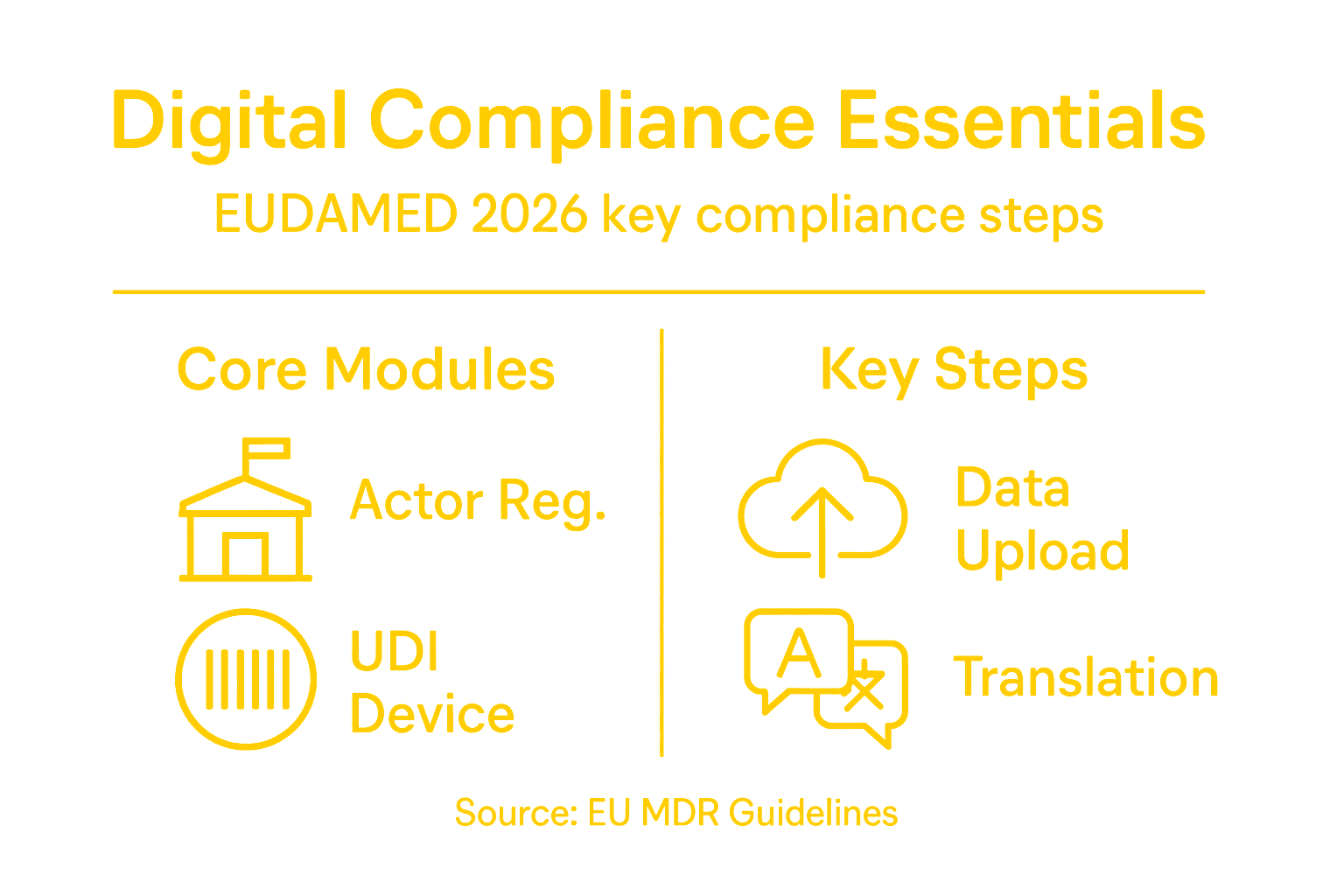
The EUDAMED system introduces four mandatory modules that manufacturers and economic operators must integrate into their compliance workflows:
Actor Registration: Comprehensive digital tracking of all medical device industry participants
UDI/Device Registration: Unique Device Identification database for precise product tracking
Notified Bodies & Certificates: Centralized certification management
Market Surveillance: Real-time monitoring of device performance and safety incidents
These modules create an unprecedented level of transparency, enabling seamless regulatory monitoring across European Union and European Economic Area markets. Economic operators, including manufacturers, authorized representatives, and importers, must now digitally submit detailed device information, fundamentally changing traditional compliance approaches.
Key Compliance Requirements:
Full digital registration of all economic actors
Comprehensive device data submission
Mandatory use of all four EUDAMED modules
Continuous digital documentation maintenance
Immediate reporting of market surveillance events
The enforcement represents more than a technological upgrade - it’s a regulatory paradigm shift demanding sophisticated digital infrastructure and meticulous documentation practices from medical device manufacturers.
Here’s how the four EUDAMED mandatory modules shape medical device market oversight:
EUDAMED Module | Main Function | Compliance Impact | Stakeholder Benefit |
Actor Registration | Tracks all industry participants | Ensures accountability in device supply chain | Simplifies regulatory audits |
UDI/Device Registration | Assigns unique identifiers to devices | Enables precise product traceability | Reduces recall complexity |
Notified Bodies & Certificates | Manages certifications centrally | Streamlines approval processes | Increases transparency |
Market Surveillance | Monitors device safety in real time | Facilitates rapid response to incidents | Improves patient protection |
Pro Tip: Begin preparing your digital compliance strategy at least 12 months before the May 2026 deadline, ensuring seamless integration of all required EUDAMED modules.
SSCP and SSP translation requirements
The EU Medical Device Regulation (MDR) mandates precise translation requirements for the Summary of Safety and Clinical Performance (SSCP) and Summary of Performance (SSP) documents across European markets. Language requirements for medical devices create complex compliance challenges for manufacturers seeking pan-European device registration.
Key translation requirements vary significantly across device classifications:
Implantable Devices: Mandatory translations in official languages of target markets
Class III Devices: Comprehensive linguistic validation required
Professional Use Devices: More flexibility in language selection
Patient-Facing Devices: Strict local language requirements
Translation obligations extend beyond mere linguistic conversion. Manufacturers must ensure:
Accurate medical terminology preservation
Contextual meaning maintenance
Technical precision across language variants
Compliance with local regulatory interpretations
Accessibility for both professional and patient users
Linguistic Complexity Factors:
Regulatory variations between Member States
Technical complexity of medical documentation
User-specific comprehension requirements
Risk classification of medical devices
Manufacturers must treat translations as critical compliance artifacts, not just language conversions.
The regulatory landscape demands more than literal translation - it requires nuanced linguistic engineering that preserves clinical meaning while meeting local regulatory standards.

Pro Tip: Initiate translation planning at least 18 months before device registration, leveraging subject matter experts who understand both medical terminology and regulatory frameworks.
Navigating multilingual and regulatory demands
The European medical device regulatory landscape demands sophisticated multilingual compliance strategies that extend far beyond simple translation. Manufacturers must develop nuanced approaches to meet the complex linguistic requirements across different Member States, each with unique regulatory interpretations.
Key regulatory language considerations include:
Documentation Scope: Covers labels, instructions, safety notices, and clinical performance documents
Language Variability: Requirements differ by device classification and end-user type
Geographical Complexity: Distinct rules for each EU and EEA member state
User Accessibility: Balancing technical precision with comprehensibility
Manufacturers must implement comprehensive linguistic validation strategies that address multiple dimensions of regulatory compliance:
Assess country-specific language requirements
Develop precise translation protocols
Maintain version control for multilingual documentation
Validate linguistic accuracy with subject matter experts
Ensure continuous compliance monitoring
Linguistic Compliance Challenges:
Terminology consistency across languages
Technical accuracy preservation
Cultural and contextual nuance adaptation
Regulatory interpretation alignment
Effective multilingual compliance is not about translation, but about comprehensive regulatory communication.
The regulatory framework requires dynamic linguistic engineering that transforms translation from a bureaucratic task into a strategic compliance mechanism.
This table summarizes key challenges in multilingual compliance for medical device documentation:
Challenge Type | Example Scenario | Business Risk | Recommended Approach |
Terminology consistency | Varying medical terms by country | Misinterpretation, non-compliance | Centralized terminology management |
Cultural/contextual adaptation | Local usage differs from source | User misunderstanding | Local expert review |
Regulatory interpretation | Member States’ unique rules | Delayed approvals | Country-specific compliance checks |
Technical accuracy | Complex device instructions | Safety incidents, recalls | SME validation process |
Pro Tip: Develop a centralized terminology management system that captures device-specific linguistic requirements across all target markets, enabling consistent and compliant multilingual documentation.
e-IFU and ongoing MDR compliance
The latest EU regulatory framework introduces comprehensive electronic Instructions for Use (e-IFU) requirements that fundamentally transform medical device documentation strategies. Manufacturers must now navigate a complex digital compliance landscape that balances accessibility, safety, and regulatory precision.
Key e-IFU compliance elements include:
Professional User Focus: Primarily applicable to devices intended for professional healthcare settings
Risk Assessment Mandate: Mandatory comprehensive evaluation before e-IFU implementation
Accessibility Requirements: Ensuring digital documents meet stringent usability standards
Paper Version Provisions: Maintaining option for physical documentation
Manufacturers must implement rigorous protocols to ensure continuous e-IFU compliance:
Conduct detailed risk assessment for digital documentation
Develop secure, accessible digital hosting infrastructure
Create clear labeling indicating e-IFU availability
Establish mechanisms for paper documentation requests
Maintain version control and update tracking
Critical Compliance Considerations:
Website stability and continuous accessibility
Document version management
User authentication and access controls
Multilingual documentation requirements
Electronic Instructions for Use are not just a technological shift, but a comprehensive regulatory transformation.
The regulatory framework demands dynamic digital documentation strategies that seamlessly integrate technological innovation with stringent medical device safety protocols.
Pro Tip: Develop a comprehensive digital documentation governance framework that anticipates regulatory changes and maintains flexible, compliant e-IFU infrastructure.
Choosing the right AI translation solution
Medical device manufacturers require sophisticated AI translation solutions that extend beyond traditional language conversion, demanding precision, regulatory compliance, and contextual accuracy. AI translation technologies represent a critical compliance infrastructure for EU MDR documentation requirements.
Key evaluation criteria for AI translation solutions include:
Regulatory Compliance: ISO 17100 and ISO 18587 certification
Domain Expertise: Subject matter expert (SME) validation
Security Infrastructure: EU data sovereignty and GDPR alignment
Terminology Governance: Precise medical and technical vocabulary control
Manufacturers must assess AI translation solutions across multiple critical dimensions:
Verify translation quality assurance processes
Evaluate SME review mechanisms
Confirm data processing security protocols
Validate terminology consistency capabilities
Review compliance documentation workflows
Translation Solution Complexity Factors:
Technical accuracy preservation
Contextual nuance understanding
Regulatory document complexity
Multi-language support requirements
Effective AI translation is not about replacement, but augmentation of human expertise.
The ideal solution requires dynamic linguistic engineering that transforms translation from a mechanical task into a strategic compliance mechanism.
Pro Tip: Develop a comprehensive evaluation matrix that scores potential AI translation solutions against regulatory, technical, and quality benchmarks specific to medical device documentation.
Master EU MDR EUDAMED 2026 with Precise AI+Human Translation Solutions
Navigating the complexities of the EU MDR EUDAMED 2026 requirements demands more than traditional translation services. The urgent challenges of mandatory digital compliance, linguistic precision for SSCP and SSP documents, and multilingual regulatory variations require a partner who understands both the technical and regulatory nuances deeply. With AD VERBUM’s specialized AI translation ecosystem, you gain access to a proprietary EU-hosted LLM-based AI combined with 3,500+ subject-matter expert linguists ensuring every medical device document meets stringent MDR, GDPR, and ISO standards.
Hybrid AI+HUMAN workflow guarantees accuracy with SME refinement
Robust terminology governance that ensures consistency across languages
Fully GDPR and HIPAA compliant infrastructure with ISO 27001 security
Faster turnaround times up to 5 times quicker than traditional methods
Ensure your medical device documentation and digital compliance processes align perfectly with the EU’s challenging regulations through a trusted partner experienced in regulated and high-stakes sectors.
Ready to transform your MDR compliance strategy now to meet the May 2026 deadline? Discover how AD VERBUM’s precise AI translation solutions can simplify your linguistic and regulatory burdens.
Contact AD VERBUM today to start your compliance journey.
Explore our translation approach to see how AI+HUMAN hybrid workflows deliver unmatched regulatory precision.
Learn more about navigating multilingual compliance and get ahead with stringent terminology control.
Frequently Asked Questions
What is EUDAMED and why is it important for EU medical device compliance?
EUDAMED is the European Database on Medical Devices, serving as a centralized IT platform aimed at enhancing regulatory oversight. It is essential for compliance as it mandates digital registration and tracking of medical devices and their economic operators, ensuring transparency and safety in the market.
What are the four mandatory modules of EUDAMED that will be required by May 2026?
The four mandatory modules of EUDAMED are Actor Registration, UDI/Device Registration, Notified Bodies & Certificates, and Market Surveillance. Each module plays a critical role in compliance by tracking industry participants, enabling product traceability, managing certifications, and monitoring device safety in real-time.
How can manufacturers prepare for the EUDAMED compliance deadline?
Manufacturers should begin preparing their digital compliance strategy at least 12 months before the May 2026 deadline. This includes integrating EUDAMED modules into their compliance workflows, ensuring accurate data submission, and maintaining continuous documentation.
What are the translation requirements for medical device documentation under the EU Medical Device Regulation (MDR)?
The EU MDR mandates specific translation requirements for documents like the Summary of Safety and Clinical Performance (SSCP) and Summary of Performance (SSP). Key factors include language translations that must be accurate, contextually appropriate, and compliant with local regulatory interpretations based on device classifications.
Recommended
