


Cannibalization Risk in Multilingual SEO: 2026 Guide
- 5 hours ago
- 9 min read

Cannibalization risk in multilingual SEO is defined as the condition where multiple language or regional variants of a website compete for the same search queries, fragmenting authority signals and reducing ranking potential across all target markets. This is not a translation quality problem. It is a structural and semantic alignment failure. Index bloat and fragmented authority cause gradual, silent traffic erosion that most teams misattribute to algorithm updates. 42% of global sites implement hreflang only on the homepage and key category pages, leaving product-level pages unprotected and exposing entire language subdirectories to cannibalization. SEO professionals managing multilingual sites need a precise, layered response covering URL architecture, hreflang governance, semantic differentiation, and content quality.
How does cannibalization risk in multilingual SEO manifest?
Multilingual SEO cannibalization shows up as multiple pages from different locale variants ranking for the same keyword in the same market. The symptom looks like ranking instability. The cause is that search engines cannot determine which version to serve, so they split authority across pages that should never compete.
The most common technical patterns include:
Mixed URL architectures. Sites using a combination of subdirectories (/en-us/), subdomains (fr.example.com), and country-code top-level domains (example.de) send conflicting geo-signals. Search engines receive inconsistent structural cues and struggle to assign locale authority correctly.
Incomplete hreflang coverage. Missing return tags invalidate hreflang annotations entirely. When the French page does not reciprocate the English page’s hreflang declaration, search engines ignore the annotation and default to language detection, which frequently serves the wrong version.
Semantic duplication beyond literal translation. Two pages targeting the same user intent in English for the UK and Australian markets, with only minor phrasing differences, compete directly. Intent overlap is the real driver of cannibalization, not word-for-word duplication.
Index bloat from thin locale variants. Automated or incomplete translations produce weak pages that consume crawl budget without contributing authority. Search engines deprioritize the entire domain section.
Pro Tip: Run a cross-locale ranking report filtered by keyword and page URL. If two or more locale variants appear in the top 20 for the same query in the same country, you have confirmed cannibalization, not just suspected it.
English-language variants are the highest-risk group. Sites serving en-us, en-gb, and en-au audiences with near-identical content and no geo-specific intent differentiation routinely cannibalize each other. The fix requires more than hreflang. It requires distinct content strategies per market.
What structural and semantic failures increase cannibalization risk?
Multilingual SEO cannibalization is fundamentally a governance failure, not a translation failure. Teams that treat localization as a content export process, rather than a market-specific publishing discipline, create the conditions for cannibalization at scale.
The root causes follow a predictable pattern:
Unified URL architecture is absent. Sites that mix structural conventions across markets produce inconsistent crawl paths. Choose one architecture, subdirectory, subdomain, or ccTLD, and apply it consistently across all locales. Partial implementations create ambiguity that search engines resolve incorrectly.
Geo-signals are weak or contradictory. Hreflang tags, metadata language declarations, internal linking patterns, and structured data markup must all point to the same locale. A page with a German hreflang tag but English metadata and no localized schema markup sends conflicting signals. Search engines weight the aggregate, and a mixed aggregate produces unpredictable results.
Semantic cluster governance is missing. Cannibalization scales when content volume grows faster than intent differentiation. Each locale needs a keyword map that reflects regional search behavior, not a translated version of the source market’s keyword map. French Canadian searchers use different query patterns than French searchers in France, even for identical products.
Automated translation without localization. Auto-translate overlays and automated language detection create inconsistent signals and trigger algorithmic quality demotions. Locale-specific metadata at the CMS content-type level is the minimum control required to prevent publishing incomplete translations.
Missing localized URL slugs. Localized slugs and metadata are not optional. A French page with an English slug (/fr/digital-marketing-strategy/) fails to reinforce locale relevance and loses ranking potential to pages with fully localized paths.
Bidirectional hreflang errors. Every hreflang annotation requires a reciprocal tag on the referenced page. Unidirectional implementations are treated as invalid by search engines and provide no cannibalization protection.
Pro Tip: Audit hreflang implementation at the page level, not just the template level. CMS plugins frequently apply hreflang to templates correctly but fail on dynamically generated pages, leaving product and blog content unprotected.
How can SEO professionals mitigate cannibalization risk effectively?
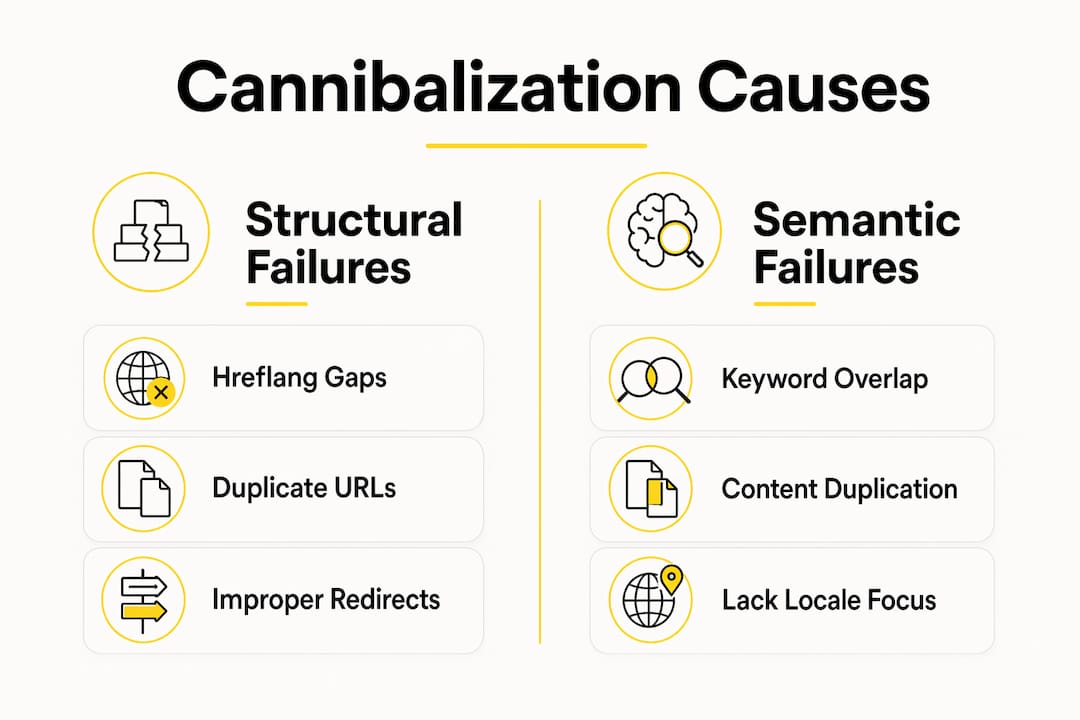
Fixing keyword overlap in multilingual sites requires a layered approach. No single tactic resolves the problem. The mitigation stack covers technical signals, content strategy, and ongoing monitoring.
Technical signal alignment
Implement hreflang with full bidirectional coverage across all indexable pages, including product, blog, and landing pages. Use x-default for language-selector or geolocation pages.
For JavaScript-heavy frontends built on frameworks like Next.js or Nuxt, move hreflang to XML sitemaps. Client-side rendering delays tag discovery, and sitemap-based delivery ensures consistent processing during crawl.
Localize metadata, URL slugs, and structured data per locale. Mixed-language schema markup is explicitly penalized. Every locale-specific page needs locale-specific signals at every layer.
Content strategy and semantic differentiation
Search engines prioritize content that directly answers specific queries with regional clarity. Translated content frequently fails this test because regional search behavior differs from the source market. A German page translated from English may answer the wrong question for German searchers entirely.

The correct approach is intent-based keyword mapping per locale, followed by native or highly controlled content creation. Each locale’s content cluster should target queries that reflect that market’s actual search behavior, not a translated version of another market’s keyword strategy.
Authority consolidation
Canonicalize overlapping content where locale differentiation is not commercially justified. A thin en-au page competing with en-us for the same query should either be differentiated or canonicalized to the primary variant.
Remove or noindex thin locale variants that consume crawl budget without contributing authority. Fixing cannibalization produces traffic improvements of 20–50% under typical conditions. Unified domain structures show 20–30% ranking improvements compared to fragmented multilingual setups.
Monitoring and iteration
Track traffic distribution by locale, rankings per locale for shared keyword sets, and indexing trends across language subdirectories. Cannibalization often reappears after content updates or CMS migrations. Monitoring is not a one-time audit. It is an ongoing control.
What are common failure modes and their impact on search performance?
The consequences of unresolved multilingual SEO cannibalization compound over time. What begins as ranking instability becomes sustained visibility loss across all target markets.
The most damaging failure modes include:
Wrong content served to wrong markets. Missing or malformed hreflang tags cause search engines to serve the incorrect locale variant. A French user receiving an English page generates a high bounce rate, low dwell time, and negative engagement signals that feed back into ranking decisions.
Domain authority fragmentation. Backlinks and engagement signals split across competing locale variants instead of concentrating on a single authoritative page. The result is that no single page accumulates enough authority to rank competitively.
Crawl budget waste. Index bloat from many weak language variants forces search engines to allocate crawl resources to low-value pages. High-value pages in the same domain section get crawled less frequently, slowing the indexing of new or updated content.
Algorithmic quality demotions. Automated translations without rigorous human review commonly trigger quality demotions affecting entire language subdirectories. The demotion applies to the subdirectory, not just the individual page, which means well-produced content in the same section gets penalized by association.
CMS and frontend pitfalls. Incomplete metadata fields, JS-rendered hreflang that search engines never process, and missing locale-specific content types are the most common CMS-level failure points. These are governance failures, not technical limitations.
International launch timing errors. Launching all locale variants simultaneously without staged indexing control creates ranking volatility. Search engines receive conflicting signals from multiple new pages targeting the same queries before any variant has established authority.
The commercial impact is direct. Mislocalized content produces poor user experience, which reduces conversion rates in target markets and undermines the business case for international expansion.
How does AD VERBUM’s AI+HUMAN hybrid translation address multilingual SEO cannibalization?
AD VERBUM’s AI+HUMAN hybrid translation workflow is designed to produce locale-specific content that supports semantic differentiation, not just linguistic conversion. The distinction matters for SEO. Multilingual content must be natively created or edited with contextual awareness because AI overview search now sources answers only from language-matched content pools. Pure translation is insufficient for visibility.
The AD VERBUM workflow follows a fixed sequence. First, client Translation Memories ™ and Term Bases (TB) are ingested to enforce terminology consistency across all locale variants. Second, the proprietary LLM-based LangOps System generates target language output constrained by client terminology and style guidance. Third, a certified subject-matter expert reviews for technical accuracy, regulatory compliance, and contextual nuance. Fourth, QA is applied in alignment with ISO 17100 and ISO 18587 standards.
This process produces content that carries consistent terminology signals across locales, which directly supports hreflang authority and reduces the semantic overlap that causes cannibalization. Localized metadata, slugs, and structured data can be integrated into the same workflow, ensuring that all SEO signals align at the point of content creation rather than as a post-publication fix.
AD VERBUM supports 150+ languages, including regional variants, which makes it a practical fit for multilingual sites managing jurisdiction-specific content requirements across markets with distinct regulatory or linguistic standards.
Pro Tip: Integrate terminology governance at the translation stage, not the review stage. When Term Bases are applied during generation, locale variants share consistent entity names and product terminology, which reduces the risk of near-duplicate content triggering cannibalization across language versions.
Key Takeaways
Multilingual SEO cannibalization is a structural and semantic governance failure that requires layered technical, content, and monitoring controls to resolve and prevent.
Point | Details |
Hreflang coverage gaps | 42% of global sites lack hreflang on product pages, leaving most content exposed to cannibalization. |
Bidirectional tags are required | Missing return tags invalidate hreflang annotations; search engines default to language detection and serve wrong versions. |
Intent mapping per locale | Translating keyword strategy from source market produces semantic overlap; each locale needs its own intent-based keyword map. |
Fixing cannibalization pays off | Traffic improvements of 20–50% are typical after resolving cannibalization; unified structures show 20–30% ranking gains. |
Automated translation carries risk | Auto-translate overlays trigger algorithmic quality demotions affecting entire language subdirectories, not just individual pages. |
The part most SEO teams get wrong about multilingual cannibalization
Most teams I have worked with diagnose multilingual cannibalization as a hreflang problem. They audit the tags, fix the missing return links, and wait for rankings to recover. Sometimes they do. More often, the underlying issue persists because the real problem was never the tags. It was the content strategy.
Hreflang tells search engines which page to serve to which audience. It does not tell search engines that the pages are meaningfully different. If your en-us and en-gb pages target the same intent with the same content structure and only minor phrasing variations, fixing hreflang concentrates authority on one variant but does not eliminate the competition. You have resolved the signal ambiguity without resolving the semantic overlap.
The teams that achieve durable results treat each locale as a distinct editorial market. They build keyword maps from regional search data, not from translated source-market maps. They assign content owners who understand regional user behavior, not just regional language. And they monitor intent drift over time, because search behavior in a market evolves, and a content strategy that was differentiated two years ago may have converged with another locale’s strategy by now.
The evolving role of AI in search adds another layer. AI-generated overviews pull from language-matched content pools. A page that lacks genuine regional relevance will not appear in those pools, regardless of how clean its hreflang implementation is. The bar for what counts as “locale-specific” is rising, and teams that treat localization as a translation task will find themselves increasingly invisible in AI-mediated search results.
The practical recommendation is to run a semantic cluster audit before a hreflang audit. Identify which locale variants are targeting overlapping intents, differentiate those intents at the content level, and then validate that your technical signals reflect the differentiation you have created. That sequence produces lasting results. The reverse sequence produces temporary ranking improvements followed by recurring cannibalization.
— Eric Brown
AD VERBUM’s approach to multilingual SEO and cannibalization prevention
Preventing keyword overlap across locale variants requires content that is genuinely differentiated at the semantic level, not just translated at the linguistic level. AD VERBUM’s multilingual SEO services address this directly through AI+HUMAN hybrid translation that enforces terminology governance, produces locale-specific metadata, and integrates subject-matter expert review at every stage.
AD VERBUM supports 150+ languages and regional variants, with QA aligned to ISO 17100 and ISO 18587. For organizations managing regulated content across multiple markets, the workflow also aligns with GDPR, HIPAA, and MDR requirements. Teams dealing with recurring cannibalization issues or preparing for international expansion can contact AD VERBUM to assess where structural and semantic gaps exist and how to close them before they affect rankings.
FAQ
What is cannibalization risk in multilingual SEO?
Cannibalization risk in multilingual SEO occurs when multiple language or regional variants of a site compete for the same search queries, splitting authority and reducing rankings across all affected locales. The root cause is structural and semantic misalignment, not translation error.
Why do hreflang errors cause multilingual cannibalization?
Missing reciprocal hreflang tags invalidate annotations entirely, causing search engines to default to language detection and serve incorrect locale variants. Every hreflang declaration requires a matching return tag on the referenced page to be valid.
How much traffic can fixing cannibalization recover?
Fixing cannibalization typically produces traffic improvements of 20–50%, with unified domain structures showing 20–30% ranking gains over fragmented multilingual setups. Extreme cases have reported gains exceeding 400%.
Is translating content enough to avoid keyword overlap?
Translation alone is insufficient. Search engines prioritize content that matches regional search behavior with direct, locale-specific answers. Translated content that mirrors source-market intent without regional adaptation competes with other locale variants rather than serving distinct audiences.
What is the safest hreflang delivery method for JavaScript-heavy sites?
Sitemap-based hreflang delivery is the most reliable method for React, Next.js, and Nuxt applications. Client-side rendering delays tag discovery, and XML sitemap placement ensures search engines process annotations during sitemap crawling, independent of page rendering.
Recommended