


Avoid EMA translation bottlenecks to speed biotech approvals

Only about one-third of EMA marketing authorization applications hit their planned submission dates, causing avoidable delays that cost biotech startups crucial weeks. Translation bottlenecks add months of lost time at the final hurdle. You’ll learn how to navigate EMA regulatory translation requirements, compare translation workflows, and implement practical solutions that accelerate your approval timeline while maintaining strict compliance.
Table of Contents
Key takeaways
Point | Details |
Only 35% of EMA submissions occur on time due to systemic delays | Poor submission timing and translation issues cause multi-month approval setbacks |
Translation errors and terminology inconsistencies cause multi-month hold-ups | QRD template non-compliance and version control failures trigger costly revalidation cycles |
AI+human hybrid workflows reduce translation turnaround by 3-5x | Proprietary LLM systems with SME review cut bottlenecks while ensuring regulatory accuracy |
EU-based ISO 27001 certified infrastructure ensures data sovereignty and GDPR compliance | Private EU-hosted translation platforms protect sensitive clinical data from exposure risks |
Strict adherence to QRD templates and terminology accelerates approvals | Enforcing EMA standards throughout translation workflows prevents agency queries and rework |
Understanding EMA submission timelines and their impact
Biotech startups face intense pressure to meet EMA submission windows, yet only 35% of Marketing Authorization Applications reach the agency on their initially planned date. This chronic unpredictability wreaks havoc on your market entry strategy. When submissions slip, the average clock-stop extension duration stretches to about 198 days, nearly matching the assessment period itself.
What causes these delays? EMA Workshop reports identified poor submission timing and frequent document updates as primary culprits affecting regulatory network workload. Approximately 42% of extended clock-stops stem from ongoing data and document revisions that could have been resolved before submission. Translation issues compound this problem when terminology inconsistencies or formatting errors surface during Day 120 reviews.
For biotech startups operating on tight cash runways, every week of delay burns investor capital and pushes back revenue milestones. Market exclusivity windows shrink. Competitors gain ground. You can’t afford to treat translation as a last-minute administrative checkbox. Understanding where EMA approval process efficiency breaks down helps you build resilience into your submission timeline before problems emerge.
“Submission delays critically impact biotech startups’ market entry timing, escalating regulatory workload and reducing approval predictability across the entire regulatory network.”
Translation bottlenecks in EMA submissions for biotech
Translation failures cluster around predictable pain points in EMA biotech submissions. Terminology inconsistencies across Module 1 regional documents cause delayed acceptances when reviewers spot conflicting medical terms in patient information leaflets versus summaries of product characteristics. Non-compliance with EMA QRD templates triggers formal observations that extend review cycles by months.
Version control failures create expensive revalidation nightmares. When your clinical study report gets updated during translation, but the amendment doesn’t propagate to all language versions, you face complete rework. Patient-facing content mistranslations lead to queries and resubmissions that could have been caught with proper SME review. These aren’t theoretical risks, they happen repeatedly to startups that underestimate translation complexity.
Common bottlenecks include:
Terminology databases not aligned across all 24 EU official languages required for centralized procedure
Formatting errors in QRD templates that don’t match EMA specifications
Missing or incorrect safety warnings in target language patient leaflets
Inconsistent dosing instructions across language versions
Poor synchronization between ongoing clinical data updates and translation workflows
Robust terminology governance prevents translation rework before it starts. When you enforce strict term base management and implement ensuring compliant translations protocols early, you eliminate the cascading delays that plague last-minute submissions. Don’t wait until Day 100 to discover your French patient leaflet contradicts the German version.

Pro Tip: Build a centralized terminology database before translation begins, involving both your regulatory affairs team and qualified medical translators to lock down critical safety terms across all target languages.
Regulatory translation requirements and standards for EMA biotech submissions
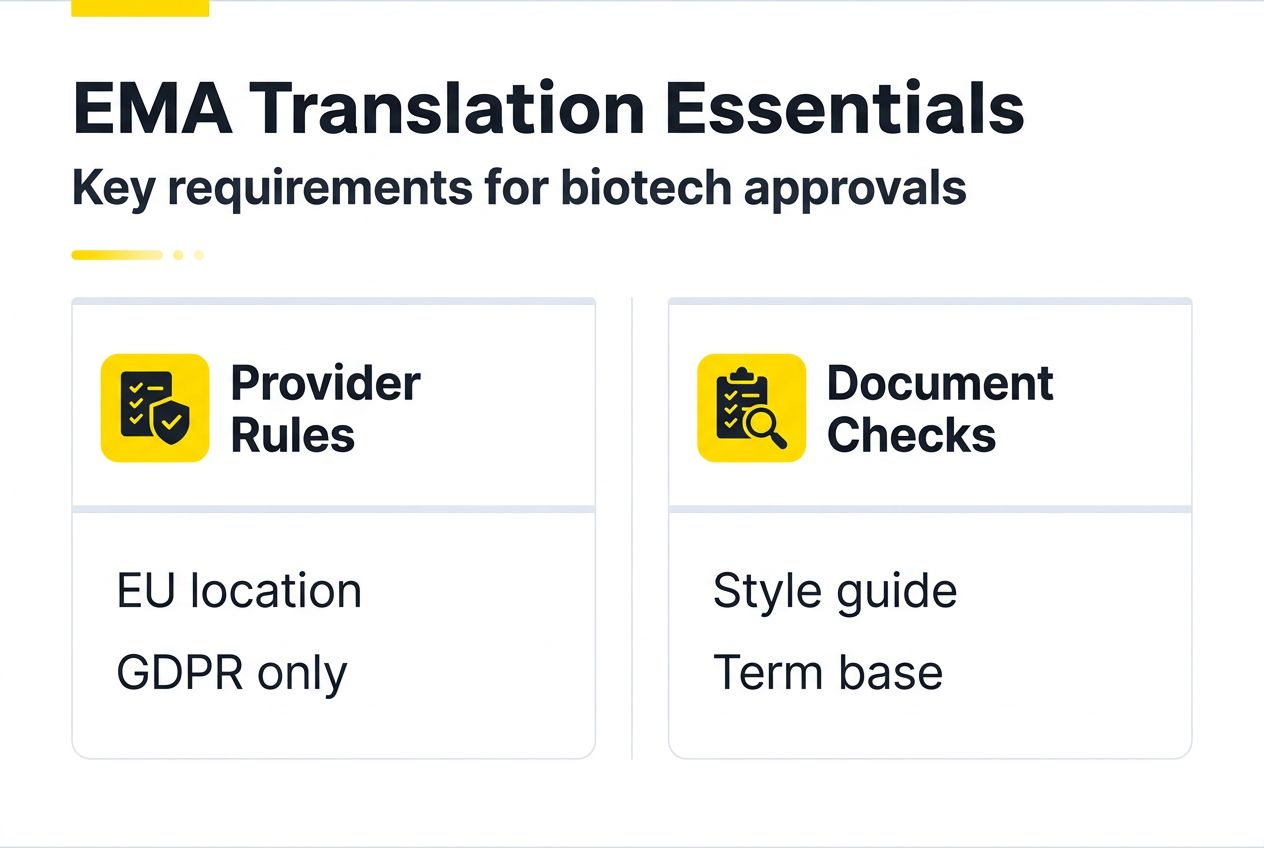
EMA mandates strict compliance with Quality Review of Documents (QRD) templates for all patient information leaflets and summaries of product characteristics across official EU languages. These templates enforce specific formatting, terminology, and stylistic conventions that your translation provider must follow exactly. Deviations trigger observations during the centralized procedure review.
You must meet these essential requirements:
Use approved QRD templates for all Module 1 regional administrative documents in each target language
Maintain terminology consistency via controlled term bases aligned to EMA vocabularies
Implement strict version control synchronization across all language variants during updates
Ensure data sovereignty and GDPR compliance through EU-based translation infrastructure
Obtain ISO 17100 and ISO 18587 certifications verifying translation quality management
Linguistic review processes verify that translated documents meet EMA style guides and terminology standards. This goes beyond simple accuracy checks. Reviewers validate that safety warnings maintain equivalent impact across languages, dosing instructions remain unambiguous, and contraindication statements preserve clinical precision. Regulatory language consistency directly affects acceptance timelines.
Data sovereignty requirements demand EU-based translation providers for biotech submissions. When your clinical trial data crosses borders to non-EU cloud services, you risk GDPR violations that regulatory audits will flag. Selecting translation partners with medical translation compliance requirements built into their infrastructure protects your submission from security-related delays and potential data breach liabilities.
Translation quality and workflows: MT vs NMT vs AI+human hybrid
Understanding translation technology options helps you choose the right approach for EMA submissions. Machine Translation (MT) produces literal output with weak context handling, making it unsuitable for safety-critical biotech documents where negation errors or dosing mistakes can have catastrophic consequences. Neural Machine Translation (NMT) improves fluency but struggles with terminology governance and domain-specific nuance required in regulatory contexts.
AI+human hybrid workflows combine proprietary large language models with subject-matter expert review to deliver both speed and accuracy. The AD VERBUM approach offers 3x to 5x faster turnaround compared to traditional translation processes while maintaining strict compliance with EMA standards. This matters when you’re racing toward a submission deadline.
Here’s how different methods compare for biotech regulatory documents:
Method | Terminology Control | Context Handling | Regulatory Compliance | Best Use Case |
MT (Machine Translation) | Weak | Literal, prone to errors | Not suitable | Internal draft reviews only |
NMT (Neural Machine Translation) | Variable | Improved but inconsistent | Requires heavy post-editing | General content, non-regulated |
AI+Human Hybrid (LLM+SME) | Strict enforcement | Document-level context | ISO-aligned QA built-in | EMA/FDA submissions, safety-critical documents |
The optimal AI+human hybrid workflow follows these steps:
Asset integration: Ingest client Translation Memories ™ and Term Bases (TB) to enforce terminology consistency from the start.
LLM generation: Proprietary AI system produces target language output constrained by your approved terminology and EMA style requirements.
Subject-matter expert review: Certified biotech linguists validate technical accuracy, regulatory compliance, and contextual nuance.
Quality assurance: Final QA aligned to ISO 17100, ISO 18587, and MDR sector requirements catches any remaining issues.
This approach eliminates the terminology drift and formatting errors that plague submissions using consumer-grade translation tools. You get speed without sacrificing the regulatory precision EMA reviewers demand. When choosing between translation methods, compare MT and AI+human approaches based on your specific document types and risk tolerance.
Pro Tip: Reserve pure MT for internal preliminary drafts only, never for documents that will face regulatory review, and always route patient-facing content through full AI+human hybrid workflows with medical SME validation.
Data sovereignty and security in EU translation workflows
Your clinical trial data contains sensitive patient information and proprietary compound details that must remain within EU jurisdiction. Using translation services that route documents through non-EU cloud infrastructure creates GDPR compliance gaps that regulatory audits will expose. 100% EU-hosted private cloud infrastructure ensures full data sovereignty by keeping all processing within European legal boundaries.
ISO 27001 certification verifies that your translation provider implements comprehensive security controls covering data encryption, access management, and incident response protocols. This isn’t optional for biotech submissions. EMA regulatory audits increasingly scrutinize how companies protect clinical data throughout the document lifecycle, including translation workflows. Public cloud tools used by general translation services lack the security posture required for MDR-regulated biotech documentation.
Critical security requirements include:
Private EU-hosted infrastructure with no reliance on third-party public cloud services for core translation processing
ISO 27001 certification demonstrating audited information security management systems
GDPR-compliant data handling procedures with documented processing agreements
Encrypted data transfer and storage protecting clinical trial information
Access controls restricting document exposure only to certified translators with security clearances
Secure workflows prevent exposure of sensitive clinical data to unauthorized parties or jurisdictions with weaker privacy protections. When you implement a comprehensive data security checklist covering translation vendor selection, you reduce the risk of data breaches that could derail your entire submission timeline.
“EMA regulatory compliance demands ISO 27001 certified private EU-hosted infrastructure for translation workflows to meet strict data sovereignty and GDPR requirements that protect patient privacy and proprietary clinical information.”
Practical steps for biotech startups to avoid translation delays
Implementing these actionable steps eliminates translation bottlenecks before they impact your EMA submission timeline. Start by integrating your Translation Memories and Term Bases into the translation workflow before any content processing begins. This upfront investment in terminology governance prevents the inconsistencies that trigger Day 120 questions.
Follow this sequence to optimize your translation process:
Audit existing terminology: Compile all approved medical terms, product names, and safety language into a controlled term base before engaging translation services.
Select EU-hosted, ISO-certified partners: Verify that your translation provider operates ISO 27001 certified infrastructure hosted entirely within the EU for data sovereignty.
Enforce QRD template compliance: Provide translators with the exact EMA QRD templates required for your target languages and mandate strict formatting adherence.
Implement version synchronization protocols: Establish clear procedures for propagating clinical data updates across all language versions simultaneously.
Schedule SME review checkpoints: Build time into your project plan for certified medical translators to validate technical accuracy and regulatory compliance.
Conduct pre-submission linguistic review: Run a final terminology consistency check across all language versions two weeks before your planned submission date.
Using SME-certified reviewers for technical and regulatory accuracy catches errors that generic linguists miss. A translator without biotech domain expertise won’t recognize when a pharmacokinetic term gets mistranslated in a way that changes clinical meaning. Monitor version synchronization strictly across all languages to avoid the expensive rework caused by unsynchronized updates.
Choosing the right translation partner makes the difference between smooth submissions and costly delays. Review the AI+human translation process tutorial to understand how advanced workflows integrate terminology governance with rapid turnaround times.
Pro Tip: Schedule translation kickoff meetings at least 8 weeks before your target submission date, giving your team buffer time to address terminology questions and implement reviewer feedback without compressing the critical path.
Common misconceptions about translation in EMA submissions
Biotech founders often hold false beliefs about translation that lead to costly submission delays. Clearing up these misconceptions helps you make informed decisions about your translation strategy.
Myth: Machine translation alone suffices for EMA submissions because modern AI is highly accurate.
Reality: MT and even advanced NMT lack the terminology governance and regulatory compliance verification required for patient safety documents. EMA reviewers will catch terminology inconsistencies and formatting errors that machine-only translation produces, triggering observations that extend your review timeline.
Myth: Terminology enforcement can be relaxed for administrative documents without impacting approval.
Reality: Module 1 regional administrative documents must maintain identical terminology to your clinical modules. Inconsistent terms between your clinical study report and patient information leaflet create confusion that generates Day 120 questions, regardless of whether the documents are labeled administrative or clinical.
Myth: Public cloud translation tools comply with GDPR requirements for biotech clinical data.
Reality: General-purpose cloud translation services route data through non-EU servers and lack the ISO 27001 security controls that EMA regulatory audits expect. Using these tools exposes you to data sovereignty violations and potential breaches of patient confidentiality that can halt your submission.
Key facts:
Human SME review remains essential despite AI translation advances to validate technical accuracy and regulatory compliance
Strict regulatory adherence throughout translation workflows actually accelerates the approval process by eliminating rework loops
Terminology consistency across all language versions is not optional, it’s a fundamental EMA requirement that directly affects acceptance timelines
Security certifications and EU-hosted infrastructure are compliance necessities, not premium features you can skip to save costs
Summary and strategic recommendations
Strict adherence to EMA language and template standards forms the foundation of successful biotech submissions. You’ve learned that only 35% of applications meet their planned submission dates, with translation bottlenecks contributing significantly to these delays. Implementing the right workflows and partner selection criteria eliminates this risk before it impacts your timeline.
Strategic recommendations for biotech startups:
Prioritize AI+human hybrid workflows that combine proprietary LLM systems with certified SME review to reduce rework cycles and speed turnaround times
Select EU-hosted, ISO 27001 certified translation services to mitigate data sovereignty risks and ensure GDPR compliance throughout the submission process
Integrate Translation Memories and Term Bases early to improve terminology consistency across all required EU languages
Enforce EMA QRD template compliance from the first translation draft to avoid formatting-related observations during regulatory review
Build translation timeline buffers of at least 8 weeks before planned submission dates to absorb unexpected revisions without compressing critical paths
Combining regulatory knowledge with advanced translation workflows avoids the costly delays that plague startups treating translation as an afterthought. When you implement robust terminology governance, secure data handling, and expert review processes, you transform translation from a submission bottleneck into a competitive advantage that accelerates your path to EMA approval.
Optimize your EMA submission translations with AD VERBUM
You now understand how translation bottlenecks delay biotech approvals and what standards you must meet. AD VERBUM’s specialized AI+human hybrid workflow cuts turnaround times by 3x to 5x while maintaining strict EMA compliance. Our 100% EU-hosted, ISO 27001 certified infrastructure ensures data sovereignty and GDPR compliance for your sensitive clinical data.
Our network of 3,500+ biotech domain experts includes medical professionals who validate terminology accuracy and regulatory compliance in your target languages. We integrate your Translation Memories and Term Bases first, then apply proprietary LLM-based translation constrained by your approved terminology, followed by certified SME review and ISO-aligned QA. Explore our multilingual SEO solutions, comprehensive localization services, and industry-specific translation capabilities to accelerate your submission timeline.
Frequently asked questions
Why is human review essential even with AI translations?
AI translation systems, even advanced LLM-based tools, lack the regulatory judgment and clinical context understanding that certified medical translators provide. Human SME reviewers catch subtle terminology errors, verify that safety warnings maintain equivalent impact across languages, and ensure compliance with EMA QRD template specifications that automated systems miss. This validation layer prevents the costly resubmissions caused by terminology inconsistencies or clinical inaccuracies that slip through machine-only workflows.
How does data sovereignty affect translation provider choice?
EMA regulatory audits increasingly scrutinize where your clinical trial data gets processed during translation. Using providers that route documents through non-EU cloud services creates GDPR compliance gaps and data sovereignty violations that can delay or halt your submission. EU-hosted infrastructure with ISO 27001 certification keeps your sensitive patient information within European legal boundaries, meeting the strict data protection requirements biotech submissions demand.
How do I maintain terminology consistency across EU languages?
Start by building a centralized term base containing all approved medical terms, product names, and safety language before translation begins. Integrate these Translation Memories and Term Bases into your translation workflow so they constrain AI output and guide human reviewers. Implement strict version control protocols ensuring that terminology updates propagate simultaneously across all language versions. Schedule cross-language terminology audits before final submission to catch any inconsistencies that could trigger EMA observations.
What are the risks of using public cloud translation tools for EMA data?
Public cloud translation services lack the security controls, data sovereignty guarantees, and regulatory compliance frameworks required for biotech clinical data. These tools route your documents through servers in multiple jurisdictions, potentially exposing patient information to unauthorized access or weaker privacy protections. They also fail to provide the audit trails, access controls, and ISO 27001 certified security management that EMA regulatory reviews expect, creating compliance gaps that can derail your submission timeline.
How do AI+human workflows accelerate submission timelines?
AI+human hybrid translation delivers 3x to 5x faster turnaround compared to traditional processes by combining the speed of proprietary LLM systems with the accuracy of certified SME review. The AI handles initial translation constrained by your terminology databases, then medical experts validate technical accuracy and regulatory compliance in parallel rather than sequential review cycles. This eliminates the multiple rework iterations caused by terminology errors or formatting mistakes, cutting weeks from your critical path while maintaining the quality standards EMA reviewers demand.
Recommended
