


Audit M&A document translations: pre-closing compliance guide
Updated: Apr 7

Accurate, consistent translations are essential to avoid regulatory delays and significant legal costs in cross-border M&A.
A structured pre-closing translation audit verifies language accuracy, terminology, and compliance across all deal documents.
Engaging certified legal linguists and maintaining thorough documentation ensures regulatory readiness and reduces error risks.
A single mistranslated condition precedent in a cross-border share purchase agreement (SPA) once forced a European acquirer to delay closing by six weeks while regulators demanded re-submitted filings in three jurisdictions. The financial cost ran into seven figures. Improper or imprecise translations are a leading factor in regulatory delays during M&A closings, and the risk compounds when deal teams treat translation as an afterthought rather than a compliance obligation. This guide walks you through a structured pre-closing translation audit, covering the SPA, shareholder agreement (SHA), regulatory filings, and condition precedent documents, so you can identify terminology drift, validate notarization chains, and close with confidence.
Table of Contents
Key Takeaways
Point | Details |
Audit requirements matter | Neglecting legal and quality standards in translation audits can cause delays or legal exposure in cross-border M&A deals. |
Preparation drives results | Organizing documents and roles before the audit minimizes errors and improves speed. |
Stepwise audits reduce risk | Following a sequenced process for translation review helps ensure accuracy and regulatory compliance. |
Proactive troubleshooting is critical | Being aware of common pitfalls allows legal teams to resolve issues before they affect deal closure. |
Understanding audit requirements for M&A translations
A translation quality audit, in the M&A context, is a systematic review confirming that every language version of a deal document carries the same legal meaning, uses consistent defined terms, and satisfies the regulatory requirements of each relevant jurisdiction. It is not a proofreading pass. It is a compliance verification exercise.
Translation compliance for regulated sectors is required by EU regulations for cross-border legal documents, and M&A transactions sit squarely within that obligation. The EU Merger Regulation, national competition authority filings, and local notarization rules each impose language requirements that vary by member state. A German-language SPA submitted to the Bundeskartellamt must meet different formal standards than a Polish-language version filed with UOKiK.
Key requirements your audit must address include:
Regulatory filing accuracy: All filings submitted to competition authorities, financial regulators, or notaries must match the executed source originals in meaning, not just surface structure.
Terminology consistency: Defined terms in the SPA (such as “Completion,” “Material Adverse Change,” or “Locked Box”) must carry identical definitions across every language version.
Choice-of-law alignment: Governing law clauses must reflect the same jurisdiction in all versions. A discrepancy here can void dispute resolution provisions.
Notarization chain integrity: Where local law requires notarized translations, the notarization must reference the correct source document version and date.
The table below compares the two most relevant quality standards for legal translation audits:
Standard | Scope | Relevance to M&A |
ISO 17100 | Translation process and competence requirements | Governs translator qualifications and review steps |
Local legal requirements | Jurisdiction-specific rules for sworn or notarized translation | Mandatory for regulatory filings in many EU states |
Pro Tip: Maintain a documentary chain of custody for every translated file, recording who translated it, who reviewed it, which source version was used, and when each step occurred. This record protects you under regulatory scrutiny and in any post-closing dispute.
Translation accuracy in regulated content is not optional when cross-border legal standards are in play.
Pre-audit preparation: Setting up for success
Once you know what is required, preparation determines the quality and speed of your audit. Rushing into a review without a complete document inventory is the single most common reason audits stall or miss critical errors.
Start by building a full inventory of every document that requires translation review. For a typical cross-border M&A transaction, that list includes:
Document type | Language versions required | Notes |
Share purchase agreement (SPA) | All deal jurisdictions | Core document; highest risk |
Shareholder agreement (SHA) | All deal jurisdictions | Check defined terms against SPA |
Regulatory filings | Jurisdiction-specific | Competition authority, financial regulator |
Condition precedent documents | Varies | Board resolutions, consents, waivers |
Notarized translations | Jurisdiction-specific | Verify notarization date and source version |
Disclosure schedules | All deal jurisdictions | Often overlooked; high terminology risk |
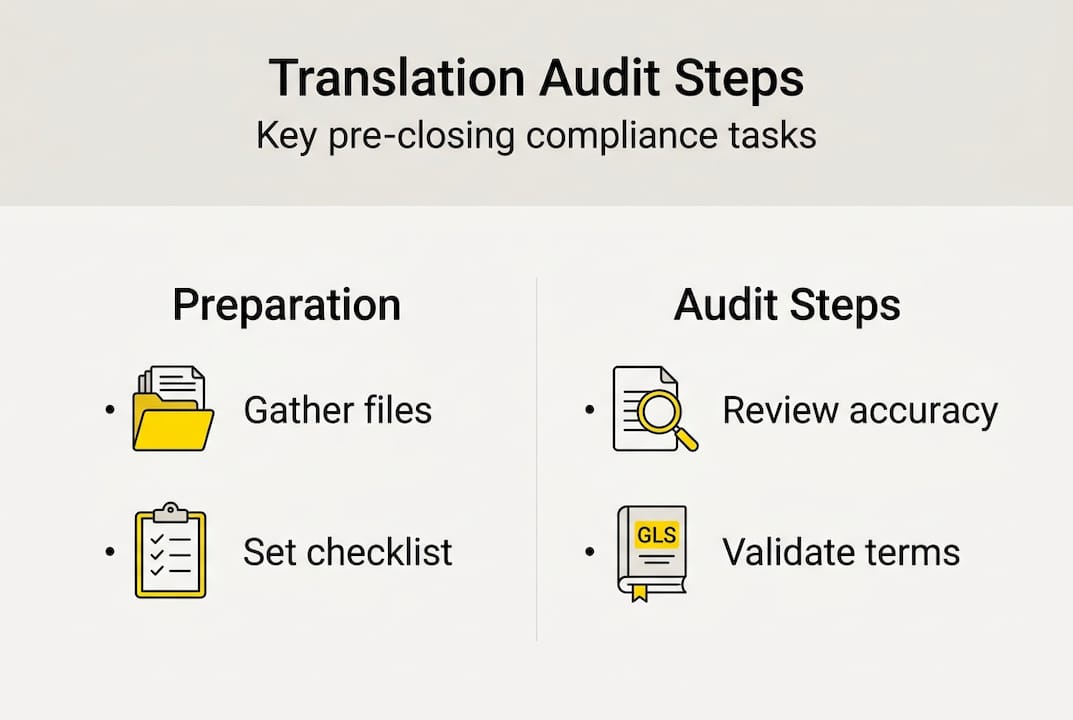
A translation audit checklist avoids missed materials and keeps the review on track when deal timelines compress. Assign clear roles before the audit begins. Your in-house legal team owns the substantive legal review. A certified legal linguist handles the linguistic and terminological review. Compliance or regulatory counsel signs off on jurisdiction-specific requirements.
Next, clarify transaction-specific terminology. Every deal generates its own defined terms, and those terms must be locked into a bilingual glossary before the audit starts. If your translation provider has not supplied one, request it immediately.
Pro Tip: Ask your translation provider to deliver a Term Base (TB) alongside every translated document set. A TB maps every defined term in the source to its approved target-language equivalent and prevents terminology drift across large, multi-document transactions.
Finally, assemble all reference materials: the executed source originals, prior drafts where definitions evolved, and any jurisdiction-specific legal glossaries. A regulated document translation workflow built around these inputs will move significantly faster than one assembled on the fly.

Step-by-step process: Conducting your translation quality audit
Now you’re ready to move from preparation to action. Here is exactly how to execute the audit under real deal pressure.
Pre-audit briefing. Convene your audit team, confirm document scope, assign sections by expertise, and set escalation thresholds. Define what triggers a retranslation request versus an in-line correction.
Segment-by-segment review of the SPA and SHA. Work through defined terms first, then representations and warranties, then closing conditions. Flag any instance where the target-language version introduces ambiguity not present in the source.
Choice-of-law clause cross-check. Verify that governing law and dispute resolution clauses are identical in legal effect across all language versions. This is where due diligence essentials often surface the most damaging discrepancies.
Regulatory filing compliance check. Compare each filed translation against the executed source. Confirm that defined terms, party names, and numerical figures match exactly. Check notarization references for accuracy.
Condition precedent document review. Board resolutions, regulatory consents, and waivers must reflect the same conditions in every language. A missing negation or a shifted tense can change the legal effect entirely.
Approval log and sign-off. Record every reviewed segment, every correction made, and every escalation decision. Quality steps for regulated sectors require documented approval at each stage.
Critical note: Last-minute translation errors discovered at the signing table are exponentially more expensive to fix than those caught during a structured pre-closing audit. Regulatory re-filings, notary re-appointments, and counterparty renegotiations can each add weeks and significant legal costs to a deal that was otherwise ready to close.
A systematic audit reduces error risk by 80%, making the investment in structured process straightforward to justify.
Pro Tip: Always validate the final translated document against the executed source original, not an intermediate draft. Version control failures are a leading cause of last-minute audit failures. Confirm file names, version numbers, and execution dates before sign-off.
For complex multi-jurisdiction deals, consider engaging best legal translation providers with certified legal SME review capacity from the outset.
Common pitfalls and troubleshooting in M&A translation audits
Even robust processes face real-world hurdles. Here’s how to spot and fix them before they derail the deal.
Up to 27% of M&A deals see translation issues cause closing delays. Most of those delays trace back to a small set of recurring failures.
The most common audit errors include:
Incomplete file sets: Disclosure schedules and condition precedent documents are routinely omitted from translation review scope. Both carry legal weight and must be audited.
Terminology drift across document versions: When the SPA and SHA were translated at different times or by different teams, defined terms often diverge. “Completion” in one document becomes “Closing” in another, creating interpretive risk.
Lack of native legal review: Linguistic fluency is not the same as legal expertise. A translator without M&A legal background may render a technically accurate sentence that carries the wrong legal meaning in the target jurisdiction.
Unverified notarization chains: Notarized translations that reference an outdated source version or an incorrect execution date will be rejected by regulators. This is a common and entirely avoidable delay.
Over-reliance on generic machine translation: Consumer-grade neural machine translation (NMT) tools cannot enforce terminology governance or handle the negation patterns and conditional structures that appear throughout SPAs. Do not use them for any deal-critical document.
Red flags that signal a need for re-audit include inconsistent party name formatting across documents, numerical figures that do not match the source, and any clause where the target-language version is shorter than the source by more than 15 percent without a clear structural reason.
For rapid troubleshooting, use a quality assurance checklist focused on defined terms, numerical accuracy, and clause completeness. If cross-border disputes arise post-closing, your audit trail is your first line of defense. A technical localization process built around terminology governance prevents most of these issues from arising in the first place.
Measuring success: Final validation and reporting
With common challenges addressed, you’re ready to document the success of your audit and close the compliance loop.
Validation criteria for a completed M&A translation audit cover three dimensions: accuracy (does the target text carry the same legal meaning as the source?), completeness (has every document in scope been reviewed and approved?), and compliance alignment (does each translated document satisfy the regulatory requirements of its target jurisdiction?).
Your final audit report should be structured and retained as a compliance record. Document the following in sequence:
Audit scope: every document reviewed, language pair, and version number.
Review methodology: who reviewed each document and in what capacity.
Findings log: every error identified, its severity classification, and the correction applied.
Approval record: sign-off by the responsible legal reviewer for each document.
Regulatory alignment confirmation: statement that each filing-bound translation meets applicable jurisdiction requirements.
The table below contrasts internal and external audit outcomes to help you decide the right model for your transaction:
Audit type | Strengths | Limitations |
Internal audit | Deal context familiarity, faster escalation | May lack linguistic or jurisdiction-specific expertise |
External audit | Certified SME review, ISO-aligned QA, independent verification | Requires briefing time and clear scope definition |
Proper audit documentation helps satisfy regulatory scrutiny and protects the deal in any post-closing challenge. Retain all audit records for the duration required by the governing law of the transaction, typically a minimum of five years in most EU jurisdictions. A regulated document workflow with built-in version control makes this retention straightforward.
A legal practitioner’s take: What most M&A audits get wrong
Having worked through the end-to-end process, one pattern stands out: most M&A translation audits fail not because of bad translations, but because of misplaced trust in the wrong parts of the process.
Legal teams often over-delegate to translation vendors without verifying that the vendor’s quality framework actually matches the deal’s risk profile. ISO 17100 certification matters, but only if the certified process was applied to your specific documents by a qualified legal linguist, not a generalist reviewer.
The second failure point is overlooking reference documents. Legal definitions that evolved across draft versions of the SPA sometimes appear in older form in the SHA or disclosure schedules because those documents were translated from an earlier draft. No automated tool catches this. Only a reviewer who has read the full document set in both languages will spot it.
Process shortcuts taken under time pressure, such as skipping the condition precedent document review or accepting a vendor’s self-certification without independent verification, are precisely the shortcuts that surface under regulatory scrutiny. Build a review protocol that treats every document as deal-critical, because under the right set of circumstances, every document is.
The practical fix is to establish workflows that ensure compliance as a standing internal protocol, not a last-minute checklist assembled per deal.
How AD VERBUM can support your M&A translation audit
For legal teams managing pre-closing translation audits under deal pressure, reliable expert support makes a measurable difference.
AD VERBUM brings 25 years of experience in high-stakes legal and regulated sector translation, with ISO 17100 and ISO 27001 certification, EU-hosted infrastructure, and a network of 3,500 certified legal linguists. Our AI+HUMAN hybrid workflow ingests your existing Term Bases and Translation Memories, generates output through a proprietary LLM-based LangOps System, and subjects every document to certified SME review aligned to ISO 17100 and ISO 18587. For M&A transactions where confidentiality is non-negotiable, our private EU-hosted infrastructure means your deal data never touches a public cloud environment. Explore our legal translation services and localization services, or contact our M&A translation team to discuss your transaction.
Frequently asked questions
What documents should be included in a cross-border M&A translation audit?
All deal-critical documents must be reviewed, including the SPA, SHA, regulatory filings, condition precedent documents, disclosure schedules, and notarized translations. A document inventory checklist ensures nothing is missed.
Who should lead the translation quality audit in an M&A transaction?
An experienced legal or compliance auditor with native proficiency in both source and target languages should lead the review, supported by certified legal linguists. Expert review is the single most important factor in achieving compliance.
How do you confirm if a translation audit meets EU legal standards?
Verify that the process aligns with ISO 17100, that jurisdiction-specific notarization and filing requirements are satisfied, and that full audit documentation is retained. Compliant translations for EU cross-border deals require all three elements.
Where can legal teams get help for complex cross-border M&A documentation translation?
Specialized legal translation providers with certified SME review, ISO-aligned QA, and EU data hosting, such as AD VERBUM, are the appropriate choice for deal-critical documentation where terminology governance and confidentiality are both required.
Recommended

