AI+Human Translation Process Tutorial for Compliance

Protecting translation assets has become a top priority for every American business relying on AI-driven solutions. With intellectual property at greater risk than ever, a single breach can expose proprietary databases and sensitive industry glossaries to the wrong hands. Up to 60 percent of organizations have experienced data leaks from unsecured language resources. If you want state-of-the-art translation outcomes, you need to master secure asset integration, leverage specialized AI, and implement expert-backed review—without compromising your company’s critical information.
Table of Contents
Quick Summary
Key Insight | Explanation |
1. Secure Translation Assets | Use private cloud services and strict access controls to safeguard translation databases and glossaries. |
2. Optimize AI Translation | Train proprietary AI with industry-specific terminology to enhance linguistic accuracy and contextual understanding. |
3. Human Oversight is Essential | Implement a multi-tiered human review process to validate AI translations for accuracy and compliance. |
4. Hybrid Translation Strategies | Combine Machine Translation with human editing to streamline the translation process while maintaining quality. |
5. Rigorous QA and Compliance | Establish a thorough validation process that ensures all translations adhere to regulatory and quality standards. |
Step 1: Integrate Translation Assets Securely
Securing your translation assets requires strategic planning and robust technological infrastructure. When integrating translation memory databases, terminology libraries, and glossaries into your AI translation workflow, protection becomes paramount.
The process begins with understanding the scalable and secure translation platform architecture that prioritizes data confidentiality. Your translation assets represent significant intellectual property and must be managed with exceptional care. Start by conducting a comprehensive audit of existing translation resources identifying sensitive terminology databases, previously translated content, and industry specific glossaries.
Within AD VERBUM’s proprietary ecosystem, asset integration follows strict protocols. First isolate all translation resources within private cloud infrastructure. Implement multi tier authentication protocols ensuring only authorized linguists and AI systems access these critical resources. Use cryptographic hashing techniques to create immutable reference points for each translation asset preventing unauthorized modifications. Apply role based access controls that restrict viewing and editing permissions based on individual user clearance levels.
Pro Tip: Always maintain offline backup copies of your translation assets in secure encrypted storage to guarantee business continuity in case of unexpected system interruptions.
Here’s a quick comparison of translation asset security measures and their business impact:
Security Measure | What It Does | Business Impact |
Private Cloud Infrastructure | Stores assets in isolated, secure environments | Reduces data breach risk |
Multi-Tier Authentication | Requires multiple proofs of identity | Limits unauthorized access |
Cryptographic Hashing | Detects unauthorized asset alterations | Preserves translation integrity |
Role-Based Access Control | Grants access by user clearance level | Ensures least-privilege permissions |
Encrypted Offline Backups | Protects backup data from cyber threats | Supports fast recovery and continuity |
Step 2: Leverage Proprietary LLM AI for Precise Output
AD VERBUM’s proprietary Large Language Model represents a significant advancement in translation technology. By implementing an AI system designed specifically for precise linguistic output, organizations can dramatically improve translation accuracy and consistency across complex documentation.

The core of effective LLM AI deployment involves understanding how specialized translation models connect with general purpose language capabilities. AD VERBUM achieves this through a collaborative framework that bridges specialized domain knowledge with advanced linguistic processing. This approach allows the AI to understand nuanced contextual requirements that traditional machine translation systems frequently miss. By fine tuning the proprietary LLM with industry specific terminology and regulatory language, the system creates translations that maintain both technical precision and linguistic authenticity.
Implementing the LLM AI requires strategic configuration. Begin by establishing comprehensive training datasets that reflect your specific industry requirements. For regulated sectors like pharmaceutical manufacturing or legal services, this means integrating precise technical glossaries and compliance specific language models. The AI will then learn to generate translations that not only translate words but comprehend the underlying regulatory and technical context.
Pro Tip: Always conduct multiple validation passes using subject matter experts to continuously refine and train your proprietary LLM AI translation model.
Step 3: Refine with Human SME Oversight and Tiered Review
AD VERBUM’s AI+Human translation workflow integrates sophisticated multilayered review mechanisms that transform raw AI output into precision validated translations. This critical step ensures that every translated document meets the highest standards of accuracy and regulatory compliance.
The refinement process begins by understanding how large language models compare with human subject matter expert analysis. While AI generates initial translations with remarkable contextual understanding, human experts provide the nuanced validation that guarantees absolute precision. AD VERBUM implements a tiered review system where translations pass through multiple specialized reviewers each focused on specific aspects of linguistic and technical accuracy.
Our proprietary review workflow involves three distinct validation stages. First a domain specific linguist reviews overall language integrity. Next a technical subject matter expert validates industry specific terminology and contextual accuracy. Finally a compliance specialist ensures the translation meets all regulatory requirements for the target industry. This multilayered approach transforms AI generated translations from good to exceptional by combining technological efficiency with human expertise.
Pro Tip: Create a comprehensive review checklist that outlines specific criteria for each tier of translation validation to maintain consistent quality across all translation projects.
The following summary outlines how human and AI roles interact in the multi-stage translation workflow:
Workflow Stage | AI Role | Human SME Role | Quality Benefit |
Initial Draft | Generate contextually relevant translation | Review language integrity | Increased output speed |
Technical Review | Flag terminology inconsistencies | Validate domain-specific accuracy | Higher technical precision |
Compliance Check | Identify potential regulatory gaps | Ensure full regulatory alignment | Certified compliance |
Final Pass | Compare outputs for discrepancies | Cross-verify document fidelity | Consistent, reliable results |
Step 4: Apply Hybrid, MTPE, and Agentic Translation Strategies
AD VERBUM’s AI+Human translation workflow integrates sophisticated translation strategies that go far beyond traditional machine translation approaches. By combining multiple advanced techniques, organizations can achieve unprecedented levels of translation precision and efficiency.
The core of our approach involves strategically integrating Translation Memory and Computer Assisted Translation tools to create a dynamic hybrid translation ecosystem. Machine Translation Post Editing (MTPE) serves as a critical component in this workflow allowing human experts to rapidly refine and validate AI generated translations. The hybrid strategy enables translators to focus on high value linguistic nuances while leveraging technological efficiency for repetitive or standard content segments.
Agentic translation represents the next evolutionary step in AD VERBUM’s approach. Unlike traditional translation methods this strategy empowers AI systems to make contextually intelligent decisions by understanding broader linguistic and cultural implications. Our proprietary AI can dynamically adjust translation strategies based on document type industry specific terminology and regulatory requirements. This means the translation process becomes increasingly intelligent and adaptive providing translations that are not just accurate but contextually perfect.
Pro Tip: Develop a comprehensive translation strategy matrix that maps different document types to specific hybrid translation approaches ensuring maximum efficiency and precision.
Step 5: Validate with Rigorous QA and Compliance Checks
AD VERBUM’s AI+Human translation workflow concludes with an exhaustive validation process designed to guarantee absolute precision and regulatory compliance. This critical final stage transforms translated content from merely accurate to definitively authoritative.
AD VERBUM implements a comprehensive validation strategy that systematically evaluates translation quality through advanced assessment methods. Our proprietary quality assurance framework involves multiple layers of rigorous checks that go beyond traditional translation review processes. Each translation undergoes a systematic evaluation that examines linguistic accuracy technical precision contextual appropriateness and strict regulatory alignment.
The validation process involves four distinct compliance verification stages. First subject matter experts conduct a comprehensive linguistic review verifying grammatical structures and semantic nuances. Second industry specific professionals validate technical terminology and domain specific language. Third regulatory compliance specialists ensure the translation meets all relevant legal and industry standards. Finally a final cross verification pass confirms that the translation maintains complete fidelity to the original document requirements. This multilayered approach ensures that every translated document meets the most stringent quality standards possible transforming AI generated content into certified compliance ready documentation.
Pro Tip: Develop a customized validation scorecard with weighted criteria specific to your industry to standardize and streamline the quality assurance process.
Elevate Compliance with AD VERBUM’s AI+HUMAN Translation Process
The article “AI+Human Translation Process Tutorial for Compliance” highlights the critical challenges companies face when translating complex, regulated documents. High-stakes industries like Life Sciences, Legal, and Manufacturing cannot risk errors or data breaches. Key pain points include securing sensitive translation assets, enforcing strict terminology, and validating regulatory compliance with precision. Traditional machine translation tools lack the rigor and security necessary to meet these demands, putting intellectual property and regulatory obligations at risk.
AD VERBUM addresses these issues with a proprietary AI+HUMAN workflow that integrates secure translation asset management, a dedicated Large Language Model AI trained on industry-specific terminology, and multilayered human subject matter expert review. Our solution ensures zero-tolerance for inaccuracies or data leakage while accelerating your translation projects by up to five times compared to conventional workflows. By leveraging our proprietary technology ecosystem hosted entirely on EU-based ISO 27001 certified servers, your data and intellectual property remain protected without compromise.
Experience the difference in precision and security with our AI+HUMAN translation service designed for regulated industries. Discover how our specialized AI translation solution enforces exact terminology and guarantees compliance across technical, legal, and medical content. Ready to transform your compliance translation process with trusted technology and expert oversight? Visit AD VERBUM today to learn more and request a consultation.
Frequently Asked Questions
What steps are involved in the AI+Human translation process for compliance?
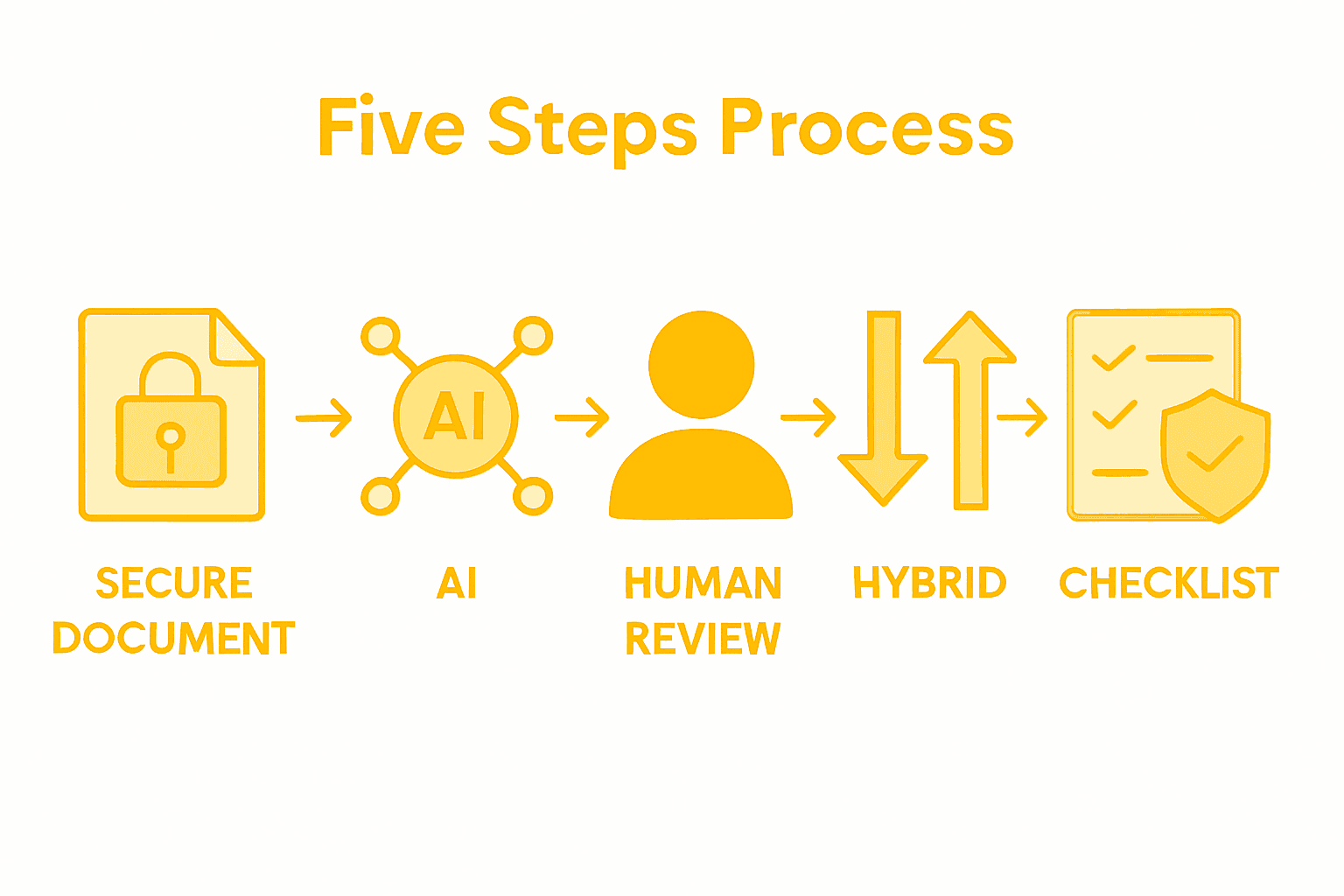
The AI+Human translation process involves five key steps: secure integration of translation assets, leveraging a proprietary Large Language Model AI, refining output with human subject matter expert oversight, applying hybrid and Agentic translation strategies, and validating with rigorous quality assurance and compliance checks. Start implementing these steps by establishing a clear protocol for each phase and tracking your progress for continuous improvement.
How do I ensure the security of my translation assets during the integration process?
To secure your translation assets, isolate them within a private cloud infrastructure and implement multi-tier authentication. Regularly conduct audits to identify sensitive resources and utilize cryptographic hashing to ensure their integrity. Maintain encrypted offline backups to further protect against unexpected system interruptions.
How can I validate the accuracy of translations for compliance in regulated industries?
You can validate accuracy through a tiered review process involving domain-specific linguists, technical subject matter experts, and compliance specialists. Establish a comprehensive review checklist to standardize evaluations, ensuring that every translation meets the industry’s regulatory requirements.
What role does AI play in enhancing translation accuracy for compliance documentation?
AI plays a crucial role by generating initial drafts that maintain contextual understanding, while human experts ensure technical precision and regulatory alignment. Aim to train your AI model with industry-specific terminology and compliance-related language for optimal results.
How does the hybrid translation strategy improve efficiency in the translation process?
The hybrid translation strategy combines Machine Translation with human post-editing, which allows experts to focus on nuanced linguistic details while leveraging AI for repetitive content. Implement this approach to increase translation speed by up to 30% while maintaining high quality and accuracy.
Recommended