


Avoid terminology errors in cross-border contracts 2026

A multinational pharmaceutical company faced a €2.3 million arbitration loss in 2025 when a translated supply agreement misrendered “exclusive distribution rights” as “preferred supplier status” in the target language. The terminology error invalidated the contract’s core protection, allowing a competitor to enter the market legally. For legal professionals managing multilingual contract portfolios, such failures demonstrate why terminology precision determines enforceability. This guide examines the specific translation errors that jeopardize cross-border contracts, the compliance frameworks that mitigate risk, and the vendor selection criteria that protect your organization from costly disputes.
Table of Contents
Key takeaways
Point | Details |
Terminology errors create enforceability risk | Mistranslated defined terms, ambiguous clauses, and inconsistent terminology invalidate contract protections across jurisdictions |
Compliance-focused translation reduces errors | ISO 17100-certified workflows deliver 60% fewer errors through structured quality assurance and legal expert review |
Vendor expertise determines contract safety | Providers with certified legal translators and terminology governance systems prevent the interpretation disputes that trigger arbitration |
Proactive terminology management protects portfolios | Term bases, bilingual legal review, and continuous glossary updates maintain consistency across contract suites and amendments |
Common terminology pitfalls in cross-border contract translation
Contract translation failures cluster around predictable linguistic traps. False friends top the list: words that look similar across languages but carry different legal meanings. “Eventual” in English means occurring at some later time, while “eventual” in Spanish means possible or contingent. A force majeure clause using this term incorrectly shifts the entire burden of proof. Ambiguous terms create equal havoc. “Reasonable efforts” translates into German as either “angemessene Bemühungen” (proportionate to circumstances) or “zumutbare Anstrengungen” (what can fairly be expected), each triggering different performance standards under German contract law.
Culturally specific expressions compound the problem. Common law concepts like “best endeavors” lack direct equivalents in civil law systems, where courts interpret obligation intensity through different doctrinal frameworks. A literal translation preserves the words but loses the legal standard, rendering the clause unenforceable or subject to unpredictable interpretation. Terminology errors are a leading cause of legal enforceability issues in translated contracts, particularly when translators lack subject matter expertise in the relevant legal system.
The most damaging errors involve defined terms. Contracts establish precise definitions in opening sections, then reference those terms throughout operative clauses. When translation handles the initial definition correctly but uses variant terminology in subsequent references, the internal logic collapses. A contract defining “Confidential Information” that later references “proprietary data” or “trade secrets” creates ambiguity about scope. Courts in target jurisdictions may treat these as separate categories, voiding protections the parties intended.
Common pitfalls include:
Literal word-for-word translation ignoring legal context and jurisdiction-specific interpretation
Inconsistent rendering of defined terms across contract sections and related documents
Missing legal nuance in obligation intensity terms like “shall,” “will,” “may,” and “should”
Failure to localize references to laws, regulations, and legal procedures in target jurisdictions
Overlooking syntax differences that alter clause relationships and conditional dependencies
Pro Tip: Engage bilingual legal experts during contract drafting to identify terminology that requires special handling in translation, creating a controlled vocabulary before translation begins rather than fixing errors afterward.
Why terminology errors threaten enforceability and compliance
Contract validity hinges on mutual understanding and meeting of minds. When translation obscures intent, courts in target jurisdictions may void the agreement entirely or interpret ambiguous terms against the drafter under contra proferentem principles. A 2024 ICC arbitration case illustrates the stakes: a licensing agreement’s translation error regarding “exclusive territory” cost the licensor $4.7 million when the panel ruled the mistranslation created reasonable doubt about geographic scope, invalidating territorial protections.
Regulatory scrutiny amplifies these risks in sectors like life sciences, finance, and defense. Compliance-focused translation workflows reduce errors by 60% through structured quality assurance that regulatory bodies increasingly expect. A clinical trial agreement mistranslating informed consent provisions or liability limitations exposes sponsors to regulatory sanctions beyond contractual disputes. Financial services contracts containing translation errors in risk disclosure or fiduciary duty clauses trigger securities law violations in multiple jurisdictions simultaneously.
Dispute resolution becomes exponentially more complex when terminology errors surface. Arbitration panels must first resolve what the contract actually says before addressing performance issues. This preliminary battle over meaning adds months to timelines and multiplies legal costs. In litigation, parties may need expert linguistic testimony to establish translation quality, turning contract disputes into technical translation trials. The uncertainty itself undermines the risk allocation that contracts exist to provide.
“Data security and compliance workflows in translation directly impact contract enforceability by ensuring terminology consistency, audit trails, and regulatory alignment that courts and arbitrators expect when evaluating cross-border agreements.”
Jurisdictional differences magnify terminology sensitivity. A “warranty” in common law systems creates strict liability, while the equivalent term in civil law jurisdictions may only establish a defect notification obligation. Translation that fails to account for these distinctions produces contracts that appear identical but operate under fundamentally different legal standards. The resulting enforcement gaps become apparent only when disputes arise, by which point correction is impossible without contract reformation or renegotiation.

Regulated industries face additional layers. Medical device supply agreements must align with MDR terminology requirements. Defense contracts require translation compliance with security classification handling and export control definitions. Financial instruments demand precise rendering of calculation methodologies and trigger events. Each sector brings specialized vocabulary where errors create not just contract disputes but regulatory exposure, audit findings, and potential criminal liability for compliance failures.
Industry standards and best practices for precise contract translation
Professional translation standards provide the quality framework that legal work demands. ISO 17100 establishes baseline requirements: qualified translators, independent review, and defined revision processes. ISO 18587 extends these principles to machine translation post-editing, specifying when and how technology can support human expertise. For legal content, these standards represent minimum thresholds, not aspirational goals.
Standard/Approach | Core Focus | Contract Translation Fit |
ISO 17100 | Human translation workflow with qualified linguists and independent review | Essential baseline for all legal content requiring enforceability assurance |
ISO 18587 | Machine translation post-editing quality requirements | Supplementary for high-volume, lower-risk contract annexes with expert oversight |
Client term bases | Organization-specific terminology governance and consistency | Critical for maintaining defined term relationships across contract portfolios |
Legal expert review | Subject matter validation by qualified legal professionals | Non-negotiable for contracts involving regulatory compliance or dispute risk |
Best practices for contract translation extend beyond standards compliance:
Source text clarity review before translation begins, identifying ambiguous terms and resolving inconsistencies
Bilingual legal expert review by professionals qualified in both source and target legal systems
Comprehensive terminology glossaries covering defined terms, legal concepts, and jurisdiction-specific references
Iterative quality assurance with back-translation validation for high-stakes clauses
Version control systems tracking terminology decisions across contract amendments and related documents
Post-delivery legal review in target jurisdiction confirming enforceability under local law
Translation memory systems serve contract work differently than other content types. Standard TM tools prioritize consistency by reusing previous translations, but contracts require context-aware matching. A “termination” clause in an employment agreement demands different terminology than “termination” in a software license. Advanced systems tag segments by contract type and legal context, preventing inappropriate reuse that creates the very inconsistencies TM exists to avoid.
Industry standards in technical translation establish the quality baseline, but contract work requires additional controls. Certification alone does not guarantee legal expertise. Translators need demonstrated experience in the specific contract categories and jurisdictions involved. A translator expert in French commercial law may lack the specialized knowledge required for Belgian employment contracts or Swiss financial services agreements, despite language fluency.
Pro Tip: Prioritize certified legal translators with active experience in your target jurisdictions and regulated industry sectors, verifying their qualifications through professional association membership and reference checks rather than relying solely on language certifications.
Quality assurance must address both linguistic accuracy and legal functionality. Regulated document translation workflows incorporate legal review as a distinct phase, not an optional enhancement. This review validates that translated terms align with target jurisdiction legal frameworks, that defined term relationships remain intact, and that clause interdependencies preserve the contract’s logical structure. Without this validation, even linguistically perfect translation may produce legally incoherent documents.
Practical strategies for managing terminology in multilingual contract translation
Terminology governance starts before translation begins. Creating comprehensive term bases requires identifying every defined term, legal concept, and jurisdiction-specific reference in your contract portfolio. This inventory becomes your controlled vocabulary, ensuring consistent handling across all translations. Term bases should include not just target language equivalents but also context notes explaining legal significance and usage constraints.
Practical steps for terminology management:
Create bilingual glossaries for each contract type and jurisdiction combination, updated continuously as new terms emerge
Establish terminology review committees including legal experts from all relevant jurisdictions
Implement translation memory systems with context-aware matching that prevents inappropriate term reuse
Conduct regular terminology audits across contract portfolios, identifying and correcting inconsistencies
Train translators on your organization’s specific terminology requirements and legal context
Build rigorous review cycles with back-translation validation for defined terms and critical clauses
Document all terminology decisions with rationale for future reference and consistency
Vendor selection determines terminology quality more than any other factor. Vendor evaluation criteria should prioritize legal expertise and terminology governance capabilities over cost or speed. Assess whether providers maintain specialized legal translator networks, how they handle term base integration, and what quality assurance processes validate legal accuracy beyond linguistic correctness.
Key evaluation questions include: Does the provider assign translators with legal qualifications in target jurisdictions? What terminology management systems do they use? How do they handle defined term consistency across document suites? What legal review processes supplement translation? Can they demonstrate experience with your specific contract types and regulatory requirements? What audit trails and quality documentation do they provide?
Contract management software integration amplifies terminology control. Modern platforms can flag defined terms automatically, track usage across documents, and alert drafters to inconsistencies before translation begins. When integrated with translation memory systems, these tools ensure that terminology decisions made during initial contract drafting flow automatically into translation workflows, reducing manual coordination and error risk.
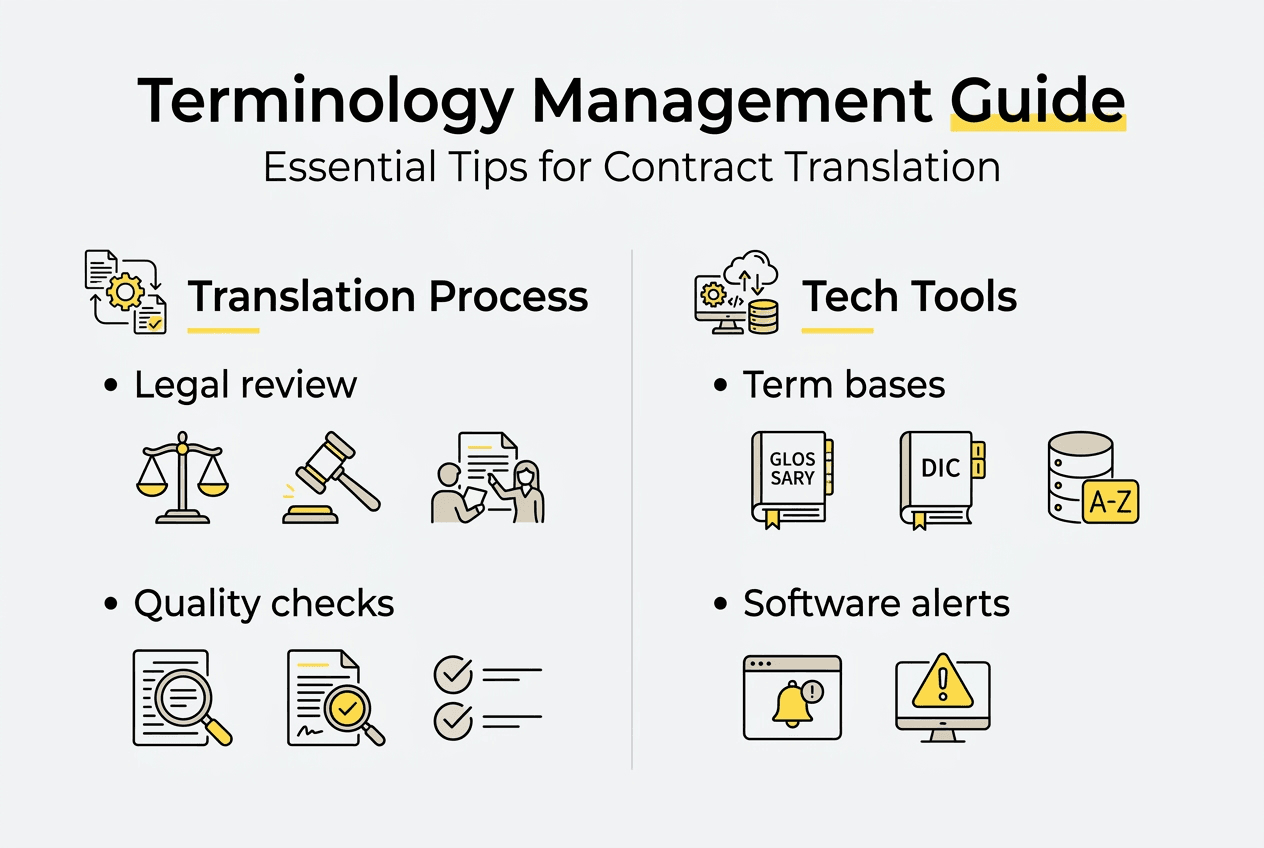
Continuous improvement requires feedback loops. After contract execution, track which translations performed well and which created interpretation questions or disputes. This intelligence informs term base refinement and translator selection for future work. Organizations managing large contract portfolios should conduct annual terminology audits, comparing translations across contract families to identify systematic inconsistencies that point to process gaps.
Pro Tip: Use contract management software integrated with translation memory systems to maintain terminology consistency automatically, flagging defined terms for special handling and ensuring that amendments use identical terminology to original contract translations.
Risk-based prioritization helps allocate resources effectively. Not every contract clause carries equal enforceability risk. Limitation of liability, indemnification, intellectual property rights, and dispute resolution provisions demand maximum precision. Routine administrative clauses like notice provisions tolerate more flexibility. Choosing legal translation providers who understand this risk stratification ensures that quality assurance efforts focus where they matter most.
Discover expert localization and translation solutions
Managing terminology risk in cross-border contracts requires translation partners who understand both linguistic precision and legal enforceability. AD VERBUM combines 25 years of legal translation experience with proprietary AI technology and a network of 3,500+ subject matter expert linguists, including legal scholars qualified in multiple jurisdictions. Our ISO 17100 and ISO 27001 certified workflows ensure that every contract translation undergoes expert legal review, terminology validation, and compliance verification aligned to your regulatory requirements.
Our localization services integrate term base management, bilingual legal review, and jurisdiction-specific quality assurance that protect contract enforceability across 150+ languages. The proprietary LangOps System combines AI efficiency with mandatory human expert oversight, delivering translations 3x to 5x faster than traditional workflows while maintaining the legal precision that regulated industries demand. Explore our approach to translation and discover how translation services designed for legal and compliance content can protect your organization from the costly disputes that terminology errors create.
FAQ
What are the most common terminology errors in contract translation?
The most frequent errors involve false friends that look similar across languages but carry different legal meanings, inconsistent rendering of defined terms across contract sections, and literal translations that ignore jurisdiction-specific legal context. Ambiguous terms like “reasonable efforts” or “best endeavors” often translate poorly because they reference legal standards that vary significantly between common law and civil law systems. Understanding these patterns helps legal professionals specify requirements when evaluating high-risk translation vendors.
How do terminology errors affect contract enforceability across jurisdictions?
Terminology errors create ambiguity that courts may resolve by voiding contracts entirely under mutual understanding doctrines or interpreting unclear terms against the drafter. In cross-border contexts, mistranslated terms can produce contracts that appear identical but operate under fundamentally different legal standards in each jurisdiction. Regulatory compliance failures compound these risks, as translation errors in disclosure requirements, liability limitations, or consent provisions trigger securities law violations, regulatory sanctions, and audit findings beyond pure contract disputes.
What best practices ensure accurate terminology in multilingual contracts?
Effective practices start with source text clarity review before translation, followed by assignment of certified translators with legal qualifications in target jurisdictions. Maintain comprehensive terminology glossaries covering all defined terms and legal concepts, then apply iterative quality assurance with independent legal expert review. Follow ISO 17100 standards as a baseline, supplement with jurisdiction-specific legal validation, and implement version control systems that track terminology decisions across contract amendments and related documents.
How should legal professionals evaluate translation providers?
Assess providers based on demonstrated legal expertise in your specific contract types and target jurisdictions, not just language certifications. Review their terminology management systems, quality assurance processes, and whether they assign translators with active legal qualifications. Verify ISO 17100 and ISO 27001 certifications for quality and security, examine their experience with regulated content in your industry, and request references from clients managing similar contract portfolios. Prioritize vendors who understand risk-based translation approaches and can demonstrate how their workflows prevent the terminology errors that create enforceability failures.
Recommended

