


Data Sovereignty: What It Means and Why It Matters

Data sovereignty means a dataset is governed by the laws of the jurisdiction where it is stored, processed, or generated, and that jurisdiction’s regulators can compel access to it. This determines who can legally reach your data: courts, law enforcement, and regulators in that country, regardless of where your company is headquartered. It matters most for personal data (PII), regulated health records, intellectual property, and defense-related files.
Jurisdiction, not geography alone, decides legal authority over data.
Access risk follows the law, not just the server location.
PII, clinical records, and IP carry the highest compliance stakes.
Key Takeaways
Data sovereignty requires mapping legal jurisdiction, technical control, and contractual terms together, since no single factor determines who can access your data.
Point | Details |
Jurisdiction beats geography | Provider domicile can override regional hosting; verify legal exposure, not just server location. |
Separate the three terms | Sovereignty means legal authority, residency means location, localization means mandatory in-country storage. |
Match controls to sensitivity | Apply minimum-viable sovereignty broadly and reserve maximum lockdown for regulated, high-risk data only. |
Contracts must name governing law | Vague residency clauses without provider-domicile language leave real legal gaps. |
AD VERBUM supports sovereign workflows | EU-hosted LangOps with ISO 27001/42001 certification and AI+HUMAN hybrid translation fits regulated document pipelines. |
Table of Contents
What Is Data Sovereignty and What Does It Cover?
Data sovereignty is the principle that data falls under the laws and regulatory frameworks of the jurisdiction where it is generated, stored, or processed, according to IBM. It is not a single law. It is a governing concept that determines which country’s courts, regulators, and law enforcement bodies have legal standing to compel access, demand disclosure, or penalize noncompliance.
Data sovereignty answers one question with legal weight: if a government or court wants this data, which government or court gets to ask?
Enterprises typically scope sovereignty assessments around these asset categories:
Personally identifiable information (PII) subject to privacy statutes
Protected health information and clinical trial records
Trade secrets, patents, and other intellectual property
Financial records subject to banking or securities regulation
Defense, export-controlled, or national-security-sensitive data
Sovereignty gets decided through three overlapping tests: where the data physically sits, whose nationality or residency the data subject holds, and who technically controls access (encryption keys, admin credentials, backup copies). A dataset can trigger more than one jurisdiction’s claim at once, which is exactly why scope planning matters before any technical work starts.
Pro Tip: Start your sovereignty assessment by classifying data into three buckets first: regulated personal data, regulated technical/IP content, and everything else. Everything else rarely needs full sovereign controls, and skipping that triage is the single biggest cause of over-engineered, overpriced compliance programs.
How Is Data Sovereignty Determined in Practice?
Jurisdictional claims arise primarily from where data is stored or processed and who controls access to it, according to NetApp. Storage location sets the baseline. A file sitting on a server in Frankfurt falls under German and EU law first. But that baseline shifts once you factor in who runs the infrastructure.
Provider domicile is the part enterprises underestimate. A cloud vendor headquartered in a different country can be compelled by its home government to produce data it hosts abroad, a dynamic legal teams call extraterritorial reach. Regional hosting alone is often insufficient because authorities can reach a provider through its corporate home jurisdiction rather than the server’s physical location, according to ISACA.
Technical design changes who holds practical access authority, independent of the law:
Encryption at rest and in transit, with customer-managed keys rather than provider-managed keys
Access logs and audit trails that prove who touched what data and when
Isolated or air-gapped infrastructure that removes shared-tenant exposure
Contractual choice-of-law clauses and data processing agreements that specify governing law and local presence requirements
A regional data center does not guarantee regional legal control. Key custody and provider domicile often matter more than the address on the data center.
The clearest illustration of this tension sits in the contrast between CLOUD Act style extraterritorial access requests and hard data-localization statutes that require in-country storage with no exceptions. One extends a home government’s reach outward; the other blocks it entirely.
Data Sovereignty vs. Data Residency vs. Data Localization
These three terms get used interchangeably in vendor marketing, and that sloppiness causes real contract disputes. Data sovereignty defines who has legal authority over data and what obligations follow, distinct from data residency, which simply describes physical location, according to Teradata.
Data residency: where data physically sits, with no legal mandate attached.
Data localization: a regulatory requirement forcing certain data to stay within a country’s borders.
Data sovereignty: the legal authority and access rights that follow from jurisdiction, encryption, and control.
Residency is enough when your only concern is latency or a soft preference for regional storage. Sovereignty becomes the real issue once a regulator, contract, or national security rule can compel access regardless of where the servers sit. Regulatory triggers that turn simple residency into mandatory localization include sector-specific health data rules, banking secrecy statutes, and defense-classification requirements.
Pro Tip: In vendor contracts, never write “data will reside in the EU” alone. Add: “data will be processed exclusively by entities subject to EU jurisdiction, with no extraterritorial access rights reserved to the provider or its parent company.” That second clause is the one that actually protects you.
Which Cloud Deployment Model Fits Sovereignty Requirements?
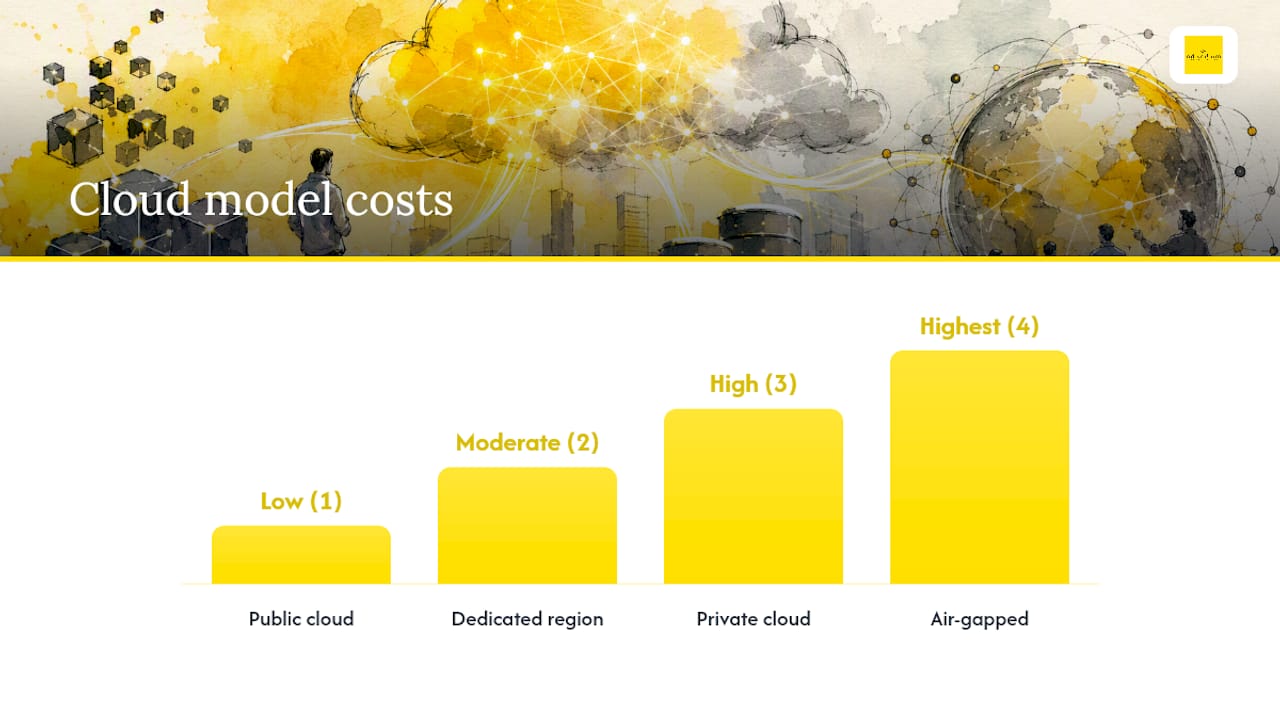
Public cloud with region selection, dedicated regions or accounts, private cloud, air-gapped/offline environments, and hybrid segmentation each carry distinct sovereignty trade-offs.
Public cloud, region-selected: fast to deploy, cost-efficient, but provider domicile risk remains unless customer-managed keys are enforced.
Dedicated region/sovereign account: stronger contractual and technical isolation, moderate cost premium.
Private cloud: full control over infrastructure and keys, higher cost, slower to scale.
Air-gapped/offline: maximum isolation for classified or defense-grade content, highest operational overhead.
Hybrid segmentation: sensitive workloads isolated, non-sensitive workloads run on public infrastructure.
Model | Control | Auditability | Cost | Scalability |
Public cloud (region-selected) | Low to moderate | Moderate | Low | High |
Dedicated/sovereign region | Moderate to high | High | Moderate | Moderate |
Private cloud | High | High | High | Low |
Air-gapped/offline | Highest | Highest | Highest | Lowest |
Regulated enterprises typically default to dedicated sovereign regions or hybrid segmentation: full lockdown for classified or clinical data, public cloud scale for everything else. That balance keeps cost from spiraling while protecting the assets that actually carry legal exposure.
Why Does Data Sovereignty Matter for Regulated Organizations?
Sovereignty failures translate directly into regulatory fines, forced disclosure under foreign legal process, contractual breach with clients who mandated specific jurisdictions, and reputational damage once a breach becomes public.
Regulatory fines under frameworks like GDPR for unauthorized cross-border transfers
Forced disclosure risk when a provider’s home government compels access
Contractual breach when a client’s data residency clause is violated
Reputational harm that follows any public disclosure of jurisdictional failure
Sovereignty considerations now shape vendor selection, incident response planning, and how cross-border data flows get architected from day one. This extends into AI training pipelines too: feeding regulated documents into a model hosted or trained outside the required jurisdiction creates the same exposure as storing the raw files there.
Sovereignty concerns have moved beyond a compliance checkbox into core risk management, with organizations segmenting sensitive workloads rather than applying blanket localization everywhere, according to TechTarget.
Beyond fines, sovereignty compliance increasingly functions as a market-access requirement. Clients in regulated sectors now ask vendors to prove jurisdictional control before signing, not after an incident forces the question.
What Should Enterprises Check Before Committing to a Vendor?
A workable enterprise checklist covers both legal mapping and technical verification, and skipping either half leaves gaps auditors will find.
Classify data by regulatory sensitivity before selecting any vendor or architecture
Map applicable laws for every jurisdiction where data subjects, storage, or processing occurs
Confirm vendor corporate domicile and whether it exposes the contract to foreign legal process
Require contractual audit rights and documented data lineage
Verify key management model: who holds encryption keys, and under what legal process could they be compelled
Confirm backup and disaster-recovery locations match the same residency commitments as primary storage
Set explicit logging and audit-trail requirements tied to access events, not just storage events
Decision thresholds matter here. Mandatory localization typically applies to health records, financial transaction data, and defense-classified material. Minimum-viable sovereignty, meaning encryption, access logging, and contractual controls without full in-country infrastructure, is often sufficient for lower-sensitivity business data. Mapping these requirements against cost, performance, and market-access goals prevents the common trap of applying maximum controls everywhere and pricing the program out of feasibility.
Legal interpretation of applicable statutes belongs with counsel or a data protection officer. Technical implementation, key management architecture, network segmentation, belongs with security and engineering teams working from that legal mapping, not ahead of it. Procurement teams evaluating language service vendors for regulated content can reference a structured provider selection framework built around these same criteria.
How Do You Implement Data Sovereignty Controls Step by Step?
Inventory and classify every dataset by sensitivity, regulatory category, and current storage location.
Map each category to applicable law, cross-referencing where data subjects reside, where processing occurs, and any sector-specific mandates.
Segment infrastructure so regulated data runs on isolated or dedicated environments, while lower-sensitivity data stays on standard infrastructure.
Apply technical controls: encryption with customer-managed keys, split-key architectures for the highest-sensitivity content, tokenization for identifiable fields, and local-only processing enclaves where regulation demands it. AI workflows should use federated or region-locked training patterns rather than shipping raw regulated text to a shared external model.
Lock in contractual controls: data processing agreement clauses specifying governing law, audit rights, and a defined process for responding to third-country legal requests.
Verify continuously: scheduled vendor audits, access-log reviews, and confirmation that backups match primary-storage residency commitments.
Engineering and procurement teams should track a shared controls checklist: key management system ownership, centralized logging, network isolation boundaries, and SLA terms that name governing law explicitly. AD VERBUM’s ISO 27001-aligned security controls illustrate how certification maps to this exact sequence for translation workflows handling regulated source documents.
Pro Tip: Don’t localize everything. A minimum-viable sovereignty model, strong encryption plus contractual controls plus audit logging, covers most mid-sensitivity data at a fraction of the cost of full in-country infrastructure. Reserve maximum lockdown for the narrow slice of data that legally requires it.

What Causes Data Sovereignty Programs to Fail?
Most sovereignty failures trace back to five recurring gaps, not to malicious actors or exotic attacks.
Mistaken assumptions about provider jurisdiction: assuming regional hosting equals regional legal control, when provider domicile can override that assumption.
Undeclared replication or backups: data copied to a different region for disaster recovery without matching residency commitments.
Weak key management: provider-held keys that leave the customer unable to prove exclusive access control.
Incomplete data mapping: shadow IT or unmonitored SaaS tools processing regulated data outside the mapped inventory.
Vague contract language: residency clauses that don’t address provider domicile or legal-process response procedures.
Mitigation starts with vendor audits that verify actual infrastructure and legal exposure, not marketing claims. Require proof-of-location documentation, insist on customer-managed keys, and write explicit backup-residency clauses into every agreement. Working with unvetted subcontractors compounds this risk considerably, particularly in translation and localization workflows where source documents pass through multiple hands before delivery. Post-incident, collect access logs, provider communications, and contract terms immediately. That evidence determines whether a breach is a contractual violation, a regulatory reportable event, or both.
Which Legal Cases and Laws Define Data Sovereignty Today?
Practitioners assessing sovereignty exposure should treat these as reference points, not exhaustive legal coverage.
GDPR sets the EU’s data protection baseline and restricts transfers outside the European Economic Area without adequate safeguards, detailed further in this GDPR compliance guide for language services.
CLOUD Act style statutes create extraterritorial access risk: a provider’s home government can compel data disclosure regardless of where the servers sit.
Schrems II invalidated the EU-US Privacy Shield, tightening adequacy requirements and forcing companies to reassess standard contractual clauses for transatlantic transfers.
National data-localization laws mandate in-country storage or processing for specific sectors, and these statutes have expanded significantly worldwide, with numerous countries now maintaining some form of localization requirement, according to the OECD.
Data localization mandates do not automatically guarantee sovereignty, particularly in public-cloud contexts where provider domicile can still create cross-border exposure, per OECD research.
For GDPR-specific obligations tied to international transfers, review this breakdown of GDPR company obligations.
Where Does AD VERBUM Fit in a Sovereign Data Pipeline?
AD VERBUM’s LangOps System runs on EU-hosted infrastructure, avoiding reliance on outsourced public cloud tooling for core processing. That architecture matters directly for legal, medical, and defense translation projects where source documents cannot leave a defined jurisdiction.
EU-hosted ecosystem with no dependency on third-country public cloud processing
ISO 27001 and ISO 42001 certification covering information security and AI governance, independently audited by Bureau Veritas
GDPR, HIPAA, and MDR alignment for regulated health, legal, and life sciences content
100 percent AI+HUMAN hybrid translation: certified subject-matter expert review on every regulated document, not just automated output
For a sovereign pipeline, the workflow runs: client Translation Memories and Term Bases ingested first, LLM-based generation constrained by that terminology, subject-matter expert review for technical and regulatory accuracy, then QA aligned to ISO 17100 and ISO 18587. Legal and defense clients evaluating AI-assisted translation should weigh this against the risks of shared public-cloud translation workflows before committing sensitive source material to any vendor’s pipeline. AI governance questions around training data exposure are worth reviewing separately, covered in this overview of legal risk in ungoverned AI use.
A Compliance Leader’s Perspective
Treat sovereignty as an ongoing risk program, not a one-time audit checkbox. The right posture is centralized governance with local enforcement: unified policy and data lineage, applied jurisdiction by jurisdiction. It only works when legal, security, procurement, and engineering own it jointly, not when it sits in one department’s queue.
Get Sovereign-Ready Translation Without Building Infrastructure Yourself
Building your own sovereign infrastructure for regulated document translation means procuring EU-based hosting, negotiating key management with cloud vendors, and vetting subject-matter reviewers on top of it, a project most compliance teams don’t have headcount for. AD VERBUM runs that infrastructure already: EU-hosted LangOps processing, ISO 27001 and ISO 42001 certification audited by Bureau Veritas, and 100 percent AI+HUMAN hybrid translation with certified subject-matter experts reviewing every regulated document before delivery.

For legal, medical, defense, or financial content where jurisdiction and auditability are non-negotiable, that combination removes the guesswork of assessing a vendor’s sovereignty posture from scratch. If your program handles regulated documentation that needs translation without leaving EU jurisdiction, start by reviewing AD VERBUM’s localization services and requesting an enterprise assessment for your specific compliance requirements.
Primary Sources for Legal and Implementation Detail
OECD localization trend data for statutory scope and country counts.
IBM and Teradata for enterprise definitions and term distinctions.
ISACA for cloud governance and provider-domicile risk analysis.
Consult legal texts and OECD reports for statutory interpretation; use vendor and industry guides for implementation patterns.
This article is general information, not a substitute for advice from a qualified lawyer. Consult a qualified legal professional about your own circumstances before acting on anything here.
Sources
Recommended
