


Data Security in Localization Guide for Regulated Buyers

Require four things before any regulated document leaves your building: an ISO/IEC 27001-scoped ISMS covering translation workflows, a validated TMS with immutable audit trails and electronic-signature support, documented supplier onboarding and offboarding controls, and full traceability for AI+HUMAN hybrid translation output. Anything less leaves gaps an auditor will find.
Put these on your RFP checklist today:
Certificate scope statement showing the ISMS covers file intake, translator access, and TM/TB handling, not just corporate IT.
SOC 2 Type II report with audit period and named auditor.
Sample exported audit log showing user ID, timestamp, and action for a translation approval.
Validation summary (IQ/OQ/PQ or equivalent) for any TMS touching FDA 21 CFR Part 11-relevant content or GDPR-covered personal data.
Key Takeaways
Regulated localization security depends on verifiable evidence, ISO/IEC 27001 scope, TMS validation records, and AI+HUMAN traceability, not vendor claims alone.
Point | Details |
Require scoped certification | Confirm ISO/IEC 27001 scope names the TMS and translator access, not just corporate IT. |
Demand audit-log samples | Ask for a live exported log before signing, showing user ID, timestamp, and action. |
Validate AI traceability | Require model version tagging, pre-edit snapshots, and reviewer sign-off records for AI+HUMAN output. |
Fix offboarding timing | Set a same-day access-revocation SLA for departing linguists and vendors. |
AD VERBUM fit | ISO 27001-certified, EU-hosted LangOps System with AI+HUMAN hybrid translation for regulated content. |
Table of Contents
What Does Data Security in Localization Actually Cover?
Data security in localization means the controls protecting source content, including personal health information (PHI) and personally identifiable information (PII), through every stage of a translation project: transfer, processing, storage, human and AI review, and final delivery. It applies equally to freelance linguists, in-house reviewers, and the AI systems increasingly used in the first drafting pass.
The scope includes:
Source files, translation memories ™, and termbases (TB)
TMS logs, approval records, and version history
AI model output before and after human post-editing
Interpreter transcripts and recorded session data
This guide does not cover data localization or data residency law, meaning legal requirements to store data inside a specific country’s borders. That’s a separate regulatory question. Here, “data security” means protecting content wherever it resides, not dictating where it resides.
What Should a Regulated Localization Procurement Checklist Include?
Vendor evaluation for regulated content follows a risk-based sequence, not a flat scorecard. A clinical trial protocol and a marketing brochure carry different exposure, and your checklist should reflect that before you request a single document.
Classify the content. Tag each document type by sensitivity (PHI, trade secret, litigation hold, public marketing) and assign a corresponding vendor tier.
Shortlist against baseline certifications. Require ISO/IEC 27001 at minimum; add ISO 17100 for translation quality and ISO 18587 if machine-translation post-editing is in scope.
Request the ISMS scope statement. Confirm it names translation memory handling, translator access, and delivery channels, not just headquarters infrastructure.
Request the SOC 2 Type II report. Check the audit period and whether the report covers the specific service line you’re buying, not a parent company’s unrelated systems.
Request TMS validation artifacts. Ask for an IQ/OQ/PQ package or validation summary if the workflow touches FDA-regulated labeling or GxP documentation.
Request a sample audit-log export. A vendor that can’t produce one on request likely can’t produce one during an FDA inspection either.
Verify encryption and access standards. Confirm TLS in transit, AES-256 (or equivalent) at rest, and SSO/MFA support.
Confirm onboarding and offboarding SOPs. Ask how fast linguist access is revoked after contract end, not just how it’s granted.
Sign with audit rights written in. The contract should let you request evidence on a recurring basis, not just at signature.
The evidence itself tells you more than a vendor’s marketing page. A Statement of Applicability shows which ISO/IEC 27001 controls the vendor actually applies and which they’ve excluded, with justification. A certificate scope page that lists only “corporate headquarters” and excludes the TMS platform is a red flag, not a formality.
Which Technical Controls Should a Translation Management System Provide?
A TMS built for regulated work looks structurally different from one built for general business translation. The difference shows up in five capabilities:
Immutable audit trails recording every file access, edit, and approval with a timestamp and unique user ID.
Electronic-signature support tying approvals to named individuals, not shared logins.
Version control with point-in-time recovery, so any prior draft can be reconstructed on demand.
Model and version tagging on AI output, identifying which engine generated a given segment.
SSO and centralized user management, removing the need for per-project passwords that never get deactivated.
On encryption, expect TLS 1.2 or higher in transit and AES-256 (or equivalent) at rest, with documented key management. File transfer should run through SFTP or a secure client portal. Email attachments and consumer file-sharing links have no place in a regulated workflow.
For FDA Part 11 and GxP expectations specifically, the TMS needs documented validation, usually an IQ/OQ/PQ package or an equivalent validation summary, plus APIs that let auditors trace a translated segment back to its source and approval history.
Pro Tip: Ask vendors for their validation summary before you ask about pricing. A platform with pre-built IQ/OQ/PQ documentation can cut your internal validation timeline by weeks compared to one that treats compliance as a bolt-on.
How Do You Control Access for Translators and Reviewers?
Supplier governance is where most localization security programs actually fail, not in the encryption layer. Onboarding should include credential verification, signed confidentiality terms, and access provisioned strictly to the project’s scope. Offboarding needs to happen the same day a contract ends, not during the next quarterly review.
Role-based access control (RBAC) matters as much for a freelance reviser as for an in-house engineer. A translator working on a patent filing shouldn’t retain read access to unrelated case files, and a subject-matter expert reviewing a drug label shouldn’t have edit rights on the termbase without a separate approval step. Audit role assignments on a fixed schedule, not only when something goes wrong.
Buyers should expect vendors to produce, on request:
Written SOPs for onboarding, offboarding, and incident response
Linguist training records tied to confidentiality and data-handling obligations
Internal audit results from the last certification cycle
Business continuity and disaster recovery plans specific to translation delivery
Unclassified glossaries, personal-device downloads, and access left active after a freelancer’s last invoice are the most common findings in language-service security audits, not exotic technical breaches.
What Traceability Does AI+HUMAN Hybrid Translation Require?
Regulators and auditors reviewing AI-assisted translation want a reconstructable chain of custody for every segment, not just a final approved file. That chain has to answer three questions on demand: what did the model generate, what did a human change, and who approved the result.
Record the model name and version used to generate the initial draft.
Preserve a timestamped snapshot of the raw AI output before human edit.
Log the human post-edit changes, tied to a unique reviewer ID.
Capture reviewer and subject-matter-expert approvals as discrete, attributable records.
Retain final sign-off evidence in an exportable, audit-ready format.
Consider a regulated product label translated through an AI+HUMAN hybrid translation workflow. The audit package for that single label should include the model version, the pre-edit output, the linguist’s tracked changes, the subject-matter reviewer’s sign-off, and the QA record confirming alignment with the source terminology base. Miss any one link, and you can’t prove what the regulator is asking about: who actually approved the words a patient will read.
What Are the Most Common Localization Security Failures?
Most failures are procedural, not technical, and they tend to cluster around a handful of predictable gaps.

Failure Mode | Concrete Mitigation |
Uncontrolled file sharing (email, personal cloud) | Mandate SFTP or a secure client portal; block email attachments in policy |
Stale or shared linguist accounts | Enforce SSO with individual credentials; audit active sessions quarterly |
Incomplete audit trails | Require TMS with immutable, exportable logging before contract signature |
AI output shipped without human review | Contractually mandate human sign-off before any regulated content ships |
Delayed vendor offboarding | Set a same-day access revocation SLA in the master service agreement |
Inadequate retention or disposal | Define retention periods per document class and require certified deletion |
Pro Tip: Rush projects are where cascade failures start. Build a standing “urgent project” protocol in advance, one that keeps the same access controls and review steps intact under time pressure, so a tight deadline never becomes the excuse for skipping the human review step.
How Do You Verify Vendor Security Claims Before Signing?
Vendor claims are only as good as the evidence behind them, and that evidence needs to be checked against the specific document, not taken at face value.
Map the ISMS scope claim to the actual certificate scope page; confirm it names the TMS and translator access, not just the corporate network.
Match the SOC 2 Type II claim to the report’s stated audit period and the named auditor.
Request a live sample audit-log export rather than a screenshot in a sales deck.
Confirm TMS validation claims against an actual IQ/OQ/PQ package or validation summary, not a one-page assertion.
Contracts for regulated work should include specific clauses: documented ISMS scope as an attached exhibit, an incident-notification SLA (24 to 72 hours is typical), defined retention and secure-disposal obligations, standing audit rights, and explicit AI model-use and traceability terms tied to validation deliverables for GxP content. For a broader look at how legal teams structure vendor oversight clauses, outsourcing guidance for law firms offers a useful parallel framework for vendor accountability language.
Some claims are acceptable as documentary evidence alone, a certificate, a report, an exported log. Others, especially first-time engagements on high-sensitivity work like clinical trial documentation or litigation discovery, warrant an on-site or third-party review before signature.
When Should Regulated Buyers Choose AD VERBUM?
AD VERBUM fits scenarios where the sensitivity of the content, not just its language pair, drives the vendor decision: legal discovery with embargoed documents, clinical trial materials, product release content ahead of launch, GxP-labeled documentation, and live interpreting events requiring retained transcripts.
The decision criteria are specific. Buyers should look for ISO/IEC 27001 scope that explicitly names the TMS and AI+HUMAN hybrid translation workflow, EU-hosted processing rather than reliance on outsourced public cloud tooling, and validation artifacts ready for GxP or Part 11 review.
AD VERBUM holds ISO 9001, ISO 17100, ISO 18587, ISO 13485, and ISO 27001 certifications, independently audited by Bureau Veritas, runs its proprietary LangOps System on EU infrastructure, and maintains a large network of subject-matter expert linguists. Certificate scope details and validation packages are available on request.
A Compliance Editor’s Perspective
Most localization security failures I’ve seen traced back to procedural gaps, not missing encryption. Run these three checks this week: pull your current vendor’s ISMS scope page, request one sample audit log, and confirm offboarding actually happens same-day.
How AD VERBUM Supports Regulated Localization Programs
AD VERBUM’s ISO 27001-scoped ISMS, ISO 17100/18587-aligned QA, and EU-hosted LangOps System were built for exactly the controls this guide describes. AI+HUMAN hybrid translation pairs LLM-based drafting with certified subject-matter expert review, giving regulated buyers a traceable record from source file to final sign-off.
If your current vendor can’t produce a certificate scope page or a sample audit log on request, that’s the gap to close first. Request AD VERBUM’s certification scope, a validation package, or a trial project with full artifact delivery through the localization services page, or reach the team directly to scope a regulated engagement.
Frequently Asked Questions
What does ISO/IEC 27001 certify for a translation vendor? It certifies the vendor’s information security management system and how that system applies to real workflows, including file intake, translator access, TM/TB handling, and delivery channels, not the vendor’s tools individually.
Is a SOC 2 Type II report enough on its own? It’s strong supporting evidence, but check the audit period and confirm the report covers the specific service line you’re buying rather than an unrelated parent-company system.
Does FDA 21 CFR Part 11 apply to translation management systems? Yes, when the TMS handles content tied to FDA-regulated submissions or labeling. It requires unique user approvals, audit trails, and documented system validation.
How is AI+HUMAN hybrid translation different from machine translation for compliance purposes? AI+HUMAN hybrid translation pairs LLM-based drafting with mandatory subject-matter expert review and full traceability records, generating an auditable chain of custody that raw machine translation output does not provide on its own.
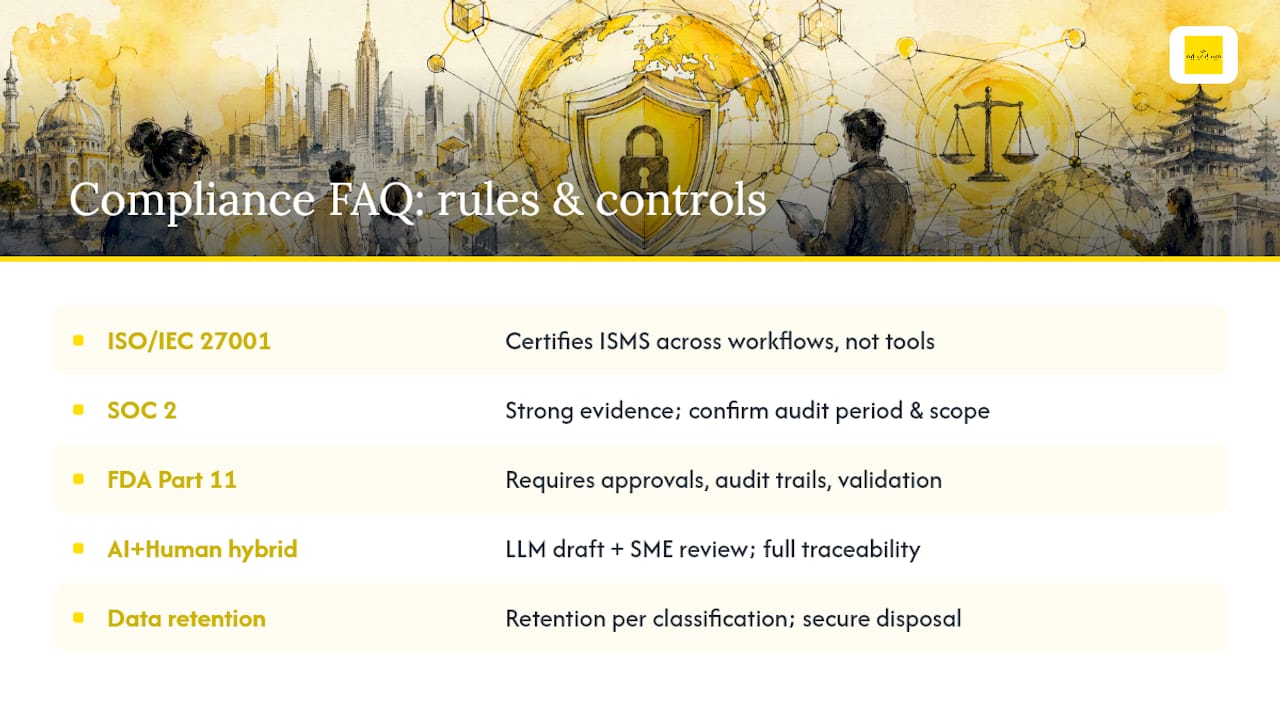
What should be in a data retention policy for localization vendors? Retention periods should match document classification, with certified secure disposal procedures documented per class and confirmed through vendor audit records, not a generic blanket policy.
Sources
Recommended
