


Translation Project Lifecycle Explained for Localization Teams

The translation project lifecycle is a structured sequence of phases running from initial intake through final delivery and post-project archival. Each phase carries specific quality, compliance, and governance obligations. For localization professionals managing regulated content, understanding this sequence is not optional — it determines whether a project meets ISO 17100, HIPAA, or GDPR requirements, or fails an audit.
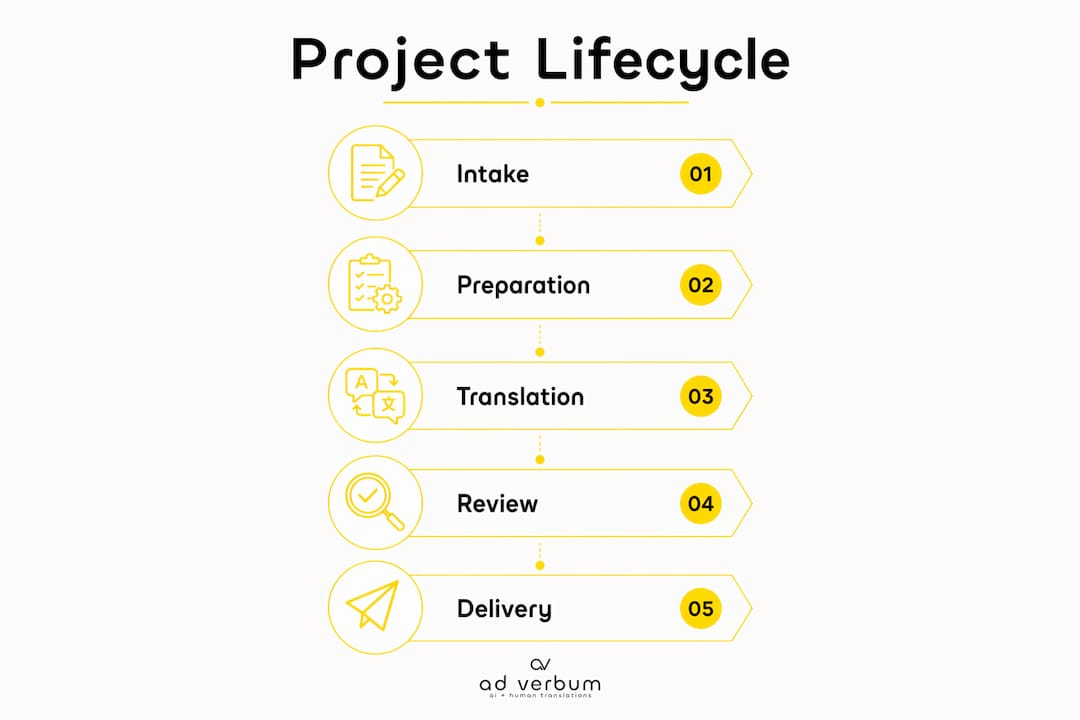
The core phases are:
Project intake and scope definition — languages, regulatory constraints, quality metrics
Team assembly and tool selection — CAT tools, TMS platforms, qualified linguists
Content preparation — source file cleaning, glossary and Translation Memory ™ setup
Translation and editing — AI+HUMAN hybrid workflows with in-tool QA
In-context review and layout adaptation — DTP checks, multilingual formatting
Final QA and linguistic verification — automated and human checks, LQA scoring
Delivery and archival — secure handoff, TM and termbase updates
Technology tools support every phase. CAT tools enforce terminology at the segment level. A TMS coordinates assignments, tracks progress, and automates QA checks. AI+HUMAN hybrid translation, where a proprietary LLM generates output constrained by client termbases and a subject-matter expert reviews for compliance, addresses the speed-versus-accuracy tension that regulated sectors cannot afford to ignore.
What does the translation project lifecycle actually cover?

Translation project management sits at the intersection of classic project management — scope, schedule, cost, risk — and content localization, covering linguistic, cultural, and technical dimensions simultaneously. That combination is what separates a localization project from a simple document translation.
Key scope elements include:
Stakeholder coordination — internal teams (legal, product, marketing), external linguists, and technology providers each carry distinct responsibilities
Linguistic assets — Translation Memories and termbases are not optional extras; they are governance infrastructure
Regulatory frameworks — ISO 17100 governs translation service quality; ISO 18587 covers post-editing of machine translation output; ISO 27001 addresses information security; GDPR and HIPAA impose data handling obligations on every vendor in the chain
Cultural and technical adaptation — localization amplifies every complexity present in a single-language translation project
A localization project typically involves RACI models, project briefs, schedules, risk registers, and communication plans tailored to multilingual delivery. Client-side project managers handle internal coordination; vendor-side project managers at language service providers manage linguist networks and deliverables.
How each phase of the translation workflow runs in practice
A clear, written project scope that defines languages, regulatory requirements, timelines, budgets, and quality metrics before work begins is the single most effective control against scope creep.
Project intake and scoping — Define target locales, compliance requirements (HIPAA, GDPR, MDR), quality targets, and success metrics. Document everything in a project brief before any file moves.
Team assembly and tool selection — Assign translators and reviewers with verified domain expertise. Select a TMS that supports your file types, security requirements, and language pairs. Define communication channels inside the TMS, not in scattered email threads.
Content preparation — Clean source files, lock versions, and load client glossaries and TMs into the tool environment. Agree on a source-file change policy before translation begins.
Translation with in-tool QA — Linguists work inside a CAT or TMS environment with TM leverage, termbase enforcement, and automated checks running in parallel. Checks cover terminology mismatches, numeric errors, tag consistency, and character limits.
Bilingual editing and proofreading — An independent editor reviews source and target texts for accuracy, terminology consistency, and style guide adherence. Editors re-run QA checks after edits to avoid introducing new errors.
In-context review and DTP — Translated content is reintegrated into its final format. DTP engineers check layout for text expansion, right-to-left scripts, and non-Latin character rendering.
Final linguistic QA and LQA scoring — A dedicated QA reviewer performs a comprehensive check on near-final assets, logging issues by severity (critical, major, minor) against client-defined quality models. Formal LQA scoring using frameworks like MQM (Multidimensional Quality Metrics) applies to samples across high-risk domains.
Delivery and archival — Files are delivered through secure, agreed-upon channels in required formats. TMs and glossaries are updated with approved content. Lessons learned are documented before the next project begins.
Pro Tip: Lock source files the moment translation starts. Mid-project source changes that bypass version control are one of the fastest ways to invalidate TM leverage and trigger rework across every language.
Compliance, risk management, and terminology governance
Terminology drift is the most underestimated compliance risk in regulated translation projects. A single inconsistent term in a medical device instruction manual or a legal contract can constitute a regulatory defect. Terminology governance via glossaries and termbases reduces this risk by enforcing approved vocabulary at every translation step, not just at final review.
Critical controls for regulated projects:
Risk registers — document known terminology ambiguities, jurisdictional compliance gaps, and linguist availability risks before the project starts
Termbase enforcement — termbases loaded into the CAT or TMS environment flag unapproved terms in real time during translation
ISO-aligned QA — ISO 17100 requires a two-step translation-plus-editing process; ISO 18587 governs post-editing of machine translation output
Data security — ISO 27001 certification and GDPR/HIPAA alignment govern how source files, TMs, and translated content are stored and accessed
Communication plans — structured escalation paths prevent misinterpretations from propagating across language pairs
AI+HUMAN hybrid translation supports compliance by combining LLM-generated output constrained by client terminology with certified subject-matter expert review. That combination addresses what legacy MT and standard NMT engines cannot: document-level context handling, terminology enforcement, and audit-ready QA documentation. For compliance best practices in regulated sectors, the governance layer matters as much as the linguistic output.
What causes translation projects to fail, and how to prevent it
Common failure modes cluster around three root causes: vague scope, unqualified linguists, and ineffective communication. Each is preventable with upfront investment.
Vague or shifting scope — leads to budget overruns and missed compliance requirements; mitigate with a written project brief signed off before work begins
Unqualified linguists — domain expertise is a structural requirement for regulated content, not a preference; vet linguists against subject-matter credentials, not just language pair availability
Terminology drift — inconsistency across files and language pairs undermines both quality and compliance; a maintained termbase with version-controlled updates is the primary control
Poor risk identification — risks not logged before the project starts surface as crises mid-delivery; build a risk register at intake, not after the first problem appears
Communication breakdowns — scattered feedback across email and spreadsheets creates version conflicts; centralize all reviewer feedback inside the TMS
The intake phase is where the cost of prevention is lowest. Every hour spent on scope definition, glossary setup, and risk logging at the start saves multiples in rework, reviewer cycles, and compliance remediation downstream.
How the lifecycle applies in regulated industries
The lifecycle adapts differently depending on sector risk. Two examples illustrate the range.
Life sciences: A medical device manufacturer translating Instructions for Use into 12 languages for EU MDR submission requires ISO 13485-aligned QA, terminology governance tied to the device’s technical file, and an audit trail covering every translation decision. The lifecycle adds a regulatory review gate between final QA and delivery, where a subject-matter expert with medical device credentials signs off on terminology and safety-critical phrasing.
Legal: A cross-border contract translation project managing jurisdictional compliance across U.S. and EU law requires terminology enforcement at the clause level, not just the document level. Lifecycle adaptation here means adding a legal review gate after editing, with a qualified legal scholar reviewing for jurisdictional accuracy before DTP.
In regulated sectors, the translation project lifecycle is not a workflow convenience — it is a compliance control. Each phase gate is a documented checkpoint that an auditor can examine. Skipping or compressing phases does not save time; it transfers risk to delivery, where the cost of failure is highest.
AD VERBUM’s proprietary LangOps System accelerates both scenarios. By ingesting client TMs and termbases before LLM generation begins, and routing output through certified subject-matter expert review aligned to ISO 17100 and ISO 18587, the system maintains audit-ready documentation at every phase. AD VERBUM states a 3x to 5x faster turnaround compared to traditional workflows, without removing the human review layer that regulated content requires.
Where AD VERBUM fits across the lifecycle
AD VERBUM is built for projects where compliance failure carries real consequences: life sciences, legal, finance, defense, and manufacturing.
Asset integration — client TMs and termbases are ingested before any translation begins, enforcing terminology governance from the first segment
LLM generation — the proprietary LangOps System produces target-language output constrained by client terminology and style guidance, hosted on EU servers with no reliance on public cloud processing
SME review — a network of 3,500+ subject-matter expert linguists, including medical professionals, engineers, and legal scholars, reviews every output for technical accuracy, regulatory compliance, and contextual nuance
ISO-aligned QA — QA is aligned to ISO 17100 and ISO 18587, with sector-specific overlays for MDR, HIPAA, and GDPR as required
Security posture — ISO 27001 and ISO 42001 certified, with all certifications independently audited by Bureau Veritas
AD VERBUM fits when the project carries audit requirements, sensitive data constraints, or terminology governance obligations that generic NMT engines cannot satisfy. For AI+HUMAN hybrid localization in regulated sectors, the combination of proprietary LLM generation, SME oversight, and ISO-certified QA covers the full lifecycle without trading compliance for speed.
Key Takeaways
A well-governed translation project lifecycle, from intake through archival, is the primary control against compliance failure in regulated localization projects.
Point | Details |
Scope definition prevents failure | A written project scope covering languages, regulatory requirements, and quality metrics stops scope creep before it starts. |
Terminology governance is a compliance control | Termbases and TMs enforced at the segment level prevent terminology drift across files and language pairs. |
QA overlays every phase | Automated checks during translation plus human LQA review at final stage catch errors that single-pass review misses. |
AI+HUMAN hybrid translation balances speed and compliance | AD VERBUM’s LangOps System delivers 3x to 5x faster turnaround while maintaining ISO 17100 and ISO 18587 aligned QA. |
Intake investment reduces downstream cost | Risk registers, glossary setup, and source file locking at intake prevent rework cycles that inflate cost and delay delivery. |
The lifecycle is a compliance architecture, not just a workflow
The conventional view treats the translation project lifecycle as a production pipeline: content goes in, translations come out. That framing misses what actually determines project outcomes in regulated sectors.
Every phase gate in the lifecycle is a documented control point. The intake scope defines what compliance means for this project. The termbase enforces it during translation. The LQA review verifies it before delivery. The archival step preserves the audit trail for the next project and the next regulatory inspection.
What localization teams underestimate is how much of their compliance exposure lives in the governance of linguistic assets, not in the translation act itself. A termbase that has not been updated in 18 months is a liability. A TM populated with pre-regulatory-change translations is a source of systematic error. The lifecycle’s value is not that it produces translations faster. It is that it makes compliance verifiable at every step, which is the only thing that matters when an auditor asks for documentation.
Recommended