


How translation memory powers compliance in regulated sectors

Translation memory is almost universally described as a productivity tool, a way to avoid retyping approved text and cut translation costs. That framing is not wrong, but it is dangerously incomplete. For compliance professionals working in life sciences, legal, and financial services, translation memory ™ is a governance asset. It preserves approved language, enforces controlled terminology, and generates the audit-ready records that regulators expect during inspections. As data regulations tighten globally and documentation volumes grow, understanding TM as a compliance mechanism rather than an efficiency shortcut changes how you evaluate, procure, and manage it.
Table of Contents
Why translation memory matters for compliance in regulated sectors
How translation memory enforces audit trails, traceability, and regulatory standards
Integrating translation memory, AI, and compliance: What regulated teams need to know
Measuring compliance ROI: How translation memory delivers operational and regulatory value
Take the next step: Strengthen your compliance with expert translation support
Key Takeaways
Point | Details |
Audit-ready translation records | Translation memory captures every change, approval, and version, creating defensible audit trails for regulators. |
Terminology consistency | Using approved translations ensures language precision and reduces compliance errors in critical documents. |
Supports AI-human workflows | TM provides the structured foundation needed for AI-driven and hybrid translation processes while staying compliant. |
Measurable compliance ROI | Employing TM cuts review time and boosts terminology compliance, directly supporting faster audits and regulatory success. |
Why translation memory matters for compliance in regulated sectors
Regulated industries carry a translation burden that general business communication simply does not. An FDA submission, a clinical trial protocol, or a financial disclosure filed across multiple jurisdictions must say the same thing, consistently, every time. A single inconsistent term in a drug interaction warning or a mistranslated negation in a liability clause is not merely a quality defect; it is a potential regulatory violation with measurable legal and financial consequences.
Translation Memory ™ ensures terminology consistency across high-stakes documents in life sciences, legal, and financial sectors by reusing approved translations for identical or near-identical segments. That reuse is not automatic cost savings; it is controlled repetition. When an approved term for a medical device component appears identically in 47 documents across three languages, that consistency becomes evidence. It shows regulators that your organization manages translation as a controlled process, not an ad hoc task assigned to whoever is available.
Consider what happens without TM in a high-stakes environment:
The same regulatory term may be translated differently by different linguists on different days.
Version updates get applied inconsistently across a document set.
Approved terminology from earlier submissions gets lost or ignored in follow-on filings.
Legal teams face exposure when translated contracts do not mirror the source language precisely.
“Consistency in regulated translation is not a preference. It is evidence that your organization controls its documentation processes. Regulators look for that evidence.”
The challenge of ensuring translation compliance is not solved by hiring skilled translators alone. Without a systemic way to store, retrieve, and enforce previously approved translations, even experienced linguists will introduce variation over time. TM eliminates that drift by design. For teams handling compliant translations for regulated sectors, TM is the foundation, not a feature.
How translation memory enforces audit trails, traceability, and regulatory standards
Regulatory bodies do not just want accurate translations. They want proof that your translation process is controlled, documented, and reproducible. FDA 21 CFR Part 11, the EU MDR, and EMA guidelines each carry expectations around data integrity, version control, and documented approval workflows. TM systems built for regulated use satisfy these expectations at the process level.
Here is how a properly configured TM creates a compliance-grade audit record:
Segment-level history. Every translation unit is logged with the original source text, the approved target text, the linguist identifier, and a timestamp. Regulators can trace any segment back to its origin.
Version tracking. When a source document updates, the TM flags changed segments and records the new approved translation separately from prior versions, preserving both.
Approval workflows. Review and sign-off actions are captured in the TM log, creating a documented chain of custody from translation to approval.
Deviation records. When a translator departs from a TM suggestion, the system notes the departure and the reason. That record is available during audits.
Compliance requirement | TM capability | Applicable standard |
Electronic records integrity | Segment-level timestamps and user IDs | FDA 21 CFR Part 11 |
Version and revision history | Tracked changes per segment | EU MDR, EMA |
Approval chain documentation | Logged review and sign-off actions | ISO 17100, ISO 18587 |
Terminology governance | Enforced term bases across segments | ISO 9001, MDR |
Audit trail reproducibility | Exportable segment history reports | FDA, EMA inspections |
TM supports regulatory compliance by maintaining audit trails and version history, meeting FDA 21 CFR Part 11, EU MDR, EMA, and other standards through tracked changes and approvals. This is not aspirational. Organizations that have navigated hybrid AI-human translation for audits report that regulators respond positively when teams can produce granular translation process records on demand, rather than scrambling to reconstruct a paper trail after the fact.

Understanding the full mechanics of a regulated document translation workflow shows why TM must be configured before the first document enters the pipeline, not retrofitted later. Similarly, reviewing translation workflows for regulatory compliance helps teams select the right process architecture for their submission timelines and audit exposure.
Pro Tip: Before your next regulatory submission, audit your TM system’s logging capabilities. Verify that it captures user IDs, timestamps, and departure-from-match records. A TM that cannot produce these logs on demand is not regulatory-grade, regardless of how accurate the translations it produces.
Integrating translation memory, AI, and compliance: What regulated teams need to know
AI translation has moved from experimental to operational for many regulated organizations. But moving fast without understanding how AI interacts with TM and compliance records creates new risks. The three main approaches differ significantly in their compliance posture.
Approach | Terminology control | Audit record | Regulated use fit |
Legacy MT (machine translation) | Weak, no enforcement | None | Not suitable without significant controls |
NMT via public SaaS engines | Variable, depends on configuration | Limited | Possible with enterprise controls; governance gaps remain |
Proprietary LLM plus TM, with SME review | Enforced via term bases and TM | Full, segment-level | Well-suited for regulated and high-stakes content |
Legacy machine translation produces literal output with weak context handling. In regulated text, that is a liability. Negations get missed. Dosing instructions lose precision. Liability clauses shift meaning. Neural machine translation (NMT) through broadly available SaaS tools improves fluency but does not consistently enforce your controlled terminology or produce the governance records regulators expect.
In AI-hybrid workflows, TM provides baseline for post-editing, records MT engine versions, post-editor credentials, and QA reports for full traceability. That means when a regulator asks which version of which engine produced a translated clinical summary, you have the answer documented. That is not a trivial capability.
AD VERBUM’s AI+HUMAN hybrid translation workflow is built around this compliance-first logic. The sequence matters:
Asset integration. Client TMs and term bases are ingested first, so every output is constrained by pre-approved terminology from the start.
LLM generation. The proprietary LangOps System produces target language output governed by client terminology and style guidance, not generic language patterns.
SME review. A certified subject-matter expert (medical professional, legal scholar, or domain engineer) reviews for technical accuracy, regulatory compliance, and contextual nuance.
QA. Quality assurance is aligned to ISO 17100 and ISO 18587, and to sector-specific requirements like MDR where applicable.
The key best practices for integrating TM into an AI-powered translation workflow include:
Establish and maintain a validated term base before deploying any AI tool.
Require that the AI system log the engine version, model parameters, and any fine-tuning applied to each job.
Ensure post-editors are credentialed in the relevant domain and that their credentials are recorded in the workflow system.
Conduct periodic TM audits to remove deprecated terms and update approved translations after regulatory guidance changes.
For teams building the AI-human translation process from the ground up, getting TM integration right from day one prevents the costly remediation work that comes when auditors flag inconsistent records later. Teams already operating hybrid models can find value in optimizing AI-human workflows to align more tightly with evolving standards.
Pro Tip: Document your MT engine and post-editor credentials as part of your standard operating procedure, not as an afterthought. Regulators increasingly treat AI-assisted translation the same way they treat any validated software process. Version records and qualified personnel documentation are expected.
Measuring compliance ROI: How translation memory delivers operational and regulatory value
Compliance professionals are often asked to justify infrastructure investments in financial terms. TM is no exception. The good news is that TM’s ROI operates on two tracks simultaneously: operational efficiency and regulatory risk reduction. Both tracks carry measurable value.
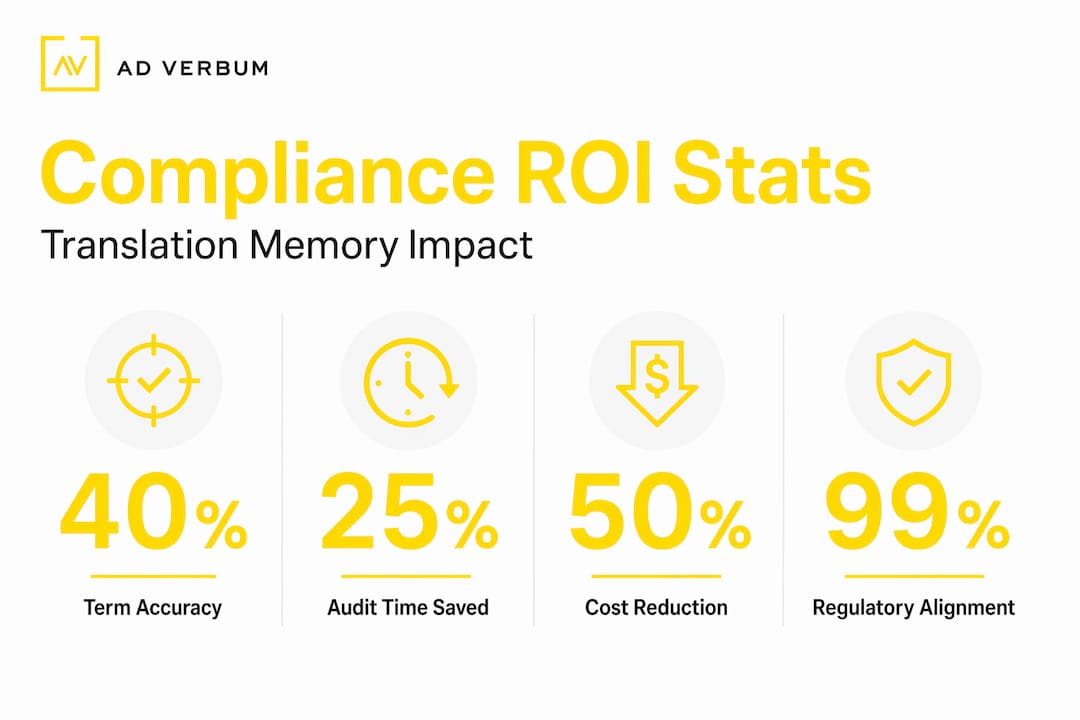
Empirical benchmarks show that high TM match rates reduce review intensity; pilots measure reuse rates, terminology compliance above the 95% target, and critical incident reduction, producing ROI through operational gains like faster audits. Let that 95% figure anchor your internal targets. Terminology compliance below that threshold signals systemic inconsistency, which is exactly the kind of pattern that triggers regulatory scrutiny.
Key ROI categories to track:
TM match rate. The percentage of incoming segments that match existing TM entries. High match rates reduce translator time and, critically, reduce the surface area for new errors to enter the document set.
Terminology compliance rate. How consistently do output documents use the approved terms from your term base? Targeting above 95% is the industry benchmark for regulated sectors.
Audit-related rework costs. Track how often translation inconsistencies generate findings during internal audits or regulatory inspections. Each finding carries remediation costs that TM-driven consistency prevents.
Time-to-submission. High TM reuse and AI-assisted generation accelerate translation turnaround. Faster submissions mean faster time-to-market for products dependent on regulatory clearance.
Regulatory incident rate. Count translation-attributable incidents per year. A properly managed TM should drive this number toward zero over successive product cycles.
Statistic callout: Organizations running structured TM programs in regulated environments frequently report that terminology compliance rates above 95% correlate directly with lower rates of deficiency findings in regulatory submissions. The cost of a single major deficiency finding typically exceeds the annual cost of a fully managed TM program.
Building a business case for TM investment means presenting both sides of that equation. On one side, the hard cost savings from reduced review time and translation rework. On the other, the risk-adjusted savings from fewer regulatory incidents, faster audits, and reduced legal exposure. When you frame TM as a risk mitigation asset rather than a translation cost, it belongs in a different conversation with leadership: the same conversation as document control systems, quality management software, and validated process tools.
The right partner matters here. Choosing a compliance translation provider with genuine regulated-sector experience means evaluating not just translation quality but TM governance, term base management, audit trail capabilities, and the security posture of the platform handling your sensitive data.
What most compliance leaders miss about translation memory
Here is the uncomfortable truth after more than two decades working with regulated organizations: most compliance leaders treat TM as an IT procurement decision, not a compliance strategy decision. They ask about licensing costs and file format compatibility. They do not ask whether the TM system meets their audit trail requirements or whether their current provider can produce segment-level records under a 48-hour regulatory inspection timeline.
That blind spot is expensive. When a major regulatory inspection hits and your legal or quality team scrambles to reconstruct translation history across three product lines in four languages, you find out quickly that a TM configured purely for efficiency was not built for defense.
The contrarian insight is this: TM’s true value does not emerge during routine operations. It emerges during crises. When a product recall requires you to audit translated labeling across every market where the product was sold, or when a regulator challenges the accuracy of a translated clinical summary, your TM either gives you answers or it does not. An underpowered TM gives you nothing.
Actionable lessons for compliance leaders who want to close this gap:
First, move beyond basic setup. A TM loaded with legacy translations and left unmanaged is a liability, not an asset. Translations approved under older regulatory guidance may no longer reflect current standards. Term bases must be actively maintained, not archived.
Second, prioritize workflow integration. TM that lives outside your quality management system is a documentation island. Integrating TM with your QMS, your regulatory information management system, and your change control process is what creates genuine traceability. That integration is what terminology enforcement for compliance actually requires in practice.
Third, invest in ongoing training. The linguists and post-editors working inside your TM-governed workflow need to understand why the rules exist, not just what the rules are. A subject-matter expert who understands why a specific term is controlled in an FDA context makes better judgment calls than one following a style guide they have never questioned.
The organizations that treat TM as a living compliance infrastructure rather than a one-time implementation consistently perform better in audit environments. They also adapt faster when regulatory guidance changes, because their terminology governance process is already in place.
Take the next step: Strengthen your compliance with expert translation support
Managing translation memory well is not just a technical challenge; it is a strategic one. AD VERBUM builds compliance-grade translation workflows for regulated sectors including life sciences, legal, finance, defense, and manufacturing. With 25+ years of regulated-sector experience, a network of 3,500+ subject-matter expert linguists, and a proprietary LangOps System hosted on EU servers under ISO 27001-certified infrastructure, AD VERBUM is structured to meet the governance, traceability, and data sovereignty requirements that regulated organizations face.
Every project ingests your existing TMs and term bases first, so approved terminology governs output from the first segment. The AI+HUMAN hybrid workflow delivers speed (3x to 5x faster than traditional processes) without sacrificing the SME review and ISO-aligned QA that compliance teams require. If your organization is ready to move from ad hoc translation management to a structured, audit-ready process, explore AD VERBUM’s regulated sector localization capabilities and industry-specific translation services to find the right fit for your compliance requirements.
Frequently asked questions
How does translation memory help with regulatory audits?
Translation memory provides a searchable audit trail with segment history, approvals, and tracked changes for regulatory inspections. TM supports regulatory compliance by maintaining audit trails and version history, giving your team auditable records on demand.
What types of compliance standards require translation memory in documentation?
Regulations like FDA 21 CFR Part 11, EU MDR, and EMA expect traceable, consistent translation management, which TM enables. These standards demand documented processes, and a properly configured TM satisfies those requirements at the segment level.
Can TM be used with AI or machine translation and still be compliant?
Yes, integrating TM with AI helps track machine outputs, editors, QA steps, and MT engine versions for compliance traceability. In AI-hybrid workflows, TM records MT engine versions, post-editor credentials, and QA reports to maintain a full compliance record.
What metrics indicate compliant translation memory use?
High TM match rates, terminology compliance above 95%, and reduction in review times and regulatory incidents signal strong TM-driven compliance. Tracking these metrics consistently gives compliance leaders objective evidence of program health.
Recommended
