


Top Secure Translation Platforms for Regulated Industries

For regulated documents, the single recommended approach is a compliance-first AI+HUMAN hybrid translation platform that enforces Bring Your Own Key (BYOK) encryption, data residency controls, and contractual no-training guarantees. AD VERBUM meets this standard with ISO 27001 and HIPAA/GDPR alignment, EU-hosted infrastructure, and certified subject-matter expert (SME) review on every project.
Non-negotiable platform elements for RFPs and SOWs:
BYOK key management and AES-256 encryption at rest
TLS 1.2+ in transit, role-based access control (RBAC), and multi-factor authentication (MFA)
Audit logs with user, timestamp, document ID, model invoked, and key rotation events
Translation Memory ™ and Term Base (TB) integration at the pipeline level
Formal SME post-editing with ISO 17100 and ISO 18587 QA sign-off
Contractual no-training guarantee and data deletion SLA
TL;DR for procurement: Require BYOK, AES-256, TLS 1.2+, RBAC, audit logs, TM/TB integration, SME post-editing, ISO 27001 certification, and a written no-training guarantee before signing any translation SOW for regulated content.
Table of Contents
What does “secure translation platform” mean for regulated documents?
How does the secure AI+HUMAN hybrid translation workflow operate?
How do MT, NMT, and proprietary LLM-based AI differ for regulated content?
What security and compliance controls should your RFP require?
What are the most common failure modes in regulated translation projects?
Standards, regulations, and sources for procurement and legal teams
What does “secure translation platform” mean for regulated documents?
A secure translation platform combines technical encryption, governance controls, and validated human review to meet the QA and compliance requirements of regulated-content workflows. The scope covers standard operating procedures (SOPs), clinical trial protocols, regulatory submissions, contracts, instructions for use (IFUs), source code comments, and engineering documentation.
What it is not: an uncontrolled free machine translation (MT) service applied to safety-critical text without human verification. Enterprise data residency controls and private deployment options are table-stakes features, not differentiators. The governing standards that define this scope are ISO 27001 (information security management), ISO 17100 (translation services quality), ISO 18587 (post-editing of MT output), HIPAA, and GDPR.
How does the secure AI+HUMAN hybrid translation workflow operate?
The workflow below is the sequence AD VERBUM uses and the one procurement should require in any SOW for regulated content.
Asset ingestion. Ingest client TMs and TBs before any generation begins. Skipping this step is the leading cause of terminology drift in AI-assisted translation.
Pre-processing. Redact or pseudonymize personally identifiable information (PII) per the applicable data processing agreement (DPA). Confirm BYOK keys are active and routing is confirmed to the contracted data region.
LLM generation. The proprietary LLM-based system produces target-language output constrained by client terminology and style guidance. Confirm the model is pinned or private; no shared public model should process regulated content without explicit training-opt-out documentation.
SME post-editing. A certified subject-matter expert reviews for technical accuracy, regulatory compliance, and contextual nuance. Human-in-the-loop verification is non-negotiable for safety-critical documentation.
ISO-aligned QA. QA aligned to ISO 17100 and ISO 18587 and, where relevant, sector requirements such as MDR.
Secure delivery. Deliver via encrypted channel. Confirm retention or deletion per contracted SLA and log the delivery event.
Pricing is typically per word or per project. AD VERBUM’s AI+HUMAN hybrid translation delivers 3x to 5x faster turnaround than traditional workflows, though SME availability and DTP complexity affect final timelines and cost.
Pro Tip: Run a pilot on a representative document set with your actual TM/TB loaded before full rollout. This is the most reliable way to detect terminology drift and process gaps before they reach a regulatory submission.
How do MT, NMT, and proprietary LLM-based AI differ for regulated content?
AI generation methods vary significantly in terminology control, auditability, and training-exposure risk. The table below maps each approach to the controls that matter for regulated workflows.
Method | Terminology governance | Training exposure risk | Audit trail | Best use case |
Legacy MT (rule-based) | Weak; no TM/TB enforcement | Low (deterministic rules) | Minimal | Internal draft only |
NMT (public SaaS engines) | Inconsistent; glossary support varies | Moderate to high without opt-out | Limited | General content, low-risk |
Hosted LLM APIs (third-party) | Variable; depends on enterprise tier | Moderate; requires written no-training guarantee | Partial | Enterprise with controls |
Private/proprietary LLM (AD VERBUM) | Enforced via TM/TB at pipeline level | Low; EU-hosted, no public cloud core | Full; user, timestamp, model, key events | Regulated, safety-critical content |
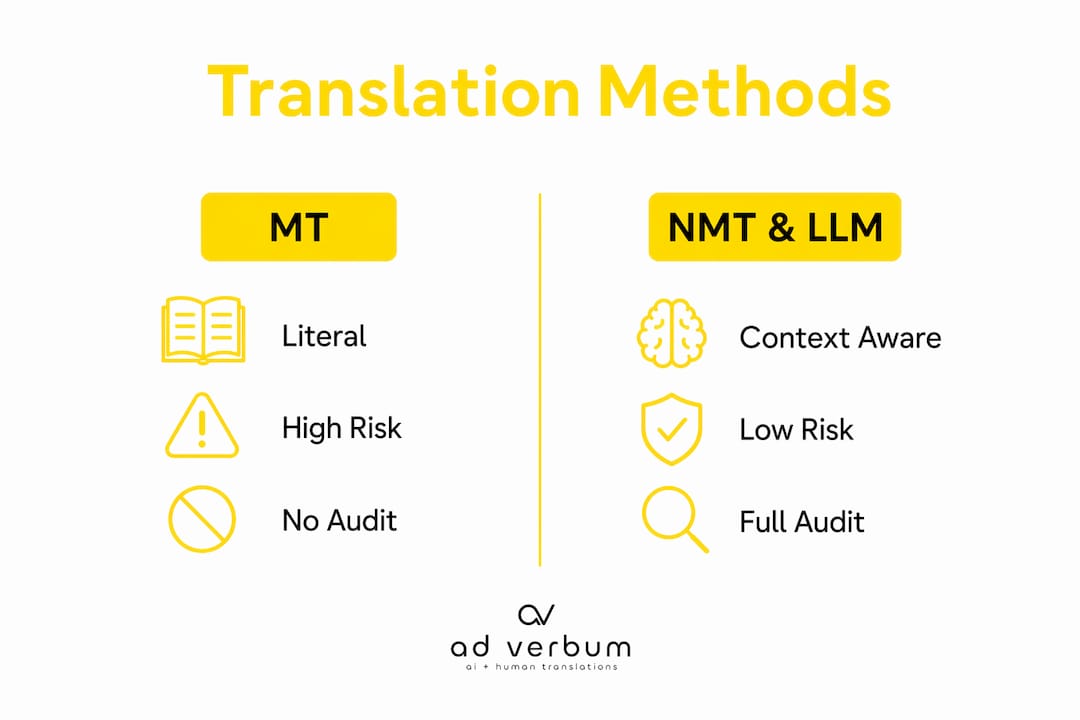
Legacy MT produces literal output with weak context handling, creating a higher likelihood of critical meaning errors in regulated text. NMT engines, including broadly available SaaS tools, show inconsistent terminology control and variable handling of negation and domain nuance. Generic machine translation lacks sufficient terminology control for regulated content. AD VERBUM’s proprietary LLM-based system uses context-sensitive generation with explicit instruction following and terminology governance, embedded in an AI+HUMAN hybrid translation workflow.
What security and compliance controls should your RFP require?
Technical controls checklist:
BYOK key management with documented key rotation schedule
AES-256 encryption at rest; TLS 1.2+ (preferably TLS 1.3) in transit
RBAC with MFA enforced for all users with document access
Encrypted backups with tested restore procedures
Data residency options confirmed in writing (EU, US, or jurisdiction-specific)
Breach notification timeline stated in the DPA (72 hours is the GDPR standard; confirm HIPAA equivalence for US-regulated content)
Contract clauses to include in SOWs:
Written no-training guarantee: customer content is not used to train or fine-tune any foundation model
TM/TB ownership: client retains full ownership; import and export rights are unrestricted
Deletion and retention: specific dates and confirmation mechanism
Audit rights: vendor must provide logs within a stated SLA; log fields must include user, timestamp, document ID, model invoked, and key rotation events
Indemnity and liability caps for regulatory failures attributable to translation errors
Certifications and audits to verify:
Certification | What it covers for translation workflows | What to still verify manually |
ISO 27001 | Information security management system | Scope of certification (does it cover translation ops?) |
ISO 17100 | Translation service quality processes | Linguist qualification records |
ISO 18587 | Post-editing of MT output | Whether post-editing is applied to all regulated content |
ISO 13485 | Medical device quality management | Whether the vendor’s scope includes your device class |
SOC 2 Type II | Security, availability, confidentiality controls | Report recency and any exceptions noted |
Bureau Veritas audit | Independent third-party verification of ISO claims | Audit date and scope statement |
Certified post-editing aligned to ISO 17100 and ISO 18587 is the formal quality assurance baseline. AD VERBUM’s certifications are independently audited by Bureau Veritas, which provides third-party verification rather than self-attestation.
For regulatory submissions that require notarized documentation, certified translation services can be integrated into the delivery package.
What does a secure platform look like in practice?
Example 1: Clinical trial protocol translation. A pharma sponsor needs a Phase III protocol translated into six languages for a multinational submission. The vendor ingests the sponsor’s existing TM and TB, activates BYOK, and routes all processing through a private model. An SME with clinical research credentials reviews each language version. QA is aligned to ISO 17100 and ISO 18587. Delivery includes a full audit trail. Turnaround for a 40-page protocol across six languages runs approximately 5–7 business days with an AI+HUMAN workflow, compared to 3–4 weeks via traditional methods. For more on this workflow, see AI+HUMAN translation in pharma.
Example 2: Medical device IFU and labeling. A medical device manufacturer needs IFUs and labeling translated for EU MDR submission. Source file DTP formatting must be preserved. The vendor enforces the client’s TB throughout generation, assigns a certified post-editor with medical device sector experience, and delivers a regulatory submission-ready package with a deletion confirmation upon project close. Acceptance criteria include zero unapproved terminology deviations and a complete change log. Complexity, DTP work, and SME availability are the primary cost drivers; projects of this type typically run 7–10 business days depending on language count and file complexity.

What are the most common failure modes in regulated translation projects?
Most failures in regulated translation are process failures, not technology failures. The TM/TB governance gap is the most common: when client terminology assets are not mapped into the translation pipeline, AI generation produces incorrect or invented technical terms.
Failure modes and mitigations:
Terminology drift. Mitigation: enforce TM/TB import at the pipeline level; run periodic terminology QA audits against the client TB.
Accidental training or data reuse. Mitigation: require a written no-training guarantee and confirm BYOK is active before any document is processed.
Weak RBAC. Mitigation: enforce MFA and document access roles in the DPA; audit user access logs quarterly.
Incomplete SME coverage. Mitigation: verify that the vendor’s SME network covers your specific domain and device class before contract signature.
Missing or incomplete audit logs. Mitigation: specify required log fields in the SOW and request a sample log before go-live.
Delayed breach notification. Mitigation: state the notification SLA explicitly in the DPA; include a tabletop incident response exercise in the onboarding plan.
Procurement request snippet: “Vendor must provide audit logs within 48 hours of request, covering user ID, timestamp, document ID, model version invoked, and key rotation events. Breach notification to the data controller must occur within 72 hours of confirmed incident.”
A pilot phase with representative documents is the most reliable verification method before production scale-up.
When does AD VERBUM fit your regulated translation project?
AD VERBUM is a compliance-first AI+HUMAN hybrid translation provider with EU-hosted infrastructure, a proprietary LangOps LLM, TM/TB integration, a 3,500+ certified SME network, and certifications covering ISO 9001, ISO 17100, ISO 18587, ISO 13485, ISO 27001, ISO 42001, and AQAP2110. Certifications are independently audited by Bureau Veritas.
AD VERBUM fits when the project involves high-risk regulatory submissions, complex engineering documentation, medical device labeling, or cross-border legal contracts where auditability and terminology governance are non-negotiable. It is the right choice when your organization needs ISO-aligned QA, HIPAA and GDPR alignment, and a private EU-hosted processing environment with no reliance on outsourced public cloud tooling.
For internal teams handling low-risk, non-regulated content at low volume, a simpler MT service may suffice. For anything touching a regulatory submission, safety-critical document, or confidential contract, the risk profile favors a provider with formal certification, SME coverage, and contractual audit rights.
Practical next steps: Request AD VERBUM’s DPA and ISO certification evidence, confirm BYOK availability for your data region, and run a pilot with a representative TM/TB set. The AI+HUMAN translation process documentation describes exactly what to expect at each stage.
Key Takeaways
Regulated translation projects require a compliance-first AI+HUMAN hybrid platform with BYOK, AES-256, TLS 1.2+, audit logs, TM/TB integration, SME post-editing, and ISO 27001 certification as non-negotiable baseline controls.
What procurement teams rarely ask but should
From the vendor side, the questions that most reliably separate a genuinely secure provider from one that only looks compliant on paper are the ones about operational artifacts, not marketing claims.
Request the vendor’s security whitepaper, sub-processor list, DPA, penetration test summary (dated within 12 months), ISO and SOC 2 evidence, sample audit logs, and SME credential lists before signing. A vendor who hesitates on any of these is signaling a gap.
Red flags to watch for: a DPA that references “reasonable efforts” rather than specific timelines; refusal to allow customer audits or log access; no TM/TB import capability; log retention periods shorter than your regulatory obligation; and SME credentials described only at the category level (“medical translator”) with no verifiable qualification detail.
A short call script that works: “Can you send us a sample audit log from a recent project, your current sub-processor list, and your DPA? We also need to confirm BYOK availability and your breach notification SLA before we proceed.” Any vendor worth contracting will respond within 24 hours with all four.
AD VERBUM: start a compliance-first translation pilot
Regulated industries need a translation partner whose security posture is verifiable, not assumed. AD VERBUM delivers AI+HUMAN hybrid translation across 150+ languages for pharma, medical device, finance, defense, and manufacturing clients, with every project backed by ISO 27001, ISO 17100, ISO 18587, ISO 13485, and AQAP2110 certifications, all independently audited by Bureau Veritas.
A pilot engagement starts with your TM/TB assets and a representative document set. AD VERBUM loads your terminology, runs the LangOps LLM under BYOK controls, assigns a certified SME from the relevant domain, and delivers with a full audit trail and QA sign-off. You receive the DPA, certification evidence, and a sample audit log before any production content is processed.
To start a pilot or request compliance documentation, visit AD VERBUM’s services page or contact the team directly.
Standards, regulations, and sources for procurement and legal teams
ISO 27001 — Information security management; confirms the vendor’s ISMS covers translation operations. Verify scope and last audit date.
ISO 17100 — Translation service quality; covers linguist qualifications, workflow, and QA processes.
ISO 18587 — Post-editing of MT output; the specific standard for AI+HUMAN hybrid translation QA.
ISO 13485 — Medical device quality management; required for IFU, labeling, and MDR submission workflows.
AQAP2110 — NATO quality assurance for defense documentation; relevant for defense and dual-use content.
SOC 2 Type II — Security, availability, and confidentiality controls; request the full report, not a summary.
HIPAA — US federal standard for protected health information; confirm the vendor’s BAA covers translation processing.
GDPR — EU data protection regulation; confirm DPA, SCCs (if applicable), and sub-processor list are current.
For vendor risk assessment templates, request third-party audit evidence from Bureau Veritas or an equivalent accredited body. For notarized commercial documents required in cross-border regulatory submissions, notarized corporate documents can be arranged through certified partners.
AD VERBUM’s compliance documentation, DPA, and pilot engagement terms are available at adverbum.com/services.
Recommended