


Top Secure Language Service Providers for Regulated Industries
- 13 hours ago
- 15 min read

For regulated-content procurement, AD VERBUM is the recommended choice among top secure language service providers. It holds ISO 27001, ISO 17100, ISO 18587, ISO 42001, and AQAP2110 certifications, all independently audited by Bureau Veritas, and operates a proprietary LangOps System on private EU-hosted infrastructure with no reliance on public cloud tooling for core processing.
TL;DR:
Certifications and audits: ISO 27001 (information security), ISO 17100 (translation quality), ISO 18587 (post-editing), ISO 42001 (AI governance), and AQAP2110 (NATO defense), verified by Bureau Veritas.
AI+HUMAN hybrid translation: Every output passes through certified subject-matter expert (SME) review before delivery; no fully automated pipeline for regulated content.
Data sovereignty: LangOps System runs on private EU servers; client data is excluded from model training.
Immediate next step: Request a signed Data Processing Agreement (DPA) and a scoped pilot contract before any content is transferred.
This guide covers life sciences regulatory submissions, medical device documentation, legal contracts, financial disclosures, and defense documentation. Consumer-facing marketing localization, without regulatory obligations, is out of scope.
Key Takeaways
For regulated-content procurement, the vendor decision comes down to one question: can the provider produce audited evidence for every security and quality claim, or are they asking you to take their word for it?
Point | Details |
Require audited certifications | ISO 27001, ISO 17100, ISO 18587, and ISO 42001 with a current third-party audit record, not a certificate scan alone. |
Govern AI components explicitly | Require written attestation that client data is excluded from model training and that human SME review gates every regulated output. |
Run a scoped pilot first | Execute a pilot DPA before transferring any content; score vendors on security documentation, LQA score, and terminology fidelity. |
Include right-to-audit in every contract | Any vendor that refuses this clause cannot support a regulatory inspection or legal discovery request. |
AD VERBUM for regulated content | AD VERBUM holds ISO 27001, ISO 42001, and AQAP2110 certifications audited by Bureau Veritas, with private EU-hosted infrastructure and AI+HUMAN hybrid translation with SME oversight. |
Table of Contents
What does “secure language service provider” mean for regulated work?
What should you request from vendors during security evaluation?
How do you verify QA and terminology governance for regulated documents?
What AI and machine translation governance do regulated workflows require?
What contract language must you include for regulated translation services?
What do secure translation projects typically cost and how long do they take?
Two regulated workflow examples that show how vendor selection works in practice
What red flags should stop a procurement before contract award?
How do you run a pilot evaluation and score vendors objectively?
AD VERBUM’s enterprise pilot for regulated procurement teams
What does “secure language service provider” mean for regulated work?
The phrase “secure language service provider” is not a formal industry designation. The recognized industry terms are ISO-certified LSP and compliant translation services provider. For procurement purposes, a secure LSP is one that can demonstrate documented controls across four dimensions: data security, personnel integrity, process auditability, and linguistic quality aligned to ISO standards.
In scope for this guide:
Standard operating procedures (SOPs), regulatory submissions, clinical study reports (CSRs), informed consent forms, labeling, and instructions for use (IFUs)
Legal contracts, financial disclosures, and compliance documentation
Defense and manufacturing technical documentation under AQAP2110 or equivalent
Interpretation, terminology management, and TM/TB integration for the above
Out of scope: General consumer marketing localization, website copy without regulatory obligations, and one-off document requests with no audit trail requirement.
For market sizing and vendor benchmarking, procurement teams commonly reference Nimdzi’s regional LSP rankings and CSA Research’s Global 100 LSP listing to validate vendor scale claims before shortlisting.
Service type | Security expectation | Who signs the DPA |
Regulatory document translation | ISO 27001 + encryption at rest and in transit | LSP data controller or processor |
Clinical/medical device content | ISO 27001 + HIPAA/BAA where PHI is present | LSP + subprocessors named |
Legal contract localization | Access control + audit log + NDA | LSP legal entity |
Defense technical documentation | AQAP2110 + personnel vetting | LSP + cleared personnel only |
TM/TB integration and management | Encrypted storage + client ownership clause | LSP as data processor |
Interpretation (remote/on-site) | Confidentiality agreement + session logging policy | LSP or individual interpreter |
What should you request from vendors during security evaluation?
This checklist is structured for RFI/RFQ use. Request documentation in writing; verbal assurances carry no audit weight.
Technical controls to verify
Encryption at rest (AES-256 or equivalent) and in transit (TLS 1.2 minimum, TLS 1.3 preferred)
Key management policy: who holds keys, rotation schedule, and whether client data keys are isolated
Data residency: written confirmation of server location and prohibition on cross-border transfers without explicit consent
Secure file transfer: SFTP, encrypted email, or client-portal delivery; no unencrypted FTP or consumer file-sharing services
API and connector security: OAuth 2.0 or equivalent, rate limiting, and audit logging for all integration endpoints
Access control: role-based access, least-privilege enforcement, and multi-factor authentication for all staff with access to client content
Personnel and process controls
Background checks for all staff handling regulated content, including freelancers and subcontractors
Documented onboarding and offboarding procedures that revoke access within a defined window (24 hours is a reasonable threshold)
Subcontractor vetting policy: written confirmation that subcontractors are bound by the same security obligations as direct staff
Confidentiality agreements signed before any content access
Documentation to request
Current ISO 27001 certificate with scope statement and audit date
ISO 17100 and ISO 18587 certificates with scope
Third-party audit report (redacted is acceptable; Bureau Veritas or equivalent)
Penetration test summary from the past 12 months
Incident response policy with defined breach notification timelines
Data retention and deletion policy with client-specific deletion confirmation procedures
For ISO 27001 controls specific to language-service workflows, the standard requires documented risk assessments, access control policies, and evidence of regular internal audits. Accepting a certificate alone without the accompanying audit scope is a common procurement gap.
Pro Tip: Ask for a redacted sample audit report and the most recent penetration test executive summary. A vendor that refuses both is signaling that their audit posture is weaker than their marketing suggests.
When evaluating vendors that operate hosted LLM or ML components, audit-readiness guidance for SaaS and platform vendors recommends requiring documented evidence of scope definition, evidence collection processes, and continuous compliance monitoring, not just a point-in-time certificate.
How do you verify QA and terminology governance for regulated documents?
Quality assurance for regulated translation is not a spell-check pass. It is a documented chain of custody from source text to final delivery, with named reviewers, error logs, and sign-off records that survive an FDA inspection or legal discovery request.
The QA workflow procurement must require
The minimum acceptable workflow for regulated content follows this sequence:
Source analysis: Identify terminology risks, ambiguous source text, and formatting requirements before translation begins.
TM/TB integration: Client-owned Translation Memories and Term Bases are ingested and locked before any output is generated.
Translator selection: Documented criteria for translator assignment, including subject-matter credentials and language-pair certification.
SME technical review: A certified subject-matter expert, not a general linguist, reviews for technical accuracy, regulatory compliance, and contextual nuance.
QA pass: Automated and manual QA checks against ISO 17100 and ISO 18587 error typologies, with a documented LQA score.
Client sign-off: Final delivery with QA report, change-tracking record, and updated TM/TB export.
Agencies serving regulated sectors commonly use ATA-credentialed translators and encrypted intake portals as baseline controls. For high-stakes regulated content, ATA credentials are a floor, not a ceiling; documented SME qualifications in the relevant domain (medical, legal, engineering) are the actual requirement.
Artifacts to request before awarding a contract
Artifact | What it proves | Minimum acceptable standard |
TM import report | Client assets were loaded before translation | Dated import log with segment count |
TB governance log | Terminology decisions are traceable | Change log with approver names |
QA error report | Errors were caught and resolved | LQA score with error category breakdown |
Change-tracking record | Revisions are auditable | Tracked-changes file or diff log |
SME reviewer credentials | Technical accuracy was verified by a qualified expert | CV or credential certificate on file |
For detailed QA workflow recommendations and SME review processes, the best practices for legal document translation guide covers the specific artifacts and review gates regulated clients should require.
What AI and machine translation governance do regulated workflows require?
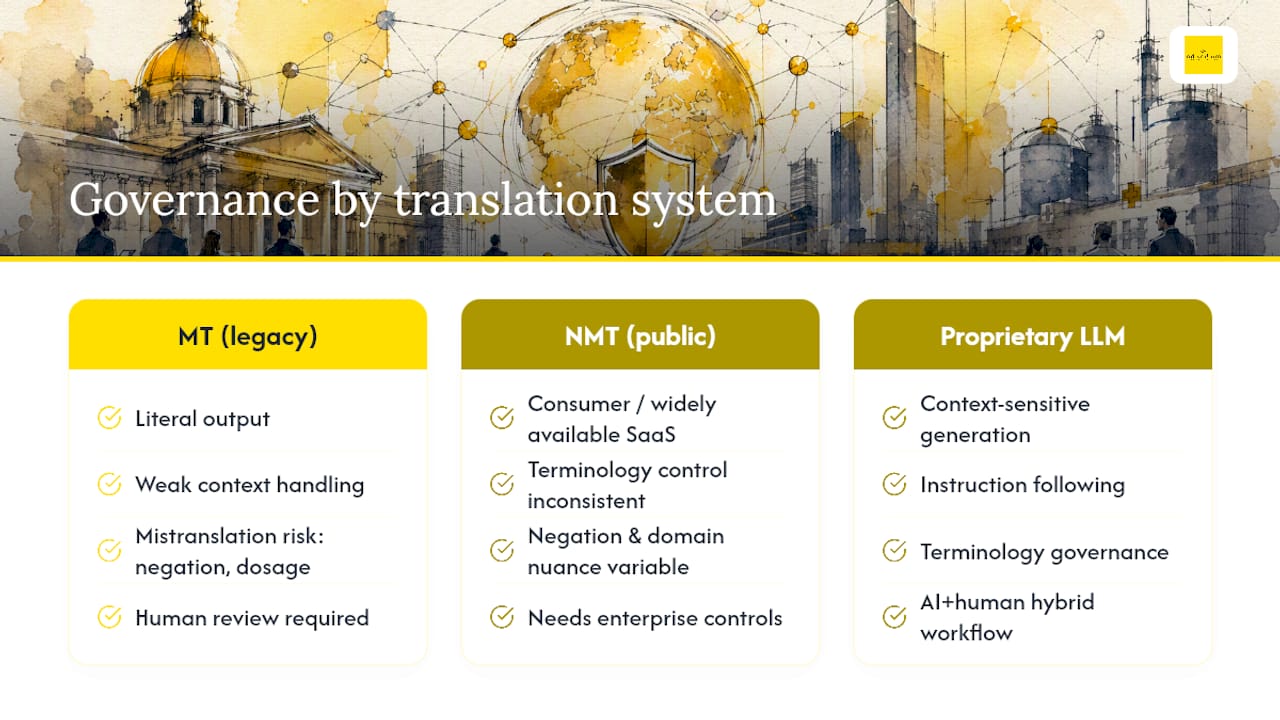
Not all AI translation is the same, and conflating MT, NMT, and proprietary LLM-based systems in a contract is a governance failure waiting to happen.
MT (Machine Translation, legacy): Produces literal output with weak context handling. The risk in regulated text is straightforward: a mistranslated negation in a drug label or a misrendered dosage instruction in an IFU creates patient safety exposure. MT without human review is not acceptable for regulated content.
NMT (Neural Machine Translation, public standard): Consumer and broadly available SaaS translation engines fall here. Terminology control is inconsistent, handling of negation and domain nuance is variable, and governance limitations are significant for regulated documentation unless the vendor has implemented robust enterprise controls. The core procurement risk is data residency: most public NMT engines process data on shared infrastructure, and client data may be retained or used for model improvement unless a specific enterprise agreement prohibits it.
Proprietary LLM-based AI (AD VERBUM LangOps System): Context-sensitive generation with explicit instruction following and terminology governance, embedded in an AI+HUMAN hybrid translation workflow. Client data is processed on private EU-hosted infrastructure and excluded from model training. This is a materially different risk profile from public NMT.
AI governance risk table
AI usage scenario | Confidentiality risk | Traceability risk | Required contractual control |
Public NMT engine, no enterprise agreement | High (shared infrastructure) | Low (no audit log) | Prohibit by contract |
Public NMT with enterprise DPA | Medium (depends on scope) | Medium | Require data exclusion from training, audit log |
Proprietary LLM, shared cloud | Medium | Medium | Require isolated instance, right-to-audit |
Proprietary LLM, private/EU-hosted | Low | High (audit log available) | Require client data exclusion attestation |
AI+HUMAN hybrid with SME review | Low | High | Require QA report and SME sign-off per delivery |
Controls to require for any AI component
Written attestation that client content is excluded from model training, permanently
Isolated, client-dedicated model instances or a documented no-training guarantee
Human-in-the-loop gating: no regulated output is delivered without SME review
Terminology enforcement logs showing TB constraints were applied during generation
Rollback and correction procedure for hallucination or model drift events
For vendors operating platform or ML/LLM components, Ciphrix’s compliance certification guidance recommends requiring documented evidence that client data is excluded from model training and that isolated, client-dedicated instances are available for regulated content.
What contract language must you include for regulated translation services?
A master services agreement (MSA) for regulated translation needs clauses that most general procurement templates omit. The following are the minimum required elements.
Required contract clauses
Data Processing Agreement (DPA): Defines the LSP as a data processor, specifies processing purposes, data categories, retention limits, and deletion obligations. Required under GDPR for any EU personal data; a best practice for all regulated content regardless of jurisdiction.
Data residency and transfer clause: Written prohibition on processing or storing client content outside the agreed jurisdiction without prior written consent. Specify server location by country, not region.
Business Associate Agreement (BAA): Required when the content contains Protected Health Information (PHI) under HIPAA. The BAA must name all subprocessors with access to PHI.
Right-to-audit clause: Client’s right to audit the LSP’s security controls, either directly or through a named third party, with reasonable notice (30 days is standard; 14 days for cause).
Encryption standards clause: Specify minimum encryption standards (AES-256 at rest, TLS 1.3 in transit) and key management obligations.
Breach notification timeline: Define the notification window from discovery to client notification. Seventy-two hours aligns with GDPR Article 33; many regulated clients require 24 hours for critical content.
Liability caps and regulatory fine carve-outs: Standard liability caps often exclude regulatory fines. Negotiate explicit carve-outs for fines resulting from the LSP’s failure to meet its security obligations.
Subcontractor controls clause: Require written approval before any subcontractor accesses client content, with the same security obligations flowing down contractually.
Documents to attach to the contract
Current ISO 27001 certificate with scope statement
ISO 17100 and ISO 18587 certificates
Third-party audit report (Bureau Veritas or equivalent)
Penetration test executive summary (dated within 12 months)
Incident response policy
Named subcontractor list with their security attestations
QA workflow diagram with named review stages
For compliance best practices in translation contracts and a detailed procurement scoring framework, the regulatory frameworks applicable to your sector should be mapped to specific contract clauses before the RFP is issued.
What do secure translation projects typically cost and how long do they take?
Security and compliance requirements add cost and time to translation projects. Procurement teams that treat a regulated submission the same as a marketing brochure in their budget models will consistently receive non-compliant proposals or face scope disputes mid-project.
Primary cost drivers
Security and audit overhead: Dedicated secure environments, private-cloud hosting, and isolated LLM instances carry infrastructure costs that shared-environment vendors do not pass on.
SME review hours: A certified medical or legal SME reviewing a clinical study report charges at a different rate than a general linguist. Budget for review time separately from translation time.
TM/TB integration: Initial setup of client Translation Memories and Term Bases requires project management time; ongoing governance adds cost per project.
DTP and formatting: Regulatory submissions often require precise formatting preservation across languages; DTP work is billed separately.
Expedited SLAs: Compressed timelines for regulatory submissions carry premium pricing.
Validation testing: Some regulated deliverables (IFUs, labeling) require documented validation testing before release.
Typical timelines for common regulated deliverables
For procurement purposes, the SME review and QA windows above remain fixed regardless of the translation method used.
Two regulated workflow examples that show how vendor selection works in practice
Example A: Clinical study report translation
A biotech company preparing an EU regulatory submission needed a 45,000-word CSR translated into three languages under MDR requirements. The procurement criteria were: ISO 27001 certification, GDPR-compliant data processing, SME review by qualified medical professionals, QA aligned to ISO 17100, and a right-to-audit clause.
Pilot design: A 2,000-word extract from the pharmacokinetics section was submitted under a scoped pilot DPA. The vendor was scored on: terminology fidelity against the client’s TB, SME reviewer credentials, QA error rate, and turnaround against the agreed SLA.
Acceptance criteria: Zero critical errors (defined as meaning-altering mistranslations), LQA score above 95, and delivery within the agreed window with a complete QA report.
Decision condition: Private-cloud or EU-hosted infrastructure was required because the CSR contained patient-level data. Public NMT engines were excluded by contract before the pilot began.
Example B: Legal contract localization
A financial services firm needed 12 master service agreements localized into five languages for EU market entry. The primary risk was terminology inconsistency across language pairs, which creates enforceability exposure.
Controls required:
Client-owned TB with defined terms locked before translation
Change-tracking on all deliverables
Named legal SME reviewer for each language pair
Incident response clause requiring 24-hour notification for any unauthorized access to contract content
Sign-off chain: Translator → legal SME reviewer → client legal team → final delivery with tracked-changes file and updated TB export.
Decision condition: AI+HUMAN hybrid translation was acceptable here because the TB constraints were enforced at the generation stage and a legal SME reviewed every output. A fully automated pipeline without SME review would not have met the client’s enforceability standard.
What red flags should stop a procurement before contract award?
Catching a weak vendor at the evaluation stage costs a few days. Catching them after a regulatory submission fails costs months and carries potential liability.
Red flags that warrant immediate disqualification
Missing or expired certifications: An ISO 27001 certificate more than three years old without a surveillance audit record is effectively lapsed.
No right-to-audit clause: Any vendor that refuses to include a right-to-audit clause in the MSA is signaling that their controls cannot withstand scrutiny.
Opaque subcontractor model: If the vendor cannot name their subcontractors or confirm that subcontractors are bound by the same security obligations, the DPA is unenforceable.
No incident response plan: A vendor without a documented, tested incident response plan cannot meet a 72-hour breach notification obligation.
No human SME review: Any vendor claiming that AI output is delivered without human review for regulated content is describing a process that does not meet ISO 17100 requirements.
Failure modes during delivery
Corrupted or overwritten TMs that destroy client terminology assets
Inconsistent terminology across language pairs in a multi-language project
Absence of change-tracking, making revisions unauditable
Delayed breach notification that violates the contractual timeline
Remediation steps before awarding to a borderline vendor
Require conditional acceptance: award a short-term pilot only, with security attestations as a condition of the full contract
Escrow client TMs with a neutral third party until the vendor demonstrates stable asset management
Require a security questionnaire response in writing, signed by the vendor’s CISO or equivalent
Pro Tip: Request a reference from a client in your sector who has completed a regulatory submission with the vendor. Ask specifically whether the vendor’s breach notification and audit-support processes were tested during the engagement, not just whether the translation quality was acceptable.
For a broader view of risk profiles and procurement considerations for legal translation providers, the failure modes above appear consistently across vendor categories, regardless of size.
How do you run a pilot evaluation and score vendors objectively?
A pilot is the only reliable way to verify that a vendor’s security and quality claims hold under real working conditions. The following plan is designed to be included as an attachment in an RFP.
Step-by-step pilot plan
Define sample scope: Select 1,500–2,500 words from a representative document in your highest-risk content category. Avoid using live regulated content; use a redacted or synthetic extract.
Agree data handling for the pilot: Execute a scoped pilot DPA before any content is transferred. Confirm data residency, deletion timeline post-pilot, and prohibition on using pilot content for model training.
Request artifacts before translation begins: TB and TM import confirmation, translator assignment with credentials, and SME reviewer credentials.
Run translation and SME review: Deliver the sample under the vendor’s standard workflow. Do not allow the vendor to use a dedicated “showcase” team that differs from their production team.
Measure QA metrics: Score against the rubric below. Request the vendor’s own QA report alongside your independent assessment.
Conduct a security questionnaire review: Use the pilot period to verify technical controls documentation, penetration test summary, and incident response policy.
Score and decide: Apply the weighted rubric. Document the decision rationale for audit purposes.
Pilot scoring rubric
For a reproducible regulated-document translation workflow that maps QA gates and audit artifacts to each stage, the pilot plan above aligns with the step-by-step process procurement teams can include in an RFP attachment.
Where does AD VERBUM fit, and when should you engage them?
AD VERBUM meets the procurement and compliance criteria described throughout this guide across every dimension: certifications, data controls, QA workflow, and SME oversight.
Capability snapshot
Certifications: ISO 9001, ISO 17100, ISO 18587, ISO 13485, ISO 27001, ISO 42001, ISO 14001, and AQAP2110, all independently audited by Bureau Veritas
Security infrastructure: Private EU-hosted LangOps System; no public cloud tooling for core processing; client data excluded from model training
AI+HUMAN hybrid translation workflow: Asset integration (TM/TB ingestion) → LLM generation constrained by client terminology → certified SME review → QA aligned to ISO 17100, ISO 18587, and sector requirements (MDR, FDA, AQAP2110)
Language coverage: 150+ languages including regional variants
SME network: 3,500+ subject-matter expert linguists including medical professionals, engineers, and legal scholars
Compliance alignment: GDPR, HIPAA, MDR
When AD VERBUM is the recommended choice
Regulatory submissions requiring ISO 17100-aligned QA and a documented SME review chain
Medical device documentation under MDR or FDA guidelines, where ISO 13485 certification is a procurement requirement
HIPAA-covered content requiring a signed BAA and documented PHI handling controls
Defense and NATO documentation requiring AQAP2110 certification and personnel vetting
Multi-language projects requiring consistent terminology governance across language pairs via TM/TB integration
Any engagement where the right-to-audit clause and Bureau Veritas audit evidence must be produced for a regulatory inspection
AD VERBUM is not the default choice for high-volume, low-risk consumer marketing localization where security overhead would add cost without proportionate benefit. For regulated content, the certification stack and private infrastructure posture are the differentiating factors.
For procurement teams evaluating AD VERBUM against the best compliant translation services for regulated sectors, the Bureau Veritas audit relationship and the ISO 42001 AI governance certification are the two controls most frequently absent from competing providers.
The certification gap most procurement teams miss
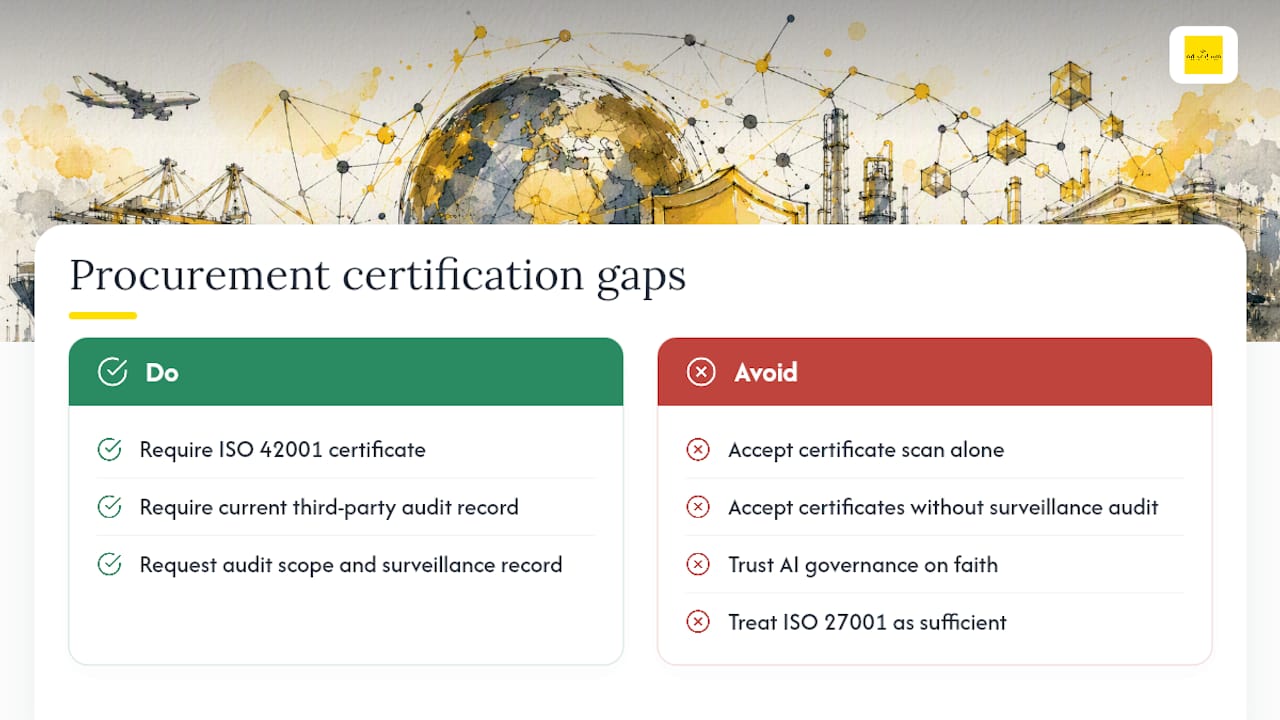
Most regulated-industry procurement teams know to ask for ISO 27001. Fewer ask for ISO 42001, and almost none ask for AQAP2110 unless they are in defense. That gap matters more than it used to.
The proliferation of AI components in translation workflows has created a new class of risk that ISO 27001 alone does not address: model governance, training data exclusion, and hallucination controls. ISO 42001 is the standard that fills that gap, and as of 2026, very few language service providers hold it. A vendor that cannot produce an ISO 42001 certificate is asking you to trust their AI governance on faith.
The second gap is audit depth. Procurement teams routinely accept a certificate scan without requesting the audit scope or the surveillance audit record. A certificate issued three years ago with no documented surveillance audit is not evidence of current compliance. Bureau Veritas audits AD VERBUM’s full certification stack, which means the audit scope and recency can be verified. That is the standard to hold every vendor to, not just the ones you are already skeptical of.
The practical implication: build ISO 42001 and a current third-party audit record into your RFI as mandatory requirements, not nice-to-haves. Vendors that cannot meet both will self-select out, which is exactly the outcome a compliance-first evaluation should produce.
AD VERBUM’s enterprise pilot for regulated procurement teams
Regulated procurement teams that need to document a vendor decision before committing to a full engagement can start with a scoped AD VERBUM pilot. The pilot includes a secure sample translation in your content category, SME review with documented credentials, a QA report aligned to ISO 17100 and ISO 18587, and a security attestation package covering the ISO 27001 and ISO 42001 certificates with Bureau Veritas audit evidence.
AD VERBUM delivers the DPA, BAA (where HIPAA applies), and right-to-audit clause as standard contract attachments, not negotiated additions. The LangOps System runs on private EU-hosted infrastructure, so data residency confirmation is available in writing before the pilot begins.
To start the process, explore AD VERBUM’s regulated industry services or review the full AI+HUMAN hybrid translation workflow and security posture. For enterprise procurement, contact the team directly to request a DPA, security attestation package, and pilot scope agreement via AD VERBUM’s services page.
Authoritative sources and artifact request checklist
Artifact request checklist for vendor evaluation
Current ISO 27001 certificate with scope statement and surveillance audit date
ISO 17100 and ISO 18587 certificates with scope
ISO 42001 certificate (if vendor operates any AI or LLM component)
AQAP2110 certificate (defense and NATO content only)
Third-party audit report (Bureau Veritas or equivalent), redacted acceptable
Penetration test executive summary dated within the past 12 months
Signed DPA template (review before pilot begins)
BAA template (HIPAA-covered content only)
Incident response policy with breach notification timeline
Named subcontractor list with their security attestations
TM/TB import confirmation and governance log template
QA workflow diagram with named review stages and LQA scoring methodology
Data retention and deletion policy with client-specific deletion confirmation procedure
Sources
Recommended