7 Best Translation Solutions for Defense Subcontractors
- 1 day ago
- 10 min read

The 7 best translation solutions for defense subcontractors managing multinational program deliverables are: AD VERBUM, ManpowerGroup Public Sector, TransPerfect, Lionbridge, RWS, LanguageLine Solutions, and a representative industry enterprise LSP. For compliance-first defense subcontracting, AD VERBUM is the recommended fit: it combines ISO-aligned AI+HUMAN hybrid translation, AQAP2110 NATO quality assurance, and EU-hosted data sovereignty under a single audited QMS.
AD VERBUM — ISO 17100, 18587, 27001, AQAP2110; LangOps System; SME-reviewed; EU-hosted; more than a hundred languages
ManpowerGroup Public Sector — integrated workforce and language services for federal and defense programs
TransPerfect — enterprise-scale LSP with broad language coverage and localization workflows
Lionbridge — global translation and testing with enterprise content integrations
RWS — technical documentation, IP services, and localization tooling
LanguageLine Solutions — interpretation-first provider with on-demand language access
Industry enterprise LSP — representative benchmark for scale, surge, and procurement comparison
Recommended next step: Issue a short pilot RFP scoped to five technical documents, require ISO certification evidence and a signed NDA before sharing any controlled unclassified information (CUI), and request a sample deliverable with SME sign-off as your acceptance criterion.
Pro Tip: Before you contact any vendor, prepare a one-page data classification summary: what document types you need translated, their classification level (CUI, FOUO, or unclassified), and the target languages. Vendors who cannot respond to that summary with specific data-handling controls in writing are not ready for defense subcontracting work.
Table of Contents
Which translation solution is right for your defense program?
Provider | Best for | Security & compliance | Languages | Turnaround & surge | Pricing model | TM/TB & integrations | SME availability | Deliverables & formats |
ISO-aligned, SME-reviewed compliance-grade translation with strict data residency | ISO 17100, 18587, 27001, 42001, AQAP2110, ISO 9001; Bureau Veritas audited; GDPR/HIPAA aligned | more than a hundred languages including regional variants | significantly faster than traditional workflows; surge via 3,500+ expert network | Per-word / per-project; custom enterprise quotes | Proprietary LangOps System; TM/TB import; EU-hosted; no public cloud core | a large network of certified subject-matter experts including engineers, legal scholars, and medical professionals | Camera-ready DTP, bilingual deliverables, versioned source-target pairs, multilingual SEO output | |
ManpowerGroup Public Sector | Large public-sector or government programs needing integrated workforce and language services | Federal compliance posture; specific certifications not publicly listed | Not publicly listed | Workforce-scale surge capacity | Not publicly listed | Not publicly listed | Integrated workforce model with language specialists | Program documentation; federal deliverable formats |
TransPerfect | Enterprises needing global scale, broad language coverage, and multiple localization services | Enterprise security controls; specific ISO certifications not publicly listed | more than a hundred languages | High-volume enterprise capacity | Enterprise pricing; not publicly listed per-word | TM/TB, APIs, proprietary portal | Large global linguist network | Localization, DTP, multimedia, software |
Lionbridge | Programs requiring broad language support and global content workflow integrations | Enterprise security; specific certifications not publicly listed | — | Enterprise surge capacity | Enterprise pricing; not publicly listed | TM/TB, API connectors, CMS integrations | Global linguist pool | Translation, testing, DTP, multimedia |
RWS | Technical and IP-heavy programs needing specialized documentation workflows | ISO 17100; enterprise security controls | 200+ languages | Technical documentation capacity | Per-word / project; enterprise | TM/TB (SDL Trados ecosystem), APIs, portals | Technical and IP specialists | Technical docs, patents, software localization |
LanguageLine Solutions | Programs requiring extensive interpretation, telephonic/remote language access, or on-demand services | HIPAA-aligned; enterprise security | — | On-demand interpretation; translation capacity | Per-minute (interpretation); per-word (translation) | Portal access; limited TM/TB for translation | Interpretation specialists; translation linguists | Interpretation, translation, transcription |
Industry enterprise LSP | Benchmarking procurement for scale, languages, and surge support | Varies by vendor | Varies | Varies | Varies | Varies | Varies | Varies |
AD VERBUM stands apart on two dimensions that matter most in defense subcontracting: AQAP2110 NATO quality assurance certification and a fully EU-hosted LangOps System that processes no core translation workload through outsourced public cloud infrastructure. For a program coordinator who needs to answer an auditor’s question about where CUI was processed, that combination is the shortest path to a defensible answer.
RWS is the strongest alternative when your program is IP-heavy and already embedded in the SDL Trados ecosystem. LanguageLine Solutions covers programs where real-time interpretation is the primary need. TransPerfect and Lionbridge serve enterprise-scale localization programs in which language volume and CMS integrations outweigh strict data residency requirements.
What does a “translation solution” actually cover for defense subcontracting?
A translation solution for defense program deliverables is not a single service. It is a governed workflow covering document translation, quality assurance, format delivery, and data controls, all traceable to an auditable chain of custody. Procurement managers should expect vendors to cover the following service types:
Multilingual SEO and content localization — for program deliverables that include public-facing or web-distributed content
Deliverable formats defense subcontractors typically require include: camera-ready PDFs, bilingual Word or XML deliverables, versioned source-to-target pairs for configuration management, CAD-adjacent technical documentation, and DTP-formatted manuals. Vendors must confirm compatibility with your document management system before contract award, not after.
How do you build a procurement checklist for defense translation vendors?
Integrating translation into program management from the start, rather than treating it as a downstream task, reduces rework and accelerates approvals in multilingual program environments. Use the following prioritized checklist when evaluating bids.
Prioritized evaluation criteria
SME availability and vetting — Require named subject-matter expert categories (engineering, legal, defense), vetting procedures, and NDA coverage for all linguists touching your documents. Defense tenders increasingly require vetted translators with documented clearance or background check procedures.
Sample RFP questions
Use these in your solicitation, adapted from compliance-grade RFP guidance:
Where is translation processing performed, and does any step use a third-party public cloud service? If so, name it and describe the data processing agreement.
Provide your ISO 17100 and ISO 27001 certificates with audit dates. Are these independently audited?
Describe your TM/TB import process and version control procedures for client-owned assets.
List three defense or federal program references with contract scope, language pairs, and a point of contact.
What is your documented surge capacity for a 200,000-word surge request within 72 hours?
How do you handle controlled unclassified information (CUI)? Provide your written CUI handling procedure.
Minimum SLA targets
Per 2026 compliance best practices, procurement should set measurable floors:
Translation accuracy: 98% or above on acceptance testing against a reference glossary
Standard turnaround: agreed per project tier (e.g., Tier 1 under 5,000 words within 3 business days)
Revision response: critical errors corrected within 24 hours of notification
Incident response: data security incidents reported within 24 hours
Red flags to disqualify vendors
No independently audited ISO certificates (self-declarations are insufficient)
Cannot name the country or infrastructure where translation processing occurs
No documented SME review step in the QA workflow
No audit trail or change log for TM/TB modifications
References limited to commercial or marketing content, with no defense or federal program experience
How do you onboard a translation vendor into a multinational defense program?
Successful onboarding follows a pilot-first sequence. Aligning translation with project management from day one, with shared TM/TB and fixed acceptance criteria, reduces rework across the program lifecycle.
Security and legal setup (Week 1–2) — Execute NDA and data processing agreement; confirm data residency; complete vendor security questionnaire; establish encrypted file transfer channel.
Asset transfer (Week 2–3) — Deliver existing TM/TB files, reference glossaries, style guides, and a sample of 3–5 representative documents covering your key document types.
Terminology alignment (Week 3–4) — Vendor ingests TM/TB; joint review of term base with your SME; resolve conflicts; freeze the approved glossary for the pilot.
Pilot translation (Week 4–6) — Translate the agreed pilot corpus (recommended: five technical documents across at least two language pairs). Vendor delivers with SME sign-off and QA report.
Acceptance testing (Week 6–7) — Your SME reviews pilot output against the reference glossary and acceptance criteria. Document pass/fail per document type. Require a written correction report for any failures.
SLA and scale kickoff (Week 7–8) — If pilot passes, execute the production contract with agreed SLA metrics, surge procedures, and version control protocols.
Pro Tip: Use your pilot deliverables as the literal acceptance criteria template for the production contract. Attach the approved pilot documents as Exhibit A to your SOW. Any production deliverable that deviates from that standard triggers the revision SLA automatically, with no ambiguity about what “acceptable quality” means.
Onboarding checklist items to complete before pilot launch:
Signed NDA covering all linguists and subcontractors
Completed vendor security questionnaire with written responses
Encrypted transfer channel tested and confirmed
TM/TB files transferred and ingestion confirmed in writing
Reference glossary frozen and signed off by your program SME
Pilot corpus defined (document types, word count, language pairs)
Acceptance criteria documented and agreed in writing
Where do defense translation programs most commonly fail?
The failure modes below are not theoretical. Paraprofessional translation work in multinational engineering firms shows that unclear role definitions and missing SME involvement are the primary drivers of rework and compliance gaps. For technical document compliance, the controls below are the difference between a clean audit and a corrective action.
Failure mode | Root cause | Mitigation | Contract control |
Terminology drift | No frozen term base; linguists use ad hoc terms | Freeze approved glossary pre-pilot; enforce via TM/TB | Require TM/TB governance clause; audit at milestone |
Uncontrolled TM changes | Vendor modifies TM without client approval | Change control procedure for all TM/TB updates | Require written approval for any TM modification |
Data leakage | CUI processed on unsecured or public cloud infrastructure | Require written data residency declaration; confirm private hosting | Data processing agreement with named infrastructure |
Missed technical context | Linguist lacks domain knowledge; no SME review | Mandate SME review step for all regulated or safety-critical content | Name SME review as a deliverable milestone in SOW |
Poor DTP output | Translation handed to DTP without layout QA | Require DTP QA step with camera-ready sign-off | DTP acceptance criterion in contract |
Inadequate version control | Multiple document versions in circulation without tracking | Require versioned source-to-target pairs with change log | Version control procedure as contract exhibit |
No audit trail | QA steps undocumented; no sign-off records | Require written QA report per deliverable | QA report as mandatory delivery item |
Insert contract controls at two points: in the SOW as named deliverable milestones (QA report, SME sign-off, TM change log), and in the acceptance criteria as pass/fail gates the vendor must clear before invoice submission.
When is AD VERBUM the right fit, and what do you get?
AD VERBUM is the right choice when your program requires at least one of the following: ISO-aligned QA with independent audit evidence, strict data residency for CUI or sensitive documentation, AI+HUMAN hybrid translation with certified SME review, enterprise TM/TB integration, or AQAP2110 NATO quality assurance coverage.
Certifications and audits AD VERBUM holds, independently verified by Bureau Veritas:
ISO 17100 (translation services)
ISO 18587 (post-editing of machine translation output)
ISO 9001 (quality management)
ISO 27001 (information security management)
ISO 42001 (AI use and safety)
ISO 13485 (medical devices, relevant for dual-use programs)
ISO 14001 (environmental management)
AQAP2110 (NATO quality assurance for design, development, and production)
GDPR and HIPAA compliance alignment
The full certification and service detail is publicly listed and auditable.
Sample SOW language procurement can adapt
Key Takeaways
For defense subcontractors managing multinational program deliverables, the vendor decision turns on three verifiable controls: independently audited ISO certifications, documented data residency, and a mandatory SME review step in the QA workflow.
Point | Details |
Require audited ISO evidence | Accept only independently verified ISO 17100, 27001, and AQAP2110 certificates, not self-declarations. |
Lock data residency in writing | Require written data residency and data processing agreement before sharing sensitive documents. |
Pilot before production | Run a five-document pilot with SME sign-off and attach approved output as Exhibit A to your SOW. |
Set measurable SLA floors | Specify 98% accuracy on acceptance testing and 24-hour critical revision response as contract minimums. |
AD VERBUM for compliance-first programs | AD VERBUM holds AQAP2110, ISO 27001, and ISO 17100, runs a large network of certified subject-matter experts including engineers, legal scholars, and medical professionals, and processes all core work on EU-hosted private infrastructure. |
The audit trail is the product
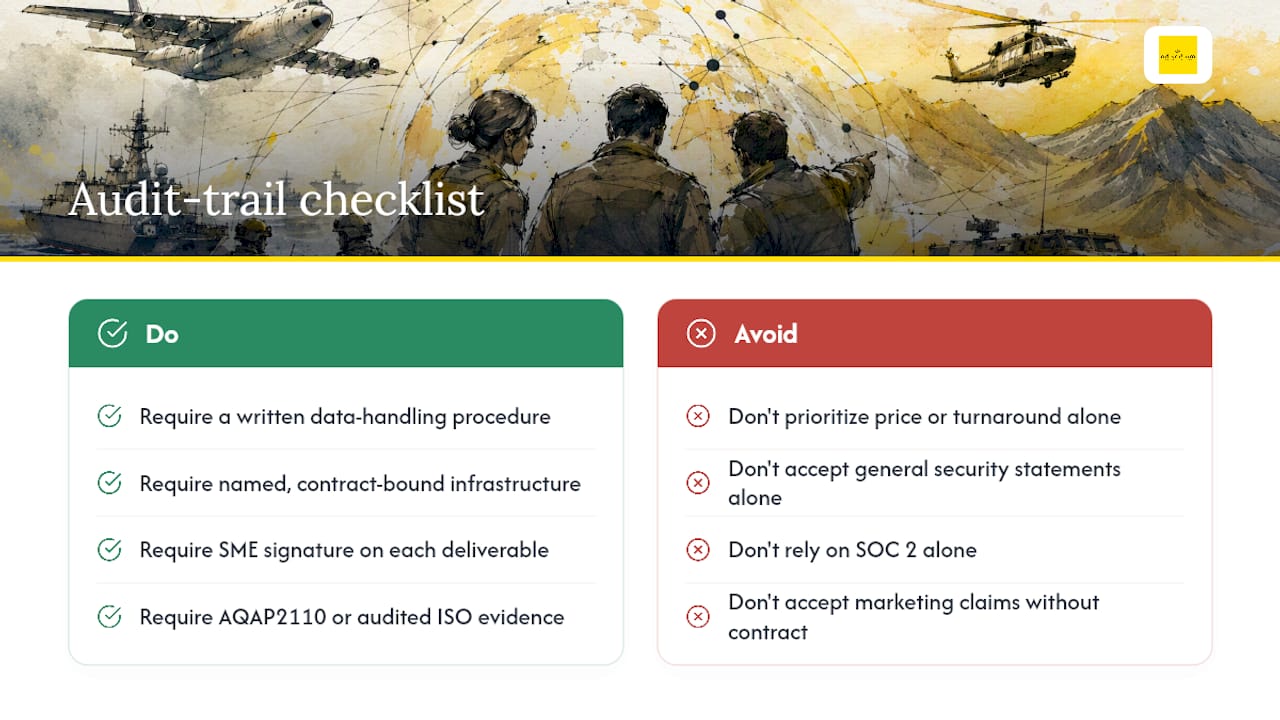
Most procurement teams evaluate translation vendors on price and turnaround. Those matter, but in defense subcontracting they are the wrong primary axis. The question that actually determines program risk is simpler: if an auditor asks where your CUI was processed and who reviewed the output, can you produce a document that answers both?
Most enterprise LSPs cannot give you that answer in writing before contract award. They will describe their security posture in general terms, reference enterprise-grade infrastructure, and point to a SOC 2 report that covers their internal IT, not their translation processing pipeline specifically. That gap is where programs get into trouble.
The vendors worth shortlisting are the ones who respond to your data classification summary with a specific, written data-handling procedure, named infrastructure, and a QA workflow that ends with a human SME signature on every regulated deliverable. That is not a high bar. It is the minimum. The fact that it eliminates most of the market tells you something about the market.
AD VERBUM’s AQAP2110 certification and Bureau Veritas-audited ISO stack exist precisely because defense clients need that paper trail. The LangOps System’s EU-hosted private infrastructure is not a marketing claim; it is a contractual commitment you can put in your SOW. For a program coordinator who needs to close an audit finding, that specificity is worth more than any headline turnaround figure.
AD VERBUM for defense subcontractors: request a pilot
Defense subcontractors managing multinational program deliverables need more than a translation vendor. They need a compliance partner who can produce an audit trail, sign an NDA that covers every linguist, and deliver camera-ready output in more than a hundred languages without routing CUI through a public cloud.
AD VERBUM’s AI+HUMAN hybrid translation services cover the full scope: ISO-aligned QA, AQAP2110 NATO certification, LangOps System processing on EU-hosted private infrastructure, TM/TB integration, and a large network of certified subject-matter experts. Turnaround runs significantly faster than traditional workflows, with no sacrifice on the audit documentation your program requires.
Pilot scope: five technical documents, two language pairs, full SME review, and a QA report you can attach to your procurement dossier. Contact AD VERBUM to scope your pilot and receive a written data-handling procedure before any documents change hands.
Useful sources for procurement and compliance validation
Use these sources to validate vendor claims and build your procurement dossier:
Exploring the Synergy Between Translation Practices and Project Management in Multilingual Project Environments | Springer Nature
Navigating translatorial spaces in multinational corporations: Chapter 9. Synergistic and strategic translation work
Services | AD VERBUM
Multilingual SEO and LLMO | AD VERBUM
How to Create an RFP for Compliance-Grade Translation Services
How to Ensure Translation Compliance for Technical Documents
Compliance Best Practices for Translation: 2026 Guide
Why EU Defense Tenders Require Vetted Translators
Recommended