


How to Test a Topic Capture API for Compliance Teams
- a few seconds ago
- 10 min read

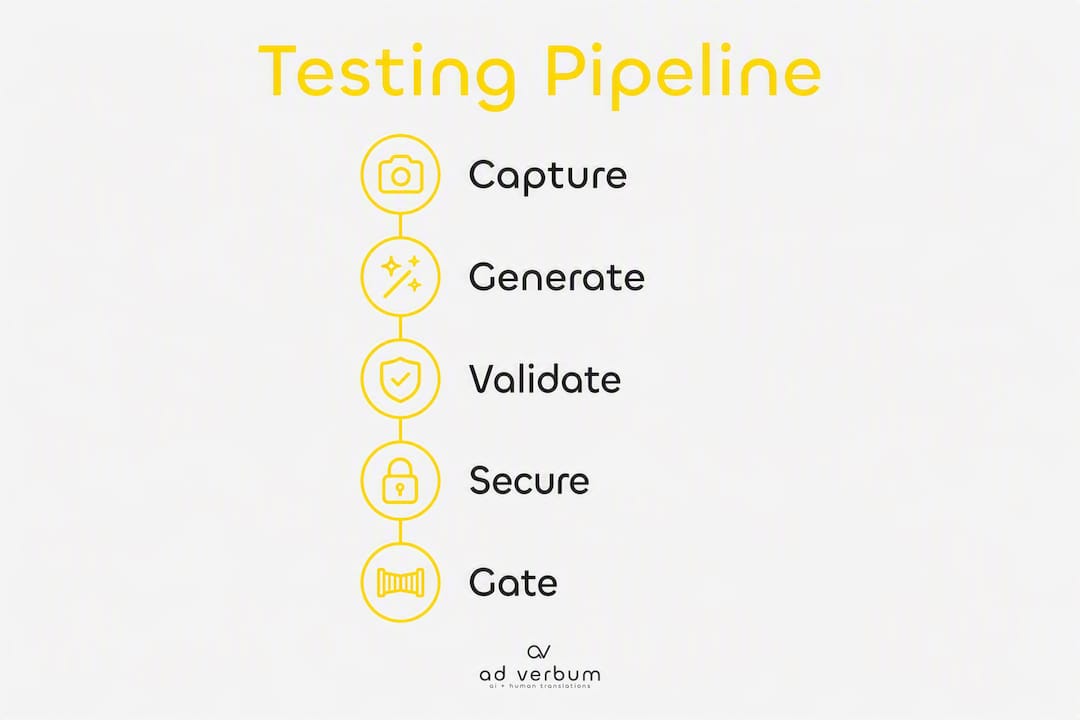
To test a topic-capture API in a regulated localization workflow, run this pipeline: capture live traffic → generate deterministic fixtures and tests → validate functional, privacy, and security properties → gate in CI. That sequence applies whether you are testing a browser-based Topics API or a backend topic-management endpoint.
Five test objectives cover the full compliance surface:
Functional correctness: responses match documented schemas and status codes
Privacy-preserving behavior: interest tokens are scoped, not leaked across contexts
Security and attack-surface mapping: undocumented endpoints, mass-assignment, and parameter pollution
Data residency and auditability: captures stay within approved jurisdictions; audit logs are retained
Drift detection: fixture diffs catch schema changes before they reach production
Immediate next actions for compliance teams: assign a QA engineer and a privacy/legal reviewer before the first capture session; start with Postman or apisnap-cli for recording; require SME sign-off on any fixture that contains regulated terminology.
Table of Contents
What does “topic-capture API” actually mean here?
The phrase covers two distinct technologies, and conflating them leads to testing the wrong surface entirely.
Class A — Browser Topics API. This is the privacy-preserving interest-signaling mechanism built into Chromium. The browser infers a user’s top topics from visited sites across weekly epochs, then exposes them via Document.browsingTopics() or the Sec-Browsing-Topics request header. Testing it requires time-compression CLI flags because default epochs run one week — impractical for any CI pipeline.
Class B — Backend topic-management APIs. These are standard HTTP endpoints: POST/PUT topic ingestion, taxonomy assignment, tokenized capture pipelines, and topic-storage interfaces. They accept JSON payloads, return structured responses, and behave like any REST API. Standard HTTP testing tools apply directly.
This guide covers both classes. Browser tests use Playwright with time-compression flags; backend tests use Postman, Jest, and MSW handlers generated from live captures. Security recon applies to Class B endpoints specifically, since Class A is browser-controlled.
How do you run the full test pipeline step by step?
Step 1: Capture live traffic

Use a proxy-based recorder to intercept real API calls. Tools like apisnap-cli run an HTTP/HTTPS proxy that stores every request and response — method, URL, headers, status code, body, and timing metadata — in a local SQLite database. Capturing only payloads is a common mistake; missing headers and timing context causes integration drift and false-positive test passes.
For Class A, drive the browser with Playwright and use --enable-features=BrowsingTopics combined with time-compression flags to collapse epochs from weeks to seconds.
Step 2: Generate deterministic fixtures and tests
Convert captures to JSON fixtures immediately. apitape generates TypeScript types, MSW handlers, and Jest test stubs from recorded responses. Replace non-deterministic fields (UUIDs, timestamps) with seeded values or stable identifiers before committing fixtures to version control. apisnap-cli can produce dozens of Jest tests from a single recording session, far faster than manual scripting.
Step 3: Validate locally
Run browser and API tests in parallel. Playwright’s APIRequestContext lets you set server-side preconditions via API calls, execute browser actions, then verify postconditions against the live backend — all in one test run. For backend topic endpoints, run Postman collections via Newman or use Playwright request fixtures against your JSON stubs.
Step 4: Security and privacy checks
PortSwigger’s API testing guidance is explicit: map endpoints beyond what the UI exposes. Undocumented parameters are a primary source of mass-assignment and parameter pollution vulnerabilities. Run authenticated and unauthenticated scenarios against every discovered endpoint, not just the documented ones.
Security checklist:
Enumerate all endpoints via recon (crawl + JS file analysis)
Test each HTTP method on every endpoint, not just the documented verb
Probe for mass-assignment by adding unexpected fields to PATCH/PUT requests
Test parameter pollution with duplicate query parameters
Verify that unauthenticated requests return 401/403, not partial data
Step 5: Gate in CI
Postman’s shift-left guidance is clear: running tests during development, not after deployment, is what actually reduces fix costs. Configure your CI pipeline to run fixture diffs on every pull request. apitape’s diff command compares saved fixtures against live API responses and fails the build on breaking changes.
CI gate checklist — fail the build on:
Schema drift (new required field, changed type, removed field)
Privacy regression (topic tokens appearing in unexpected response fields)
Authentication bypass (unauthenticated request returning 2xx)
Fixture hash mismatch without an approved change record
Pipeline step | Primary tool | Output artifact |
Capture live traffic | apisnap-cli, proxy recorder | SQLite session, raw JSON |
Generate fixtures and tests | apitape, apisnap-cli | JSON fixtures, Jest tests, MSW handlers |
Browser Topics API validation | Playwright + time-compression flags | Test report, interest-token log |
Backend API validation | Postman/Newman, Jest | Pass/fail report, schema validation log |
Security recon | PortSwigger techniques, Postman | Endpoint map, vulnerability log |
CI drift detection | apitape diff, fixture hash check | Diff report, CI gate status |
Pro Tip: Redact PII and HIPAA-protected fields from captures before they ever touch a fixture file. Build the redaction step into the capture pipeline itself — not as a post-processing cleanup — so no sensitive data reaches version control.
What controls does regulated documentation require?
Compliance teams in HIPAA, ISO, and AQAP environments need more than passing tests. They need auditable evidence that the pipeline itself is controlled.
Required controls:
Data residency: captures processed and stored within approved jurisdictions only
Encryption: TLS in transit; AES-256 or equivalent at rest for fixture stores
Audit logging: immutable logs of capture sessions, fixture changes, and CI gate decisions
Access controls: role-based access to capture sessions; no developer self-approval on fixture changes touching regulated data
Retention and redaction: defined retention periods for capture artifacts; automated redaction of PHI/PII before fixture commit
SME review gates: subject-matter expert sign-off required before any fixture containing regulated terminology enters the baseline
Decision matrix:
Scenario | Fixture type required | SME review required | ISO/AQAP gate |
Non-production synthetic data only | Synthetic fixtures | No | Recommended |
Production-like data, no PHI | Redacted production captures | Yes | Required |
PHI or HIPAA-regulated content | Fully redacted + synthetic | Yes + legal review | Required |
Defense/AQAP documentation | Redacted captures + audit log | Yes + AQAP sign-off | Mandatory |
Audit evidence to retain: capture session logs, fixture diff reports, CI gate decisions, SME sign-off records, and any drift remediation tickets. For high-stakes regulated workflows, these artifacts are what auditors actually inspect.
Two concrete examples you can adapt today
Example A: Browser Topics API with time compression
Objective: Verify that Document.browsingTopics() returns correctly scoped interest tokens across simulated epochs.
Setup: Launch Chromium via Playwright with --enable-features=BrowsingTopics,PrivacySandboxAdsAPIsOverride and --browsing-topics-bypass-ip-is-publicly-routable-check. Add the epoch-compression flag to collapse one week to seconds.
Test outline: Navigate to a publisher page, call browsingTopics(), assert the returned array contains topic objects with topic, version, and configVersion fields. Simulate a second epoch, repeat the call, and assert the topic list updates. Capture the Sec-Browsing-Topics header on an outbound fetch request and verify it is present and non-empty.
Deliverables: Playwright test file, interest-token log, CI job that runs with time-compression flags.
Example B: Backend topic-management API capture and Jest/MSW generation
Objective: Validate a tokenized POST endpoint that ingests topic assignments for a localization project.
Step | Action | Artifact |
Record | Run apisnap-cli against POST /api/topics with auth token | SQLite session |
Generate token | Authenticated GET /api/auth/token → capture response | Token fixture |
Generate tests | apisnap generate tests | Jest test file |
Generate mocks | apisnap generate mocks | MSW handler file |
Fixture diff | apitape diff session-1 session-2 | Drift report |
CI job | Newman run + apitape diff on PR | Pass/fail + diff artifact |
Acceptance criteria: POST returns 201 with topicId and assignedAt fields; unauthenticated POST returns 401; fixture diff shows zero breaking changes against baseline.
Implementation note: Replace orderId-style auto-increment fields with seeded UUIDs in fixtures. Strip any project-name strings that could contain PHI before committing.
What failure modes should you plan for?
Non-deterministic captures produce flaky tests. Live API traffic includes timestamps, session IDs, and server-generated values that change on every call. Fix this at the fixture-generation step: use apitape’s type generation to identify volatile fields, then replace them with seeded stable values.
Schema drift goes undetected without CI diffing. An API team adds a required field; your fixtures still pass because they were generated before the change. apitape’s diff command catches this automatically — but only if you run it on every pull request, not just on release branches.
PII and HIPAA data leaks into test artifacts. This is the highest-severity failure mode in regulated environments. Build automated redaction into the capture pipeline before any data touches a fixture file. Define a policy-driven filter list (field names, regex patterns for SSNs, MRNs, etc.) and enforce it at the proxy layer.
Undocumented endpoints expand the attack surface. PortSwigger’s recon methodology shows that endpoints not exposed by the UI are often the ones most vulnerable to mass-assignment. Run active recon — crawl JavaScript files, inspect network traffic, test HTTP verb variations — and add every discovered endpoint to your test suite.
For auditors: document each failure mode, its mitigation control, and the test that verifies the control. A digital asset risk framework approach — cataloging each artifact, its sensitivity classification, and its retention policy — maps directly onto this requirement.
Where does AD VERBUM fit in this pipeline?
The capture-and-fixture pipeline validates API behavior. What it does not validate is whether the regulated terminology inside those payloads is accurate, consistent, and compliant with the target-language standard. That is where AD VERBUM enters.
AD VERBUM’s AI+HUMAN hybrid translation workflow ingests client Translation Memories and Term Bases first, then runs its proprietary LLM-based LangOps System to generate output constrained by that terminology. Certified subject-matter experts — medical professionals, engineers, legal scholars — review every output for technical accuracy and regulatory compliance. QA is aligned to ISO 17100 and ISO 18587, with sector-specific overlays for MDR, AQAP 2110, and HIPAA.
Engage AD VERBUM when:
Fixture payloads contain regulated terminology that must be consistent across 150+ language variants
EU data-residency requirements apply (AD VERBUM’s LangOps System runs on private EU-hosted infrastructure)
ISO 27001, ISO 42001, or AQAP 2110 audit evidence is required for the translation layer
SME review and documented sign-off are contractual obligations
The workflow sequence: fixture artifacts and source-language content enter the AD VERBUM pipeline at the asset-integration step. The LangOps System processes them against client TMs and TBs. SME review produces a signed QA record. That record becomes an audit artifact alongside your CI gate reports.
Pro Tip: Include artifact retention periods, audit-access rights, and an SLA for drift-triggered re-translation in your AD VERBUM service agreement. Auditors will ask for these terms by name.
Key compliance checklist for sign-off
Pipeline requirements:
Capture sessions logged with full context (headers, methods, status codes, timings)
Fixtures redacted of PHI/PII before version control commit
Jest tests and MSW handlers generated from real traffic, not manually scripted
Playwright browser tests run with time-compression flags for Topics API
Security recon completed; all discovered endpoints added to test suite
CI gate configured to fail on schema drift, privacy regression, and auth bypass
Acceptance checklist:
[ ] Fixture diff report attached to PR
[ ] SME sign-off on any fixture containing regulated terminology
[ ] Audit log of capture session retained per retention policy
[ ] CI gate status green (no breaking drift, no privacy regression)
[ ] Redaction pipeline verified against PHI field list
Minimal starting toolchain for a one-sprint proof of concept: apisnap-cli (capture + test generation), apitape (fixture management + drift detection), Playwright (browser and API validation), Postman/Newman (collection-based CI runs), Jest + MSW (unit and integration tests).
The case for treating API testing as a compliance discipline
The standard framing for API testing is a developer problem: catch bugs early, ship faster. That framing misses the actual risk in regulated localization workflows. When a topic-capture API feeds content into a translation pipeline that produces HIPAA-regulated patient instructions or AQAP-governed defense documentation, a schema drift event is not a bug. It is a compliance incident.
The shift-left principle matters here, but for a different reason than speed. Early capture-based testing creates the audit trail. A CI gate report from sprint two is evidence. A hotfix applied three days before a regulatory submission is not. Teams that treat fixture generation and drift detection as compliance controls — not just developer conveniences — are the ones whose audit packages hold up under scrutiny.
SME involvement at the fixture-review stage is the step most teams skip because it feels premature. It is the step that prevents a mistranslated dosage instruction from making it through five CI gates undetected.
AD VERBUM handles the compliance layer your test pipeline cannot
Regulated documentation teams that have built a solid capture-and-fixture pipeline still face one gap: the pipeline validates API behavior, not linguistic accuracy or terminology governance across languages. AD VERBUM closes that gap with ISO 27001 and ISO 42001 certified infrastructure, AQAP 2110 and HIPAA-aligned workflows, and a network of 3,500+ subject-matter expert linguists who produce signed QA records that stand up in audits.

AD VERBUM’s localization services integrate directly with your fixture and TM artifacts, delivering 3x–5x faster turnaround than traditional workflows without sacrificing the audit trail. Two concrete next steps: contact AD VERBUM for a pilot engagement scoped to your regulated document type, or request an artifact-handling addendum that specifies retention periods, audit-access rights, and drift-remediation SLAs for your contract.
Key Takeaways
Testing a topic-capture API for compliance requires a five-step pipeline — capture, generate, validate, secure, and gate — with audit artifacts retained at every stage.
Point | Details |
Two distinct API classes | Browser Topics API needs time-compression flags for CI; backend topic APIs use standard HTTP testing tools. |
Deterministic fixtures are mandatory | Replace volatile fields with seeded values; use apitape or apisnap-cli to generate fixtures from real traffic. |
CI gating is a compliance control | Fail builds on schema drift, privacy regression, and auth bypass — not just on functional test failures. |
Audit artifacts at every step | Retain capture logs, fixture diffs, CI gate reports, and SME sign-off records for regulatory review. |
AD VERBUM covers the linguistic layer | ISO 27001/42001 certified, HIPAA-aligned, with SME review and QA records that satisfy audit requirements. |
Useful sources and standards
“API testing is important as vulnerabilities in APIs may undermine core aspects of a website’s confidentiality, integrity, and availability.” — PortSwigger Web Security Academy
Topics API — MDN Web Docs: browser Topics API specification, epoch behavior, and time-compression guidance
API Testing — Playwright: APIRequestContext usage, precondition/postcondition patterns, storage state for authenticated flows
API Testing — Postman: shift-left testing rationale and CI integration guidance
API Testing — PortSwigger Web Security Academy: recon methodology, mass-assignment testing, parameter pollution
apitape — GitHub: fixture recording, type generation, MSW handler generation, drift detection
apisnap-cli — Brian Munene: proxy-based capture, Jest test generation, MSW mock generation
Capture best practices: full-context capture requirements (headers, methods, status codes, timings)
ISO 17100 (translation services), ISO 18587 (post-editing of machine translation output), ISO 27001 (information security management), AQAP 2110 (NATO quality assurance for defense): available via ISO.org and NATO standardization portals
Recommended