


Secure Medical Document Localization: A Compliance Guide
- 9 hours ago
- 15 min read

Use an ISO-aligned, HIPAA-ready AI+HUMAN hybrid translation workflow with strict access controls, TM/TB governance, and an auditable provenance trail. That is the operational answer for any compliance or procurement lead building a secure localization process for U.S. regulated healthcare.
For an RFP or statement of work, require these components at minimum:
Business Associate Agreement (BAA) signed before any PHI is transferred
ISO certifications: ISO 17100 (translation services), ISO 18587 (post-editing), ISO 27001 (information security), ISO 13485 (medical devices) where applicable
Encryption: AES-256 at rest, TLS 1.2+ in transit
Access controls: role-based, least-privilege, with ephemeral review tokens for SME reviewers
SME medical review: certified subject-matter expert sign-off, not just bilingual review
TM/TB integration: client-owned Translation Memories and Term Bases ingested at project start
Audit trail: immutable, tamper-evident provenance log covering every handoff
Two immediate next steps (within 48–72 hours):
Request a signed BAA draft and a sample QA report from any vendor under consideration. Per medical translation compliance guidance, these two documents prove vendor claims faster than any marketing sheet.
Run a one-document pilot with fully redacted or pseudonymized PHI. This stress-tests the vendor’s intake controls, TM/TB governance, and QA output before you commit to a full project scope.
Table of Contents
What does “medical document localization” actually mean for regulated U.S. use?
Why does a weak localization process put patients and your organization at risk?
Which medical documents require the strongest security and localization controls?
How to run a secure localization workflow from intake to deployment
What security and compliance controls does U.S. medical localization require?
How do you choose and contract a vendor for secure medical localization?
What goes wrong in medical localization, and how do you prevent it?
When is AD VERBUM the right choice for your localization program?
The risk-first mindset that separates compliant localization from compliant-looking localization
AD VERBUM delivers the compliance architecture your medical localization program needs
What does “medical document localization” actually mean for regulated U.S. use?
Translation converts text from one language to another. Localization goes further: it adapts content for a target market’s regulatory environment, cultural context, measurement conventions, and format requirements. For U.S. regulated healthcare, that distinction carries legal weight.
In scope for this guide: any document where a localization error could affect patient safety, regulatory acceptability, or legal liability. That includes clinical trial documentation (protocols, informed consent forms, case report forms), Instructions for Use (IFUs) and device labels, regulatory submissions to the FDA, patient-facing records and discharge summaries containing PHI, and pharmacovigilance reports.
Out of scope: general consumer marketing copy with no regulated claims, internal HR documents with no PHI, and unregulated promotional materials. These may still benefit from professional translation, but they do not require the full security and QA architecture this guide describes.
Core localization tasks for regulated documents include TM/TB integration, terminology governance, regulatory adaptation (units, dosage conventions, labeling requirements), desktop publishing (DTP) and layout, multilingual QA, SME sign-off, and provenance logging. Each task introduces a potential control point — and a potential failure point if the control is absent.
Why does a weak localization process put patients and your organization at risk?
Secure, compliant localization directly affects patient safety, regulatory acceptability, and corporate liability. A mistranslated dosage instruction or an incorrectly rendered contraindication is not an editorial error. It is a patient safety event with potential FDA enforcement consequences.
The primary risk categories:
Mistranslated dosages or contraindications: a numeric transposition or a negation dropped in translation can invert a clinical instruction
PHI exfiltration: sending unredacted patient records through unsecured email or consumer-grade translation tools violates HIPAA and triggers breach notification obligations
Failed regulatory submissions: FDA reviewers reject submissions with inconsistent terminology or untraceable translation provenance
Audit failures: missing QA records, unsigned BAAs, or undocumented subprocessors create material findings in HIPAA audits
Reputation and liability exposure: a recalled device label or a retracted informed consent form generates litigation risk that dwarfs the cost of proper localization controls
HIPAA’s Security Rule requires covered entities and their business associates to implement technical safeguards protecting electronic PHI, including access controls and audit controls. Any vendor handling PHI during localization is a business associate and must sign a BAA. FDA guidance on electronic submissions and device labeling further requires that translated content be traceable to its source and validated for accuracy. These are not aspirational standards. They are enforceable requirements.
Which medical documents require the strongest security and localization controls?
Not all medical documents carry the same risk profile. Prioritizing controls by document type lets you allocate QA resources and security architecture where they matter most.

Highest controls required
Clinical trial documentation (protocols, informed consent forms, investigator brochures, case report forms) sits at the top. These documents are subject to FDA 21 CFR Part 11 requirements for electronic records, ICH E6(R2) GCP guidelines, and IRB review. A localization error here can invalidate trial data or expose participants to unintended risk. PHI handling, SME sign-off by a clinical reviewer, tamper-evident provenance, and full audit trails are non-negotiable.
IFUs, device labels, and packaging inserts for FDA-regulated medical devices also demand maximum controls. Device labeling is a regulatory submission artifact. Errors in dosage, contraindication, or warning text can trigger a Class II or Class III recall. DTP is especially critical here: truncated text in a label graphic can suppress a warning entirely.
High controls required
Regulatory submissions (510(k)s, PMAs, drug applications) require consistent terminology across all translated sections, traceable provenance, and QA documentation the FDA reviewer can audit. Multi-jurisdiction submissions add complexity: the same source document may need adaptation for both FDA and EU MDR requirements, with different terminology conventions in each.
Patient records and discharge summaries containing PHI require strict data minimization before localization begins. Pseudonymization or redaction of identifiers is a prerequisite, not an afterthought.
Moderate controls
Patient-facing educational materials and multilingual consent forms that do not contain PHI still require SME review for clinical accuracy, but the data-security architecture is less intensive. Marketing materials making regulated claims (e.g., drug efficacy statements) require regulatory review but typically carry lower PHI exposure.
How to run a secure localization workflow from intake to deployment
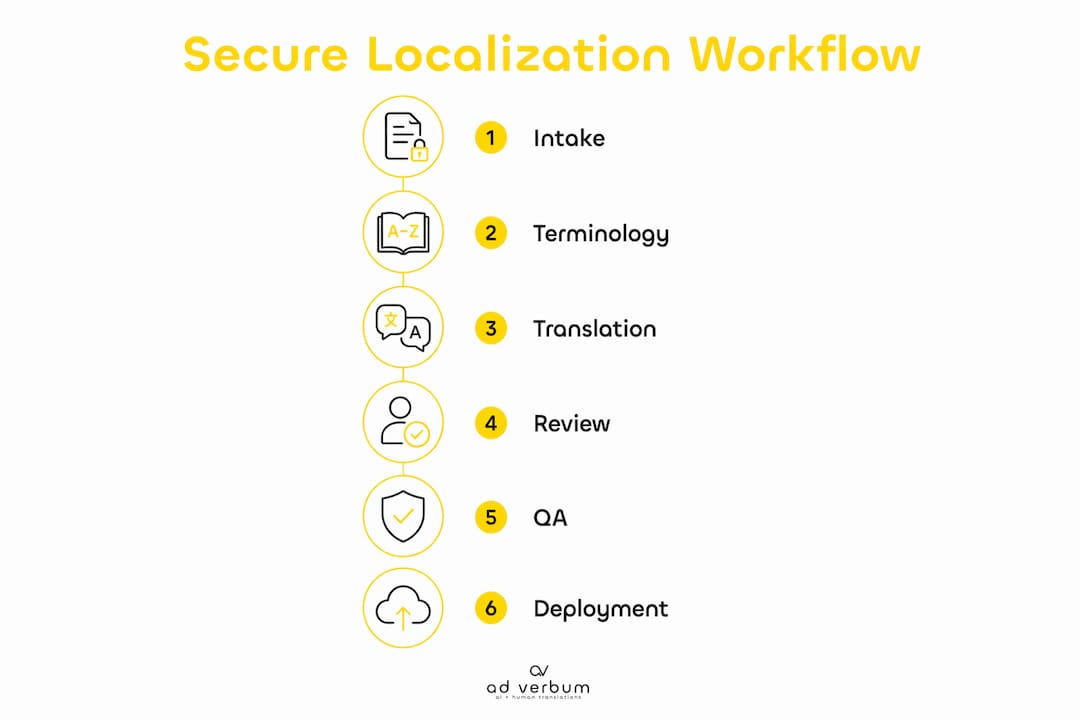
The workflow runs in this sequence: asset intake and classification → data minimization → TM/TB ingestion → AI+HUMAN draft generation → SME clinical review → QA → provenance capture → secure delivery → acceptance testing → post-deployment monitoring.
Step-by-step:
Asset intake and classification. Receive source files through a secure, access-controlled channel. Classify each document by risk tier (see above) and flag PHI-containing files for immediate data minimization.
Data minimization and redaction. Pseudonymize or redact PHI before the document enters the translation environment. Assign a project ID that links the redacted version to the original without exposing identifiers.
TM/TB ingestion and terminology governance. Load client-owned Translation Memories and Term Bases into the localization environment. Lock regulated terminology (drug names, device identifiers, dosage units) so the system cannot override approved terms.
Secure AI+HUMAN draft generation. The proprietary LLM-based system generates target-language output constrained by the ingested TM/TB and client terminology guidance. This is not legacy MT or a consumer NMT engine. The system handles document-level context and follows explicit terminology instructions.
SME clinical review. A certified subject-matter expert — a medical professional or clinical linguist, not a general bilingual reviewer — checks the draft for technical accuracy, regulatory compliance, and contextual nuance. This step is where dosage errors, negation failures, and terminology drift get caught.
QA (linguistic, functional, and DTP). QA aligned to ISO 17100 and ISO 18587 covers linguistic accuracy, consistency, and completeness. DTP review checks that layout changes have not truncated safety-critical text or altered table structures.
Provenance capture. Generate a cryptographic hash (SHA-256 or equivalent) of the final approved document. Log the hash, reviewer identities, timestamps, and approval chain in an immutable audit record. Systems implementing blockchain-based provenance logging can embed geolocation metadata and time-limited access tokens to further constrain who can view the document and when.
Secure delivery. Deliver the final file through an encrypted channel into the target system (EHR, regulatory submission platform, or document management system). Confirm receipt and integrity against the stored hash.
Acceptance testing. The client’s compliance reviewer validates the delivered document against acceptance criteria: terminology consistency, regulatory format compliance, and QA sign-off documentation.
Post-deployment monitoring. Schedule periodic revalidation of TMs and TBs as source content evolves. Flag any source document updates that require localization refresh.
Contract and SLA checklist to require from vendors:
Signed BAA covering all subprocessors
Data residency specification (where PHI is processed and stored)
Breach notification SLA (typically 72 hours or less)
Right-to-audit clause covering vendor and named subprocessors
TM/TB ownership and return-of-assets clause
Turnaround SLAs with surge capacity provisions
Acceptance criteria defined in the SOW, not left to vendor discretion
Pro Tip: During SME review, grant reviewers view-only access through ephemeral session tokens that expire after the review window. Geofenced, time-bound access controls combined with blockchain logging can validate that access occurred only within approved parameters — a control that location-based access research confirms mitigates misuse by tying access to contextual constraints rather than key possession alone.

What security and compliance controls does U.S. medical localization require?
The required controls fall into four categories: technical, contractual/organizational, QA and standards, and auditing.
Technical controls:
Encryption at rest using AES-256; encryption in transit using TLS 1.2+ or TLS 1.3
Role-based access control with least-privilege assignment; no shared credentials
Ephemeral review tokens for external SME access, with automatic expiration
Secure DTP workstations with no local storage of PHI
Immutable audit trails recording every access, edit, approval, and delivery event
Self-custody key management: architectures where decryption keys remain with the data owner provide stronger legal defensibility than cloud-provider-held keys, reducing exposure to third-party subpoenas. Digital document authentication practices reinforce this principle for evidentiary use.
Contractual and organizational controls:
BAA executed before any PHI transfer, naming all subprocessors
Subprocessor list with individual controls documented
Employee background checks and confidentiality agreements for all personnel with PHI access
Incident response plan with defined notification timelines
Auditor access rights written into the contract
QA and standards:
ISO 17100 alignment for translation process controls
ISO 18587 alignment for post-editing of AI-generated output
ISO 27001 certification for information security management
ISO 13485 certification for medical device document handling
Procurement evidence standard: ISO certificates and recent audit reports are stronger evidence than marketing claims. Request scanned certificate copies with the auditor’s name and audit date to validate recency. AD VERBUM’s ISO certifications are independently audited by Bureau Veritas — ask any vendor for equivalent third-party verification.
Sample contract language (paraphrased templates, not legal text):
BAA clause: “Vendor agrees to execute a Business Associate Agreement in accordance with 45 CFR §164.504(e) prior to receiving any PHI and to extend equivalent obligations to all subprocessors.”
Subprocessors clause: “Vendor shall maintain and provide upon request a current list of subprocessors with access to client data, including the controls applied to each.”
Audit rights clause: “Client retains the right to audit vendor’s security controls and QA records upon 30 days’ written notice, including access to subprocessor documentation.”
How do you choose and contract a vendor for secure medical localization?
Start with the non-negotiables. Any vendor that cannot produce a signed BAA, current ISO 27001 and ISO 17100 certificates, and a named SME medical reviewer network should not advance past initial screening. The compliance requirements for medical translation are well-established; a vendor unfamiliar with them is a liability.
Vendor questionnaire — send this before any demo:
Provide your current ISO 27001, ISO 17100, ISO 18587, and ISO 13485 certificates with auditor name and date.
Describe your PHI handling process from intake to deletion, including subprocessors.
List all subprocessors with access to client data and the controls applied to each.
Describe your SME medical reviewer network: credentials, vetting process, and how reviewers are matched to document type.
Provide a sample QA report from a comparable medical localization project (redacted as needed).
What is your breach notification SLA, and can you provide a sample incident response plan?
Describe your TM/TB governance: who owns the assets, how are they locked for regulated terminology, and how are they returned at project end?
What are your standard and surge turnaround times for a 10,000-word clinical trial protocol?
Contract clause checklist:
BAA with subprocessor extension
Indemnity for gross negligence in translation errors
Data breach notification within 72 hours
Right to audit vendor and named subprocessors
Data deletion or return of keys at project end
Change-management process for TM/TB updates
Defined acceptance criteria in the SOW
Cost and timeline factors that materially affect decisions:
Regulatory submission packs with multi-language DTP cost significantly more than patient-facing leaflets. Volume, language pair complexity, DTP requirements, and SME reviewer availability all affect turnaround. A hybrid translation provider using AI+HUMAN workflows can deliver 3x to 5x faster than traditional workflows (per AD VERBUM’s stated figures) without sacrificing QA rigor, which matters when FDA submission deadlines are fixed.
What goes wrong in medical localization, and how do you prevent it?
Failure Mode | Impact | Leading Indicators | Immediate Mitigation | Long-Term Fix |
Terminology drift | Inconsistent drug/device names across documents; regulatory rejection | TM hit rate declining; reviewer corrections increasing | Freeze TM for regulated terms; manual consistency check | Scheduled TM/TB audit; locked term governance |
Dosage mistranslation | Patient safety event; recall risk | Numeric errors in QA review; SME flags | Pull document; re-translate affected segment with SME sign-off | Add numeric QA check as mandatory step |
PHI leakage via email | HIPAA breach; notification obligation | Unredacted files in email threads | Revoke access; notify privacy officer; assess breach scope | Enforce secure portal delivery; redaction before intake |
TM contamination | Propagated errors across all documents using that TM | Unusual reviewer correction patterns | Quarantine TM; audit affected segments | Separate TMs by risk tier; version control |
DTP truncation | Safety warnings suppressed in label layout | Text overflow flags in DTP review | Reject DTP; reflow layout with linguist review | DTP QA checklist with character-count validation |
Mitigation checklist for operations and procurement:
Lock regulated terminology in TBs; prohibit overrides without compliance sign-off
Enforce redaction/pseudonymization before any file leaves the client environment
Use secure portals with ephemeral access for SME review; no email transfer of PHI
Separate TMs by document risk tier; apply version control
Require post-release monitoring with a defined revalidation trigger (e.g., any source update above a defined word-change threshold)
On incident response: when a localization error is discovered post-deployment, preserve all QA records and version history before any remediation. Notify the relevant stakeholders (medical affairs, regulatory, legal) immediately. Remediate the translation with a full SME re-review, not a patch edit. Document the corrective action in a formal CAPA record and include it in the next vendor performance review. The compliance best practices for translation framework recommends treating post-deployment errors as quality events with root-cause analysis, not one-off fixes.
Two real-world scenarios showing the workflow in practice
Scenario 1: Phase III clinical trial informed consent form (ICF) package
A U.S. sponsor requires ICFs translated into Spanish, Mandarin, and Portuguese for a multi-site trial. Success: all three language versions pass IRB review on first submission with no terminology queries.
Controls applied: PHI pseudonymized before intake; client TM/TB ingested with locked clinical terminology; AI+HUMAN draft generated with document-level context; clinical linguist SME reviewed each version against the English source and the protocol glossary; QA covered linguistic accuracy, numeric consistency, and IRB format requirements; SHA-256 hash logged at final approval.
Acceptance criteria: zero unresolved SME flags; terminology 100% consistent with approved glossary; QA sign-off documented; provenance hash delivered with the final files.
One failure that occurred: the Portuguese draft rendered a dosage frequency as “twice weekly” where the source said “twice daily.” The SME reviewer caught it during clinical review. The segment was re-translated, re-reviewed, and re-hashed before delivery. The audit trail recorded the correction event with timestamps and reviewer identity.
Typical cost drivers: three language pairs, DTP for IRB format, clinical SME review, and provenance documentation. Turnaround on a 5,000-word ICF package: approximately 3–5 business days with an AI+HUMAN hybrid workflow.
Scenario 2: Medical device IFU and patient leaflet (EU MDR + FDA dual submission)
A device manufacturer needs an IFU and patient leaflet localized into 12 EU languages plus Spanish for the U.S. market. Success: both FDA and EU MDR submissions accepted without labeling queries.
Controls applied: separate TMs maintained for FDA and EU MDR terminology conventions; DTP reviewed for text overflow in all 13 language versions; regulatory reviewer confirmed compliance with FDA 21 CFR Part 801 and EU MDR Annex I; provenance log delivered as part of the technical file.
Acceptance criteria: no DTP truncation in any language; all warning and contraindication text rendered in full; regulatory reviewer sign-off documented; technical file provenance complete.
One failure that occurred: the German DTP version truncated a contraindication warning due to text expansion. The DTP QA checklist flagged the overflow. The layout was reflowed, re-reviewed by the SME, and re-approved before the technical file was compiled.
For regulatory document localization at this scale, the combination of locked TBs, DTP QA checklists, and dual-jurisdiction SME review is what prevents the kind of labeling inconsistency that triggers regulatory queries.
When is AD VERBUM the right choice for your localization program?
AD VERBUM is the right fit when the work involves regulated content, audit requirements, PHI handling, or multi-language device and clinical documentation that cannot tolerate terminology drift or provenance gaps.
Decision conditions where AD VERBUM is recommended:
Enterprise regulated content: clinical trials, IFUs, regulatory submissions, patient records
ISO evidence required: ISO 17100, ISO 18587, ISO 27001, ISO 13485 certificates independently audited by Bureau Veritas
HIPAA alignment with BAA execution before PHI transfer
TM/TB integration with client-owned assets and locked terminology governance
SME medical reviewers: access to a an extensive expert linguist network including medical professionals
EU-hosted secure infrastructure with no reliance on public cloud tooling for core processing
AI+HUMAN hybrid translation delivering significantly faster turnaround than traditional workflows.
AD VERBUM’s workflow sequence:
Asset intake → TM/TB ingestion → LLM-based AI+HUMAN draft generation (constrained by client terminology) → certified SME clinical review → QA aligned to ISO 17100 and ISO 18587 → provenance capture → secure delivery.
Client handoffs occur at intake (source files and TM/TB assets) and at delivery (final files plus QA documentation and provenance hash).
When AD VERBUM is not the right fit:
Small one-off consumer translations with no regulated claims, unregulated marketing copy with no PHI, and projects where the buyer explicitly does not require ISO-aligned QA or audit documentation. For those use cases, the full compliance architecture is overhead without benefit.
Pro Tip: Request AD VERBUM’s ISO certificates and a sample QA report before the contract is signed. ISO certificates with a named auditor and audit date are the fastest way to validate that the vendor’s security and quality claims are current, not legacy marketing copy.
Key Takeaways
Secure medical document localization requires an ISO-aligned AI+HUMAN hybrid workflow, HIPAA-ready controls, TM/TB governance, and an auditable provenance trail — every component must be contractually required, not assumed.
Point | Details |
BAA is the first gate | No PHI should transfer to any vendor without a signed BAA covering all subprocessors. |
ISO certificates need auditor verification | Request scanned certificates with auditor name and date; marketing claims alone are insufficient evidence. |
TM/TB governance prevents terminology drift | Lock regulated terms in client-owned Term Bases; prohibit overrides without compliance sign-off. |
Provenance capture is a contract deliverable | Require a SHA-256 hash log and immutable audit trail as part of every project’s final deliverables. |
AD VERBUM for regulated work | AD VERBUM’s AI+HUMAN hybrid workflow and ISO 27001/17100/13485 certifications address the full compliance and security requirement for U.S. regulated medical localization. |
The risk-first mindset that separates compliant localization from compliant-looking localization
Most localization failures in regulated healthcare are not caused by bad translators. They are caused by process gaps: a TM that was never locked, a PHI file that went through email because the secure portal was inconvenient, a DTP review that got skipped because the deadline moved. The technical controls described in this guide exist precisely because human judgment under deadline pressure is not a reliable last line of defense.
The governance piece that organizations consistently underinvest in is terminology stewardship. A Term Base is only as good as its last audit. Clinical terminology evolves, drug names change, and regulatory conventions shift across jurisdictions. Scheduling a quarterly TM/TB review, tied to a defined revalidation trigger for any source content update above a meaningful change threshold, is the single operational habit that prevents terminology drift from compounding across a document library.
Audit cadence matters too. An annual ISO surveillance audit from your vendor is a floor, not a ceiling. Internal compliance reviews of localization QA records, conducted on the same cycle as your other regulated process audits, catch vendor performance degradation before it becomes a regulatory finding. Build that cadence into your vendor contracts from day one.
AD VERBUM delivers the compliance architecture your medical localization program needs
For regulated medical localization, the difference between a vendor and a compliant partner is documented: a signed BAA, current ISO certificates, a named SME reviewer, and a QA report you can hand to an auditor. AD VERBUM provides all of it, backed by 25+ years of experience in regulated industries and certifications independently audited by Bureau Veritas.
AD VERBUM’s medical translation services cover the full workflow: AI+HUMAN hybrid translation with a proprietary LLM-based LangOps System, TM/TB integration, certified SME medical review, QA aligned to ISO 17100 and ISO 18587, and secure EU-hosted infrastructure with HIPAA and GDPR alignment across 150+ languages.
What procurement teams can request from AD VERBUM:
Signed BAA draft for legal review
Sample QA report from a comparable medical localization project
Current ISO certificates (ISO 17100, ISO 18587, ISO 27001, ISO 13485) with Bureau Veritas audit details
TM/TB handover terms and asset ownership documentation
Pilot project scope and SLAs for a single redacted document
To start a secure pilot or request a BAA, contact AD VERBUM through the LangOps features page or reach the team directly at adverbum.com/contact.
Useful sources
The following references support the security, compliance, provenance, and standards claims in this guide. Use them during vendor evaluation and compliance reviews to validate controls against primary or authoritative sources.
Geocrypt: Location-Based Secure File Encryption and Access Control — supports geofenced, time-bound access controls and blockchain-based provenance logging for ephemeral review access.
Secure Document Vault — Encrypted Institutional Storage | JIL Sovereign — supports AES-256 encryption, SHA-256 integrity hashing, on-chain provenance, and self-custody key management for tamper-evident document storage.
Why Digital Document Authentication Matters in Court | Computer Forensics Lab — supports provenance, metadata handling, and tamper-evidence practices for legal and regulatory evidentiary use.
A Guide to Disclosure of Metadata | Computer Forensics Lab — supports metadata collection and presentation requirements for audits and regulatory submissions.
AD VERBUM — Secure document translation process — documents AD VERBUM’s ISO credentials and AI+HUMAN hybrid workflow for regulated translation.
Medical Translation Requirements: Complete Guide to Compliance | AD VERBUM — covers HIPAA, FDA, and compliance requirements for medical translation; supports BAA and QA procurement criteria.
Technical document localization process guide | AD VERBUM — supports ISO certification verification and LangOps infrastructure claims.
How to use these sources in procurement: present the Geocrypt and JIL Sovereign references when evaluating a vendor’s provenance and access-control architecture. Use the Computer Forensics Lab references when defining metadata disclosure requirements for regulatory submissions. Use the AD VERBUM references as a benchmark for what ISO-aligned, HIPAA-ready documentation from a vendor should look like.
Recommended