


Step-by-Step Translation Compliance Guide for Regulated Industries

Translation compliance is defined as the systematic alignment of translation workflows with regulatory requirements, quality standards, and certification mandates governing a specific industry or jurisdiction. For compliance professionals and localization specialists working in Life Sciences, Legal, Finance, or Defense, this is not a style preference. It is a process control obligation. This step-by-step translation compliance guide covers the full workflow: from document validation and translator qualification through AI+HUMAN hybrid execution, post-translation quality assurance, and final certification. The governing frameworks include ISO 17100, ISO 18587, and federal requirements such as 8 CFR 103.2 (USCIS). Getting any phase wrong creates rejection risk, audit exposure, and regulatory liability.
What prerequisites and tools are essential to start translation compliance workflows?
Translation compliance begins before a single word is translated. The source document, the translator’s qualifications, the terminology infrastructure, and the data handling environment must all meet defined standards before production starts.
Source document requirements are the first control point. Documents must be complete, legible, and free of unauthorized alterations. For regulated submissions, this means verifying that all pages are present, that signatures and seals are visible and unobstructed, and that any stamps or notarizations are intact. A document with a cropped seal or missing page will fail at intake regardless of translation quality.

Translator qualifications are non-negotiable in regulated sectors. ISO 17100 mandates that translators hold either a recognized translation qualification or a degree in a relevant subject field combined with two years of professional experience. For medical device documentation, legal filings, or defense contracts, subject-matter expertise is an additional requirement, not an optional credential. An AI+HUMAN hybrid translation model addresses this by pairing LLM-based generation with certified subject-matter expert review, covering both speed and domain accuracy.
The foundational prerequisites for any compliant translation workflow include:
Terminology assets: Machine-readable glossaries (Term Bases) and Translation Memories ™ loaded before production begins
File format standards: Source files in formats that preserve layout fidelity (PDF/A, DOCX, XML) with scanning resolution of at least 300 DPI for physical documents
Data protection controls: Secure file transfer protocols, access control logs, and data processing agreements aligned with GDPR or HIPAA as applicable
Certification framework: A defined certification statement template specifying translator name, competency declaration, accuracy statement, date, and contact information
Feedback and archiving protocol: A defined process for client feedback handling and project archiving per ISO 17100 standards
Pro Tip: Version-control your Term Bases from day one. Glossary drift, where terminology diverges across document versions, is one of the most common hidden compliance failures in long-running regulated projects.
What are the detailed step-by-step procedures to ensure translation compliance?
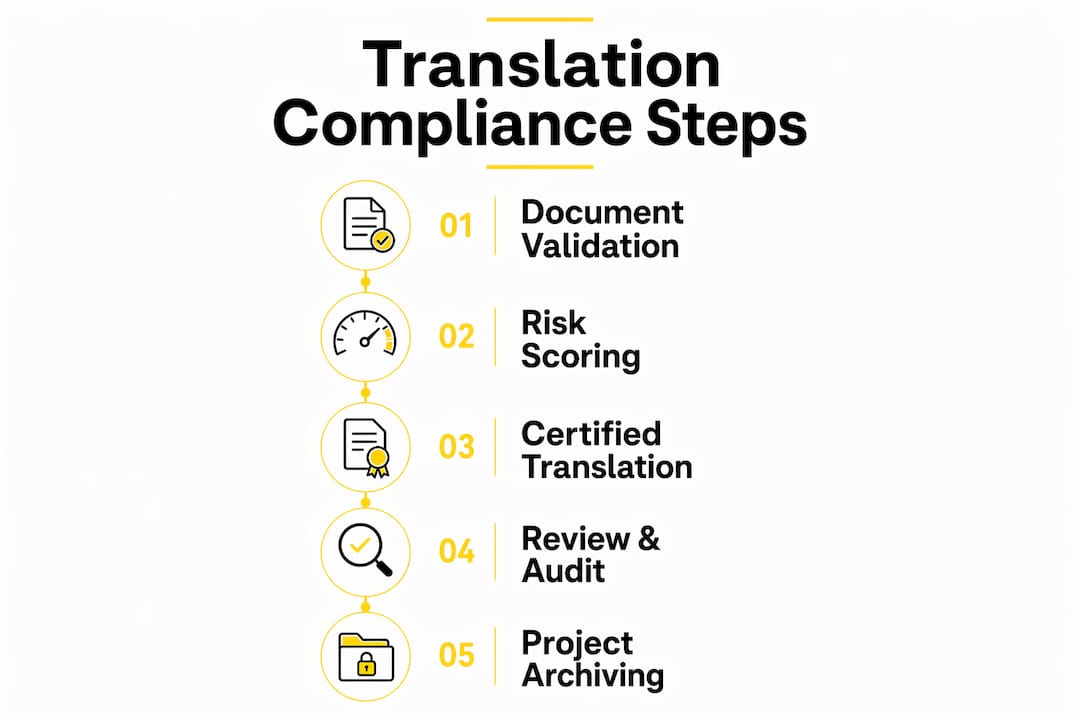
A compliant AI translation workflow follows a defined sequence. Deviating from the order or skipping steps creates traceability gaps that surface during audits or regulatory review.
Pre-translation document validation. Verify document completeness against a translation compliance checklist: all pages present, signatures legible, seals and stamps unobstructed, notarizations intact. Flag anomalies in writing before proceeding. Do not correct source errors. Mirror them exactly in the translation and note them in the certification statement.
File preparation and format standardization. Convert source files to production-ready formats. For scanned documents, confirm 300 DPI minimum resolution. For structured files (XML, DITA, InDesign), extract translatable strings using a CAT tool or TMS that preserves tags and formatting codes. Corrupted tags in regulated documentation cause formatting failures that reviewers treat as translation errors.
Asset integration. Ingest client Translation Memories and Term Bases into the translation environment before any LLM generation begins. This step constrains output to approved terminology and prevents the system from generating plausible but non-compliant alternatives.
LLM-based translation generation. The proprietary LLM-based system produces target language output constrained by the loaded terminology and style guidance. This is categorically different from legacy MT or public NMT engines: context-sensitive generation with explicit instruction following produces output that respects negation, domain nuance, and document-level consistency.
Subject-matter expert review. A certified subject-matter expert reviews the output for technical accuracy, regulatory compliance, and contextual nuance. This step is mandatory in regulated sectors. AI translation alone is a documented workflow risk; human oversight with domain expertise is the control that closes the gap.
Post-translation quality assurance. Run automated checks for glossary term alignment, untranslated source strings, localized number formats, and intact formatting codes. Apply segment-level risk scoring to prioritize human review on high-stakes content such as dosage instructions, legal definitions, or safety warnings.
Certification statement preparation. Draft the certification statement to include the translator’s full name, a statement of accuracy and completeness, a declaration of competency in both source and target languages, the date, and contact information. For USCIS submissions, mirror the source document’s formatting in the translation to reduce rejection risk.
Final review and submission packaging. Compile the translated document, certification statement, and any supporting documentation (notarization, apostille) into the submission package. Confirm file naming conventions match the receiving agency’s intake requirements.
Phase | Key control | Output |
Document validation | Completeness and legibility check | Validated source file with anomaly log |
Asset integration | TM and TB ingestion | Terminology-constrained translation environment |
LLM generation | Instruction-following LLM with terminology governance | Draft target language output |
SME review | Certified expert review for accuracy and compliance | Reviewed and corrected translation |
QA | Automated glossary check, risk scoring, format verification | QA-cleared translation |
Certification | Statement with name, competency, accuracy, date | Certifiable translation package |
Pro Tip: Segment-level risk scoring, flagging segments by content type and consequence of error, lets your SME reviewer focus time on the 10% of content that carries 90% of the regulatory risk. Apply it before human review, not after.
Which regulated decision criteria and compliance standards govern translation workflows?
ISO 17100 is the primary international standard governing translation service quality. It defines requirements across five domains: translation resources, pre-production, production, post-production, and process quality controls. Critically, ISO 17100 frames compliance as managing a quality-enabling workflow rather than guaranteeing linguistic perfection. This distinction matters for auditors: the standard requires documented process controls, not just a good translation.
For U.S. federal submissions, 8 CFR 103.2 (USCIS) requires that certified translations include the translator’s full name, a statement of accuracy, a declaration of competency, the date, a signature, and contact information. Completeness takes precedence over aesthetics. Missing marginal notes, stamps, or certification details are the leading cause of USCIS rejections, not translation quality.
The table below maps key standards to their compliance requirements and the decision criteria that determine applicability:
Standard / Regulation | Core requirement | Applies when |
ISO 17100 | Documented workflow, qualified translators, QA controls, archiving | Any professional translation service engagement |
ISO 18587 | Post-editing of machine translation output by human reviewer | AI or MT output used in production |
8 CFR 103.2 (USCIS) | Certified statement with competency, accuracy, date, signature | U.S. immigration document submissions |
ISO 13485 | Translation controls for medical device documentation | Medical device regulatory submissions (MDR, FDA) |
ISO 27001 | Information security management for translation data | Sensitive or confidential document handling |
Source document anomalies require a specific handling protocol. If the source contains a spelling error, a crossed-out word, or an illegible stamp, the translation must mirror that anomaly exactly and note it in the certification statement. Improvised corrections by the translator, however well-intentioned, constitute a departure from source fidelity and create audit risk. The translator’s role is to render the source accurately, not to improve it.
Auditability is a standing requirement under ISO 17100. The standard requires client feedback handling and project archiving as formal process components. This means every project must have a documented feedback loop and a retrievable archive of source files, translation outputs, QA records, and certification statements.
What are common failure modes in translation compliance and how can they be mitigated?
The most costly translation compliance failures are procedural, not linguistic. They occur at predictable points in the workflow and are preventable with defined controls.
The most frequent failure modes include:
Partial translations: Omitting headers, footers, marginal notes, or stamps. For USCIS and legal submissions, missing document elements are the primary cause of Requests for Evidence (RFEs) and outright denials.
Generic certification statements: Using a boilerplate certificate that omits the translator’s competency declaration or fails to reference the specific document. Receiving agencies treat vague certificates as non-compliant.
Signature workflow errors: Submitting unsigned certifications or certifications signed by someone other than the translator of record.
Formatting mismatches: Delivering a translation in a file format or layout that does not correspond to the source, making side-by-side review impossible for the receiving agency.
Glossary drift: Terminology inconsistency across document versions or within a single document, particularly in AI-assisted workflows where glossary enforcement is not automated.
The single most underestimated risk in regulated translation is not a bad translation. It is an incomplete one. A technically accurate translation that omits a stamp, a marginal note, or a certification element will be rejected on procedural grounds before anyone reads the content.
Mitigation requires structural controls, not just reviewer attention. Glossaries must be machine-readable and version-controlled, integrated before translation begins and verified automatically after completion. Segment-level risk models must flag high-consequence content for mandatory human review. QA checklists must cover document completeness, certification element verification, and format conformance as discrete checkpoints, not a single pass-through review. The translation quality assurance checklist approach, applied at each phase rather than only at the end, is the most reliable mitigation for downstream rejection risk.
Key takeaways
Translation compliance in regulated industries requires documented process controls, certified human oversight, and version-controlled terminology governance at every phase of the workflow.
Point | Details |
Define compliance scope first | Identify applicable standards (ISO 17100, 8 CFR 103.2, ISO 13485) before starting any translation project. |
Validate source documents before translation | Check completeness, legibility, seals, and signatures; log anomalies rather than correcting them. |
Integrate terminology assets pre-production | Load Term Bases and Translation Memories before LLM generation to prevent glossary drift. |
Apply segment-level QA | Use risk scoring and automated glossary checks to prioritize SME review on high-consequence content. |
Certify with full traceability | Include translator name, competency declaration, accuracy statement, date, and contact in every certification. |
What I’ve learned about compliance translation that most guides skip
After working with regulated translation workflows across Life Sciences, Legal, and Defense sectors, the pattern I see most often is this: organizations invest heavily in translator quality and almost nothing in process architecture. They hire credentialed linguists, then route documents through informal email chains with no version control, no terminology governance, and no defined QA checkpoints. The translation is good. The workflow is not. And it is the workflow that auditors examine.
The shift that changes outcomes is treating terminology governance as infrastructure, not documentation. A glossary that lives in a shared spreadsheet is not a compliance control. A machine-readable Term Base that is ingested before translation begins, enforced during generation, and verified automatically after completion is a compliance control. That distinction separates organizations that pass regulatory review from those that spend weeks responding to RFEs.
The AI+HUMAN hybrid translation model matters here not because AI is faster, but because a well-architected hybrid workflow enforces terminology governance at scale in a way that purely manual workflows cannot sustain. The human reviewer’s role shifts from catching everything to reviewing what the risk model flags as high-consequence. That is a better use of subject-matter expertise, and it produces more consistent compliance outcomes.
The other thing most guides skip: traceability is not a post-project activity. Every decision made during translation, every anomaly flagged, every glossary override, needs to be logged in real time. When an auditor asks why a specific term was rendered a specific way in a regulatory submission, “the translator made a judgment call” is not an acceptable answer. A documented decision trail is.
How Adverbum supports translation compliance in regulated industries
AD VERBUM’s regulated localization services are built on the AI+HUMAN hybrid translation model: proprietary LLM-based generation constrained by client Term Bases and Translation Memories, followed by certified subject-matter expert review and QA aligned to ISO 17100 and ISO 18587. For medical device documentation, the workflow extends to MDR alignment. For legal and immigration submissions, certification statements meet USCIS and jurisdiction-specific requirements. AD VERBUM’s infrastructure is ISO 27001 certified, hosted on private EU servers, and GDPR and HIPAA aligned. With 3,500+ subject-matter expert linguists across 150+ languages and turnaround 3x to 5x faster than traditional workflows, AD VERBUM is built for compliance professionals who cannot afford procedural gaps.
FAQ
What is translation compliance in regulated industries?
Translation compliance is the alignment of translation workflows with applicable regulatory standards, quality controls, and certification requirements. In regulated sectors, this includes adherence to ISO 17100, ISO 18587, and jurisdiction-specific mandates such as 8 CFR 103.2 for USCIS submissions.
What must a certified translation include for USCIS?
A USCIS-compliant certified translation must include the translator’s full name, a statement of accuracy and completeness, a declaration of competency in both languages, the date, a signature, and contact information. Missing any of these elements is a leading cause of rejection.
Why is AI translation alone insufficient for compliance?
AI translation without human oversight is a documented workflow risk in regulated sectors. Managed workflows with certified subject-matter expert review reduce quality incidents and meet the human oversight requirements mandated by ISO 17100 and ISO 18587.
How does glossary drift cause compliance failures?
Glossary drift occurs when terminology becomes inconsistent across document versions or within a single project, typically in AI-assisted workflows without automated enforcement. Version-controlled, machine-readable Term Bases integrated before translation and verified after completion prevent this failure mode.
What does ISO 17100 require for translation project archiving?
ISO 17100 requires that translation service providers handle client feedback formally and archive project records for accountability and quality verification. This means source files, translation outputs, QA records, and certification statements must be retrievable for audit purposes.
Recommended