


What Regulated Translation Pricing Actually Covers in 2026

Regulated translation pricing means paying for compliance controls, not just words converted from one language to another. For human translation of regulated documents, expect prices within a typical range depending on domain and complexity, according to specialized pricing research. Compliant full machine-translation post-editing (MTPE) under ISO 18587 runs $0.08 to $0.15 per word, while light post-editing drops to $0.02 to $0.06.
Before you compare a single quote, verify what process each vendor actually includes:
Does the price include independent revision by a second linguist, or just one pass?
Is subject-matter expert (SME) review built in, or billed separately?
Does the quote specify translation memory ™ and term base (TB) usage, or bundle it into a flat rate?
Is desktop publishing (DTP) for formatted files, like InDesign IFUs, priced separately?
Two quotes at $0.12 per word are not the same offer if one skips independent revision.
Key Takeaways
Regulated translation pricing depends more on which process steps a quote includes than on the per-word rate alone, and buyers who compare process first avoid the costliest procurement mistakes.
Point | Details |
Compare process, not just price | Request a line-item breakdown covering translation, revision, SME review, and QA before comparing dollar figures. |
Match workflow to risk | Require ISO 17100 human workflows for high-risk documents; reserve ISO 18587 MTPE for lower-risk content after a suitability assessment. |
Budget for real premiums | Expect 20 to 40% more for rare languages and specialization, and 25 to 50% more for rush turnaround. |
Put security in the contract | Specify data hosting location, access controls, and confidentiality terms explicitly, especially for HIPAA or GDPR-covered content. |
AD VERBUM as the audit-ready option | AD VERBUM combines ISO 17100/18587-aligned QA, SME review, and EU-hosted AI+HUMAN hybrid translation for regulated procurement needs. |
Table of Contents
Primary Cost Drivers Behind Every Regulated Translation Quote
Regulatory Requirements That Shift Pricing by Industry and Jurisdiction
Confidentiality and Data Security Costs Baked Into Regulated Pricing
How Contract Terms and SLAs Shape Regulated Translation Pricing
Regional Pricing Differences and Currency Effects on Translation Costs
Get Regulated Translation Pricing That Matches Your Audit Requirements
What Regulated Translation Pricing Includes and Excludes
Regulated translation covers documents where an error carries legal, financial, or patient-safety consequences: clinical trial protocols, instructions for use (IFUs) for medical devices, regulatory submissions to agencies like the FDA or EMA, legal contracts, financial audit reports, and defense specifications. Pricing for this category bundles the translation itself with the process controls that make it defensible in an audit.
Several process elements drive cost beyond the base word rate:
Independent revision by a second qualified linguist, distinct from the original translator
SME review by a credentialed reviewer (a pharmacist, patent attorney, or licensed engineer, for example)
Terminology management through a governed term base, not ad hoc glossaries
DTP work to preserve layout in regulated formats like labeling artwork or tagged XML
Certification statements or notarization for legal admissibility
The distinction between ISO 17100 and ISO 18587 matters here. ISO 17100 governs human translation workflows and requires translation, a translator’s self-check, independent revision, and final verification. ISO 18587 governs post-editing of machine-translated output and requires a suitability assessment plus a defined level of human correction. A quote citing “ISO-compliant” pricing should specify which standard applies, since they describe different workflows with different cost structures.
Pro Tip: Ask every bidder to map their quote to ISO 17100 or ISO 18587 line by line. A vendor that can’t do this in five minutes probably isn’t actually running that workflow.
Primary Cost Drivers Behind Every Regulated Translation Quote
Six factors explain almost every price variation you’ll see across bids for the same document.
Language pair and translator pool depth. Common pairs like English to Spanish draw from a deep, competitive pool. Rare pairs, such as English to Icelandic or English to Khmer, routinely add 20 to 40% because qualified regulatory linguists are scarce.
Subject-matter specialization. A patent attorney reviewing a licensing agreement or a licensed physician reviewing a clinical summary costs more per hour than a generalist linguist, and that cost shows up in the per-word rate.
File engineering complexity. Scanned PDFs requiring OCR, tagged XML, or InDesign files with embedded graphics all add DTP hours that a plain Word document doesn’t require.
Asset reuse through TM and TB. Repeated or highly similar segments get discounted, sometimes to a fraction of the full rate, but vendors define “repetition” differently. Get the fuzzy-match discount table in writing.
Volume and minimum fees. Large volumes unlock per-word discounts; short documents under a few hundred words often trigger a flat minimum project fee regardless of word count.
Urgency and security handling. Rush turnaround adds a premium, and projects requiring NDA execution, HIPAA-compliant handling, or restricted access controls add administrative cost on top of the linguistic work.
Productivity data on MTPE illustrates why the “just use AI and edit it” pitch understates real cost: full post-editing throughput for specialized content ranges from roughly 200 to 600 words per hour depending on source quality, and adding the mandatory second review for ISO 18587 compliance adds another 10 to 20% to total project time. That second review isn’t optional if you need the compliance claim to hold up.
How Vendors Quote Regulated Work, With Sample Budgets
Per-word pricing works fine for straightforward, high-volume content. It breaks down for regulated work with heavy DTP, inconsistent source quality, or extensive SME review, where per-project pricing with a capped estimate or per-hour billing for review stages gives procurement teams a more predictable number.
Representative rate bands, based on current industry data:
Regulated human translation (medical, legal, financial): $0.15 to $0.40 per word, scaling with severity of consequence and specialization required
Compliant full MTPE under ISO 18587: $0.08 to $0.15 per word
Light post-editing (lower-risk, informational content only): $0.02 to $0.06 per word
Common add-ons layered onto the base rate:
DTP and formatting, typically billed hourly or per page
Back-translation for high-risk clinical or regulatory content
Certification statements for legal submission
Notarization for documents requiring authentication before a notary or consulate
Rush surcharges of 25 to 50% for compressed timelines
Specialization premiums of 20 to 40% for rare domains or credentialed reviewers
Notarization procedures and requirements vary by jurisdiction and document type; notarial services specializing in cross-border document authentication can clarify what a specific legal submission requires before you budget the certification line item. For a deeper breakdown of how per-word math translates into a full project budget, see this practical guide to translation cost per word.
When to Accept MTPE and When to Require Full ISO Workflows
Match the process to the actual risk, not to the lowest quote in your inbox.
Assess these four factors before choosing a pricing model:
Does an error risk patient safety or product misuse?
Is the document part of a formal regulatory submission with legal weight?
Does the content create contractual liability if mistranslated?
Will the translated document be released publicly or to regulators?
If the answer to any of those is yes, require an ISO 17100-aligned workflow: SME reviewers, independent revision, and a traceable QA record you can produce in an audit. If the risk is genuinely low, MTPE under ISO 18587 is acceptable, but only after a documented suitability assessment confirming the source content and MT engine are appropriate for post-editing, plus a second review stage.
Your RFP should explicitly request:
Copies of current ISO certifications, not just a claim of alignment
A sample audit trail from a comparable past project
Reviewer CVs or credential summaries for SME staff
A written explanation of how TM and TB assets are governed and handed over
MT-suitability reports for any project proposing post-editing
Government procurement guidance reinforces this approach: the GSA’s translation services ordering guide treats documented QA practices and linguist qualification as explicit evaluation factors, not optional extras.
Pro Tip: Build a one-page comparison template that lists process steps as rows and vendors as columns before you look at a single price. Comparing dollar-per-word alone is how buyers end up with the cheapest quote and the weakest audit trail.
Where Low-Cost Regulated Translation Quotes Fail
A quote well below market range is not a bargain until you know what it excludes. Recurring failure patterns:
Skipped independent revision. A single translator works alone with no second linguist check, which ISO 17100 explicitly requires.
Undisclosed machine translation. Output is run through MT and lightly cleaned up, then billed as full human translation with no disclosure.
Weak terminology management. No governed term base means inconsistent terms across a submission, a common finding in regulatory audits.
Lost formatting or embedded fields. Tables, cross-references, and metadata get dropped during file conversion and never get restored.
No audit trail. There’s no record of who translated, who reviewed, and what changed between drafts.
Mitigate these contractually, not just verbally. Require revision logs and full TM/TB handover at project close, define QA metrics in the statement of work, set a correction SLA with a fixed remediation window, and request a paid test translation before committing to a full-volume contract. Add liability allocation, audit rights, and HIPAA or GDPR-aligned data processing clauses for any project involving patient or personal data.
Where AD VERBUM Fits in a Regulated Procurement Process
AD VERBUM has operated in regulated language services for more than 25 years, holding ISO 9001, ISO 17100, ISO 18587, ISO 13485, ISO 27001, ISO 42001, and AQAP 2110 certifications, independently audited by Bureau Veritas. That certification stack matters because audit costs for ISO 18587 and 17100 compliance run into real money for any vendor maintaining them properly, which is exactly why a certified vendor’s pricing sits above uncertified competitors.
The AD VERBUM AI+HUMAN hybrid translation workflow runs in a fixed sequence:
Asset integration. Client TM and TB assets are ingested first, so existing terminology governs the output from the start.
LLM generation. The proprietary LangOps System, hosted on EU servers, generates target-language output constrained by client terminology.
SME review. A certified subject-matter expert reviews for technical accuracy and regulatory compliance.
**QA aligned to ISO 17100 and ISO 18587, plus sector-specific requirements like MDR for medical devices.
Procurement teams evaluating AD VERBUM for high-risk documents should request certification copies, a sample audit trail, and confirmation of EU data hosting before signing. Fit is strongest where audit requirements, data sovereignty, and SME oversight aren’t negotiable.
Regulatory Requirements That Shift Pricing by Industry and Jurisdiction
Compliance obligations differ sharply by sector, and each layer of obligation adds cost. Life sciences translations tied to FDA submissions or EU Medical Device Regulation (MDR) filings require documented linguist qualifications and traceable review chains, since a mistranslated IFU can trigger a product recall. Financial services translations, particularly for audit reports or disclosure documents, often need reviewers with accounting or regulatory credentials familiar with jurisdiction-specific reporting standards.

Legal translation pricing shifts with the destination court or authority. A contract destined for litigation in one jurisdiction may need a sworn or certified translator recognized by that jurisdiction’s courts, while an internal reference translation of the same contract needs no such credential. Defense sector work often requires cleared linguists and facility-level security controls under frameworks like AQAP 2110, which restricts the vendor pool and raises the baseline rate.
Jurisdictional differences also affect what counts as an acceptable process. Some countries require a translator’s official seal or government registration for a translation to be legally valid; others accept a signed certification statement from any qualified translator. Procurement teams working across multiple markets should confirm jurisdiction-specific requirements before assuming one certification format works everywhere.
None of this is optional overhead. A translation that’s linguistically accurate but fails to meet the destination jurisdiction’s procedural requirements gets rejected regardless of quality, and re-doing it under deadline pressure costs more than budgeting correctly the first time.
Confidentiality and Data Security Costs Baked Into Regulated Pricing
Regulated documents routinely contain protected health information, trade secrets, unfiled patent claims, or classified specifications. The security controls needed to handle that data safely show up directly in the price.
Vendors processing content through public cloud-based machine translation tools without enterprise-grade data controls create real exposure: unless robust governance exists, that content can be logged, cached, or used to improve third-party models. Regulated buyers should confirm where translation processing physically occurs, who has access, and whether the vendor relies on outsourced public infrastructure for core processing.
Costs that come with proper data security include:
Signed NDAs and confidentiality agreements as standard project intake
Access controls that restrict a document to only the linguists assigned to it
Private or dedicated infrastructure instead of shared public tooling
Compliance alignment with frameworks like GDPR for EU personal data or HIPAA for protected health information
Buyers commissioning clinical trial documentation, patient-facing materials, or financial disclosures should treat data handling as a line item, not an assumption. Ask directly where servers are hosted, whether the vendor’s infrastructure is EU-based if GDPR applies, and what access-control logs exist for a given project. A vendor that can’t answer these questions specifically is a vendor you can’t audit later, regardless of how competitive the per-word rate looks on paper.
How Contract Terms and SLAs Shape Regulated Translation Pricing
The service-level agreement attached to a translation contract changes the effective price as much as the per-word rate does. A contract with a 24-hour correction SLA and defined liability caps costs more to deliver than one with no remediation commitment, and that cost difference should show up transparently in the quote.
Key contractual terms that affect pricing:
Turnaround guarantees. A guaranteed delivery window with penalty clauses for missed deadlines costs more than a best-effort estimate.
Correction and remediation SLAs. A defined window for fixing errors after delivery, at no additional charge, adds vendor overhead that gets priced in upfront.
Liability allocation. Contracts that shift financial responsibility for translation errors onto the vendor, up to a defined cap, command higher pricing than contracts silent on liability.
Audit rights. The right to inspect a vendor’s QA records, reviewer credentials, or process documentation on demand is a meaningful contractual protection that a low-cost vendor may resist granting.
TM/TB ownership and portability. Contracts should specify that translation memory and term base assets built during the engagement belong to the client and transfer cleanly if the relationship ends.
Buyers who negotiate strong SLAs and liability terms should expect to pay a premium over a bare-bones per-word arrangement. That premium buys enforceability, which matters considerably more than a marginally lower rate when a mistranslated clause ends up in litigation.
Regional Pricing Differences and Currency Effects on Translation Costs
Translation rates vary by the linguist’s home market, not just by language pair. A certified legal translator based in Western Europe or North America typically charges more than a comparably qualified linguist in a lower cost-of-living region, even for the same language pair and specialization level. Regulated buyers sourcing from a global vendor network will see this reflected in rate cards that differ by delivery region.
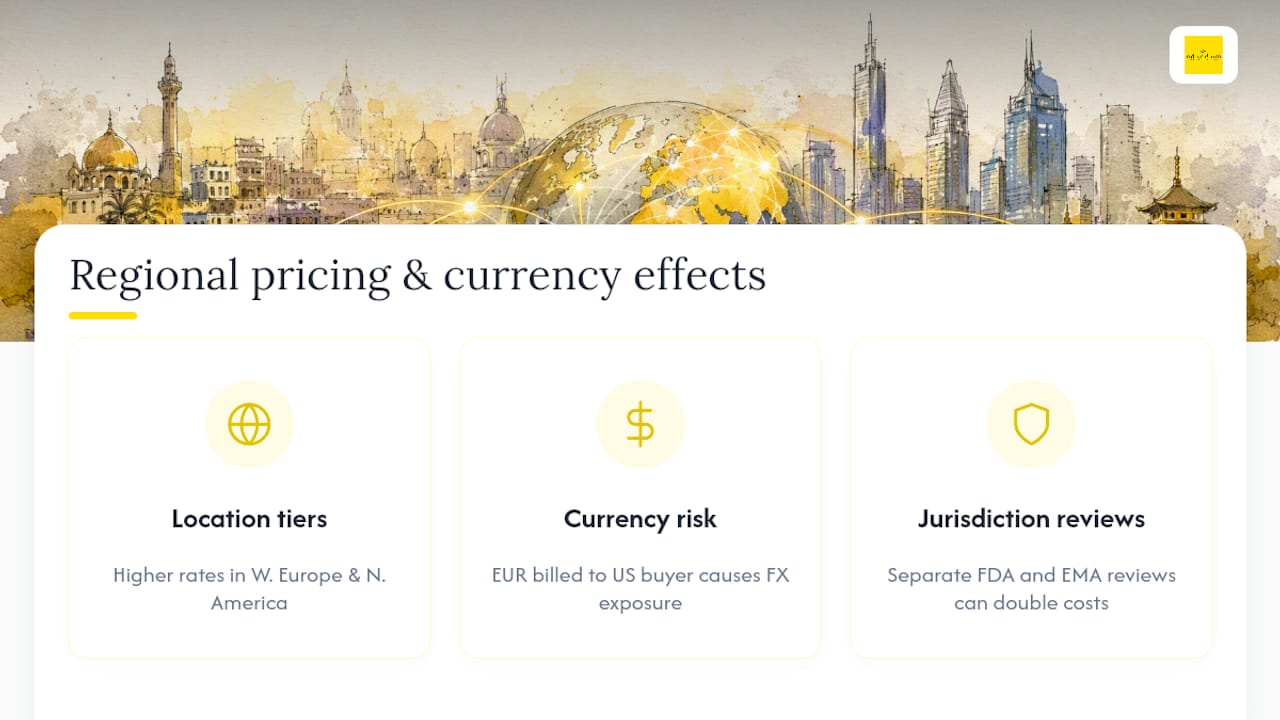
Currency fluctuation adds a layer of complexity for multi-year or multi-region contracts. A vendor quoting in euros for a US-based buyer, or in US dollars for a European buyer, exposes one party to exchange-rate risk over the life of a contract. Long-term regulated translation agreements, especially in life sciences or defense with multi-year documentation cycles, should specify the invoicing currency and whether rates adjust for currency movement or stay fixed for the contract term.
Regional regulatory divergence compounds this. A single source document destined for both FDA and EMA submission may need separate terminology treatment and separate certification statements for each jurisdiction, effectively doubling certain review costs even when the core translation work overlaps. Procurement teams managing multi-region regulatory filings should budget for jurisdiction-specific review as a distinct line item, not assume one certified translation satisfies every market.
Why Procurement Teams Overvalue the Per-Word Number
The biggest mistake in regulated translation procurement isn’t picking a vendor that’s too expensive. It’s comparing the wrong number. A per-word rate tells you almost nothing about whether a quote includes independent revision, SME review, or a usable audit trail, and most RFPs still ask vendors to compete on that single figure.
The conventional advice, get three quotes and pick the middle one, assumes those quotes describe the same work. They rarely do. One vendor’s $0.18 per word includes a licensed pharmacist reviewing every clinical claim. Another vendor’s $0.16 per word includes a single generalist translator and no second check. Those aren’t competing prices for the same product; they’re different products wearing the same unit of measurement.
What should change first: every RFP for regulated content should require a line-item breakdown, translation, revision, SME review, DTP, QA, before any price comparison happens. That single procedural change catches more problems than any amount of vendor vetting after the fact. Certification badges matter, but they mean little if nobody on the buying side checks what specific workflow generated the quote in front of them.
— Eric Brown
Get Regulated Translation Pricing That Matches Your Audit Requirements
Comparing per-word rates across vendors only works once you know each quote includes the same process. AD VERBUM builds that transparency in from the start: every project runs through asset integration with your existing TM and TB, proprietary LLM generation on EU-hosted infrastructure, certified SME review, and QA aligned to ISO 17100 and ISO 18587.
For procurement teams juggling life sciences, legal, finance, defense, or manufacturing documentation across 150+ languages, that means one workflow standard instead of negotiating process inclusions quote by quote. AD VERBUM’s ISO 27001 and ISO 42001 certifications, GDPR and HIPAA alignment, and private EU-hosted processing address the data sovereignty questions that stall regulated procurement cycles. Review the full range of AD VERBUM services to see which certifications and workflows apply to your document type, or check industry-specific coverage to confirm experience in your regulatory environment before requesting a formal quote.
Sources
Recommended

