Secure Enterprise Translation: The Controls That Actually Matter

The recommended approach for translating regulated, confidential, or high-value content is certified AI+HUMAN hybrid translation built on enterprise access controls, encryption in transit and at rest, and auditable, tamper-evident logs. Free public machine translation tools and uncertified vendors fail this bar because they cannot prove data handling, retention limits, or terminology governance to an auditor.
Three controls separate a genuinely secure enterprise translation program from a risky one:
Authentication and access: single sign-on (SSO), multi-factor authentication (MFA), and role-based access limiting who touches a document and when.
Encryption: TLS 1.2 or higher in transit, AES-256 at rest, with documented key management.
Auditability: tamper-evident logs showing who accessed, edited, or exported a file, retained long enough to satisfy your regulator.
If a translation vendor cannot produce these on request, the relationship carries risk your compliance team hasn’t priced in. Before signing anything, put a specific line in the RFP: request current ISO 27001 certification, a recent SOC 2 or penetration test summary, and sample audit log output. A vendor that hesitates on any of the three indicates they may not meet security requirements.
Key Takeaways
Secure enterprise translation succeeds when authentication, encryption, and auditable SME-reviewed workflows are enforced together, not treated as separable checkboxes.
Point | Details |
Verify three controls first | Confirm SSO/MFA, TLS/AES-256 encryption, and tamper-evident audit logs before evaluating anything else. |
Match technology to content risk | Reserve LLM-based AI translation with SME review for regulated content; avoid public MT entirely for sensitive material. |
Secure the full file path | Use SFTP or managed APIs with least-privilege service credentials, and govern storage separately from transport. |
Request certification artifacts, not badges | Ask for current ISO 27001, ISO 17100, and ISO 18587 certificates plus sample audit logs during procurement. |
Pilot before scaling | AD VERBUM’s AI+HUMAN hybrid workflow, EU-hosted infrastructure, and ISO-aligned QA make it a fit for a logged, SME-reviewed pilot on regulated content. |
Table of Contents
What Secure Enterprise Translation Covers, and What It Doesn’t
Secure enterprise translation means translating content where a confidentiality breach, meaning error, or compliance gap carries legal, financial, or safety consequences. That includes regulated clinical and pharmaceutical documentation, patent filings and litigation materials, financial disclosures and audit records, defense and export-controlled technical manuals, and protected health information under HIPAA. It also covers structured data feeding automated systems, where a mistranslated field can corrupt a downstream process rather than just confuse a reader.
It does not cover casual or low-stakes content. A marketing blog post translated for SEO reach, an internal FAQ, or a public press release doesn’t need the same audit trail as a clinical trial consent form. Applying full regulatory-grade controls to every piece of content wastes budget and slows teams down without reducing real risk. Confidential business translation earns the term “confidential” because the content itself carries stakes; the controls should scale to match.
This distinction matters up front because the standards referenced throughout this guide, ISO 27001 for information security, ISO 17100 for translation service quality, ISO 18587 for machine translation post-editing, and the compliance frameworks GDPR and HIPAA, apply specifically to regulated and high-stakes categories. Vendors like AD VERBUM build their workflows around these standards precisely because their client base sits in Life Sciences, Legal, Finance, Defense, and Manufacturing, sectors where the definition above is the norm, not the exception.
What Technical Controls Should a Secure Translation Vendor Have?
A vendor’s security posture is only as strong as its weakest access point. For translation providers, that’s usually the human layer: linguists, reviewers, and project managers logging into a portal from dozens of locations.
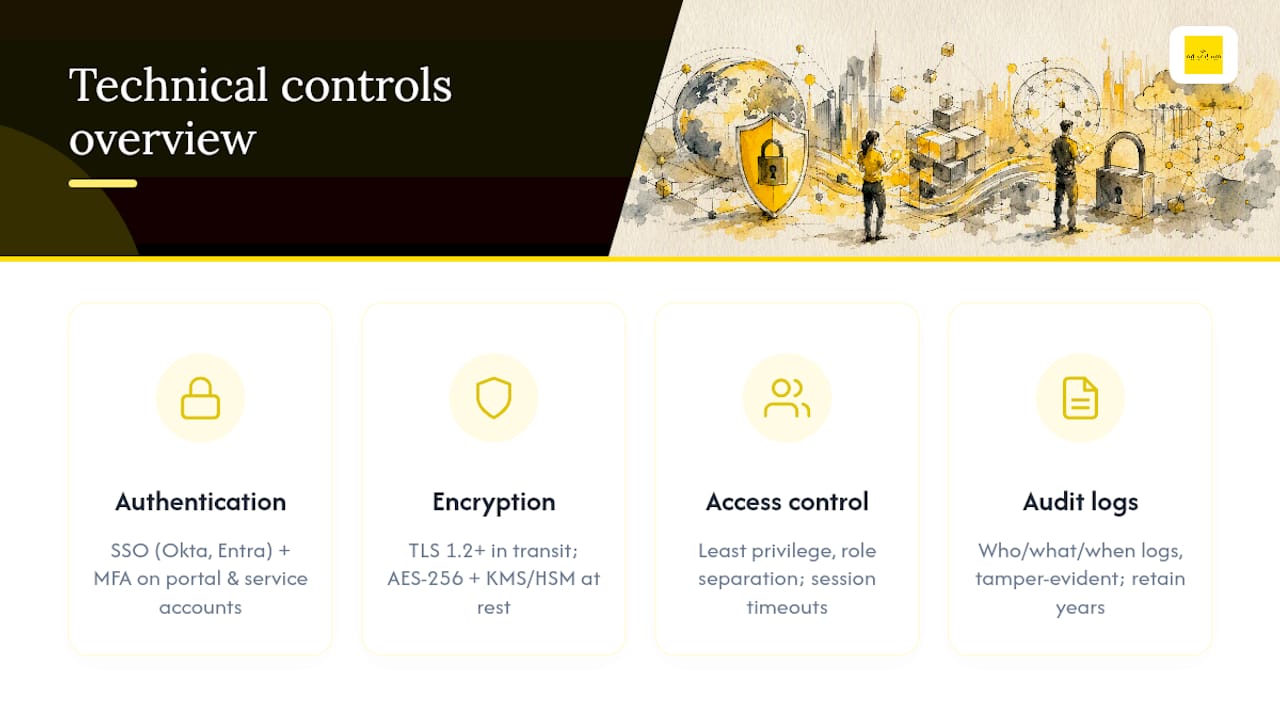
Authentication should never rely on username and password alone. SSO through your existing identity provider (Okta, Microsoft Entra ID, or similar) and MFA on both the client-facing portal and any vendor service accounts close the most common entry point for credential-based attacks. Service accounts used for automated file transfer deserve the same scrutiny as human logins; a static, unrotated API key sitting in a script is a liability that outlives whoever set it up.
Encryption has two distinct legs, and vendors sometimes conflate them. Data in transit needs TLS 1.2 or higher, no exceptions for legacy connections. Data at rest, meaning files sitting on a server between upload and delivery, needs AES-256 encryption with a documented key management approach, ideally backed by a key management service (KMS) or hardware security module (HSM) rather than keys stored alongside the data they protect. Microsoft’s Azure AI Translator documentation illustrates the pattern well: private endpoints keep translation traffic off the public internet entirely, which matters when the content in transit is a draft patent application or an unredacted clinical study report.
Access control inside the vendor’s environment should follow least-privilege principles. A linguist working on a single project should not have visibility into your full document repository, and a reviewer’s session should time out and require re-authentication after a defined idle period. Role separation between translators, reviewers, and project managers isn’t bureaucratic overhead; it’s what makes an audit answerable.
Audit logs are the artifact that turns “we have security” into “we can prove it.” A usable log records who accessed a file, what action they took (view, edit, download, export), and when, in a format that can’t be silently altered after the fact. Retention should match your regulatory obligation, often several years for regulated industries, not the vendor’s default of 90 days. Ask for a sample export before you sign anything, not after an incident forces the question.
MT, NMT, and AI Translation Are Not the Same Risk Profile
Vendors and buyers routinely use “machine translation” as a catch-all, but the three technologies underneath that label carry meaningfully different risk.
Legacy MT (rule-based or statistical machine translation) produces literal, word-for-word output with weak context handling. It struggles badly with negation, idiom, and domain terminology, which makes it a poor fit for anything where a subtle meaning shift changes a clinical dosage instruction or a contract obligation.
NMT (neural machine translation), the technology behind most consumer and broadly available SaaS translation engines, handles fluency far better but still shows inconsistent terminology control and variable handling of negation and nuance. Academic work on large language model behavior documents hallucination risks and the need for domain-specific constraints when generative models produce unsupervised output, a risk that carries over to NMT systems operating without enterprise-grade terminology governance.
LLM-based AI translation, the category AD VERBUM’s proprietary system falls into, generates context-sensitive output that follows explicit terminology instructions rather than translating in isolated sentence fragments. The distinction that matters for security teams isn’t the model architecture, it’s governance: is the model privately hosted, or does every document you submit pass through a public SaaS endpoint with unclear data retention terms?
That governance question decides whether automated translation is safe for your content:
Private model hosting removes the risk of your source text training someone else’s public model.
Disabled external telemetry stops usage data and content fragments from leaving your controlled environment.
Enforced Translation Memory and Term Base integration keeps terminology consistent and auditable rather than improvised per session.
Subject-matter expert (SME) post-editing catches the hallucination and context errors that even well-constrained models still produce.
QA aligned to ISO 17100 and ISO 18587 turns quality control from a vague promise into a documented process.
Skip any one of these and you’ve reintroduced the exact risk the certification was supposed to remove.
How Do You Securely Transfer Files for Translation?
File transfer is where security policy meets daily operational reality, and it’s also where most incidents actually happen, not in some dramatic breach, but in a misrouted email attachment or a shared drive link left open longer than intended.
Match the transfer method to volume and sensitivity. SFTP suits scheduled, high-volume batch transfers with predictable file structures. A secure customer portal works well for occasional, ad hoc submissions where a human should confirm receipt. A managed API fits continuous, high-frequency integration with a content management or product information system. Industry guidance on secure file handling is consistent on one point: free consumer-grade transfer tools have no place in this list, regardless of volume.
Configure automation connectors with least-privilege credentials. Trados documentation on its SFTP automation connector specifies dedicated service users and defined credential prerequisites before a connector can automate project creation from a repository. Reusing a general-purpose admin credential for an automated connector is a common shortcut that eliminates the audit trail you’d need if something went wrong.
Remember SFTP secures transport, not storage. Files moved over SFTP arrive encrypted in transit, but what happens to them once they land on an endpoint is a separate governance question, meaning retention, access control, and eventual deletion at both ends need their own written policy.
Preserve terminology governance during TM/TB ingestion. Translation Memories and Term Bases often contain client-specific proprietary language. Ingest them into an environment with the same access controls as the source documents, not a shared staging folder with looser permissions.
Handle CI/CD localization pipelines with ephemeral credentials. For teams pushing localized strings through automated build pipelines, use short-lived tokens rather than long-standing secrets, and monitor connector activity the same way you’d monitor any other production integration. Operational documentation from platforms like Vasont Inspire shows how job locking and structured transfer steps prevent two processes from silently overwriting the same file mid-translation.
Which Certifications Actually Prove Translation Security?
Certifications matter only if you know what each one actually verifies, because vendors frequently list a wall of logos without explaining what they mean for your specific content.
ISO 27001 certifies an information security management system, covering risk assessment, access control, and incident response at the organizational level. This is the baseline; a vendor without it shouldn’t be handling regulated content at all.
ISO 17100 certifies the translation service process itself, covering translator qualifications, revision steps, and project management.
ISO 18587 certifies post-editing of machine translation output specifically, the standard that applies directly when an LLM or NMT system generates a first draft that a human then refines.
ISO 42001 addresses AI management systems, an increasingly relevant certification as more vendors embed generative AI into their pipelines.
ISO 13485 applies specifically to medical device documentation and quality systems.
AQAP2110 is the NATO quality assurance standard relevant to defense-sector translation work.
HITRUST becomes relevant when translated content touches U.S. healthcare data flows that intersect with HITRUST-certified systems in your own environment.
Certification names alone don’t constitute proof. Ask for the current certificate with its expiration date, a recent SOC 2 report or penetration test summary, and specific data processing agreement (DPA) language covering sub-processors and cross-border transfer. For GDPR-governed data moving between the EU and other jurisdictions, confirm the vendor’s hosting location and transfer mechanism explicitly rather than assuming compliance from a certification badge. Cross-border transfer questions get more complex, not less, when a document contains protected health information or export-controlled technical data, so residency should be a named requirement in the contract, not an assumption.
How Do You Roll Out a Secure Translation Program?
Classify content and map regulatory exposure. Identify which documents carry PHI, IP, financial disclosure obligations, or export controls before you send anything to a vendor.
Write procurement requirements before you shop vendors. Specify required certifications, encryption standards, audit log retention, and SLA terms in the RFP itself, not as a follow-up question after a demo.
Onboard integrations with credential hygiene from day one. Use dedicated service accounts, rotate keys on a defined schedule, and grant access scoped to the specific project or repository, never broad admin rights by default.
Operationalize SME review and QA gates. Require sign-off from a qualified subject-matter reviewer before regulated content ships, and set explicit data retention and purge schedules so files don’t linger past their useful life. This regulated document workflow framework outlines how the review and gating steps fit together operationally.
Verify before you scale. Run a pilot with full logging enabled, request a recent penetration test summary, and review the audit trail from that pilot line by line before committing to a larger volume.
What Goes Wrong, and How Do You Prevent It?
Four failure patterns account for most enterprise translation security incidents, and each has a specific, testable fix.
Leakage through public MT or a misconfigured connector. A well-meaning employee pastes a confidential clause into a free translation site, or a connector inherits broader file access than intended. Mitigation: explicit contract language banning public MT for regulated content, plus technical controls (DNS or proxy blocks) that prevent it at the network level.

Terminology and meaning errors in regulated text. An unconstrained model mistranslates a dosage unit or a legal term of art. Mitigation: enforce the client’s own Translation Memory and Term Base, and require signed SME attestation on every regulated deliverable, not a spot check.
Credential compromise and insider risk. A shared or stale credential gets exposed, or a departing linguist retains access. Mitigation: rotate keys on a fixed schedule, enforce MFA everywhere, and run quarterly access reviews that actually revoke unused permissions.
Incomplete audit trails. Logs exist but can be edited after the fact, or they simply don’t cover export events. Mitigation: tamper-evident logging, signed manifests for each deliverable, and periodic third-party audits rather than self-attestation alone.
Pro Tip: Run one deliberate test transaction through your vendor’s full pipeline, upload to delivery, and request the resulting audit log before you sign a master agreement. A vendor that can’t produce a clean, complete log for a single test file will not produce one for your production volume.
Where Does AD VERBUM Fit Into a Secure Translation Program?
AD VERBUM’s AI+HUMAN hybrid translation model fits best where the stakes described throughout this guide are real: regulated content, mandatory audit trails, strict terminology control, and sensitive data that cannot pass through a public model’s black box.
The workflow follows a fixed sequence. First, client Translation Memories and Term Bases are ingested to constrain output before generation starts. Second, AD VERBUM’s proprietary LLM-based LangOps System produces target-language output bound by that client terminology. Third, a certified subject-matter expert, a medical professional, engineer, or legal scholar depending on the content, reviews for technical accuracy and regulatory fit. Fourth, quality assurance runs aligned to ISO 17100 and ISO 18587, with sector-specific requirements like MDR applied where relevant.
Operational proof points back the process: ISO 27001 and ISO 42001 certification, private EU-hosted infrastructure with no reliance on outsourced public cloud tooling for core processing, and a network of over 3,500 subject-matter expert linguists. AD VERBUM’s own ELIA industry membership listing reflects its standing among established language service providers serving regulated sectors.
For a procurement checklist, request:
Current ISO 27001, ISO 42001, ISO 17100, and ISO 18587 certificates with expiration dates.
Confirmation of EU hosting location and data residency terms.
Sample audit log output and SME attestation documentation from a comparable prior project.
A Practitioner’s Note on What Actually Prevents Incidents
Most enterprise translation security failures I’ve seen in outline don’t trace back to a broken encryption protocol. They trace back to a skipped SME review or an audit log nobody ever checked until an incident forced the question. Certifications establish that a vendor built the right system. Auditability is what lets you prove, six months later, that the system actually worked the way it was supposed to. Treat SME sign-off and log review as operational habits, not paperwork, and most of the failure modes above never get the chance to happen.
— Eric Brown
Ready to Move From Policy to a Working Pilot?
Everything above describes what a secure enterprise translation program should look like on paper. AD VERBUM’s advantage is that the AI+HUMAN hybrid workflow, ISO 27001 and ISO 42001 certification, and EU-hosted infrastructure already exist in production, so you’re evaluating a running system, not a roadmap.
For regulated content, sensitive IP, or documentation with a compliance deadline attached, AD VERBUM’s translation services run on the exact sequence described in this guide: TM/TB ingestion, constrained LLM-based generation, SME review by a qualified linguist in your domain, and QA aligned to ISO 17100 and ISO 18587. Teams handling export-controlled or defense-grade material can also review AD VERBUM’s defense-sector translation capabilities for air-gapped and SCIF-adjacent requirements.
A practical first step: scope a pilot around one sample sensitive document, request logging enabled from the first upload, and require full SME review before delivery. Reach out through AD VERBUM’s translation page to define that pilot scope and request the certification and audit artifacts covered above as part of the RFP.
Sources
Recommended