


PMCF compliance: multilingual evidence under EU MDR Annex XIV

Post-market clinical follow-up is not a formality. In 2026, Notified Bodies like BSI, TÜV SÜD, and SGS are treating PMCF documentation as live clinical evidence, not administrative output. They are scrutinizing translated PMCF plans and evaluation reports with the same rigor applied to pre-market submissions. Manufacturers who treat language quality as a secondary concern are discovering this the hard way, through major findings, delayed renewals, and requests for full re-submission. This guide cuts through the confusion around multilingual requirements under EU MDR Annex XIV Part B and gives post-market surveillance managers and regulatory affairs leads a practical framework for staying audit-ready.
Table of Contents
Evidence methodologies: Risk-based, multilingual data collection in 2026
What Notified Bodies scrutinize: Common audit pitfalls and 2026 trends
Debunking the ‘multilingual evidence standard’: What regulators actually require
A practitioner’s view: What really matters for PMCF success in 2026
Ensure multilingual PMCF compliance: Next steps with AD VERBUM
Key Takeaways
Point | Details |
Ongoing PMCF compliance | Continuous, risk-based PMCF is required for all but justified exemptions and is closely audited by Notified Bodies. |
Multilingual documentation matters | Accurate, regulatory language support is vital across all PMCF documentation and evidence, not just IFUs. |
Tailored methodologies win audits | Notified Bodies prefer proactive, risk-aligned, and well-localized evidence to generic, poorly translated plans. |
Avoid common NB pitfalls | Generic documentation, poor endpoints, or missing audit trails in any language trigger increased Notified Body findings. |
Early localization strategy | Incorporate expert translation and localization up front to ensure compliant, pan-EU PMCF processes. |
Understanding PMCF under EU MDR Annex XIV
Post-market clinical follow-up is defined under EU MDR Annex XIV Part B as a mandatory, continuous, proactive process for gathering and evaluating clinical data on a device after it reaches the market. This is not a one-time study or a periodic literature search conducted to close a gap. It is a structured, ongoing program tied directly to your device’s risk profile and clinical evidence base.
Who must implement PMCF? In principle, every manufacturer placing a CE-marked device on the EU market. Legacy devices transitioning under MDR timelines are not exempt unless the manufacturer can demonstrate, with documented justification, that a PMCF program is unnecessary. That justification must itself be evidence-based and defensible to a Notified Body reviewer.
Annex XIV Part B requires manufacturers to proactively collect post-market clinical data to confirm safety and performance, update the clinical evaluation, and identify previously unknown risks. The process must be continuous, not episodic.
Where confusion enters is around the phrase “multilingual evidence standard.” Many regulatory teams assume this refers to a specific normative requirement in Annex XIV. It does not. The confusion typically stems from conflating post-market surveillance translation obligations with the clinical data requirements in Part B. Understanding this distinction is the first step toward building a defensible program.
Key obligations under Annex XIV Part B include:
A documented PMCF plan with clear objectives, methods, and timelines
A PMCF evaluation report that analyzes collected data against the plan
Integration of findings into the Clinical Evaluation Report (CER), PSUR, and PMS system
Evidence that the program is risk-based and proportionate to the device’s classification
Review the full EU MDR PMCF guide if you need a regulatory baseline before moving into documentation specifics.
Core PMCF documentation: Plans, reports, and integration
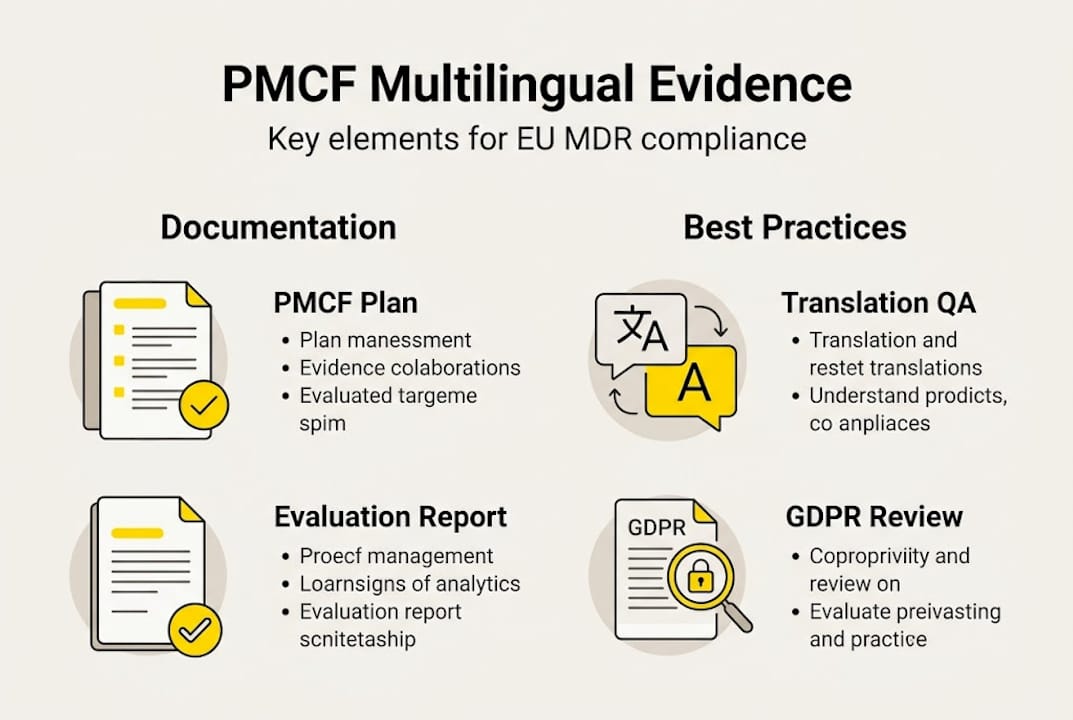
The two foundational documents are the PMCF Plan and the PMCF Evaluation Report. Key PMCF documents include the PMCF Plan covering objectives, methods, and timelines per MDCG 2020-7, and the PMCF Evaluation Report analyzing collected data per MDCG 2020-8, both integrated into the CER, PSUR, and PMS.
Document | Governing guidance | Core content | Integration point |
PMCF Plan | MDCG 2020-7 | Objectives, methods, timelines, endpoints | CER, PMS plan |
PMCF Evaluation Report | MDCG 2020-8 | Data analysis, conclusions, residual risks | CER update, PSUR |
CER | MDCG 2020-5 | Clinical evidence synthesis | Technical file |
PSUR | MDCG 2022-21 | Periodic safety update | Notified Body submission |
Where manufacturers consistently underperform is in translation quality across these documents. BSI and TÜV SÜD reviewers are not just checking whether a translation exists. They are checking whether the translated version preserves the precise regulatory meaning of endpoints, risk statements, and benefit-risk conclusions. A mistranslated endpoint in a PMCF Plan submitted in German or French is not a minor error. It is a substantive deficiency.
Steps to align PMCF documentation for audit success:
Map your PMCF Plan objectives directly to identified CER gaps and residual risks before drafting.
Use MDCG 2020-7 and 2020-8 templates as structural baselines, not optional frameworks.
Commission translating PMCF documentation through certified clinical linguists who understand MDR terminology, not general medical translators.
Maintain a translation audit trail showing source version, translator credentials, review steps, and final approval.
Synchronize PMCF Evaluation Report updates with CER revision cycles to avoid version misalignment.
Validate that CER translation best practices are applied consistently across all language versions before Notified Body submission.
Documentation completeness is table stakes. Language precision is what separates a clean review from a major finding.

Evidence methodologies: Risk-based, multilingual data collection in 2026
Building a compliant PMCF evidence base means selecting methods that are statistically valid, risk-proportionate, and executable across multiple EU markets. PMCF methodologies include surveys, registries, clinical investigations, literature reviews, and real-world evidence, all of which must be risk-based, statistically powered, and traceable to CER gaps and residual risks.
Method | Strengths | Key risks |
Patient surveys | Direct safety and satisfaction data | Translation errors distort data; GDPR compliance required |
Device registries | Large-scale, longitudinal real-world data | Variable data quality across EU sites |
Literature review | Cost-effective for established devices | Publication bias; may not address device-specific gaps |
Clinical investigations | Highest evidentiary value | Resource-intensive; long timelines |
Real-world evidence (RWE) | Captures routine use conditions | Regulatory acceptance still evolving |
For pan-EU data collection, multilingual survey design is not optional. If you are running a patient-reported outcomes survey across Germany, Italy, Spain, and Poland, each language version must be linguistically validated, not just translated. SGS and BSI reviewers will ask whether your survey instrument was back-translated and cognitively debriefed. If it was not, your data integrity is questionable.
GDPR compliance adds another layer. Any personal data collected as part of PMCF must be handled under a lawful basis, with data processing agreements in place for any third-party translation or data management vendors. Full translation audit trails are part of your traceability record.
Pro Tip: Build your translation and localization workflow into the PMCF Plan at the design stage. Manufacturers who treat managing multilingual data collection as an afterthought routinely face deficiencies flagged during NB review, because language inconsistencies surface as data integrity issues, not just formatting problems.
For pan-EU localization best practices that apply across multi-country submissions, the same principles of terminology governance and linguistic validation apply to PMCF instruments.
Review multilingual survey guidance for current expectations on survey design and data collection standards.
What Notified Bodies scrutinize: Common audit pitfalls and 2026 trends
BSI, TÜV SÜD, and SGS are not reviewing PMCF submissions with a checklist mentality. They are assessing whether your program is genuinely fit for purpose: whether the plan addresses real risks, whether the evidence collected answers the questions posed, and whether the language across all document versions is consistent and precise.
NB scrutiny in 2026 focuses on data integrity, risk linkage, and language coherence between plan, report, and CER. Common pitfalls include generic plans and missing endpoints. Manufacturers with high-risk Class IIb and Class III devices are receiving the most intensive review, but Class IIa findings are increasing.
Trending NB expectations in 2026 include:
Real-world evidence integration with documented methodology and statistical rationale
AI-assisted data analysis tools with validated outputs and audit trails
EUDAMED data alignment, ensuring registry entries match PMCF plan commitments
Pan-EU evidence coverage, meaning data from multiple member states, not just one or two markets
Common audit failures to avoid:
Generic PMCF plans that copy templates without device-specific risk mapping
Underpowered studies where sample size justification is absent or inadequate
Inconsistent terminology across language versions of the same document
Missing translation audit trails with no record of translator credentials or review steps
Endpoint drift where the evaluation report addresses different questions than the plan specified
Weak CER linkage where PMCF conclusions are not reflected in the updated clinical evaluation
Review NB audit translation issues and EUDAMED compliance trends to understand how these findings are evolving across submission types.
For deeper context on audit findings patterns, the NB audit findings resource provides structured analysis of recurring deficiency categories.
Debunking the ‘multilingual evidence standard’: What regulators actually require
Let’s be direct. There is no explicit multilingual evidence standard in Annex XIV. The phrase circulates in regulatory forums and causes genuine confusion among compliance teams. What MDR and Notified Bodies actually require is more specific and more demanding than a single standard.
Annex I of the MDR requires that instructions for use and labeling be provided in the official language or languages of the EU member states where the device is made available. This is a hard legal obligation. Your IFU translation rules must be followed precisely, with certified translations for every applicable language.
For PMCF specifically, the multilingual obligation flows from the scope of your data collection. If you are gathering safety data from patients and clinicians across multiple member states, that data must be collected in their languages, and the resulting evidence must be coherent when synthesized into your evaluation report. Notified Bodies will ask how you ensured linguistic equivalence across survey versions.
Best practices for multilingual PMCF compliance:
Apply linguistic validation protocols to all patient-facing survey instruments
Maintain a master terminology glossary across all language versions of PMCF documents
Require certified clinical SME linguists for PMCF Plan and Evaluation Report translation
Document the translation process as part of your quality management system under ISO 13485
Ensure GDPR-compliant data processing agreements cover all language service vendors
Pro Tip: Robust language quality review during evidence collection is significantly cheaper than correcting deficiencies after NB submission. A single major finding requiring re-translation and re-submission can cost more in time and resources than a full upfront linguistic validation program.
For additional PMCF language guidance, the regulatory navigator resource covers practical compliance steps in detail.
A practitioner’s view: What really matters for PMCF success in 2026
After reviewing hundreds of PMCF submissions, the pattern is consistent. The failures are rarely scientific. Manufacturers with strong clinical teams and well-designed evidence programs still receive major findings because their language infrastructure does not match their clinical rigor. A precisely designed registry study loses credibility when the German-language patient consent form uses a different risk terminology than the English-language PMCF Plan.
The checklist approach to PMCF compliance is a trap. You can tick every box in MDCG 2020-7 and still receive a finding from TÜV SÜD because your evaluation report does not read as a coherent continuation of your plan across language versions. True compliance requires integrating regulatory, linguistic, and quality management systems from the start, not bolting translation on at the end.
Forward-thinking teams are building EUDAMED alignment, AI translation QA, and RWE methodology into their PMCF programs early. They are also investing in trusted language providers with verified MDR-specific audit trails and certified clinical linguists, because that is what BSI and SGS reviewers are asking to see in 2026. When you justify a reduced PMCF scope to a Notified Body, the quality of your language and documentation is itself evidence of your regulatory maturity.
Ensure multilingual PMCF compliance: Next steps with AD VERBUM
If your PMCF documentation is heading toward a Notified Body review, the language quality of every translated plan, report, and survey instrument will be scrutinized. AD VERBUM supports medical device manufacturers with audit-ready multilingual PMCF translation through a certified AI+HUMAN hybrid workflow: client Translation Memories and Term Bases are ingested first, a proprietary LLM-based LangOps System generates output constrained by your terminology, and certified clinical SME linguists review for MDR-specific accuracy and regulatory coherence.
With ISO 13485, ISO 17100, and ISO 27001 certification, EU-hosted infrastructure, and MDR-specific audit trails built into every project, AD VERBUM is structured for exactly the compliance environment BSI, TÜV SÜD, and SGS are enforcing in 2026. Explore our multilingual regulatory approach and multilingual evidence solutions, or contact AD VERBUM to discuss your next PMCF submission.
Frequently asked questions
Does Annex XIV of the EU MDR formally define a multilingual evidence standard for PMCF?
No, Annex XIV does not define a strict multilingual evidence standard. However, evidence collection must support IFU and labeling in all required EU languages, and pan-EU survey data must be linguistically validated across member state languages.
What are the essential PMCF documents under EU MDR Annex XIV?
The two essentials are the PMCF Plan and the PMCF Evaluation Report. Both documents must align with MDCG 2020-7 and 2020-8 respectively and integrate into the CER, PSUR, and PMS documentation set.
How do Notified Bodies assess multilingual aspects of PMCF in 2026?
BSI, TÜV SÜD, and SGS review how surveys, reports, and safety data support access across EU regions. They assess translation accuracy and regulatory language coverage, including audit trails showing certified clinical linguist involvement.
What common PMCF documentation mistakes lead to Notified Body findings?
Frequent issues include generic or untailored plans, lack of statistical power, missing translation audit trails, and weak linkages to clinical evidence gaps identified in the CER.
How should PMCF evidence be collected for pan-EU compliance?
Evidence should be gathered via risk-based, statistically valid multilingual methods such as surveys and registries, fully traceable and aligned with CER-identified risks and residual uncertainties.
Recommended
