


Why Data Security Matters in Translation for Regulated Industries

Data security in translation is defined as the set of technical, contractual, and procedural controls that protect sensitive information throughout every stage of a translation workflow, from initial file transfer through final delivery and archiving. For professionals in healthcare and finance, this is not a best practice. It is a compliance obligation enforced by HIPAA, GDPR, and sector-specific frameworks that carry significant legal and financial consequences when violated. Translation workflows introduce exposure points that most organizations fail to map until after a breach occurs. Understanding why data security matters in translation, and what controls address each risk, is the foundation of any defensible compliance posture in 2026.
Why data security matters in translation workflows
Translation processes create new attack surfaces that do not exist in standard document workflows. A patient record, a loan agreement, or a clinical trial protocol does not become less sensitive when it crosses a language boundary. Yet the act of translation typically involves file transmission, third-party access, AI processing, and storage in systems outside the organization’s primary security perimeter.
Translation workflows introduce risk points across transmission, processing access, storage, and auditing that require the same controls applied to electronic health records or payment systems. This means encryption, access controls, retention management, and auditability are not optional add-ons. They are baseline requirements.

The industry term for this discipline is translation data governance, though the phrase “data security in translation” accurately describes the operational scope. Both terms refer to the same set of controls applied specifically to language service workflows. Regulated organizations need to understand both the technical and contractual dimensions before engaging any translation vendor.
What are the main data exposure risks in translation workflows?
Every step in a translation workflow is a potential exposure point. The risks are not hypothetical. They are structural, and they appear in predictable patterns across healthcare and finance organizations.
The primary exposure vectors include:
Transmission vulnerabilities. Files sent via unencrypted email or uploaded to consumer cloud storage travel without protection. A single intercepted file containing protected health information (PHI) or personally identifiable financial data constitutes a reportable breach under both HIPAA and GDPR.
Processing access risks. Human translators, AI systems, and project managers all require access to source documents. Without role-based access controls and unique credentials, the principle of least privilege is violated and audit trails become unreliable.
Storage and retention risks. Translation memory databases silently accumulate sensitive data across projects, persisting well beyond the original project’s end date. A translation memory built over three years may contain PHI from dozens of patients or confidential financial terms from multiple clients, with no retention policy governing its deletion.
Audit trail gaps. Without detailed logs recording who accessed which document, when, and what operations were performed, breach detection and regulatory response become impossible. HIPAA requires these logs to be retained for six years.
Subcontractor exposure. Many translation vendors use freelance networks or third-party post-editors. Each additional party in the chain is an additional risk node unless contractually bound and technically controlled.
Pro Tip: Map every step of your translation workflow as if it were a data flow diagram for a payment system. Invisible handoffs, such as a project manager forwarding a file to a freelancer, are where breaches originate.
How do regulatory frameworks demand data security in translation?
HIPAA and GDPR impose specific, enforceable requirements on how sensitive data is handled during translation. These are not general data protection principles. They are detailed technical and contractual mandates.
HIPAA requirements for translation security
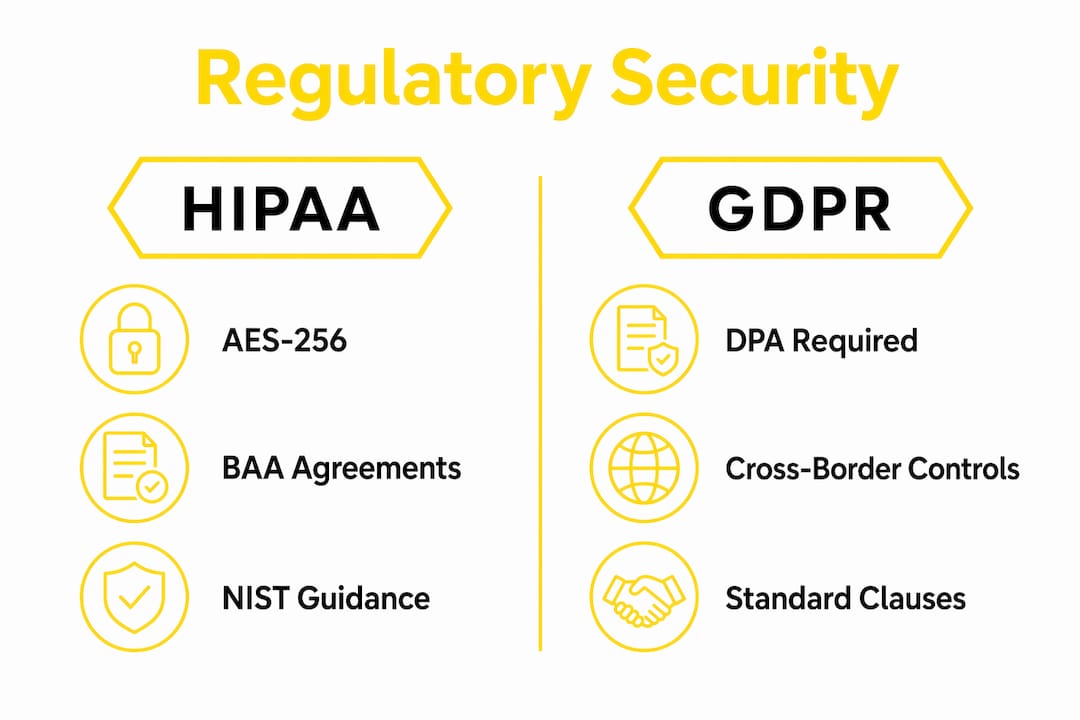
HIPAA mandates risk-based mandatory encryption following NIST guidance, with AES-256 as the accepted standard for data at rest and TLS 1.2 or 1.3 for data in transit. As of 2026, encryption is no longer treated as an addressable safeguard subject to organizational discretion. It is required. Critically, encryption provides a safe harbor in breach notification: if data is properly encrypted and keys are not compromised, the incident may not trigger mandatory reporting.
HIPAA also requires Business Associate Agreements (BAAs) with any vendor that handles PHI, including translation providers. A BAA must define the permitted uses of PHI, security obligations, breach notification timelines, and data destruction requirements. HIPAA compliance demands contractual BAAs alongside encryption to govern how translation vendors handle protected information. Encryption alone does not satisfy the requirement.
GDPR requirements for translation security
Under GDPR Article 28, Data Processing Agreements must be signed before any personal data is processed by a vendor. As of 2026, incomplete or absent DPAs render processing unlawful. A compliant DPA must specify the subject matter and duration of processing, the nature and purpose of processing, the type of personal data involved, security obligations, subprocessor management, breach notification procedures, and data deletion or return upon contract termination.
GDPR Chapter V restricts cross-border data transfers without adequate safeguards such as Standard Contractual Clauses (SCCs) or Binding Corporate Rules (BCRs). For organizations translating documents into languages served by vendors outside the EU, encryption is a required supplementary measure, not a substitute for legal transfer mechanisms.
Control area | HIPAA requirement | GDPR requirement |
Encryption at rest | AES-256, NIST-aligned, mandatory 2026 | Required as appropriate technical measure |
Encryption in transit | TLS 1.2/1.3 | Required as appropriate technical measure |
Vendor agreement | Business Associate Agreement (BAA) | Data Processing Agreement (DPA, Article 28) |
Audit logging | 6-year retention, access and operation logs | Breach notification within 72 hours |
Cross-border transfers | Restricted to covered entities and BAs | SCCs or BCRs required; encryption supplementary |
Subprocessor management | BAA required for each subcontractor | DPA must list and govern all subprocessors |
Pro Tip: If your translation vendor cannot produce a signed BAA or DPA before processing begins, stop the workflow. Processing data without these agreements in place is a regulatory violation, not a procedural gap.
What technical measures are essential for securing translation processes?
Technical controls form the first line of defense in translation data security. They must be verified, not assumed, when evaluating any translation vendor or internal workflow.
Encryption in transit and at rest. All file transfers must use TLS 1.2 or 1.3. All stored files, including source documents, translated outputs, and translation memories, must be encrypted with AES-256. Verify that the vendor’s infrastructure applies these standards by default, not only on request.
Access control mechanisms. Each user in the translation workflow must have unique credentials. Role-based access control (RBAC) limits exposure to the minimum necessary. Multi-factor authentication (MFA) is required for any system containing PHI or sensitive financial data.
Audit trails. HIPAA requires detailed audit logs recording who accessed PHI, what operations were performed, and when data was transmitted, retained for six years. These logs must be tamper-evident and accessible for regulatory audits. A vendor that cannot produce access logs on request fails this requirement. For a structured approach to building these records, the translation audit trail guide for FDA and EMA compliance provides a practical framework.
Translation memory security. Sensitive content persists in translation memories beyond project completion, requiring explicit retention limits and access restrictions independent of document-level protections. Translation memory databases must be encrypted, access-controlled, and subject to documented retention and deletion policies.
AI translation tool evaluation. Not all AI translation tools carry the same risk profile. Legacy machine translation (MT) systems produce literal output with weak context handling, increasing error risk in regulated text. Consumer neural machine translation (NMT) engines, including broadly available SaaS tools, present governance limitations for regulated documentation. A proprietary LLM-based system with EU-hosted infrastructure, terminology governance, and subject-matter expert review addresses these gaps directly.
Pro Tip: Encryption is necessary but not sufficient. Verify key management practices and confirm that no plaintext exposure occurs at any processing stage, including during AI inference or human review.
What contractual and procedural safeguards complement technical security?
Technical controls protect data in transit and at rest. Contractual and procedural controls govern human behavior, vendor accountability, and the legal enforceability of security commitments.
Before any translation vendor processes sensitive data, the following must be in place:
A signed BAA (for HIPAA-covered data) or DPA (for GDPR-covered data) that specifies security obligations, permitted uses, breach notification timelines, subprocessor management, and data destruction requirements.
A list of all subprocessors the vendor uses, with confirmation that each is bound by equivalent contractual obligations. A vendor who uses freelance translators without individual confidentiality agreements and access controls is not compliant, regardless of what the master contract states.
Documented evidence of the vendor’s security certifications. ISO 27001 certification indicates a formally audited information security management system. It is the minimum acceptable standard for vendors handling regulated data.
Procedural controls inside the organization must include confidentiality agreements for all staff with translation access, background checks for personnel handling PHI or sensitive financial data, least-privilege access policies, and regular security training. The certified translation vendor checklist for regulated procurement provides a structured framework for evaluating these controls during vendor selection.
Translation data security requires a holistic approach. Technical, contractual, and procedural controls must work together. A vendor with strong encryption but no BAA is non-compliant. A vendor with a signed DPA but no audit logging cannot support breach response. All three layers must be present and verifiable.
Pro Tip: Never rely on vendor self-attestation alone. Require audit rights in your BAA or DPA, and exercise them. A vendor that resists an audit is a vendor that has something to hide.
What are common failure modes in translation data security?
Most translation data breaches in regulated industries follow predictable patterns. Identifying them in advance is the most direct path to prevention.
Failure mode | Risk | Mitigation |
Consumer translation tools for PHI | Google Translate transmits data externally without BAAs or audit trails, violating HIPAA | Prohibit consumer tools by policy; use only certified secure providers |
Missing or incomplete BAA/DPA | Processing is unlawful; no legal recourse in breach | Execute compliant agreements before any data transfer |
Unencrypted transmission | Data intercepted in transit constitutes a reportable breach | Enforce TLS 1.2/1.3 for all file transfers; prohibit email attachments for sensitive documents |
Uncontrolled translation memories | Sensitive segments persist indefinitely without deletion | Implement retention policies and access controls on all TM databases |
No audit logging | Breach detection and regulatory response are impossible | Require tamper-evident logs with six-year retention from all vendors |
Unvetted subcontractors | Third-party translators access data without contractual controls | Require vendor disclosure of all subprocessors; verify individual confidentiality agreements |
The data security checklist for regulated sectors provides a step-by-step verification framework that maps directly to these failure modes. Organizations that complete this checklist before engaging a vendor eliminate the most common breach pathways before data changes hands.
Pro Tip: The highest-risk moment in any translation project is the first file transfer. If your vendor’s onboarding process does not include a security review before that transfer, the process is broken.
Key takeaways
Data security in translation is a compliance requirement enforced by HIPAA and GDPR, demanding technical, contractual, and procedural controls at every stage of the translation workflow.
Point | Details |
Translation creates new exposure points | Transmission, processing, storage, and auditing each introduce risks that require specific controls. |
Encryption is mandatory, not optional | HIPAA mandates AES-256 at rest and TLS 1.2/1.3 in transit as of 2026; GDPR requires equivalent technical measures. |
BAAs and DPAs are legal prerequisites | Processing sensitive data without signed agreements is a regulatory violation, not a procedural gap. |
Translation memories need governance | Sensitive data persists in TM databases beyond project end; retention limits and access controls are required. |
Vendor verification cannot be skipped | ISO 27001 certification, audit rights, and subprocessor disclosure are minimum standards for regulated procurement. |
What I’ve learned about translation security that most compliance guides miss
I have reviewed translation vendor contracts for organizations in Life Sciences, Finance, and Defense for years. The pattern I see most often is not malice. It is structural blindness. Organizations apply rigorous data governance to their core systems and then send the same data to a translation vendor via email with no BAA, no encryption verification, and no audit requirement. The translation workflow is treated as an administrative task rather than a data processing activity.
The 2026 regulatory environment has closed that gap on paper. HIPAA’s encryption mandate and GDPR’s DPA requirements are now explicit and enforced. What has not changed is the organizational tendency to treat compliance as a one-time checkbox rather than an ongoing control. A signed BAA from 2022 does not cover a vendor’s new subprocessor added in 2025. A translation memory created under one contract does not automatically fall under the retention policy of the next.
The organizations that get this right treat translation data governance the same way they treat EHR access governance or payment processing governance. They map the data flow, verify every control, and audit the vendor annually. They do not assume that a vendor’s ISO 27001 certificate means every subcontractor in their network is equally controlled.
AI+HUMAN hybrid translation models, when built on private infrastructure with documented QA processes, reduce the attack surface significantly compared to workflows that route data through public cloud NMT engines. But the technology is only part of the answer. The contractual and procedural layers are where most organizations remain exposed, and where the next breach is most likely to originate.
How AD VERBUM secures your translation projects
AD VERBUM’s secure translation services are built for regulated industries where data exposure is not an acceptable risk. The AI+HUMAN hybrid translation workflow runs on a proprietary LLM-based LangOps System hosted on private EU servers, with no reliance on public cloud tooling for core processing. Every project is covered by GDPR and HIPAA-aligned contractual frameworks, including DPAs and BAAs, before any data is transferred. ISO 27001 certification provides independent verification of the information security management system. Subject-matter expert linguists, including medical professionals, legal scholars, and engineers, review every output for technical accuracy and regulatory compliance. For organizations that need compliant multilingual content delivered at speed without compromising data governance, AD VERBUM delivers 3x to 5x faster than traditional workflows while maintaining full auditability.
FAQ
What is data security in translation?
Data security in translation is the application of technical, contractual, and procedural controls to protect sensitive information throughout every stage of a translation workflow, from file transfer through delivery and archiving.
Does HIPAA apply to translation vendors?
Yes. Any vendor that handles protected health information, including translation providers, qualifies as a Business Associate under HIPAA and must sign a BAA before processing begins. Operating without a BAA is a direct HIPAA violation.
Is Google Translate compliant with HIPAA or GDPR for sensitive documents?
No. Consumer translation tools like Google Translate transmit data externally without BAAs or audit trails, making them categorically non-compliant with HIPAA for PHI. They also lack the DPA framework required under GDPR Article 28.
What is a translation memory and why does it create security risk?
A translation memory is a database that stores previously translated segments for reuse. It silently accumulates sensitive content across projects and persists beyond individual project timelines, requiring explicit retention policies, access controls, and deletion procedures to remain compliant.
What certifications should a secure translation vendor hold?
At minimum, ISO 27001 for information security management. For healthcare translation, HIPAA alignment and ISO 13485 are relevant. For regulated documentation broadly, ISO 17100 and ISO 18587 govern translation quality and post-editing standards. Require evidence of each certification, not just a claim.
Recommended
