


How should US applicants source patent translation for PCT filings?

US applicants should source patent translation from a provider that translates the full application as filed, uses qualified technical and legal linguists, protects confidential data and documents each control. The USPTO requires an accurate English translation of the complete application, with no partial translations. Each destination office sets its own language and deadline rules.
Table of Contents
What do patent translation services cover?
Patent translation converts a patent application, or a related patent document, from one language into another while preserving the legal scope of the claims. It covers the description, the claims, text in the drawings and the abstract. It can also cover the request form, amended claims, office actions, prior-art references and search reports.
Claims need particular care. Smith and Bernard (2022, IDEA journal) argue that a translation must reflect what the author wrote, not what the translator believes was meant. They add that ambiguity in the source claim language must be preserved in the target language, because removing it may narrow the scope of what is disclosed or claimed.
This article is for localization, regulatory, legal operations and content leads who commission patent translation. It does not cover patent drafting or prosecution strategy. Those belong to the patent attorney or agent of record.
Which terms matter
PCT: the Patent Cooperation Treaty, which lets an applicant file one international application and later enter national or regional phases.
National phase: the stage in which the application enters a specific country or region, often requiring a translation into that office’s language.
Designated Office: the national or regional office in which protection is sought.
Attestation: a statement that the translation is accurate.
Which patent documents need translation, and how do requirements vary by jurisdiction?
The documents depend on the stage and the destination.
International phase
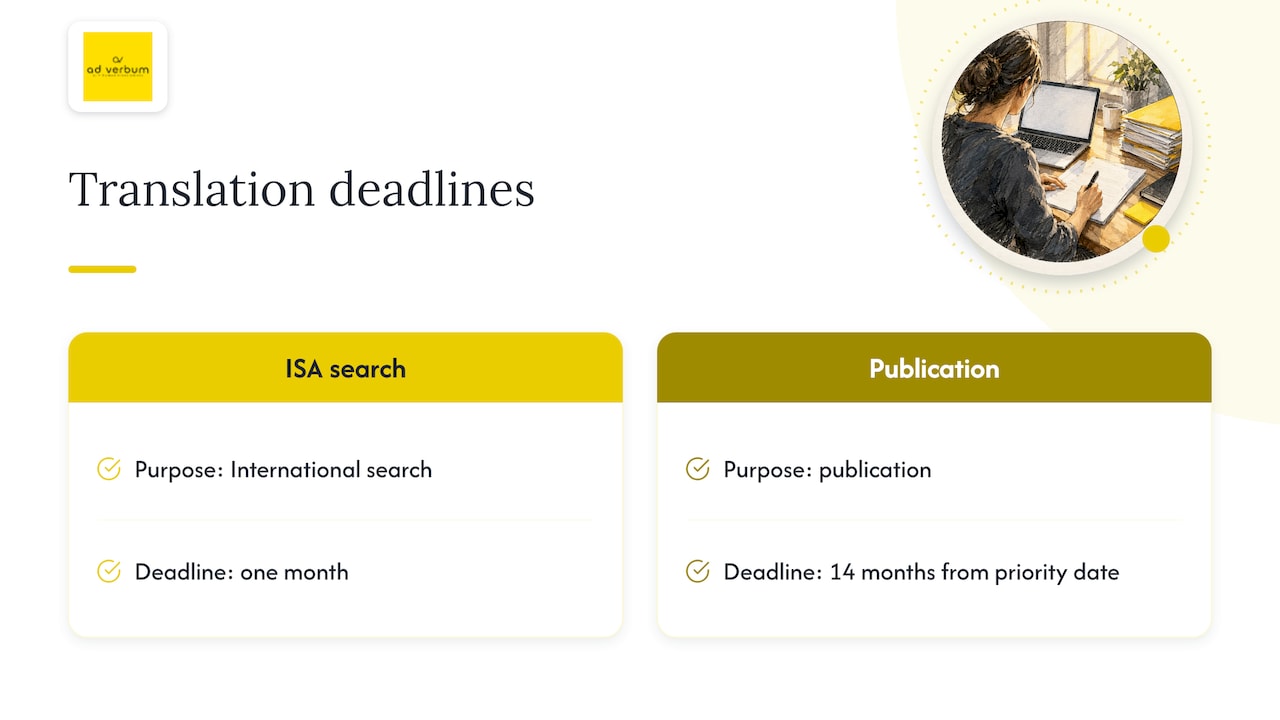
An international application may be published only in Arabic, Chinese, English, French, German, Japanese, Korean, Portuguese, Russian or Spanish. The WIPO PCT Applicant’s Guide states that a translation is required for search or publication when the filing language is not one of these, or is not accepted by the searching authority. PCT Rule 12 sets a one-month limit for a translation for the International Searching Authority and a 14-month limit from the priority date for a translation for publication.
National phase
Under PCT Rule 49.5, the translation contains the description, claims, text matter of the drawings and abstract. If the designated Office requires it, the translation also contains the request. When Article 19 amendments exist, it contains the claims as filed and as amended. Rule 49.2 requires the translation language to be an official language of the designated Office.
The same rule treats missing items differently. The Office may invite the applicant to translate the abstract within a reasonable time. Missing claim translations under the both-versions requirement may lead the Office to disregard the untranslated claims.
Destination examples
United States: the USPTO instructions for Form PTO-1390 (January 2025) require an accurate English translation of an international application not published in English. The translation covers the application as filed, or with accepted Rule 26 changes or Rule 91 rectifications. A partial translation that omits drawing text or original claims is unacceptable.
Europe: the EPO Guidelines (2026, A-XIII 3) require a translation within 31 months when the international application was not published in an EPO official language. No translation is accepted if it was published in one.
Other offices: the WIPO national-phase guide lists office-specific rules. Japan requires a Japanese translation within 30 months from the priority date, extendable in certain circumstances. Italy requires it within the PCT time limit or two months from entry, not extendable. Spain requires it within 30 months, with a two-month grace invitation.
How does the patent translation process work, and who owns each control?
A controlled process assigns an owner and a check to every step. The sequence below applies to a national-phase or direct foreign filing.
Scope definition. Owner: patent counsel and localization manager. Confirm the destination office, the language, the documents and the deadline. Control: a written scope that lists every part of the application, including drawing text and amended claims.
Terminology preparation. Owner: localization manager with the inventors or technical staff. Collect the source term base, earlier filings in the same family and approved translations. Control: a signed-off glossary and translation memory for the family.
Source check. Owner: provider project manager. Confirm the source is the text as filed, or as amended with accepted changes. Control: a version record tied to the filing.
Translation. Owner: a linguist with expertise in the technical field and patent language. Control: claim-by-claim translation that keeps dependency, antecedent basis and numbering consistent.
Independent review. Owner: a second qualified linguist. Control: a bilingual comparison against the source, covering numbers, units, chemical names and reference signs.
Quality assurance. Owner: provider QA. Control: automated checks for consistency, omissions and formatting, plus a documented QA record. ISO 17100 and ISO 18587 are the relevant standards for translation services and for post-editing of machine translation output.
Client or counsel review. Owner: patent counsel. Control: a review of claim wording against filing strategy, with changes logged.
Delivery and attestation. Owner: provider and counsel. Control: delivery in the format the office requires, with an accuracy statement where the office asks for one.
Archive. Owner: localization manager. Control: the approved translation and terminology are stored for later family members, office actions and litigation.
Every step needs access control on the files, an audit trail of who changed what, and a defined retention period.
What does it cost, and what moves the price and turnaround?
Translation vendors usually charge per source word, per page or per project. Four factors move the price: word count, language pair, technical difficulty, and deadline. Reuse of translation memory from earlier family members lowers the volume that needs new translation. A quote should state the scope, the language pair, the word count basis, the review steps, the delivery format, the turnaround and the handling of revisions.
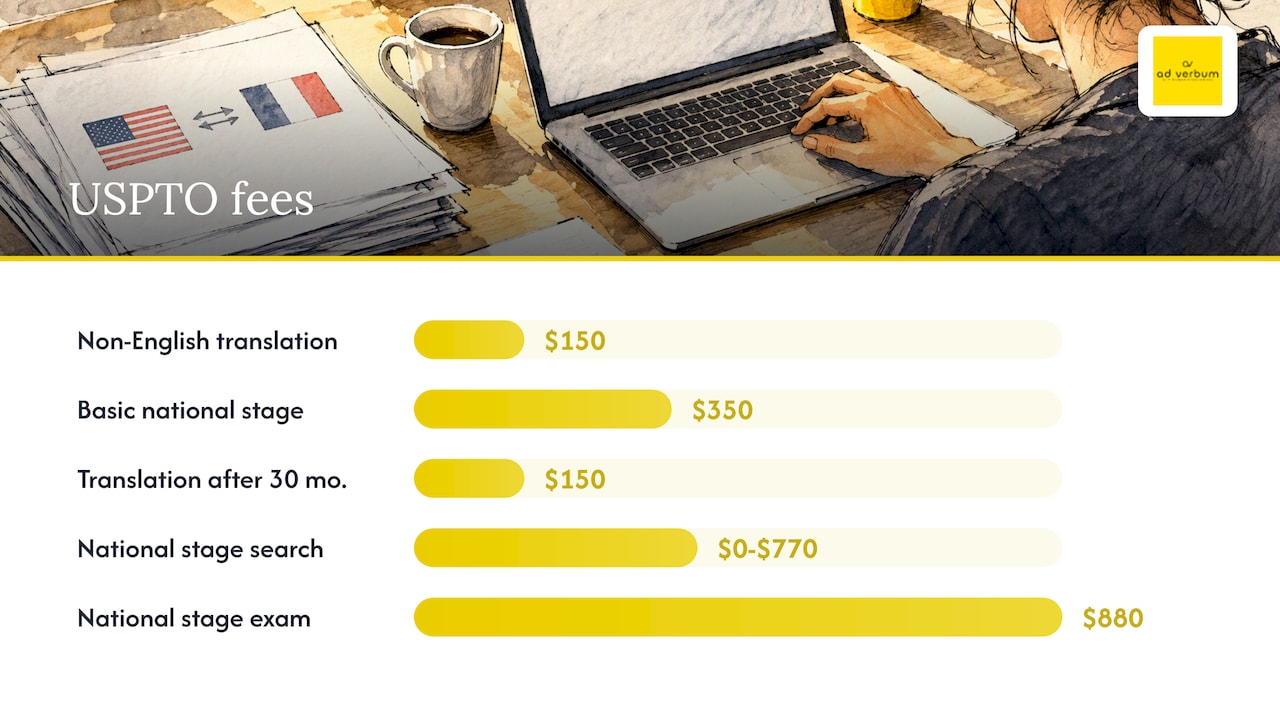
Office fees are separate from translation fees. The USPTO fee schedule, effective January 19, 2025 and last revised November 1, 2026, lists these items:
Item | Authority | Fee |
Non-English translation fee, nonprovisional | 37 CFR 1.17(i) | $150 ($60 small entity, $30 micro entity) |
Basic national stage fee | 37 CFR 1.492(a) | $350 |
English translation filed after 30 months | 37 CFR 1.492(i) | $150 |
Surcharge for late search fee, examination fee or oath | 37 CFR 1.492(h) | $170 |
National stage search fee | USPTO schedule | $0 to $770 depending on the situation |
National stage examination fee, other situations | USPTO schedule | $880 |
Read the live schedule before budgeting, because fees change.
What applies in the United States today?
The USPTO filing guide states that a nonprovisional utility application filed in a language other than English needs an English translation, a statement that the translation is accurate and the fee under 37 CFR 1.17(i). If these are missing, the applicant receives a notice and a time period to supply them. The Consolidated Patent Rules (July 2026 update) state the same for 37 CFR 1.52(d)(1). They also state that a provisional application in a non-English language needs no translation at the provisional stage.
For national stage entry, 37 CFR 1.495 requires the copy of the international application and the basic national fee within 30 months from the priority date. The same rules state that this period may not be extended, and the application becomes abandoned as to the United States if the requirements are not met. A submission under 35 U.S.C. 154(d)(4) must follow 37 CFR 1.417: it must identify the international application and be marked “Mail Stop PCT”, or it is treated as a filing under 35 U.S.C. 111(a).
How do human translation, machine translation and post-editing differ?
Machine translation (MT) and neural machine translation (NMT) are not AI translation in the sense used here. They produce raw output from a generic engine. Post-editing is the human correction of that output, governed by ISO 18587. AI+HUMAN hybrid translation combines a controlled language model with subject-matter expert review of every segment.
The USPTO has addressed AI use directly. Its April 11, 2024 Federal Register guidance states that a practitioner who uses AI tools to draft claims must modify them into patentable form before submission. For specifications and drawings drafted with AI, it calls for extra care to verify technical accuracy. Smith and Bernard also report that the USPTO has prohibited translators from using machine translation, beyond an extremely limited scope, on International Search Reports because of confidentiality concerns. They note that unedited machine translations have appeared as trial exhibits.
What should US organizations check when choosing a provider?
Apply these criteria in order.
Linguist qualification. The same Smith and Bernard article reports that USPTO attestation rules in 37 CFR 41.154(b) and 42.63(b) do not specify translator qualifications. Federal Rule of Evidence 604 requires a translator qualified to make a true translation. A certificate signed by a project manager who cannot read the source language may be challenged. Ask who signs and what that person reads.
Technical field match. The linguist should hold expertise in the invention’s field, such as medical devices, chemistry or software.
Confidentiality and data location. The April 2024 USPTO guidance states that AI systems may retain user input, possibly to train models or share it with third parties, in breach of 37 CFR 11.106 confidentiality duties. It adds that tools on servers outside the United States may export data in violation of export and national security rules. It tells practitioners to understand a tool’s terms, privacy policy and cybersecurity practices before use. Ask where files are processed, who can access them and whether a data processing agreement applies.
Certification. Look for ISO 17100, ISO 18587 and ISO 27001, audited by an independent body.
Terminology governance. The provider should load and maintain your term base and translation memory.
Evidence trail. Require logs for review, QA and delivery.
Turnaround under pressure. Priority dates and the 30-month limit are fixed, so confirm capacity.
What do typical cases look like?
Case 1: PCT national phase into Japan. A device maker holds a PCT application published in English. Counsel needs a Japanese translation of the description, claims, drawing text and abstract within the Japanese office’s limit. Owners: counsel for scope, the provider for translation and review, the localization manager for terminology reuse across the family.
Case 2: Direct filing in the United States from a German-language application. The applicant needs an English translation of the nonprovisional application, a statement of accuracy and the 37 CFR 1.17(i) fee. The translation covers the complete text, including drawing text.
Case 3: Foreign prior art in a dispute. A Japanese reference becomes evidence. Smith and Bernard report that in IPR2017-00851 competing translations were challenged under Federal Rules of Evidence 801, 802, 702, 604 and 403, and that a translation offered as evidence must come with a declaration of accuracy. A documented translator qualification and review record supports admissibility.
Which failure modes occur, and what mitigates them?
Failure mode | Mitigation |
Partial translation omits drawing text or original claims | Written scope listing every part of the application |
Claim ambiguity is resolved by the translator | Instruction to preserve source ambiguity, plus claim-level review by counsel |
Missed 30-month or other office deadline | Docketed internal deadline set before the office limit, with provider capacity confirmed |
Inconsistent terminology across a patent family | Shared term base and translation memory under governance |
Confidential invention data reaches a public engine | Private processing environment, access control, data processing agreement |
Unqualified signer on the accuracy statement | Named qualified linguist with a documented review |
Wrong source version translated | Version record tied to the filing and accepted amendments |
Where does AD VERBUM fit?
AD VERBUM has 25+ years of industry experience and a network of 3,500+ subject-matter expert linguists. Its proprietary LangOps System runs on EU servers, and its AI+HUMAN hybrid workflow supports 150+ languages. Certifications include ISO 17100, ISO 18587, ISO 27001, ISO 42001 and ISO 13485, audited by Bureau Veritas. Client translation memories and term bases are integrated. See the AD VERBUM translation and localization services.
What is our view on patent translation?
Patent translation is a risk control, not a commodity. The claims define what the applicant owns, so the translation must carry the scope of the source without adding or removing meaning. We argue for AI+HUMAN hybrid translation under governance. A language model applies approved terminology consistently across a patent family. A subject-matter expert reviews every segment and decides what a claim says. Raw machine output does not meet that standard. Data handling belongs in the same decision. Unpublished inventions are confidential, so processing location, access control and audit trails are selection criteria, not afterthoughts. Eric Brown
Key points
Translate the full application as filed. The USPTO does not accept partial translations.
Requirements differ by office: check the language, the content and the deadline for each destination.
The 30-month US national stage period under 37 CFR 1.495 may not be extended.
Preserve claim ambiguity from the source. Do not resolve it in translation.
Qualified linguists, independent review and a QA record support accuracy statements and evidence use.
Confidential invention data needs controlled processing, access control and an audit trail.
Reuse terminology and translation memory across the patent family.
Office fees are separate from translation fees. Read the live USPTO schedule.
FAQ
How much does it cost to translate a patent?
The cost depends on word count, language pair, technical difficulty, deadline and reuse of earlier translations. Vendors quote per word, page or project. Office fees are separate: the USPTO lists a $150 non-English translation fee under 37 CFR 1.17(i), with reductions for small and micro entities.
Does a provisional application need an English translation?
No. A provisional application filed in a non-English language does not need an English translation at the provisional stage, per 37 CFR 1.52(d)(1) as reproduced in the July 2026 Consolidated Patent Rules. A nonprovisional application does.
Can a translation cover only the claims?
For US national stage entry, no. The USPTO states that a partial translation, such as one omitting drawing text or original claims, is unacceptable. Other offices set their own scope, so confirm each one.
Is machine translation acceptable for patent filings?
Raw machine output does not meet filing or evidence standards on its own. The USPTO guidance calls for human verification of technical accuracy, and unedited machine translations have drawn challenge in trials.
Sources

