


Manufacturing Translation Services: US Rules, Data and Vendor Duties

A US manufacturer that translates safety data sheets, work instructions, manuals, SOPs and training content needs a provider that applies subject-matter review, terminology control, an audit trail and secure data handling to every file. Under OSHA 29 CFR 1910.1200, labels and safety data sheets must be in English, and other languages may be added. Training must be understandable to employees.
Table of Contents
What counts as manufacturing translation and where does it apply?
Manufacturing translation is the conversion of technical, operational and regulatory content used in production, quality, safety and sales into other languages. The content is controlled. Each document has an owner, a version and a use that can create liability if the translation is wrong.
The scope covers these document groups:
Safety content: safety data sheets (SDSs), container labels, warning signs, lockout and tagout procedures, and hazard communication training.
Operational content: standard operating procedures, work instructions, batch records, maintenance manuals and quality procedures.
Product content: user manuals, installation guides, specifications, packaging, and software strings for machine interfaces.
Workforce content: employee handbooks, site agreements, onboarding and safety training.
Commercial and legal content: contracts, supplier agreements, certificates and marketing material.
The jurisdiction in this article is the United States. The data categories in scope are proprietary engineering data, supplier and customer information, and employee records that appear inside training and HR documents. Some manufacturers in the pharmaceutical, medical device, machinery and software sectors also hold regulated content such as protected health information or device documentation. Those cases need extra controls that are covered below.
General business translation differs from manufacturing translation in three ways. The terminology is specialized and must stay identical across thousands of documents. The documents change often, so updates must reach every language version. The reader acts on the text, for example by operating a machine or handling a chemical.
What does OSHA require for translated safety documents?
OSHA’s Hazard Communication Standard, 29 CFR 1910.1200, sets the language rules for chemical hazard information in US workplaces.
The key points are:
The SDS must be in English. The employer may also maintain copies in other languages (paragraph (g)(2)).
Workplace labels must be legible and in English. Other languages may be added alongside the English (paragraph (f)(10)).
The SDS has 16 numbered sections in a fixed order.
Newly significant hazard information must be added to the SDS within three months of the responsible party becoming aware of it, per the eCFR text of the standard (paragraph (g)(5)).
The consequence for translation is direct. A translated SDS or label supplements the English original. It does not replace it. Each translated copy must match the current English version, so the three-month update window applies to every language version the employer keeps.
Training has its own language rule. OSHA’s eTool guidance states that hazard communication training must be conducted in a language workers can understand, with an opportunity to ask questions. State programs repeat the point. Minnesota OSHA’s enforcement guidelines state that when employees receive job instructions in a language other than English, hazard communication training and information must also be in that language. The Texas Department of Insurance states that employers must train employees in a manner and language they understand and must keep training records.

The training record is therefore a document the translation workflow should feed. The translated course, its version and its delivery date belong in the same quality system as the English original.
How should a manufacturer run the translation workflow, step by step?
Each step below names an owner and a control. A step without an owner is the usual point where errors enter.
Step 1: Inventory and classify the content
Owner: localization manager with the quality or EHS (environment, health and safety) lead.
List every document type, its source language, its target languages and its regulatory weight. Classify each as safety-critical, regulated, operational or commercial. The classification decides the review depth. Control: a documented content register with a named owner for each document family.
Step 2: Fix the source before translating
Owner: document author.
Ambiguous source text produces ambiguous translations. Use controlled phrasing, short sentences and consistent product names. Confirm the English version is the approved current one. NIST’s Process Industries Data Handover Guide names a master copy from which all other versions are derived as a key consistency criterion. The same principle applies here: the approved English file is the master, and every translation derives from it. Control: a released, version-numbered source file.
Step 3: Build and govern terminology
Owner: localization manager with engineering and regulatory input.
Collect approved terms for components, processes, units, hazards and regulatory phrases. Store them in a term base. Store previously approved sentences in a translation memory. Both assets should be supplied to the provider and used on every job. AD VERBUM integrates client Translation Memories and Term Bases into its workflow. Control: a term base with an owner, an approval rule for new terms and a change log.
Step 4: Translate with AI+HUMAN hybrid production
Owner: provider project manager.
In an AI+HUMAN hybrid workflow, a purpose-built language model produces the draft and a subject-matter linguist reviews and corrects it. Machine translation (MT) and neural machine translation (NMT) are not the same thing as this model. The distinction matters in the contract: the vendor should state which technology is used, where it runs and who reviews the output. Post-editing of machine output follows the ISO 18587 standard. Control: a named reviewer with documented subject-matter qualification for each job.
Step 5: Run quality assurance
Owner: provider quality lead, with a client reviewer for safety-critical files.
QA covers terminology compliance, numbers and units, tags and formatting, and completeness against the source. NIST’s guide lists information-quality criteria for engineering data handover: clarity, accessibility, usability, consistency, compatibility, completeness, timeliness, accuracy and cost. It also states that processes to ensure quality must be agreed and put in place as part of the project quality plan. Those criteria translate into a practical QA checklist. Control: a QA report per deliverable and an agreed error-correction procedure.
Step 6: Approve and release
Owner: in-country reviewer or plant manager.
For safety content, a bilingual supervisor or in-country engineer should confirm that the text is usable on the floor. Control: a signed approval stored with the document version.
Step 7: Manage updates
Owner: document control.
When the English source changes, the changed segments must be identified and retranslated, and the older language versions withdrawn. This is where document version control discipline pays off: every language file should carry the version of the source it was derived from, so an auditor can match each translation to its master. Control: a version map linking each translation to its source revision, with an audit trail of who changed what and when.
What decision criteria separate vendors?
Use criteria that can be verified in a contract or an audit report. The list below follows the controls in the workflow.
Criterion | What to require | Why it matters |
Quality management | ISO 9001 and ISO 17100 certification | Defines the process and the qualifications of translators and reviewers |
Post-editing standard | ISO 18587 for machine output review | Sets requirements for human review of machine-generated text |
Information security | ISO 27001 certification, access control, encryption, audit trail | Protects drawings, specifications and employee data |
AI governance | ISO 42001 or an equivalent documented AI management system | Defines how AI is used and overseen |
Data location | Stated hosting location and subprocessors | Controls where proprietary content is processed |
Subject expertise | Linguists with engineering, medical or legal backgrounds | Reduces terminology errors |
Asset handling | Use of your translation memory and term base | Keeps terms consistent across documents |
Sector requirements | Device, defense or pharma standards where relevant | Matches the vendor to your regulatory context |
Language coverage | All target languages and regional variants | Avoids splitting work across vendors |
Pricing model | Per word, per page or per project, stated in writing | Makes budgets comparable |
Certification should be independently audited. Ask for the certificate, its scope and the name of the auditing body.
What affects cost?
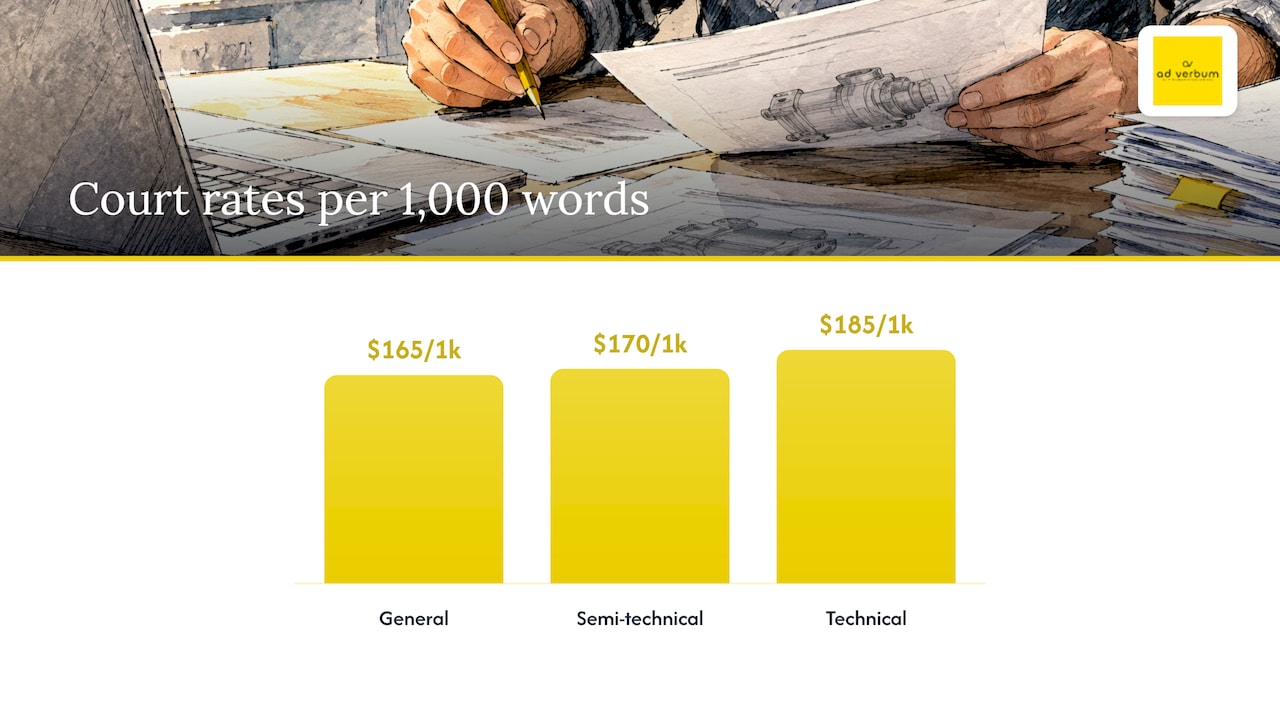
Cost depends on word count, subject complexity, language pair, file format, turnaround, review depth and the reuse of translation memory. The federal court system publishes a translation rate schedule that shows the effect of complexity. It lists $165 per 1,000 words for general documents, $170 for semi-technical documents and $185 for technical documents. It describes technical documents as full of highly specialized terminology and requiring special expertise or lengthy research. The schedule is for court work and is not a market price list for manufacturers. It does show the principle that technical content costs more than general content.
Enterprise language work is usually quoted by scope. AD VERBUM charges per word, page or project scope and provides custom quotes for enterprise clients. It does not publish prices.
What examples show the workflow in practice?
The examples below are illustrations of the controls, not client case studies.
Example 1: Safety data sheet for a plant with Spanish-speaking staff
A chemical blender in Texas keeps the English SDS as the official document under 29 CFR 1910.1200. It also keeps a Spanish copy for floor staff. The owner is the EHS manager. The controls are a version map linking the Spanish copy to the English revision and a three-month update check when new hazard information appears. The Spanish copy is replaced whenever the English one changes.
Example 2: Machinery operator manual for export
A machinery maker sells equipment in several countries. The localization manager supplies a term base of component names and torque units. The provider uses the term base for every language. A subject-matter reviewer checks the warnings. QA verifies numbers, units and figure callouts. The approved text is released with the machine software version.
Example 3: Medical device manufacturing documentation
A device manufacturer translates instructions for use and quality procedures. The regulatory affairs manager owns the content register. The vendor should hold ISO 13485 and operate under documented information security controls. Where protected health information may appear in complaint files or clinical material, the contract should address HIPAA alignment, access control and data location.
Example 4: Training on a bilingual shift
A plant in Minnesota instructs a shift in a language other than English. Under the state’s enforcement guidelines, hazard communication training for that shift must also be in that language. The translated course, the trainer, the date and the attendance list are stored as training records.
What are the failure modes and mitigations?
Failure mode | Result | Mitigation | Control |
Translating an unapproved draft | Wrong content in every language | Translate only released source files | Version-numbered source |
Inconsistent terms | Confusion about parts or procedures | Term base and translation memory on every job | Term base owner and change log |
Outdated translated SDS | Mismatch with the English SDS | Update every language copy when the English changes | Version map, three-month check |
Label replaced by translation | Noncompliance with the English label rule | Keep English and add other languages | Label review checklist |
Unreviewed machine output | Errors in safety text | Subject-matter review of every draft | Reviewer record |
Training delivered in an unfamiliar language | Training not understood | Deliver in a language workers understand | Training records |
Confidential files sent through uncontrolled channels | Leakage of drawings or specifications | Secure transfer, access control, documented hosting | ISO 27001 scope and audit trail |
No in-country approval | Text correct but unusable on the floor | Local supervisor sign-off | Signed approval |
Data security deserves a separate check. Manufacturing files contain specifications, supplier terms and sometimes employee data. Ask where files are stored, who can open them, whether content is used to train public models and whether every access is logged. The answers belong in the contract and the data processing terms.
Where does AD VERBUM fit?
Perspective
Our view is that manufacturing translation is a controlled process, not a file exchange. The English master, the term base and the review record matter as much as the translated text. AD VERBUM combines a proprietary LangOps System hosted on EU servers with review by subject-matter linguists. We hold ISO 9001, 17100, 18587, 13485, 27001 and 42001 certifications, among others, audited by Bureau Veritas. Our stated turnaround is 3x to 5x faster than traditional workflows, with human review on every job. Eric Brown
AD VERBUM is a language service provider with more than 25 years of experience and a network of 3,500+ subject-matter linguists. It offers AI+HUMAN hybrid translation in 150+ languages, including regional variants, plus localization, interpretation, multilingual SEO, voice over and multilingual documentation. Its certifications include ISO 9001, ISO 17100, ISO 18587, ISO 27001, ISO 42001 and NATO AQAP 2110. It integrates client Translation Memories and Term Bases. See the AD VERBUM services.
Key points
OSHA 29 CFR 1910.1200 requires English SDSs and English labels. Other languages are permitted in addition.
Hazard communication training must be understandable to the employees who receive it.
Newly significant hazard information must be added to the SDS within three months, in every language copy kept.
Approved English source files act as the master from which each translation derives.
Terminology is governed with a term base and a translation memory, each with a named owner.
AI+HUMAN hybrid production requires a named subject-matter reviewer and a QA report.
Vendors are compared on audited certifications, data location, access control, audit trail and asset handling.
Technical content costs more than general content because it needs specialist expertise.
FAQ
Does OSHA require translated safety data sheets?
OSHA requires the SDS to be in English. The employer may also maintain copies in other languages. A translation is therefore an addition that must stay consistent with the current English SDS. Source: 29 CFR 1910.1200.
Can a translated label replace the English label?
No. Workplace labels must be in English. Other languages may appear alongside the English text. The label review should confirm that the English text is present and legible.
Does safety training need to be translated?
Training must be delivered in a language workers can understand. OSHA’s eTool guidance says so, and state guidance such as Texas states the same for employers in that state. Keep training records for each language version.
What certifications should a manufacturing translation vendor hold?
Start with ISO 17100 for translation services, ISO 18587 for post-editing, ISO 9001 for quality and ISO 27001 for information security. Add ISO 13485 for medical devices and ISO 42001 for AI governance where relevant. Request the certificate and the scope.
How is manufacturing translation priced?
Pricing usually depends on volume, subject complexity, language pair, format and turnaround. A federal court rate schedule shows technical documents priced above general ones. Enterprise projects are normally quoted by scope.
Sources

