


NordicTrans.com Alternatives for Regulated Content in 2026
- 3 hours ago
- 11 min read

For U.S. buyers who need Nordic language translation with documented compliance controls, the shortlist breaks into three categories: compliance-first AI+HUMAN hybrid providers (AD VERBUM is the recommended choice for regulated work), boutique Nordic language specialists for lower-risk content, and automated NMT platforms for informal or ad-hoc tasks. NordicTrans positions itself as a Nordic specialist with per-word and per-page pricing and 24/7 availability, but its public profile does not document ISO certifications, audit trail exports, or SME reviewer assignment logs at the level regulated industries require.
Pick a compliance-first AI+HUMAN hybrid provider when your content is regulated (medical devices, legal filings, defense documentation) and you need reviewer logs, terminology governance, and ISO-aligned QA artifacts.
Pick a boutique Nordic specialist when the content is marketing, general business communication, or internal documentation with no audit requirement and a tight budget.
Pick an automated NMT platform only for informal, low-risk content where speed matters more than governance. Consumer tools like DeepL or Google Translate do not produce audit artifacts or enforce terminology.
Immediate next step: Request a vendor checklist or audit-ready pilot from any shortlisted provider before signing a contract.
Table of Contents
How do NordicTrans alternatives compare side by side?
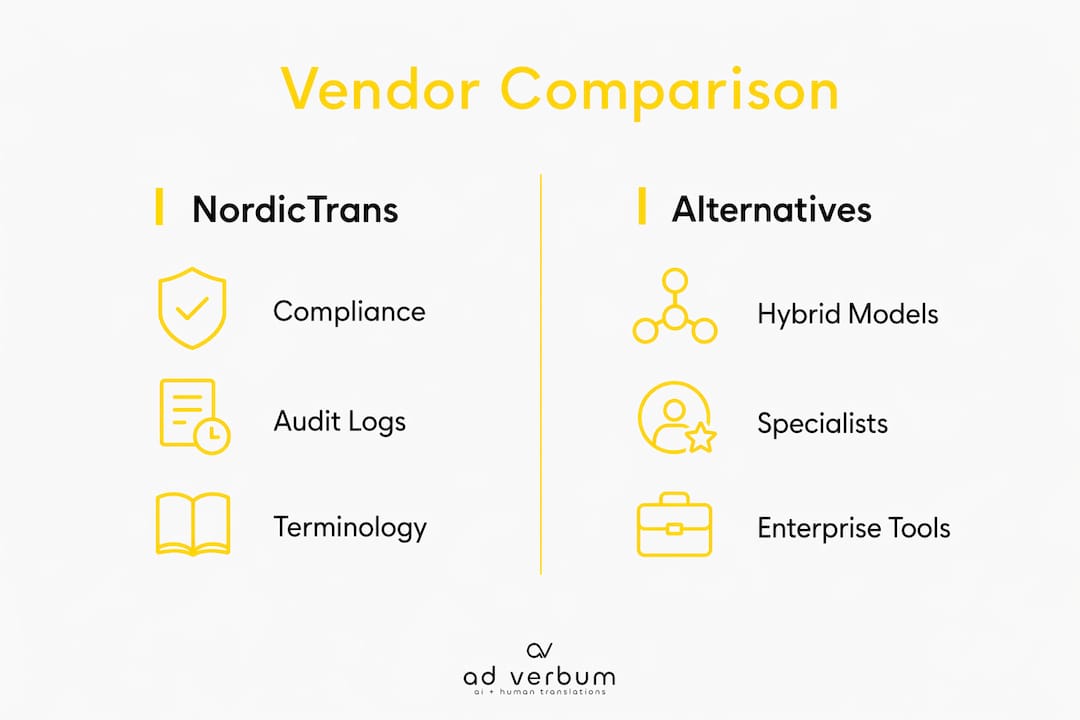
The table below maps five provider categories across the dimensions that matter most for regulated Nordic-language work. Use it to identify which category fits your use case, then verify individual vendors against the criteria in Section 4.
Dimension | NordicTrans (reference) | AD VERBUM (compliance-first hybrid) | Boutique Nordic specialist | Enterprise traceability-focused LSP | Automated NMT platform + SME add-on |
Best for | Nordic language volume work | Regulated, audit-required content | Marketing, general business | Large enterprise, multi-language programs | Informal, ad-hoc, low-risk content |
Nordic coverage | Danish, Finnish, Norwegian, Swedish | 150+ languages incl. Nordic variants | Deep Nordic focus | Varies by vendor | Varies; quality inconsistent on Nordic |
Pricing model | Per word / per page | Per word / project / custom quote | Per word / project | Enterprise contract | Subscription / per-character |
Turnaround / SLA | 24/7 availability stated | 3x–5x faster than traditional workflows | Project-dependent | SLA-driven, scalable | Near-instant (no SME review) |
Data security & compliance | Not publicly documented at ISO level | ISO 27001, ISO 42001, EU-hosted, GDPR/HIPAA aligned | Varies; often undocumented | Typically ISO 27001; varies | Typically public cloud; limited governance |
Workflow | Human translation | AI+HUMAN hybrid (LLM + certified SME) | Human-only | Human + CAT tools | Automated NMT; optional human review |
Quality controls | Not publicly documented | ISO 17100, ISO 18587, SME review, Bureau Veritas audited | Translator review; rarely ISO-certified | ISO 17100 common; audit depth varies | Minimal; no segment-level accountability |
Integrations | Not publicly listed | TM/TB import, API, major file formats | Limited | TM/TB, API, TMS integrations | API, CMS plugins |
Support | 24/7 stated | Dedicated PM, escalation path | Direct translator contact | Account manager, SLA escalation | Ticket-based; no dedicated PM |
Pro Tip: When reading a vendor SLA, look specifically for three things: whether reviewer assignment is logged per segment, whether match-rate reporting is exportable, and whether the SLA includes a penalty clause for missed turnaround. A vendor that cannot show you a sample audit artifact before contract signature is unlikely to produce one after.
What does “alternatives to NordicTrans” actually cover?
The term covers five distinct provider categories, each suited to a different risk level and use case.
Compliance-first AI+HUMAN hybrid providers (e.g., AD VERBUM): regulated sectors, audit trail requirements, ISO-certified QA.
Boutique Nordic specialists: deep native-language expertise for Danish, Finnish, Norwegian, and Swedish; suitable for marketing and general business content.
Enterprise traceability-focused LSPs: large-volume programs needing multi-language coverage and documented workflows, though Nordic depth varies.
Secure AI+human platforms with SME review: faster turnaround with human oversight; compliance posture depends on the vendor’s certification stack.
Certified freelance networks with SME review: cost-effective for lower volumes; audit trail completeness is inconsistent.
Out of scope: one-off consumer apps for high-risk or safety-critical content, and unpaid community translation platforms. Aggregator directories list dozens of small agencies that may cover Nordic languages, but directory presence does not verify certifications or audit-readiness. For context on scale differences, large multilingual publishing programs (like UN or JW.org) operate at a fundamentally different volume than a typical regulated-content vendor shortlist.
Key regulatory and quality risks that change the choice:
Auditability: can the vendor export segment-level reviewer logs and QA gate records?
Data residency: where is your content processed and stored? EU-hosted infrastructure matters for cross-border GDPR exposure.
SME oversight: does the vendor assign a certified subject-matter expert, or a general linguist?
How do you evaluate NordicTrans alternatives before signing?
Use this checklist as a pass/fail gate for compliance work; for legal-industry perspective on arbitration and documentation requirements, see Arbitrations in Employment Law Cases | Serendib Law Firm. A vendor that cannot satisfy key certification and audit criteria should not handle regulated content.
Request evidence of certifications such as ISO 17100, ISO 18587, ISO 27001, audit trail exports, terminology governance, SME availability in Nordic languages, data residency declarations, SLA turnaround commitments, integration capabilities, pricing transparency, and third-party audit references.
Sample RFP questions to send shortlisted vendors:
“Can you provide a sample deliverable with tracked changes and reviewer assignment logs?”
“What is your data deletion policy, and can you provide written confirmation of deletion after project close?”
“How do you handle terminology conflicts between our Term Base and your in-house glossary?”
“What is your escalation path if a deliverable fails our acceptance criteria?”
Pro Tip: For regulated document translation, require that the vendor’s SLA explicitly states the turnaround for each workflow stage (translation, SME review, QA), not just the total delivery time. Stage-level SLAs are what make audit timelines defensible.
What does a vendor trial and validation process look like?
Run this sequence before committing to any NordicTrans replacement for regulated content.
Shortlist two to three vendors based on the checklist above; eliminate any that cannot produce audit artifacts on request.
Execute an NDA and data handling agreement before sharing any content. Involve legal and IT at this stage.
Define pilot scope: one representative document type (e.g., a 1,000-word section of a medical device IFU or a legal filing excerpt).
Request a sample deliverable with full tracked changes, reviewer assignment log, and QA gate record.
Apply acceptance criteria: minimum SME pass rate, zero unresolved terminology conflicts, audit trail completeness, and turnaround within the negotiated SLA.
Audit the logs: have your SME reviewer or compliance lead verify that the reviewer assignment and QA records match the deliverable.
Go/no-go decision: if the vendor meets all acceptance criteria, proceed to contract. If not, document the gaps and either require remediation or move to the next shortlisted vendor.
Involve procurement, legal, IT, and at least one domain SME reviewer in steps 2–6. For legal and compliance translation, the SME reviewer’s sign-off on the pilot deliverable is the most defensible acceptance record you can hold.

How do MT, NMT, and AI+HUMAN hybrid differ for Nordic regulated work?
The three workflow types produce fundamentally different outputs for terminology control, auditability, and compliance suitability.
Workflow | Speed | Nordic accuracy | Audit logs | Terminology governance | Regulated content suitability |
Legacy MT | Fast | Weak on context and idiom | None | None | Not suitable |
NMT (consumer/SaaS) | Fast | Better; inconsistent on domain terms | None or minimal | Limited; no enforcement | Low; governance gaps for regulated use |
AI+HUMAN hybrid (AD VERBUM) | 3x–5x faster than traditional | High; constrained by TM/TB and SME review | Full segment-level logs | Enforced via TM/TB and LLM constraints | High; ISO 17100/18587 aligned |
Legacy MT produces literal output with weak context handling. The risk in regulated text is a critical meaning error that no human reviewer catches because no human reviewer is assigned. NMT tools like Google Translate, Microsoft Translator, and DeepL are useful for informal content, but they do not produce audit artifacts, enforce terminology, or provide segment-level accountability. Trusted options for regulated industries must provide traceable source-to-deliverable records, and that is a separate capability from native-language fluency.
AD VERBUM’s AI+HUMAN hybrid runs a constrained LLM generation step against the client’s TM and TB, followed by certified SME review and ISO-aligned QA. The result is a deliverable with audit artifacts, not just a translated file.
Pro Tip: Require full SME translation (not just post-editing) when the source document contains safety warnings, dosage instructions, legal obligations, or any text where a missed negation creates liability. Post-editing is appropriate for lower-risk sections where the MT output is structurally sound and the SME is verifying terminology and tone.
Which alternative fits your specific situation?
Scenario 1: U.S. medical device release requiring FDA/MDR audit trail
A U.S. medical device manufacturer needs Instructions for Use translated into Swedish and Finnish for an EU market release. The submission requires documented reviewer credentials, segment-level QA records, and ISO 13485-aligned process evidence. The right choice is a compliance-first AI+HUMAN hybrid provider. AD VERBUM holds ISO 13485 alongside ISO 17100 and ISO 18587, with certifications independently audited by Bureau Veritas. Next step: request a pilot on a representative IFU section with full reviewer logs and a sample QA gate record before contract signature.
Scenario 2: Nordic market campaign with a two-week turnaround and limited budget
A marketing team needs Danish and Norwegian copy for a product launch, with no regulatory requirement and a tight timeline. A boutique Nordic specialist or a secure NMT platform with SME spot-checks is appropriate. Audit trail completeness is not a requirement here; native fluency and brand tone accuracy are. Next step: request two to three sample translations of a short copy block and evaluate tone and terminology against your brand guidelines before committing to volume.
What goes wrong when switching vendors, and how do you prevent it?
Common failure modes when moving away from NordicTrans or any incumbent provider:
Missing audit trails: the new vendor delivers a translated file with no reviewer log. Mitigation: require a sample audit artifact before contract signature, and include a contractual obligation to deliver logs with every project.
Terminology drift: the new vendor ignores your existing Term Base or applies its own glossary. Mitigation: verify TM/TB migration in the pilot; require a terminology conflict report as part of every deliverable.
Hidden revision fees: the contract quotes a per-word rate but charges separately for revisions, QA, or project management. Mitigation: request a full fee schedule and cap revision charges contractually.
Insufficient SME expertise: the vendor assigns a general linguist to medical or legal content. Mitigation: require written confirmation of the assigned reviewer’s credentials for your domain.
Data residency surprises: content is processed on public cloud infrastructure in a jurisdiction that conflicts with your data governance policy. Mitigation: require a written data residency declaration before sharing any content.
Contract clauses to require:
Obligation to deliver segment-level reviewer logs and QA gate records with every project.
Written data deletion confirmation within a defined period after project close.
SLA penalty clause for missed turnaround at each workflow stage.
Right to audit the vendor’s QA process on reasonable notice.
For data security in translation projects, the contractual controls are as important as the technical ones. A vendor with strong certifications but no contractual obligation to produce logs gives you no recourse if the artifacts are missing.
When is AD VERBUM the right alternative?
AD VERBUM fits when at least one of these conditions is true: the content is regulated (medical, legal, defense, financial), the project requires documented audit trails, strict terminology governance is non-negotiable, or data residency on EU-hosted infrastructure is required for cross-border compliance.
The AI+HUMAN hybrid workflow runs in this sequence:
Asset integration: client TM and TB are ingested first, constraining all subsequent output.
LLM generation: AD VERBUM’s proprietary LangOps System produces target-language output governed by client terminology and style guidance.
SME review: a certified subject-matter expert reviews for technical accuracy, regulatory compliance, and contextual nuance.
QA: aligned to ISO 17100 and ISO 18587, with sector-specific requirements (e.g., MDR) applied where relevant.
Trust signals to verify:
ISO 9001, ISO 17100, ISO 18587, ISO 13485, ISO 27001, ISO 42001, ISO 14001, AQAP2110
GDPR and HIPAA compliance alignment
Bureau Veritas independent audit of certifications
EU-hosted private infrastructure; no reliance on public cloud tooling for core processing
3,500+ subject-matter expert linguists across medical, legal, engineering, and defense domains
150+ languages including Nordic regional variants
Pro Tip: When verifying AD VERBUM’s certifications, ask for the Bureau Veritas audit reference number and cross-check it against the Bureau Veritas public registry. That single step separates a claimed certification from a verified one, and it takes less than five minutes.
Key Takeaways
For regulated Nordic-language translation, audit-readiness is a separate capability from language fluency, and it must be verified before contract signature, not assumed from directory listings.
Point | Details |
Shortlist by use case | Compliance-first hybrid for regulated work; boutique Nordic specialist for marketing; NMT only for informal content. |
Audit artifacts are non-negotiable | Require segment-level reviewer logs, QA gate records, and a data deletion confirmation for any regulated project. |
Verify certifications independently | Ask for the Bureau Veritas audit reference or equivalent; a claimed ISO certificate is not the same as a verified one. |
Run a structured pilot | Apply pass/fail acceptance criteria on a representative document before committing to volume. |
AD VERBUM for compliance-first work | AD VERBUM’s AI+HUMAN hybrid, ISO stack (incl. ISO 13485, ISO 27001), and EU-hosted infrastructure fit regulated Nordic-language projects. |
The case for demanding more from your translation vendor
The translation industry has spent years selling language fluency as the primary differentiator. For marketing copy, that is fine. For a medical device IFU, a legal filing, or a defense specification, fluency is the baseline, not the differentiator. What actually separates a vendor worth trusting from one that looks credible on a directory listing is whether they can hand you a complete audit artifact at the end of a project: reviewer assignment logs, QA gate timestamps, terminology conflict reports, and a data deletion confirmation.
Most buyers do not ask for these things until something goes wrong. By then, the contract is signed, the project is delivered, and the missing documentation is a compliance gap with no easy fix. The shift happening in 2026 is that procurement leads in regulated industries are starting to require audit artifacts upfront, as a condition of shortlisting, not as an afterthought. That is the right instinct, and it is what the trial process in this article is designed to support.
AD VERBUM’s audit-ready pilot for Nordic regulated content
If your project involves regulated content in Danish, Finnish, Norwegian, Swedish, or any of the 150+ languages AD VERBUM supports, the most useful next step is a scoped pilot before you commit to volume.
The pilot includes a sample translation of a representative document section, complete with reviewer assignment logs, TM/TB migration verification, a QA gate record aligned to ISO 17100 and ISO 18587, and a draft SLA proposal with stage-level turnaround commitments. AD VERBUM’s certifications, including ISO 13485, ISO 27001, and ISO 42001, are independently audited by Bureau Veritas, and the LangOps System runs on EU-hosted private infrastructure with GDPR and HIPAA compliance alignment. For buyers who need to present a vendor selection rationale to legal, IT, or a regulatory body, the pilot deliverable is the evidence package.
Request your localization pilot directly from AD VERBUM to receive a scoped quote and sample deliverable within your project timeline.
Useful sources and standards to verify claims
ISO 17100 (translation services standard): iso.org
ISO 18587 (post-editing of machine translation): iso.org
ISO 27001 (information security management): iso.org
HIPAA guidance (U.S. Department of Health and Human Services): hhs.gov
GDPR text (EU regulation): gdpr-info.eu
NordicTrans Trustpilot listing: uk.trustpilot.com
Worldmetrics Scandinavian translation benchmark (2026): worldmetrics.org
EHLION machine translation tool review (2025): ehlion.com
Powerling: most-translated websites analysis: powerling.com
AD VERBUM localization services: adverbum.com/localization
AD VERBUM compliance best practices guide: adverbum.com
Vendor pages and AD VERBUM proof pages are included for verification. During any trial, request exported audit artifacts directly from the vendor. A published certification claim is a starting point; the exported artifact is the evidence.
This article is published by AD VERBUM and reflects its perspective as a language service provider. It is general information, not professional legal or regulatory advice. Verify current standards and compliance requirements with the relevant primary sources or a qualified professional for your specific situation.
Recommended