


Multilingual Page Speed SEO Impact: 2026 Technical Guide

Multilingual page speed SEO impact is defined as the measurable effect that per-locale loading performance has on Google’s Core Web Vitals scores and, by extension, on search rankings for each localized version of a site. Google ranks multilingual sites lower when they fail Core Web Vitals thresholds for Largest Contentful Paint (LCP), Interaction to Next Paint (INP), and Cumulative Layout Shift (CLS). Sites that load in more than 3 seconds lose substantial traffic, with conversion drops proportional to each additional second of delay. The performance penalty applies independently to every language version, meaning a fast English site does not protect a slow Spanish or Japanese counterpart from ranking suppression.
What are the primary technical factors causing page speed variation in multilingual sites?
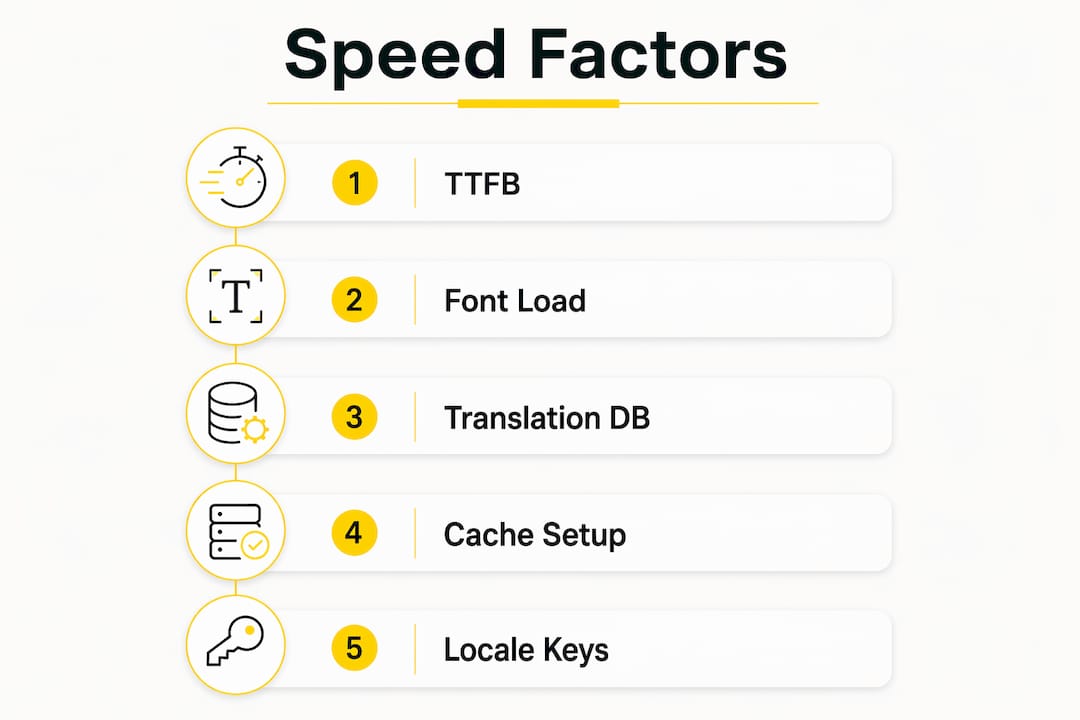
Four technical factors account for most of the speed variation seen across language versions: Time to First Byte (TTFB), font loading, translation architecture, and caching configuration. Each one compounds the others when left unaddressed.
TTFB and server response
TTFB measures the time between a browser’s request and the first byte of a server response. On multilingual sites, TTFB climbs because the server must detect the user’s language, query the correct translation data, and assemble the response before sending anything. Optimized multilingual sites achieve sub-200ms TTFB globally, while poorly configured setups regularly exceed 1–2 seconds. That gap directly determines whether a page passes or fails Google’s Core Web Vitals assessment.

Font loading overhead
Multilingual sites often serve character sets for Latin, Cyrillic, Arabic, CJK (Chinese, Japanese, Korean), and other scripts simultaneously. Loading full font families for every script on every page request inflates payload sizes dramatically. Unoptimized fonts cause 1.8-second delays and correlate with 37% higher bounce rates. Font subsetting, covered in detail below, is the primary mitigation.
Translation architecture and database load
Heavy translation plugins increase database query load, harming TTFB on every page request. Plugins that store multiple duplicates of content objects create database bloat that grows with each new language added. Replacing dynamic plugin queries with static .mo files or CDN-integrated delivery reduces query overhead significantly and keeps TTFB stable as the site scales.
Caching configuration
Standard CDNs often cache without language differentiation, causing cache misses and, in some cases, serving the wrong language version to users. Language-aware cache keys that include locale codes solve both problems. Multilayered caching, combining a CDN edge layer with server-side object caching, produces the most consistent results across geographies.
TTFB above 200ms signals a server-side bottleneck that requires CDN or database fixes, not front-end tweaks.
Font files without subsetting routinely exceed 500KB per script family.
Translation plugins with no persistent caching re-query the database on every page load.
Language-agnostic CDN caching causes locale mismatches that harm both UX and crawl efficiency.
Cache purge workflows must target individual locales, not the entire site, after content updates.
Pro Tip: Audit your cache key configuration first. If your CDN does not include the locale code in the cache key, every other performance fix you apply will deliver inconsistent results across language versions.
How to optimize TTFB and server response times for multilingual sites
Reducing TTFB to under 200ms across all language versions requires changes at the infrastructure level, not the application level. Front-end optimizations alone cannot compensate for slow server responses.
Deploy edge computing for language detection. Move language detection and routing logic to the CDN edge rather than the origin server. Edge computing for language detection reduces TTFB by 300–500ms compared to origin-based detection. The browser receives the correct language version faster because the decision happens at the nearest edge node, not a central server.
Implement database connection pooling. Translation data queries open and close database connections on every request without pooling. Persistent database connection pools cut overhead by 50–100ms per request. Index translation tables on language code and content ID columns to prevent full-table scans.
Upgrade server protocols. HTTP/2 multiplexes multiple requests over a single connection, reducing latency for the parallel asset requests that multilingual pages generate. HTTP/3 adds QUIC transport, which further reduces connection setup time on high-latency networks common in emerging markets where multilingual sites often target users.
Use persistent object caching. Redis or Memcached dramatically improves performance in WordPress multilingual environments by caching translation plugin queries in memory. This removes repetitive database reads and keeps CPU load stable under traffic spikes.
A/B test TTFB improvements by locale. Measure TTFB separately for each language version using synthetic monitoring tools. A change that improves TTFB for English users may have no effect on Japanese users if the edge node serving Japan was not part of the deployment. Treat each locale as an independent performance target.
Pro Tip: Set a TTFB alert threshold of 200ms per locale in your monitoring stack. When a single locale breaches the threshold, investigate that locale’s CDN routing and database query plan before assuming a global infrastructure issue.
Why is font subsetting critical for multilingual page load speed?
Font subsetting is the practice of generating font files that contain only the character glyphs required for a specific language or script, rather than the full Unicode character set. It is the single highest-impact front-end optimization available to multilingual sites.
Font subsetting reduces font loading time from 1.1 seconds to under 0.3 seconds and pushes LCP compliance rates above 90%. Subsetting compresses font file sizes to 12–28% of their original size. That reduction directly accelerates First Contentful Paint (FCP) and LCP, the two Core Web Vitals metrics most sensitive to font loading.
CSS unicode-range for per-language subsets
The CSS unicode-range descriptor tells the browser which character ranges a font file covers. The browser downloads only the font files whose unicode-range intersects with characters present on the current page. A Japanese page loads the CJK subset. A German page loads the Latin subset. Neither page downloads the other’s font data. Font subsetting combined with CSS unicode-range allows browsers to load only the glyphs needed per language, drastically reducing font payload sizes and improving both FCP and CLS.
Preventing layout shift from font loading
Cumulative Layout Shift scores degrade when fonts load after the browser has already painted text using a fallback font, causing visible reflow. The CSS property font-display: optional prevents layout shift by telling the browser to use the fallback font permanently if the web font does not load within the first render cycle. Managing font loading with CSS overrides achieves a 40–50% improvement in CLS scores. For multilingual sites, this matters most on pages that mix scripts, where fallback font metrics differ significantly from the web font metrics.
Generate language-specific font subsets during the build process, not at runtime.
Declare unicode-range for every font face in your CSS to enable selective loading.
Use font-display: optional for decorative fonts and font-display: swap for body text where layout shift risk is lower.
Self-host subsetted fonts rather than relying on third-party font CDNs that may not cache per locale.
The impact of page speed on SEO is most visible in LCP scores, and font optimization is the fastest path to LCP improvement on content-heavy multilingual pages.
Common configuration pitfalls that degrade multilingual site speed
Most multilingual site performance problems trace back to four configuration errors that are straightforward to identify and fix.
Misconfigured hreflang tags. Incorrect hreflang correlates with poor performance and misdirected traffic in localized search results. Hreflang errors do not directly slow page load, but they cause Google to index the wrong language version for a given region, wasting crawl budget and suppressing rankings. Modern search engines use multiple signals beyond hreflang for language and regional context. Relying solely on hreflang without supporting technical signals is insufficient.
Language-agnostic CDN caching. A CDN that does not include the locale in its cache key serves cached English content to French users, or worse, triggers a cache miss and forces an origin request for every localized page. Including language codes in cache keys improves localized cache hit rates and prevents content mismatches. This is a CDN configuration change, not a code change, and takes under an hour to implement.
Translation plugin database overhead without persistent caching. Translation plugins that store multiple duplicates of content objects create database bloat that grows with each language added. Without persistent object caching via Redis or Memcached, every page request re-queries the full translation table. The fix is to enable persistent caching at the object layer and configure cache invalidation per locale, not globally.
Failing to purge caches per locale after content updates. A global cache purge after a content update clears cached pages for all languages simultaneously, causing a traffic spike of cache-miss requests that overwhelms the origin server. Locale-scoped purge workflows clear only the affected language version, keeping other locales served from cache during the rebuild period.
Pro Tip: Run a crawl of your multilingual site with a tool that reports response times per URL. Sort by TTFB descending. The slowest URLs almost always share a common locale, CDN region, or translation plugin configuration error.
How to measure and validate multilingual page speed improvements for SEO
Measurement must be locale-specific. Aggregate site performance data masks the ranking problems that exist in individual language versions.
Use Google Search Console Core Web Vitals reports by language version. Google Search Console flags multilingual pages with speed issues at the URL level. Filter the Core Web Vitals report by language subfolder or subdomain to identify which locales fail LCP, INP, or CLS thresholds. INP and LCP variations across language versions correlate directly with rankings and bounce rates in those geographies.
Monitor TTFB and FCP across locales with synthetic testing. Run synthetic performance tests from server locations that match your target markets. A test from a US server does not reflect the experience of a user in Southeast Asia. Use monitoring that supports geographic test locations and set per-locale TTFB and FCP baselines before making infrastructure changes.
Interpret engagement metrics by language. Bounce rate and conversion rate by language version reveal whether speed improvements translate to user behavior changes. A locale with improved Core Web Vitals scores but unchanged bounce rates signals a content or UX problem, not a performance problem. Separating the two prevents misattribution of ranking changes.
Schedule ongoing performance audits. Multilingual sites degrade over time as new languages are added, plugins are updated, and content volume grows. Quarterly performance audits per locale catch regressions before they affect rankings. Benchmark each locale against the sub-200ms TTFB and 90%+ LCP compliance targets established during initial optimization.
For a broader view of how multilingual SEO strategies interact with technical performance, treating speed and content planning as separate workstreams produces inconsistent results.
Key Takeaways
Multilingual page speed directly determines Core Web Vitals scores for each language version, and failing those scores suppresses search rankings independently per locale.
Point | Details |
Core Web Vitals apply per locale | Google evaluates LCP, INP, and CLS independently for each language version of a site. |
Font subsetting is the top front-end fix | Subsetting reduces font load time from 1.1 seconds to under 0.3 seconds and lifts LCP compliance above 90%. |
Language-aware cache keys prevent mismatches | CDN cache keys must include locale codes to avoid serving wrong-language content and causing cache misses. |
TTFB under 200ms requires infrastructure changes | Edge computing and database connection pooling are the primary levers, not front-end optimizations. |
Measurement must be locale-specific | Aggregate performance data hides per-language ranking problems that require individual monitoring. |
The performance debt most multilingual SEO teams ignore
The most common mistake I see in multilingual SEO audits is treating page speed as a one-time project rather than a recurring maintenance obligation. Teams invest heavily in the initial optimization, achieve strong Core Web Vitals scores across all locales, and then add two new languages six months later without revisiting the font subsetting pipeline, the CDN cache key configuration, or the database indexing strategy. The new locales degrade silently while the team monitors aggregate performance metrics that still look acceptable.
The second pattern that concerns me is the assumption that hreflang configuration is a performance fix. Hreflang tells Google which language version to serve to which audience. It does not affect how fast that version loads. I have reviewed sites with flawless hreflang implementation that still failed Core Web Vitals for three of their five language versions because the translation plugin was running uncached database queries on every request. The technical SEO and the performance engineering have to be addressed as separate, parallel workstreams.
The third issue is the over-reliance on automated translation plugins without evaluating their performance profile. A plugin that produces acceptable translation quality but adds 400ms of TTFB on every request is a ranking liability. The right approach to translation technology selection accounts for performance impact alongside linguistic quality. AI+HUMAN hybrid translation workflows that pre-generate translated content and serve it as static or cached output avoid the runtime query overhead that plugin-based approaches introduce. That architectural choice matters more for long-term multilingual SEO performance than any individual front-end optimization.
— Eric Brown
How AD VERBUM supports multilingual localization and site performance
Multilingual site performance depends on translation output that is ready to serve efficiently, not generated at runtime through database-heavy plugin queries.

AD VERBUM’s AI+HUMAN hybrid translation workflow pre-generates localized content through its proprietary LangOps System, with subject-matter expert review aligned to ISO 17100 and ISO 18587. The output integrates directly with Translation Memories and Term Bases, producing consistent terminology that reduces the content variation that causes cache fragmentation. AD VERBUM supports 150+ languages, including regional variants, and delivers output 3x to 5x faster than traditional translation workflows. For teams managing multilingual localization across regulated sectors, AD VERBUM’s ISO 27001 certified, EU-hosted infrastructure keeps sensitive content within defined data boundaries throughout the translation process.
FAQ
What is multilingual page speed SEO impact?
Multilingual page speed SEO impact refers to how loading performance for each language version of a site affects its Core Web Vitals scores and Google search rankings. Google evaluates LCP, INP, and CLS independently per locale, so a slow language version ranks lower in that language’s search results regardless of how fast other versions perform.
How does TTFB affect multilingual SEO rankings?
TTFB above 200ms signals server-side latency that delays First Contentful Paint and LCP, both of which are Core Web Vitals ranking factors. Edge computing and persistent object caching are the primary methods for reducing TTFB across all language versions to within acceptable thresholds.
Why do fonts cause speed problems on multilingual sites?
Full Unicode font families contain glyphs for hundreds of languages, producing files that can exceed 500KB per font weight. Without subsetting and CSS unicode-range declarations, browsers download the entire font file even when only a small character set is needed, inflating page weight and delaying LCP.
What is a language-aware cache key?
A language-aware cache key includes the locale code (for example, en-US or fr-FR) as part of the CDN cache identifier. Without it, a CDN may serve a cached English page to French users or register a cache miss for every localized URL, forcing origin requests that increase TTFB and server load.
How often should multilingual site performance be audited?
Quarterly audits per locale are the minimum for sites with active content publishing. Adding a new language, updating a translation plugin, or expanding to a new CDN region each requires a fresh performance baseline to confirm that TTFB, LCP, and CLS targets are still met for every affected locale.
Recommended

