


Merchant agreement localization: avoiding trust losses
- Mar 26
- 10 min read

Payment platforms expanding merchant acquisition across Europe and beyond face a localization challenge that goes beyond regulatory compliance. Companies lose $2B+ annually to contract translation errors, with individual fines reaching $15M due to translation discrepancies. Merchant agreements, fee schedules, dispute resolution procedures, and acceptable use policies must be translated with the same legal precision as the original, or the platform inherits ambiguity risk in every jurisdiction where a localized version governs the commercial relationship. This article examines the merchant agreement document types most vulnerable to translation-induced ambiguity, the jurisdictional localization requirements payment platform legal functions must manage, and how terminology-controlled, legally reviewed translation workflows protect platform integrity across markets.
Table of Contents
Key Takeaways
Point | Details |
Lawyer linguists essential | Using lawyer linguists reduces misinterpretations and protects enforceability across multiple jurisdictions. |
Back translation critical | Back translation verifies that the target language preserves the original contractual meaning and avoids drift. |
Terminology controlled translation | A terminology controlled translation workflow minimizes inconsistent terms and supports consistent billing and dispute resolution. |
PSD2 compliance risk | Focusing on PSD2 and local language disclosures reduces regulatory penalties and reputational damage. |
Why payment platforms lose trust through localization errors
Payment platforms lose trust when localized agreements fail legal tests, leading to terminations and compliance fines. Ambiguous payment terms create the first vulnerability. A clause stating “payment within 30 days” may trigger different legal obligations depending on jurisdiction: some markets interpret this as 30 calendar days, others as 30 business days, and still others require explicit specification of the calculation method. When translation fails to clarify this nuance, merchants may dispute late payment penalties or withhold funds, eroding trust in the platform’s fairness.
Jurisdiction issues compound the problem. Governing law clauses must specify which legal framework applies when disputes arise, but poor localization can misrepresent liability clauses and governing law precedence. A merchant agreement translated from English to German might state that “English law governs” without clarifying whether the English-language version or the German-language version prevails in court. This ambiguity creates dispute exposure, as merchants may argue the localized version should govern under consumer protection statutes in their home jurisdiction.
Merchants terminate agreements or churn when terms appear unfair or unclear in translation. Key risk areas include:
Liability caps that shift risk disproportionately to merchants due to mistranslated indemnification clauses
Chargeback procedures that fail to specify timeframes or evidence requirements in the target language
Prohibited activities lists that omit or mistranslate regulated business categories, exposing merchants to unexpected account suspensions
Fee schedules that use inconsistent terminology for transaction types, creating billing disputes
Regulators impose fines when translated contracts fail local legal compliance. Payment platforms operating under PSD2 in the EU, for example, must provide merchant agreements in the official language of each member state where they acquire merchants. If a localized agreement omits mandatory disclosures about data processing or dispute resolution timelines, the platform faces regulatory penalties and reputational damage.
“Lawyer-linguists are critical over general translators due to legal precision needs. A general translator may render ‘consideration’ in a fraud liability clause as a synonym for ‘thought’ or ‘reflection’ rather than the legal concept of contractual exchange, fundamentally altering the clause’s enforceability.”
Choosing translation providers for banking and fintech requires evaluating legal subject-matter expertise, not just linguistic fluency. Payment platforms that rely on general translation services for merchant agreements inherit systemic risk, as subtle legal meaning errors compound across thousands of merchant relationships.
Essential localization processes to ensure legal precision
A proven multi-step workflow safeguards legal validity in multilingual merchant agreements. The six-step translation workflow critical for risk mitigation includes:
Analysis: Legal translators review source agreements to identify jurisdiction-specific terms, regulatory references, and ambiguity-prone clauses requiring special handling.
Terminology extraction: Build glossaries mapping legal terms to target-language equivalents, ensuring consistency across all merchant-facing documents.
Translation: Certified legal translators render agreements with attention to contractual meaning, not just linguistic equivalence.
Review: Bilingual legal experts compare source and target versions to verify legal accuracy and flag potential ambiguities.
Certification: Official seals confirm compliance with target jurisdiction standards, providing audit trail documentation for regulators.
QA: Translation quality assurance checklist protocols verify error density remains below 0.1% for high-stakes clauses.
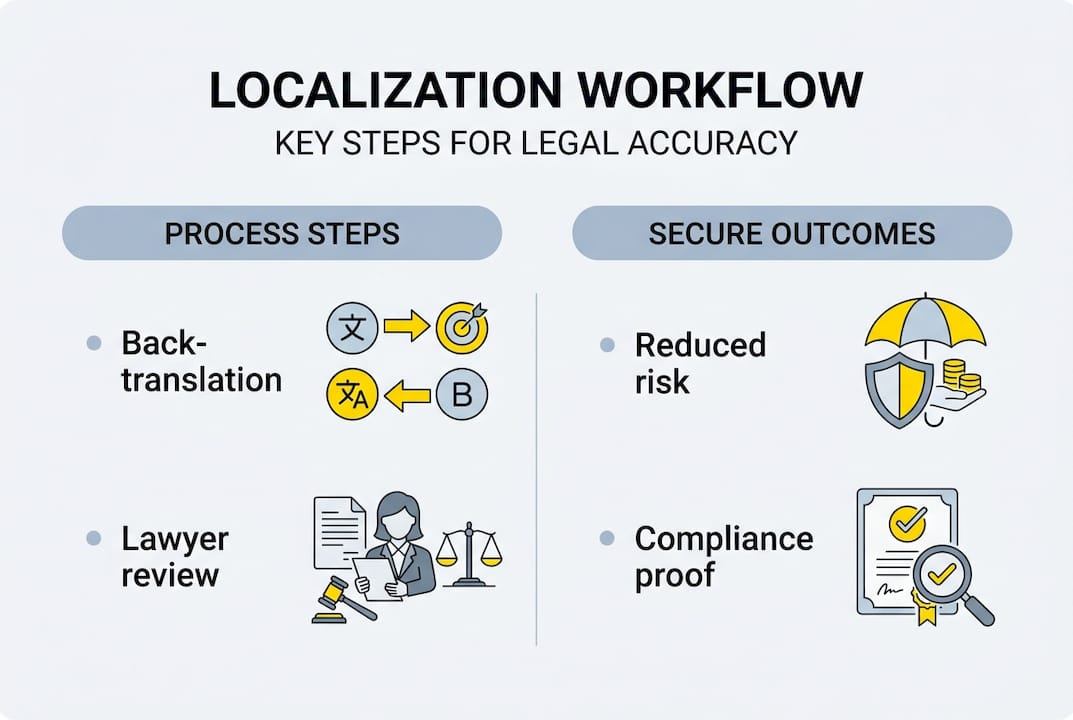
Back-translation identifies subtle errors proactively. In this process, a second translator renders the localized agreement back into the source language without seeing the original. Comparing the back-translated version to the source reveals meaning shifts invisible in direct translation review. For example, a German merchant agreement clause translated to English as “The merchant assumes all liability” might back-translate as “The merchant accepts full responsibility,” revealing that the German version unintentionally broadened the liability scope beyond the original intent.
Key mechanics include back-translation, lawyer-linguist review, terminology glossaries, and official seals for jurisdictional legal validity. Terminology glossaries ensure consistency and legal term accuracy across all merchant touchpoints, from onboarding screens to dispute resolution emails. A payment platform operating in 15 markets might maintain a 500-term glossary covering chargeback types, fee categories, prohibited activities, and compliance obligations, with each term mapped to legally vetted equivalents in every target language.
Pro Tip: Implement a regulated document translation workflow that requires dual sign-off from both a certified legal translator and an in-house legal counsel familiar with the target jurisdiction before any merchant agreement goes live.
Process step | Purpose | Outcome |
Analysis | Identify legal complexity and jurisdiction-specific requirements | Risk assessment and translation strategy |
Terminology extraction | Build consistent legal vocabulary across documents | Reduced ambiguity and dispute exposure |
Translation | Render agreements with legal precision | Contractually sound target-language versions |
Review | Verify legal accuracy through bilingual expert comparison | Error detection before publication |
Certification | Provide official validation of legal compliance | Audit trail for regulatory review |
QA | Measure error density and enforce quality thresholds | Continuous improvement and risk mitigation |
Navigating jurisdictional nuances and ambiguous contract clauses
Ambiguities like “30 days” can differ legally by jurisdiction, creating enforcement challenges when disputes arise. In the UK, “30 days” in a commercial contract typically means calendar days unless otherwise specified. In Germany, the Civil Code (BGB) interprets time periods as calendar days but requires explicit language for business day calculations. France’s Commercial Code defaults to business days for payment terms unless the contract states otherwise. A payment platform using identical English-language merchant agreements across these markets without localization creates three different legal obligations depending on where a dispute is filed.

Some legal concepts lack direct translation equivalents. The English legal concept of “consideration” in fraud liability clauses, for example, has no single-word equivalent in many civil law jurisdictions. Translating this as the German “Gegenleistung” (counter-performance) or French “contrepartie” (counterpart) shifts the legal meaning, as these terms focus on reciprocal obligations rather than the broader common law doctrine that consideration validates contractual promises. Payment platforms must either provide explanatory footnotes in localized agreements or restructure clauses to avoid jurisdiction-specific legal concepts altogether.
Governing law clauses must be drafted to specify local version precedence. A bilingual merchant agreement should state: “In the event of conflict between language versions, the [English/German/French] version shall prevail.” Without this clause, courts in civil law jurisdictions may default to interpreting the local-language version as authoritative under consumer protection statutes, even if the platform intended the English version to govern.
Use bilingual contract templates incorporating prevailing language clauses to reduce risks:
Draft master agreements in English with modular clauses that can be adapted for jurisdiction-specific requirements
Create side-by-side bilingual templates for high-risk markets, with the prevailing language version in the left column and the local translation in the right column
Include a preamble stating which version governs and under what dispute resolution framework
Maintain version control systems that link source and target agreements, enabling rapid updates when regulatory requirements change
Pro Tip: Involve bilingual legal experts early in contract drafting, not just during translation review. A lawyer fluent in both the source and target languages can identify ambiguity-prone clauses during the drafting stage and restructure them to minimize translation risk before localization begins.
Ambiguous clause | Risk | Secure alternative |
“Payment within 30 days” | Jurisdiction interprets as calendar vs. business days | “Payment within 30 calendar days from invoice date” |
“Reasonable fees apply” | Undefined standard creates dispute over what constitutes reasonable | “Fees as specified in Schedule A, updated quarterly” |
“Governing law: English law” | Unclear whether English-language or local-language version prevails | “Governed by English law; English-language version prevails in disputes” |
“Merchant assumes liability for chargebacks” | Scope of liability undefined, may conflict with local consumer protection | “Merchant liable for chargebacks resulting from unauthorized transactions as defined in Section 5.2” |
Ensuring translation compliance for technical documents requires parallel attention to legal and operational terminology. Chargeback reason codes, for example, must be translated consistently across merchant agreements, dispute resolution portals, and reporting dashboards. Inconsistent terminology between the legal agreement and operational systems creates merchant confusion and support burden. Selecting best legal translation providers means evaluating their ability to maintain terminology consistency across document types, not just their legal translation credentials.
Implementing localization to minimize operational and compliance risks
Operational risk is minimized by embedding localization in contract drafting stages, not treating it as a post-drafting task. Payment platforms that draft merchant agreements in English and send them for translation after legal review inherit two problems: first, the source agreement may contain clauses that are difficult or impossible to translate with legal precision into target languages; second, the translation timeline delays market entry and creates pressure to rush legal review in target jurisdictions.
Integrate localization into contract drafting with bilingual templates and prevailing language clauses to minimize operational risk. Start by drafting agreements with localization in mind. Avoid idioms, cultural references, and jurisdiction-specific legal concepts that lack equivalents in target markets. Use consistent terminology throughout the agreement, defining key terms in a definitions section that translators can reference. Structure sentences simply, with one main clause per sentence, to reduce ambiguity in translation.
Bilingual contract templates ensure clarity and legal compliance by presenting source and target versions side by side. This format enables merchants to compare versions, reducing disputes over meaning. It also simplifies legal review, as in-house counsel can verify that the localized version accurately reflects the source agreement without requiring fluency in the target language.
Prevailing language clauses specify which version governs in disputes, eliminating ambiguity about legal interpretation. These clauses should state: “This agreement is executed in [English] and [German]. In the event of conflict, the [English] version shall prevail. However, both versions are equally authentic for purposes of interpretation, and courts may refer to both versions to resolve ambiguities.”
Regular legal quality assurance ensures LQA error density remains below 0.1% for high-stakes clauses. Implement step by step translation quality assurance protocols that measure error rates across liability, governing law, fee disclosure, and dispute resolution sections. Track error patterns over time to identify systematic issues, such as inconsistent translation of chargeback terminology or ambiguous rendering of time periods.
Avoid AI-only translations for high-stakes clauses despite time savings. Legacy machine translation (MT) produces literal output with weak context handling, creating higher likelihood of critical meaning errors in safety-critical or regulated text. Public neural machine translation (NMT) engines offer inconsistent terminology control and variable handling of negation and domain nuance, with governance limitations for regulated documentation unless robust enterprise controls exist. Payment platforms requiring audit-ready localization should use AI+HUMAN hybrid translation workflows that combine LLM-based generation with certified subject-matter expert review and ISO-aligned QA.
Practical integration steps for localization teams:
Establish a legal translation style guide specifying how to handle jurisdiction-specific terms, time periods, and liability clauses
Build translation memories from previously reviewed merchant agreements to ensure consistency across updates and new markets
Create term bases mapping legal concepts to target-language equivalents, with usage notes explaining context and restrictions
Require dual sign-off from legal translators and in-house counsel before publishing any localized merchant agreement
Implement version control systems that track changes to source and target agreements, enabling rapid identification of localization gaps when terms are updated
Schedule quarterly legal QA audits to measure error density and verify that localized agreements remain compliant as regulations evolve
Explore AD VERBUM localization services for merchant agreements
Payment platforms expanding merchant acquisition across Europe need localization partners who understand that merchant agreements are legal instruments, not marketing content. AD VERBUM offers expert localization tailored for legally precise merchant agreements, with workflows that include back-translation and lawyer-linguist reviews to minimize risk. Their AI+HUMAN hybrid translation combines proprietary LLM-based generation with certified subject-matter expert review, ensuring terminology consistency and legal accuracy across 150+ languages.
AD VERBUM’s localization services integrate translation memories and term bases from your existing merchant agreements, maintaining consistency as you expand into new markets. Their ISO 27001-certified infrastructure and EU-hosted data sovereignty posture address the compliance requirements payment platforms face under GDPR and PSD2. Explore AD VERBUM services to see how their legal translation expertise and multilingual SEO and LLMO capabilities can enhance both contract clarity and search visibility for merchant-facing content.
Frequently asked questions
What is the difference between translation and localization for merchant agreements?
Translation converts text from one language to another, while localization adapts legal content to meet jurisdiction-specific requirements. Localization includes translating regulatory references, adjusting liability clauses to comply with local consumer protection laws, and formatting dates, currencies, and time periods according to target market conventions. For merchant agreements, localization ensures legal enforceability, not just linguistic accuracy.
How do I verify that a translated merchant agreement is legally valid in the target jurisdiction?
Engage a bilingual legal expert licensed to practice in the target jurisdiction to review the translated agreement against local commercial law, consumer protection statutes, and payment services regulations. Request certification from the translator confirming compliance with legal translation standards. Implement back-translation to identify meaning shifts, and compare the back-translated version to the source agreement to verify legal accuracy.
Should payment platforms use the same merchant agreement template across all markets?
No. Regulatory requirements, consumer protection standards, and commercial law principles vary significantly across jurisdictions. While you can maintain a master agreement template with modular clauses, each localized version must be adapted to comply with target market legal requirements. Use bilingual contract templates with prevailing language clauses to manage multi-jurisdiction agreements efficiently while maintaining legal precision.
What are the most common translation errors in merchant agreements that lead to disputes?
Ambiguous payment terms, mistranslated liability caps, inconsistent chargeback terminology, and unclear governing law clauses account for the majority of disputes. Time period specifications like “30 days” that fail to clarify calendar vs. business days, liability clauses that shift risk disproportionately due to mistranslation, and fee schedules with inconsistent terminology create merchant confusion and legal exposure. Implementing terminology glossaries and lawyer-linguist review workflows reduces these errors.
How often should localized merchant agreements be reviewed for legal accuracy?
Review localized merchant agreements annually or whenever source agreements are updated, whichever comes first. Regulatory changes, court rulings, and evolving payment industry standards may require updates to liability clauses, compliance disclosures, or dispute resolution procedures. Quarterly legal QA audits help identify localization gaps before they create compliance exposure or merchant disputes.
Can AI translation tools handle merchant agreement localization?
AI-only translation tools lack the legal precision required for high-stakes merchant agreements. Legacy machine translation produces literal output with weak context handling, while public neural machine translation engines offer inconsistent terminology control. AI+HUMAN hybrid translation workflows that combine LLM-based generation with certified legal translator review and ISO-aligned QA provide the accuracy and audit readiness payment platforms require for regulated documentation.
Recommended