


How to Translate a SFCR for Multi-Jurisdiction Solvency II Reporting

When you manage multi-jurisdiction Solvency II reporting, knowing how to translate a SFCR accurately across member states is one of the most operationally demanding tasks your team faces. A mistranslated section heading, a drifted QRT label, or a broken cross-reference in your French or Polish summary can create comparability failures, internal review conflicts, and direct regulatory scrutiny. This article walks through the complete translation workflow: regulatory requirements, preparation controls, execution standards, and version management for groups publishing in multiple official EU languages.
Table of Contents
Key takeaways
Point | Details |
Structure must survive translation | The five-section SFCR format requires exact section numbering and heading preservation in every target language. |
Scope decision comes first | Most multinational groups translate only the SFCR summary, not the full report, to manage risk and cost. |
QRT labels need controlled translation | Narrative text and QRT table labels follow different translation rules; conflating them causes line-item drift. |
Version control is non-negotiable | Translated summaries must be tightly coupled to the master SFCR, with all QRT-driven edits propagated by controlled re-translation. |
2027 redesign requires workflow adaptation | Commission Delegated Regulation (EU) 2026/269 restructures the SFCR into two parts for FY2027, requiring a full rebuild of your translation cross-reference matrices. |
How to translate a SFCR for multi-jurisdiction Solvency II reporting
The SFCR is not a marketing document, a press release, or a general disclosure. It is a regulated five-section report covering Business and Performance, System of Governance, Risk Profile, Valuation for Solvency Purposes, and Capital Management, plus a mandatory Summary. Every heading, section number, and internal cross-reference has a structural function. When comparing SFCR across jurisdictions, supervisors and group-level reviewers rely on that structure to locate and verify consistent disclosures. Any translation that treats the SFCR like general corporate text will break that comparability.
Solvency II reporting requirements under the Delegated Regulation mandate that the SFCR Summary be published publicly. Member State supervisors can and do require that the summary be available in their official languages. That means a group operating in Germany, France, Poland, and Ireland may need to manage four language versions of the same controlled disclosure document, all traceable back to one master report.
The 2027 structural redesign adds a time-critical dimension. Commission Delegated Regulation (EU) 2026/269 replaces the existing five-section format with a two-part SFCR for fiscal year 2027 reports, disclosed in 2028. FY2026 reports, due spring 2027, are the last under the current framework. That means you have one more cycle under the existing structure before translation templates, cross-reference matrices, and term bases all need rebuilding.
Pro Tip: Build your translation workflow documentation as a two-version artifact right now: one that maps the current five-section structure, and one placeholder for the two-part redesign. When the restructuring lands, you will not be starting from zero.
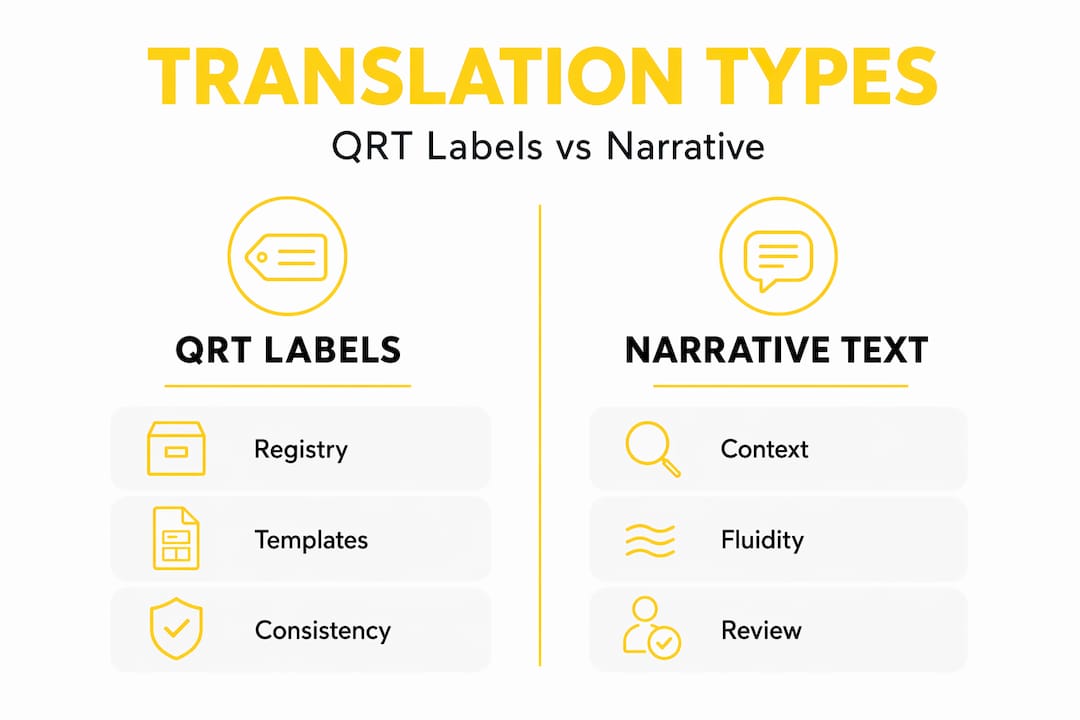
The distinction between narrative translation and QRT label translation is where most teams make their first error. QRT-derived appendices carry fixed templates. Labels in those tables must be mapped precisely in target languages, not paraphrased. Treating a QRT label the same way you treat a governance narrative paragraph will introduce line-item drift that is nearly impossible to reconcile in a cross-language review.
Preparation before translation begins
Sound multinational SFCR translation starts well before the first sentence goes to a linguist. The preparation phase defines scope, establishes controls, and aligns the translation workflow with your actuarial and compliance timelines.
Identify jurisdictions and official language requirements. Map each member state where you have a material presence or a subsidiary with public disclosure obligations. Confirm which supervisory authorities require or expect a local-language SFCR summary. Not all do, but assumptions here are a compliance risk.
Define translation scope: summary only or full report. Large groups commonly translate only the SFCR summary into the official languages of relevant member states. Translating the full report multiplies cost and version control complexity significantly. Agree on scope at the governance level, document it, and get sign-off from compliance before briefing your language service provider.
Establish terminology governance aligned with EIOPA standards. Build or update a Term Base covering EIOPA glossary terms, your group-specific defined terms, and QRT label equivalents in each target language. This is the single most important investment you can make for terminology consistency in multilingual filings. A term base applied inconsistently across translation cycles is nearly as risky as having none at all.
Create a version control framework linked to the master SFCR. Assign version identifiers to the master report and each language version. Define the rule: translated summaries are updated only when a controlled change to the master is approved. No ad hoc edits in individual language versions.
Coordinate QRT integration timing with actuarial teams. QRT data frequently finalizes late in the reporting cycle. Your translation workflow must account for a late-stage data lock. Build a buffer for targeted re-translation of QRT-affected sections rather than re-translating the entire summary.
Pro Tip: Run a pre-translation alignment session with both your actuarial team and your language service provider before the first draft is complete. Catching a QRT label disagreement at that stage costs an hour. Catching it after four language versions are in review costs days.
Executing the translation with regulatory accuracy

The execution phase covers how the document actually moves through translation while maintaining structural integrity, terminology precision, and cross-jurisdiction consistency.
The translation approach for a regulated SFCR must be categorically different from general financial content. Legacy machine translation (MT) generates literal output with weak context handling, producing a high likelihood of meaning errors in regulated text. Generic neural machine translation (NMT) engines available as SaaS tools offer inconsistent terminology control and variable handling of negation and domain nuance; they lack the governance architecture that audit-grade SFCR translation requires.
AD VERBUM’s AI+HUMAN hybrid translation workflow is built for exactly this document class. The sequence works as follows:
Asset integration. Client Translation Memories ™ and Term Bases (TB) are ingested first, constraining all downstream output to approved terminology and prior translation decisions.
LLM generation. AD VERBUM’s proprietary LLM-based LangOps System produces target language output explicitly constrained by client terminology governance and style guidance.
SME review. A certified subject-matter expert with financial and regulatory credentials reviews for technical accuracy, regulatory compliance, and contextual nuance.
Quality assurance. QA is aligned to ISO 17100 and ISO 18587, with audit-trail documentation at each stage.
The table below illustrates the key difference between translation approaches for SFCR content:
Translation approach | Terminology control | Regulatory audit support | SME review |
Legacy MT | Minimal | None | No |
Generic NMT (SaaS) | Inconsistent | Limited | No |
AD VERBUM AI+HUMAN | Enforced via TM and TB | Full audit trail | Yes, ISO-certified |
Maintaining exact section numbering and internal cross-references is a separate discipline from pure language translation. Translation must function as content mapping, preserving headings and structural anchors, not free localization. A reference in the Risk Profile section to figures disclosed in the Capital Management section must resolve correctly in the German version, the French version, and every other language version. If the cross-reference breaks, an auditor reviewing comparing SFCR across jurisdictions will flag it immediately.
Cross-reference matrices must be rebuilt each reporting cycle to prevent silent errors when structural changes occur. This is not a one-time setup task. It is a cycle-by-cycle control.
Pro Tip: Treat QRT label translation as a separate controlled process from narrative text translation. Maintain a QRT label registry for each target language, reviewed by both your actuarial team and a certified financial linguist. This registry becomes an audit artifact.
Verification and ongoing management across jurisdictions
Publishing a translated SFCR summary is not the end of the workflow. Ongoing management, version control, and audit documentation are operational requirements, not optional good practice.
Establish a controlled change propagation rule. Any late-stage edit to the master SFCR, particularly edits driven by revised QRT data, must trigger a formal review of every affected translated section. Drift between the master SFCR and translated summaries is one of the most common compliance failures in multinational disclosure management.
Manage reviewer comments across local reviewers. Different jurisdiction teams will submit review comments on their local-language versions. Without a central coordination function, you will face conflicting edits that each satisfy local reviewers but create inconsistencies across versions. Assign one central owner for cross-language consistency, not four separate owners for four separate versions.
Document the audit trail at every stage. Keep records of: source document version, translation brief, TM and TB versions used, SME reviewer credentials, QA sign-off, and publication date for each language version. Supervisory inspections increasingly examine the process behind disclosures, not just the output.
Prepare translation infrastructure for the 2027 SFCR redesign. The interplay between SFCR simplification and disclosure continuity is the central challenge heading into the two-part format. Your translation cross-reference matrices, QRT label registries, and TM assets will need structured updates before the FY2027 cycle begins. Treating this as a 2028 problem will leave your team under-resourced when it matters most.
Pro Tip: Create a version reconciliation log that records, for each reporting cycle, which sections of the master SFCR changed, which translated sections were updated as a result, and who approved the update. This document will be your first line of defense in any regulatory inspection.
Large groups already operate dual-stream processes: one stream for the regulatory SFCR release, a separate stream for managing multi-language summary publications with rigorous mapping controls. If your organization is not yet operating this way, the 2027 redesign is the right trigger to build that architecture now.
My take on where SFCR translation workflows actually break down
I have reviewed enough multi-jurisdiction SFCR translation processes to identify where they fail. The failure is almost never linguistic. Linguists who specialize in Solvency II know the text. The failures are structural and procedural.
The first common failure point is scope creep in QRT label translation. Teams that do not formally separate QRT label translation from narrative translation end up with linguists making judgment calls on controlled financial terms. That is how you get “eligible own funds” rendered differently across three language versions of the same document.
The second failure is treating version control as an IT concern rather than a compliance control. Version control for translated SFCRs is a regulatory audit matter. If you cannot demonstrate, document by document and cycle by cycle, that your French summary reflects the same approved master as your German summary, you have a disclosure governance gap.
I am also direct about the 2027 redesign risk. Teams that wait until the new two-part format is finalized before updating their translation infrastructure will face a compressed timeline with no margin for the careful rebuild that cross-reference matrices and term bases require. The FY2026 cycle, which is the final cycle under the current SFCR framework, is the time to build the parallel template. Not after.
The right language service partner for this work holds ISO 17100 and ISO 18587 for translation quality, ISO 27001 for information security, and can demonstrate certified SME linguists with Solvency II experience. For guidance on selecting compliant translation providers for regulated EU financial documents, the criteria are well-established. The question is whether your current provider meets all of them.
How AD VERBUM supports compliant SFCR translation workflows
AD VERBUM is certified to ISO 17100, ISO 18587, and ISO 27001, with a network of 3,500+ subject-matter expert linguists who include certified financial and regulatory specialists with direct Solvency II experience. For groups managing multinational SFCR translation across multiple EU member states, AD VERBUM’s AI+HUMAN hybrid translation workflow applies client TM and TB assets from the first step, constrains LLM output to EIOPA-aligned terminology governance, and delivers SME-reviewed, QA-documented translations with a full audit trail.
All processing runs on private EU-hosted infrastructure with no reliance on public cloud tooling, keeping your regulated disclosure data under GDPR-compliant data sovereignty controls. With turnaround 3x to 5x faster than traditional translation workflows, AD VERBUM supports your annual SFCR publication schedule without compromising quality or compliance. Learn more about AD VERBUM’s translation approach for regulated financial documentation.
FAQ
What sections of the SFCR must be translated for multi-jurisdiction reporting?
Member states can require that the SFCR Summary be available in their official language. Most large groups translate only the Summary, not the full five-section report, to manage version control complexity while meeting disclosure obligations.
How do you handle QRT table labels in SFCR translation?
QRT labels use fixed templates and must be translated through a controlled label registry, not treated as free narrative text. Each label must be mapped precisely in every target language and reviewed by a certified financial SME to prevent line-item drift across jurisdictions.
What is the biggest version control risk in multinational SFCR translation?
Drift between the master SFCR and translated summaries after late-stage QRT data edits is the most common failure. Translated summaries should be treated as controlled disclosure documents and updated only through a formal change propagation process tied to the master.
How does the 2027 SFCR redesign affect translation workflows?
Commission Delegated Regulation (EU) 2026/269 replaces the five-section format with a two-part structure for FY2027. This requires rebuilding translation cross-reference matrices, updating QRT label registries, and revising TM assets before the new reporting cycle begins.
What certifications should a translation provider hold for SFCR work?
For audit-grade SFCR translation, your language service provider should hold ISO 17100 and ISO 18587 for translation quality, ISO 27001 for information security, and demonstrate certified SME linguists with documented Solvency II and EIOPA terminology experience.
Recommended