


MDR technical documentation translation guide for EU market entry

Medical device manufacturers entering the EU market confront a critical challenge: EU MDR explicitly requires technical documentation to be translated into official language(s) of Member States where marketed to ensure safety information is understood locally. Translation errors trigger audit nonconformities, delay market clearance, and risk patient safety. This guide walks you through compliant MDR documentation translation, from regulatory prerequisites to AI+human hybrid workflows that deliver audit-ready multilingual files.
Table of Contents
Key takeaways
Point | Details |
MDR translation compliance | Accurate MDR translation requires strict adherence to EU language rules and terminology governance across Member States. |
AI+human hybrid workflows | Workflows aligned with ISO 17100 and ISO 18587 reduce translation errors and accelerate delivery timelines. |
Common translation pitfalls | Ignoring language variants, skipping SME review, and neglecting TM/TB usage cause audit failures. |
Secure translation processes | GDPR and ISO 27001 compliance with EU-hosted infrastructure protect sensitive MDR documentation data. |
Realistic project timelines | Typical MDR translation projects span 2 to 6 weeks, delivering audit-ready multilingual documentation efficiently. |
Understanding EU MDR translation requirements
The EU Medical Device Regulation (MDR) 2017/745 establishes clear obligations for technical documentation translation. Regulation (EU) 2017/745 on Medical Devices mandates that manufacturers translate technical files into at least one official language per EU Member State where the device will be sold. This ensures that Notified Bodies, competent authorities, and end users access safety-critical information in their native languages.
Translation obligations cover all components of the technical documentation:
Instructions for Use (IFU) and labeling materials
Clinical evaluation reports and risk management files
Declaration of Conformity and performance specifications
Post-market surveillance documentation and adverse event reports
Audit bodies scrutinize translations for completeness, consistency, and terminology accuracy during conformity assessments. Inconsistent terminology or incomplete language coverage creates nonconformities that halt market entry. Understanding these mandates forms the compliance baseline for successful EU market access.
Prerequisites: what you need before starting MDR translation
Effective MDR translation begins long before linguists receive source files. Preparation determines whether your project delivers audit-ready documentation or triggers costly rework cycles.
Essential prerequisites include:
Complete MDR source technical files with finalized content
Client-specific Translation Memories ™ and Term Bases (TB) enforcing consistent terminology
Mandatory use of ISO 17100 and ISO 18587 ensures translation services meet quality management requirements
Identification of target Member States and their official languages, including regional variants
Access to certified linguists with medical device sector expertise
Translation Memories capture previously approved translations, ensuring consistency across document versions and product lines. Term Bases lock in regulatory terminology, device nomenclature, and brand-specific language. Without these assets, each translation project starts from zero, multiplying error risk and timeline.
Prerequisite Asset | Purpose | Compliance Impact |
Translation Memory ™ | Enforce consistency across documents and versions | Prevents terminology drift flagged in audits |
Term Base (TB) | Lock regulatory and device-specific terminology | Ensures Notified Body terminology acceptance |
ISO 17100 alignment | Establish quality management framework | Demonstrates process traceability for auditors |
ISO 18587 alignment | Govern post-editing of machine translation output | Validates SME review and quality assurance steps |
Certified SME linguists | Provide medical device domain expertise | Confirms technical accuracy and regulatory compliance |
These prerequisites create the foundation for a regulated translation workflow that withstands Notified Body scrutiny.

Step-by-step AI+human hybrid translation workflow
Compliant MDR translation combines proprietary AI technology with expert human oversight. This hybrid approach delivers accuracy, speed, and audit readiness that neither AI alone nor manual translation can match.
The workflow follows four sequential stages:
Asset integration. Import client Translation Memories and Term Bases before any translation begins. These assets constrain the AI system to approved terminology and style guidelines from the first draft.
Proprietary LLM-based AI generation. The system produces target language output guided by terminology rules, document context, and regulatory style requirements. Unlike generic machine translation, this step enforces client-specific constraints.
Certified SME linguist review. Medical device professionals evaluate AI-generated drafts for technical accuracy, regulatory compliance, and contextual nuance. They catch domain-specific errors that automated systems miss.
Quality assurance validation. Final QA follows ISO 17100 and ISO 18587 standards, creating process traceability and post-editing validation that auditors require.
Pro Tip: Engage SME linguists during Term Base creation, not just during review. Early terminology validation prevents expensive rework when audit bodies reject inconsistent terms later.
This AI+human translation process reduces critical errors by over 70% compared to unreviewed machine translation while accelerating delivery by 3 to 5 times versus purely manual workflows. The combination delivers benefits of AI+human translation that satisfy both speed and compliance requirements.
Common mistakes and troubleshooting in MDR translation
Even experienced manufacturers stumble on predictable MDR translation pitfalls. Recognizing these errors early prevents audit delays and market entry setbacks.
Frequent mistakes include:
Neglecting TM and TB integration. Starting translation without client Translation Memories and Term Bases causes terminology drift that auditors flag immediately. Each document uses different terms for identical concepts, creating compliance gaps.
Over-reliance on literal machine translation. Unreviewed MT outputs introduce up to 30% critical errors in safety-critical text. Literal translations miss contextual meaning, regulatory nuance, and device-specific terminology requirements.
Ignoring official language variants. Translation audit nonconformities related to terminology inconsistency and missing language variants occur in approximately 25% of MDR technical file submissions. Treating Spanish (Spain) and Spanish (Latin America) as interchangeable violates Member State requirements.
Insufficient SME involvement. Linguists without medical device expertise miss safety-critical translation errors. A misplaced modifier in contraindications or dosage instructions creates patient harm risk and regulatory liability.
Pro Tip: Implement terminology enforcement and SME review checkpoints at the start of translation, not after drafts are complete. Front-loading expert oversight prevents cascading errors that multiply rework costs.
Troubleshooting requires root cause analysis. When terminology inconsistencies appear, audit whether TM and TB assets were current and properly imported. When contextual errors emerge, verify that SME linguists with device-specific expertise performed reviews.
Expected timelines and measurable outcomes
Realistic timeline expectations help manufacturers plan MDR market entry strategies and resource allocation effectively.
Typical MDR translation turnaround is 2 to 6 weeks depending on document complexity. Variables include document volume, language pair complexity, terminology preparation status, and SME reviewer availability. The AI+human hybrid approach accelerates delivery by 3 to 5 times compared to traditional manual workflows.
Measurable outcomes demonstrate workflow effectiveness:
Metric | Traditional Manual Workflow | AI+Human Hybrid Workflow |
Project duration | 6 to 12 weeks | 2 to 6 weeks |
Critical error rate | 15% to 30% | Under 5% |
Terminology consistency | 70% to 85% | 95%+ |
Audit rejection risk | Moderate to high | Low |
Cost per word | Baseline | 20% to 40% reduction |
Error rates drop by over 70% when SME-reviewed hybrid workflows replace unreviewed machine translation or inconsistent manual processes. Speed improvements of 3 to 5 times enable faster market entry without sacrificing compliance quality.
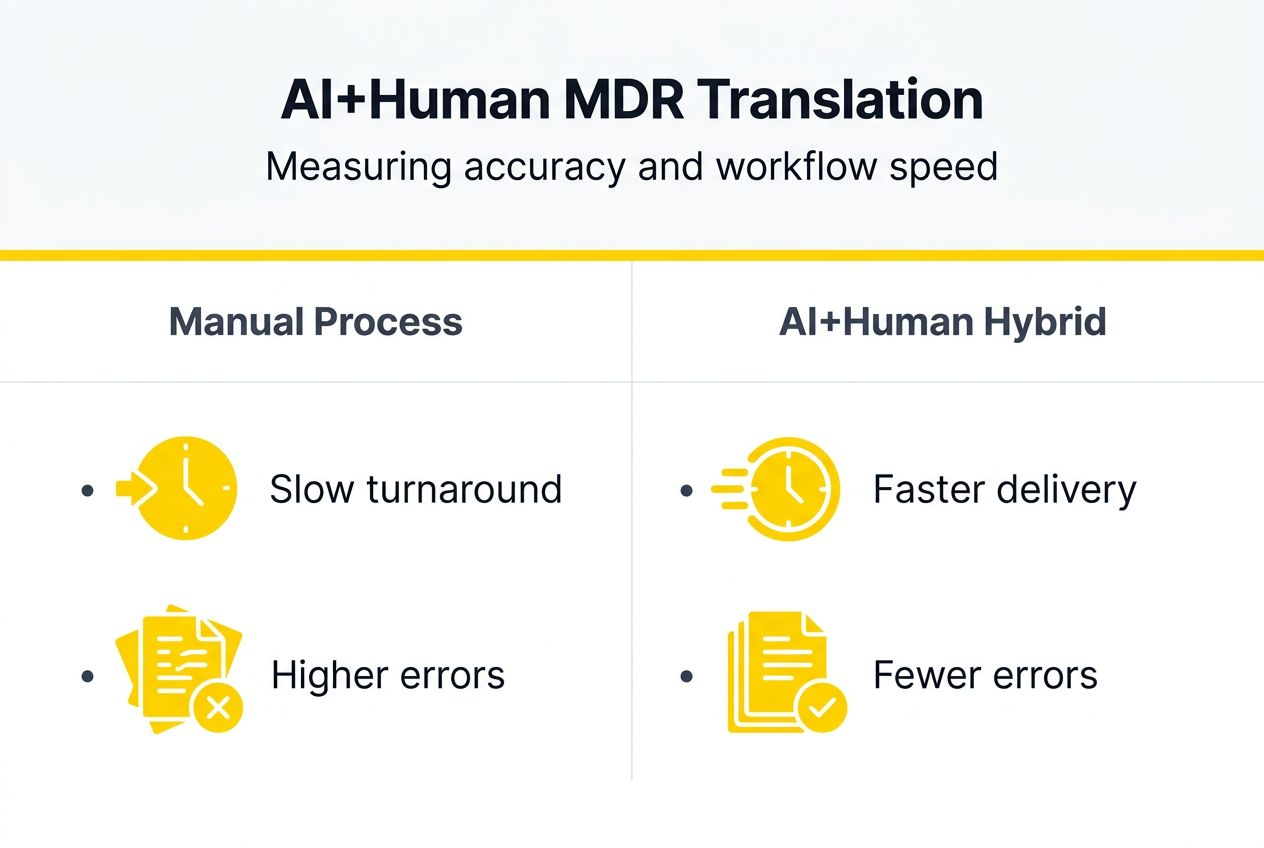
Optimizing AI+human translation processes requires balancing automation efficiency with expert oversight. Manufacturers who invest in comprehensive Term Base development and early SME engagement see the strongest timeline and quality improvements.
Data security and compliance considerations
MDR technical documentation contains proprietary device designs, clinical data, and trade secrets. Translation providers must implement rigorous data protection measures throughout the documentation lifecycle.
Essential security standards include:
ISO 27001 certification. ISO 27001 certification and GDPR compliance with private EU-hosted infrastructure are essential to protecting sensitive MDR documentation from data breaches. This standard establishes information security management systems with documented controls, risk assessments, and incident response procedures.
GDPR compliance. EU data sovereignty laws mandate that personal data and sensitive business information remain within EU jurisdiction. Translation providers must demonstrate where data is processed, stored, and transmitted.
Private EU-hosted infrastructure. Avoid public cloud processing for MDR files. Public SaaS translation platforms expose documentation to unauthorized access, data mining, and jurisdiction conflicts. Private, dedicated infrastructure minimizes breach risk.
Access controls and audit trails. Implement role-based access ensuring only authorized linguists and project managers view specific documents. Maintain detailed audit logs tracking who accessed files, when, and what changes occurred.
Key data security practices:
Execute Data Processing Agreements (DPA) with translation providers detailing data handling, storage, and deletion procedures
Require multi-factor authentication for all system access
Encrypt files in transit and at rest using current cryptographic standards
Conduct regular security audits and penetration testing
Maintain incident response plans for data breach scenarios
For manufacturers, data security failures create dual risks: regulatory noncompliance penalties and competitive intelligence loss. A data security checklist for translations helps verify that providers meet EU MDR data compliance requirements before sharing sensitive documentation.
Comparing translation technologies: MT vs NMT vs proprietary AI
Manufacturers face confusing choices when selecting translation technology for MDR documentation. Understanding the strengths and limitations of each approach clarifies decision criteria.
Legacy Machine Translation (MT) produces literal, word-for-word output with weak contextual understanding. Legacy MT has high error rates up to 30% and lacks contextual nuance, making it unsuitable for standalone MDR documentation translation. MT works for gist translation or internal draft content but fails audit requirements without extensive post-editing.
Neural Machine Translation (NMT) leverages deep learning to improve fluency and phrase-level context. Public NMT engines (Google Translate, DeepL) handle general content well but struggle with technical terminology governance. Without robust enterprise controls, NMT produces inconsistent device nomenclature and mishandles safety-critical negations.
Proprietary LLM-based AI with SME oversight combines context-sensitive generation, explicit instruction following, and terminology enforcement. This approach integrates client Term Bases and Translation Memories before generation, constraining output to approved language. Certified SME review adds regulatory compliance validation and technical accuracy checks that automated systems cannot perform.
Technology | Accuracy | Terminology Control | Context Handling | Compliance Suitability | SME Integration |
Legacy MT | Low | Minimal | Weak | Unsuitable | Manual post-editing required |
Public NMT | Moderate | Variable | Moderate | Limited without controls | Optional add-on |
Proprietary AI + SME | High | Strict enforcement | Strong | High with QA | Mandatory integrated review |
For regulated MDR content, AI vs NMT translation comparison demonstrates that proprietary AI with mandatory SME review offers the best balance of accuracy, speed, and compliance assurance. Public NMT tools suit low-risk content where terminology drift does not create regulatory liability. Legacy MT remains appropriate only for rough drafts requiring complete human rewriting.
Decision criteria favor proprietary AI when:
Documentation faces Notified Body audit scrutiny
Terminology consistency affects regulatory acceptance
Safety-critical content requires zero-error translation
Data sovereignty mandates EU-hosted processing
ISO-aligned QA processes provide audit traceability
Manufacturers should evaluate translation technology based on compliance requirements first, then optimize for speed and cost within that constraint.
Discover expert MDR translation solutions at AD VERBUM
Navigating MDR translation complexity requires specialized expertise that combines regulatory knowledge, linguistic precision, and secure infrastructure. AD VERBUM delivers AI+human hybrid workflows specifically designed for medical device manufacturers pursuing EU market entry.
Our proprietary LangOps System integrates your Translation Memories and Term Bases before translation begins, ensuring terminology consistency from the first draft. Certified medical device linguists review every document for technical accuracy and regulatory compliance. ISO 27001 certified processes and GDPR-secured EU-hosted infrastructure protect your sensitive technical files throughout the translation lifecycle.
With support for 150+ languages including regional variants, AD VERBUM helps you meet Member State requirements across the entire EU market. Our proven workflows reduce translation errors by over 70% while accelerating delivery by 3 to 5 times compared to traditional approaches. Explore our multilingual SEO and LLMO services to optimize market reach, review our comprehensive translation services portfolio, or contact AD VERBUM to discuss your specific MDR documentation requirements.
Frequently asked questions
What languages must MDR technical documentation be translated into?
MDR requires translation into official language(s) of each Member State where the device is marketed. Companies must verify specific language variants and dialects per market, as some Member States recognize multiple official languages. Documentation for Belgium requires French, Dutch, and German versions, while Switzerland needs German, French, Italian, and Romansh translations depending on target cantons.
How does AI+human hybrid translation improve MDR documentation quality?
AI accelerates drafting with consistent terminology control enforced through Translation Memories and Term Bases. SME review adds technical accuracy, regulatory compliance validation, and contextual nuance that automated systems miss. ISO 17100 and ISO 18587 standards guarantee process traceability and quality assurance that satisfy Notified Body audit requirements. This combination reduces critical errors by over 70% while maintaining speed advantages.
What are the key data security standards for MDR translation?
ISO 27001 certification and GDPR compliance with private EU-hosted infrastructure protect sensitive MDR documentation data throughout translation. ISO 27001 ensures robust information security management with documented controls and incident response procedures. GDPR mandates strict data privacy and EU data sovereignty measures. Translation providers should use private, secure EU-hosted processing infrastructure rather than public cloud platforms to minimize breach risk and maintain regulatory compliance. Implement our data security checklist when evaluating providers.
What common mistakes should be avoided in MDR translation?
Ignoring client Translation Memories and Term Bases causes terminology drift that auditors immediately flag. Literal machine translations introduce critical errors without SME review, particularly in safety-critical instructions and contraindications. Audit nonconformities arise in approximately 25% of MDR technical files due to terminology inconsistencies and missing language variant coverage. Failing to consider official language variants creates incomplete compliance that delays market clearance. Lack of certified SME oversight risks translation inaccuracies that affect patient safety and regulatory acceptance.
Recommended

