


How to Build a Translation Audit Trail for FDA & EMA

An FDA inspector asks for your translation audit trail on day one of a site inspection. You hand over a folder of printed certificates, some email threads, and a manually typed log that was completed two weeks after the translations were finalized. That single moment can shift a routine inspection into a critical finding. For clinical QA managers running transatlantic trials, the challenge is real: 96% of sites inspected by EMA in 2024 received major or critical findings linked to audit trail gaps. This guide gives you a practical, step-by-step roadmap to build a site-level translation audit trail that satisfies both FDA and EMA inspectors simultaneously.
Table of Contents
Preparation: Prerequisites for an audit-ready translation process
Build: Step-by-step creation of a compliant site-level translation audit trail
Verification: How to ensure your audit trail passes inspection every time
Our perspective: Why most translation audit trails still fail inspections—and how to break the cycle
Key Takeaways
Point | Details |
Strict regulatory demands | Both FDA and EMA require comprehensive, secure audit trails for translated clinical documents. |
Preparation is key | Having the right SOPs, tools, and qualified personnel in place is essential for building compliant audit trails. |
Every step must be logged | Audit trails must capture who did what, when, and how, from translation request to archival filing. |
Validation prevents findings | Regular self-inspections and use of validated digital systems can minimize the risk of inspection failures. |
Understanding FDA and EMA audit trail requirements
To address this pressing risk, we begin by clarifying what regulators are really looking for at the site level. These are not interchangeable frameworks. Each authority has its own technical emphasis, and in a dual-authority inspection scenario, your audit trail must satisfy both at once.
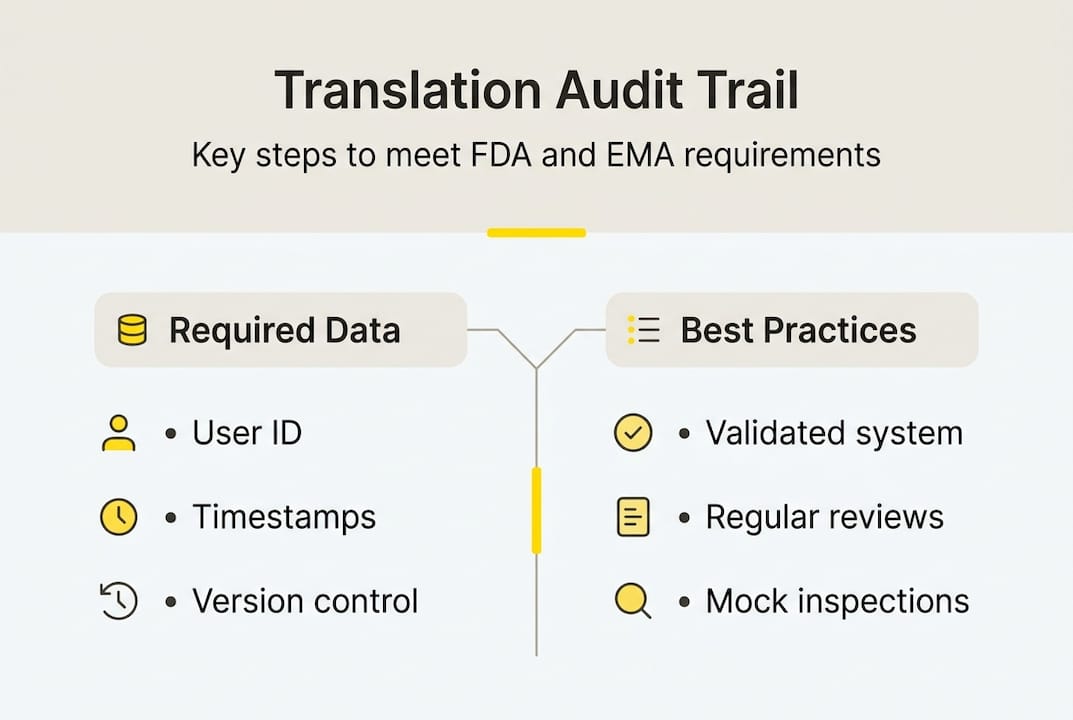
FDA 21 CFR Part 11 governs electronic records and signatures in clinical trials conducted under FDA oversight. It requires computer-generated, time-stamped audit trails for every electronic record, capturing who made a change, what was changed, the original value, the new value, and the exact date and time. For translated documents managed in an electronic system, this means every version save, reviewer action, and certification step must be logged automatically. Manual overrides or retrospective edits are red flags.
EMA GCP under ICH E6(R3) takes a principles-based approach. It emphasizes traceability in essential records and audit trails for all document changes, with particular focus on the Investigator Site File (ISF). Traceability means an inspector can reconstruct the full lifecycle of a translated document, from the original request through to the final version filed in the ISF or Trial Master File (TMF). The ICH E6(R3) GCP requirements reinforce that quality must be built into the process, not appended at the end.
Here is a clear comparison of what each framework demands:
Requirement | FDA 21 CFR Part 11 | EMA GCP / ICH E6(R3) |
Audit trail type | Computer-generated, automatic | Any form, but must be traceable |
Key metadata | User ID, timestamp, old/new values | Identity, date, reason for change |
Electronic system | Validated, Part 11 compliant | Risk-based validation acceptable |
Version control | Mandatory | Mandatory |
Chain of custody | Record-level | Document lifecycle |
A compliant translation audit trail must capture all of the following elements:
Translation request record: who commissioned the translation, date, document version
Translator credentials: qualifications, subject-matter expertise, and any certification
Back-translation records: independent translator identity, output, and reconciliation notes
Certificate of Translation (CoT): signed, dated, linked to the specific document version
Reviewer and approver identities: with timestamps and sign-off rationale
Version history: every draft, with change reasons documented
ISF/TMF filing confirmation: date, file location, responsible person
Missing even one of these fields is enough to generate a finding. This is not about bureaucratic box-checking. It is about demonstrating that your translated documents are trustworthy and that no undocumented change could compromise patient safety or data integrity. Reviewing the medical translation requirements applicable to your trial type is a useful starting point before building your system.
Preparation: Prerequisites for an audit-ready translation process
With regulatory expectations established, let’s set up the necessary groundwork for audit-ready translation. The most common reason audit trails fail inspections is not a missing document. It is a missing system. Teams that start logging after the translation is complete are already behind.
Before a single word is translated, you need these elements in place:
Written SOPs covering translation commissioning, back-translation, review, and filing
A designated process owner at both sponsor and site level
A roster of qualified translators with credentials documented and verified
A validated electronic system or a structured manual log, with clear templates
A version control protocol that covers both source and translated documents
A filing plan that maps each translated document to the correct ISF or TMF section
The choice between a manual log and a validated electronic system matters more than most teams realize:
Factor | Manual log | Validated e-system |
Audit trail completeness | Depends on human discipline | Auto-generated, always complete |
FDA Part 11 compliance | Requires extensive controls | Native compliance |
EMA GCP alignment | Possible but labor-intensive | Efficient and traceable |
Error risk | High (retrospective entries, gaps) | Low |
Scalability | Poor for multi-site trials | Strong |
For transatlantic trials with multiple sites across EU and US jurisdictions, a validated e-system is the practical answer. Paper logs are legally acceptable but require extraordinary discipline to maintain in real time, across sites, in multiple languages.

Pro Tip: When you update your translation SOP, immediately version the old one and file it in the TMF with the effective date. Inspectors frequently ask to see SOP change history. If your team is working from a version that predates a regulatory update, that gap alone can generate a finding. Keep your regulated translation workflows current and traceable.
Build: Step-by-step creation of a compliant site-level translation audit trail
Once the preparatory pieces are set, it is time to build the actual audit trail in a stepwise manner that holds up under the toughest inspection. Follow this sequence for every document that requires translation at the site level.
Commission the translation. Log the request: document name, version, source language, target language, requestor identity, date, and reason. Attach the source document version to the log entry.
Assign a qualified translator. Record translator name, credentials, and any conflict-of-interest declaration. For patient-facing materials, confirm the translator holds relevant medical or clinical expertise.
Produce the translation. The translator delivers the output with a signed Certificate of Translation, confirming accuracy and professional accountability.
Conduct back-translation. Assign an independent translator to render the target-language document back into the source language. Back-translation and independent review are the gold standard for high-stakes documents such as Informed Consent Forms (ICFs).
Perform independent review and reconciliation. A qualified reviewer compares original and back-translated text, documents any discrepancies, and records the resolution rationale. This step must be signed and dated.
Log all actions in real time. Every step above generates a log entry: who did what, when, why, and what system or paper record confirms it. For electronic systems, these entries must be compliant with TMF reference model standards.
File in ISF/TMF. The final translated document, CoT, back-translation, reconciliation notes, and full log are filed together. Document the filing date and responsible person.
Inspector note: When translation audit trail records are missing, incomplete, or reconstructed after the fact, EMA inspectors classify this as a critical finding affecting data integrity. The log must be started at the moment of commissioning, not at the moment of filing.
Pro Tip: For multi-site transatlantic trials, create a translation tracking matrix that lists every document requiring translation, its current status, and its filing location. Update it in real time. This single tool can manage EU translation audit risks across dozens of sites and significantly reduce inspection preparation time. If you are dealing with regulatory submissions, eCTD module translation guidance can help you align filing requirements across both authorities.
Verification: How to ensure your audit trail passes inspection every time
With your audit trail in place, the final layer of defense is verification. No system is perfect on first build. The goal is to find your own gaps before an inspector does.
Run this self-check before any inspection or audit:
Can you retrieve every translation record within minutes, not hours?
Does each record include user identity, timestamps, and version history?
Are all Certificates of Translation signed, dated, and linked to the correct document version?
Are back-translation and reconciliation records filed alongside the final translation?
Are your SOPs current and version-controlled?
Are system access logs available and showing no unauthorized modifications?
Knowing where failures typically occur helps you prioritize. Here are the most common inspection findings, their root causes, and fast fixes:
Finding | Root cause | Quick fix |
Missing timestamps | Manual log completed after the fact | Switch to e-system with auto-timestamp |
Version mismatch | Source document updated, translation not | Implement document change notification protocol |
Missing CoT | Certificate not requested or filed | Mandate CoT as a translation deliverable in SOP |
Unqualified translator | Credentials not verified or documented | Pre-qualify translator roster before trial start |
Incomplete reconciliation | Back-translation done, but discrepancies not resolved on record | Add mandatory sign-off step to review SOP |
The 96% finding rate at EMA-inspected sites is not an outlier. It reflects a systemic gap between what QA teams believe their process produces and what inspectors actually find in the files. Translation accuracy and documentation are among the most scrutinized areas, with process weaknesses triggering critical findings that delay trials and damage sponsor credibility.
A mock inspection is your most powerful verification tool. Assign one team member to play inspector, hand them the trial’s translation log, and ask them to reconstruct the audit trail for a single ICF. Time it. Note every gap. Fix it before the real inspection. Strengthening medical translation compliance through this kind of internal challenge is far less costly than a critical finding. You can also review how other sponsors avoid EMA translation bottlenecks by building smarter review cycles into their workflows.
Our perspective: Why most translation audit trails still fail inspections—and how to break the cycle
Let’s take a step back and share an expert perspective on where QA leaders can genuinely get ahead of compliance cycles. After 25+ years working with regulated translation across life sciences, one pattern stands out: most audit trail failures are not about the quality of the translation itself. They are about the documentation of the process around it.
Teams that treat translation as a procurement task rather than a clinical process step will always struggle at inspection. The fix is a mindset shift, not just a new template. ICH E6(R3)'s move toward a risk-based, principles-first approach is actually good news for sponsors. It means you do not need a perfect paper trail for every low-risk document. It means you need a defensible, consistent process for high-risk ones, particularly ICFs and patient communications.
The insider truth is this: inspectors are not looking for perfection. They are looking for evidence that your team understood the risk, designed a process to control it, and executed that process in real time. Retroactive logging, no matter how complete, signals the opposite. Start your log at the point of translation request, not at the point of filing, and your inspection outcomes will change.
Compliant translation workflows made easy with AD VERBUM
For teams looking to bypass manual pitfalls and simplify compliance, expert help is at hand.
AD VERBUM’s AI+HUMAN hybrid translation workflow is built for exactly the transatlantic dual-authority scenario this guide describes. Our proprietary LangOps System, hosted on EU-based private infrastructure, ingests your existing Translation Memories and Term Bases, generates terminology-governed output, and routes every document through certified subject-matter expert review aligned to ISO 17100, ISO 18587, and ISO 13485. Every step in the process generates a documented, traceable record compatible with FDA Part 11 and EMA GCP expectations. Explore our localization compliance solutions, review our compliance-driven approach, or request a compliance consultation to discuss your specific trial requirements.
Frequently asked questions
What is required in a compliant translation audit trail for clinical trials?
A compliant audit trail must document every translation action, user identity, timestamp, version changes, certifications, and file all logs in the ISF or TMF. FDA 21 CFR Part 11 and EMA GCP both prescribe secure, traceable documentation for clinical translations, though with different technical emphases.
What’s the difference between FDA Part 11 and EMA GCP in terms of audit trail expectations?
FDA Part 11 requires computer-generated audit trails for electronic records, while EMA GCP emphasizes traceability and version control for all essential documents, especially at the site level. Part 11 and EMA GCP focus on different technical dimensions of traceability, which is why a dual-authority trial needs a process that satisfies both simultaneously.
Can paper-based logs satisfy FDA and EMA audit trail demands?
Yes, but only if logs are complete, contemporaneous, signed, and time-stamped at each process step. Validated e-systems offer significantly greater inspection resilience by auto-generating records that cannot be retroactively altered.
What documents are most scrutinized in translation audit trails?
ICFs, patient-facing communications, and clinical study protocols attract the most inspection attention, with ICFs receiving the closest scrutiny. Translation accuracy in ICFs and related documents is a primary inspection focus for both FDA and EMA.
Recommended
