


MDR Article 10(11): Certified IFU translations for CE marking

Many regulatory affairs managers treat IFU translation as something to finalize after CE marking approval, a last administrative step before shipping product. That assumption is wrong, and it costs companies market access. MDR Article 10(11) makes certified translation a legal prerequisite for placing a device on the EU market, not a formality that follows it. Notified Bodies verify translation completeness as part of technical documentation review under Annexes IX through XI. If your IFU translations are missing, incomplete, or produced without a certified process, your CE marking timeline stalls. This article explains exactly what Article 10(11) requires, when translations must be ready, and how to build a compliant, audit-ready workflow.
Table of Contents
Key Takeaways
Point | Details |
Translation is mandatory pre-CE marking | Certified IFU translations must be completed before CE marking and market entry in the EU. |
Language requirements vary by country | Each Member State determines its required IFU language, not all 27 EU languages are mandatory for every device. |
Notified Bodies demand proof | You must show compliant translation certificates during technical documentation review or risk approval delays. |
Early planning prevents costly delays | Strategic translation planning saves time, expense, and regulatory setbacks when entering the EU market. |
What does MDR Article 10(11) actually require?
The legal text is direct. MDR Article 10(11) requires manufacturers to ensure that the device is accompanied by the information set out in Section 23 of Annex I, covering labels and instructions for use, in an official Union language determined by the Member State in which the device is made available to the user or patient. This is not a recommendation. It is a manufacturer obligation tied to market placement.
Annex I, Section 23 defines what counts as “accompanying information.” This includes the label affixed to the device, the label on packaging, and the full instructions for use. Every element within Section 23 falls under the translation obligation. If your device carries a symbol that requires textual explanation in the IFU, that explanation must appear in the required language. There are no partial exemptions based on device class for this obligation, though Class I devices with lower risk profiles may have reduced IFU requirements under specific conditions.
A persistent myth among manufacturers entering multiple EU markets is that Article 10(11) demands translation into all 24 official EU languages simultaneously. It does not. The obligation is market-specific. The Member State where you place the device determines which language applies. Selling in Germany requires German. Selling in Poland requires Polish. Selling in both requires both. You build your language matrix based on your distribution map, not on a blanket EU-wide list.
For manufacturers registering devices in EUDAMED, the EU’s central database for medical devices, there is an additional consistency requirement. Labeling data entered into EUDAMED must align with the physical label and IFU content. Discrepancies between EUDAMED records and physical device documentation create audit exposure. Translation errors that alter meaning, even subtly, can create these discrepancies and trigger non-conformity findings.
What this means in practice for manufacturers:
Identify every Member State where the device will be marketed before beginning translation
Map required languages to each market using current Member State guidance
Ensure all Section 23 Annex I elements are included in each translated version
Align translated IFU content with EUDAMED labeling records
Retain certified translation documentation for Notified Body review
For a detailed breakdown of what technical documentation must include, the IFU documentation translation guide covers the full scope of MDR-required content. The medical translation compliance guide also addresses certification standards that apply to regulated translation workflows.
The timing: Why IFU translation is a pre-CE marking obligation, not a formality
With the requirements clear, the next critical question is when those translations must be completed. The answer is unambiguous: before CE marking, not after.
Article 10(11) makes compliant IFU a manufacturer obligation before placing the device on the market. Because technical documentation, including the IFU, is a prerequisite for Notified Body approval under Annexes IX through XI, translations are part of the review package, not a post-approval deliverable. Notified Bodies do not approve incomplete documentation and return to finish the language work later. They review what you submit. If translations are absent or non-compliant, the review stops.
Here is the sequence that applies to most Class IIa, IIb, and III devices:
Finalize the source IFU in the original language, with all Section 23 Annex I content complete
Identify all target Member States and their required languages
Commission certified translations from a qualified language service provider
Integrate translations into the technical documentation file
Submit the complete technical documentation, including all IFU translations, to the Notified Body
Address any translation-related queries raised during Notified Body review
Receive CE marking approval with compliant IFU translations already in place
The most common compliance pitfall is misreading the timeline. Teams finalize the source IFU late in the development cycle, then discover that certified translation into six or eight languages requires weeks of lead time. Rushing this step introduces errors. Errors in IFU translations are not minor. Under MDR, inaccurate or misleading instructions for use can constitute a serious incident trigger if they contribute to patient harm.
Another frequent mistake is assuming that Member State language requirements are static. Countries update their accepted language lists. Romania, for example, has updated its conditions for accepting English-language IFUs. Relying on outdated guidance creates gaps that surface during Notified Body scrutiny. The notified body scrutiny points article covers what reviewers specifically check in 2026.
Understanding translation compliance requirements for regulated documentation also helps teams avoid the liability exposure that comes from using uncertified translation methods. The risks of relying on generic machine translation for safety-critical content are covered in detail in the machine translation liability risks resource.
Pro Tip: Lock your source IFU content at least eight to ten weeks before your planned Notified Body submission date. This gives certified translators adequate time to produce accurate, reviewable output without compressing the QA cycle.
Member State language realities: What ‘all 27 EU official languages’ really means for IFU translation
Understanding the timing, let’s clarify what it means to be certified in all EU languages, and why this is not as straightforward as it sounds.
The myth that every device needs translation into all 27 EU languages persists because manufacturers conflate EU membership with uniform language law. The EU has 24 official languages, not 27, and the obligation applies only in the Member States where you actually market the device. A manufacturer selling exclusively in the Netherlands, Belgium, and Austria needs Dutch, French, German, and possibly Dutch regional variants, not 24 languages.
The practical complexity comes from per-country variation in what is accepted. Some Member States permit English-language IFUs for healthcare professionals under specific conditions. Others require full translation into the national language regardless of professional context. A few allow dual-language formats. These rules are not harmonized at the EU level; each Member State sets its own requirements.

Member State | Primary IFU language | English accepted for professionals? | Notes |
Germany | German | No | Full German IFU required |
France | French | No | French required by law |
Netherlands | Dutch | Conditional | English permitted with Dutch summary |
Sweden | Swedish | Conditional | English accepted in some professional settings |
Romania | Romanian | Conditional (updated) | Recent guidance allows English with conditions |
Poland | Polish | No | Full Polish IFU required |
This table reflects general patterns. Always verify current requirements directly with the relevant competent authority or a qualified regulatory consultant before finalizing your language matrix.
One underappreciated risk: manufacturers who rely on outdated language requirement tables. Member State guidance evolves. Romania’s updated conditions for English acceptance, for instance, changed the compliance picture for manufacturers who had previously budgeted for full Romanian translation in all cases. Staying current with EU MDR language requirement updates is an ongoing operational task, not a one-time check.
For teams managing multi-market rollouts, the service providers for EU language requirements overview compares how different LSPs handle per-country variation. Post-market obligations also carry language requirements, covered in the post-market translation insights article.
Pro Tip: Build a living language matrix document that maps each target Member State to its current IFU language requirement, the date you last verified it, and the source of that verification. Treat it as a controlled document with version history.
How to achieve and document compliant IFU translations for CE marking
With specific country requirements in mind, here is how to deliver certified, inspection-ready translations for CE marking.
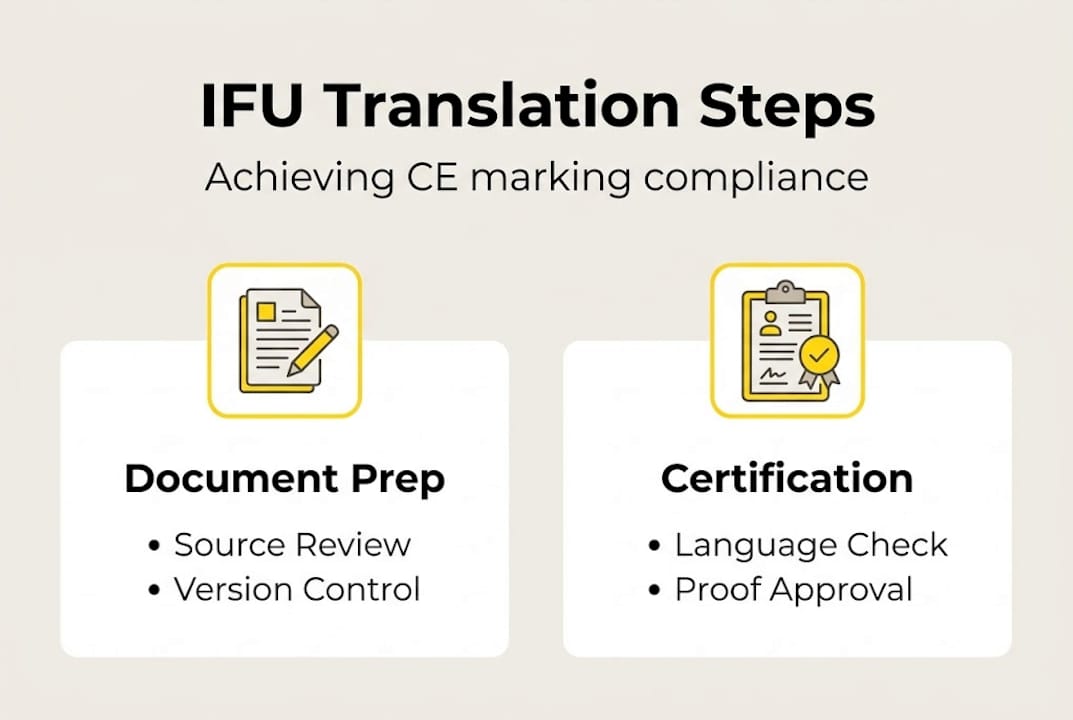
Selecting the right translation provider is the first decision with direct regulatory consequence. Under MDR, the IFU must be “indelible, easily legible and clearly comprehensible to the intended user or patient,” as stated in the MDR text. That comprehensibility standard requires translators who understand both the device’s clinical context and the regulatory expectations of the target market. Generic translation services do not meet this bar for regulated medical device documentation.
The step-by-step process for compliant IFU translation:
Freeze the source IFU and assign a document version number before translation begins
Confirm the language matrix for all target Member States using current competent authority guidance
Select a certified LSP holding ISO 17100, ISO 13485, and ISO 27001, the certification trifecta that MDR Article 10(11) compliance in practice demands from a language service provider
Provide the LSP with your existing Translation Memories and Term Bases to enforce terminology consistency
Receive the translated output and conduct a bilingual review with a subject-matter expert
Complete a formal QA pass aligned to ISO 17100 and ISO 18587
Obtain a signed translator declaration or certification statement for each language
Integrate all certified translations into the technical documentation file with clear version traceability
Checklist item | Required for Notified Body? | Documentation format |
Source IFU version control | Yes | Document management system record |
Language matrix with Member State verification | Yes | Controlled spreadsheet or RA system |
Certified translation for each target language | Yes | Translated document plus certification statement |
Bilingual QA review record | Yes | Review log with reviewer credentials |
LSP ISO 17100 and ISO 13485 certification | Yes | LSP certificate copies on file |
EUDAMED labeling data alignment check | Yes | Cross-reference record |
Documentation gaps are the most common reason translation work fails Notified Body review. Having translations completed is not enough. You need evidence of the process: who translated, what qualifications they hold, what QA steps were applied, and how the output maps to the source document.
The EUDAMED compliance essentials resource covers the labeling consistency requirements that connect IFU content to database records. For teams facing capacity constraints, translation bottleneck solutions addresses workflow acceleration without sacrificing quality. Managing multilingual risk across multiple EU sites adds another layer of complexity that requires systematic controls.
Pro Tip: Request a sample translation of a technically complex IFU section before committing to a provider. Evaluate terminology accuracy, not just fluency. A translation can read smoothly and still contain clinical errors that would fail regulatory review.
The uncomfortable truth: Why the ‘translation as afterthought’ approach puts companies at risk
Even with clear steps available, manufacturers repeatedly underestimate what is at stake when translation is treated as a checklist item rather than a core regulatory function.
Field recalls and import blocks linked to incomplete or inaccurate IFU translations are not hypothetical. They happen, and they are expensive in ways that go beyond the immediate cost of remediation. When a device reaches market with non-compliant IFU translations, the competent authority response can include withdrawal from the specific Member State market, mandatory corrective action, and reputational damage with the Notified Body that approved the device. Post-2025, Notified Bodies are applying stricter scrutiny to translation completeness precisely because MDR implementation exposed how many manufacturers had treated this obligation loosely under the old MDD framework.
The contrarian point worth making: early investment in a robust technical translation guide process and certified LSP relationships is not a cost center. It is a market access insurance policy. Manufacturers who build translation into the development timeline, rather than bolting it on at the end, consistently experience fewer Notified Body queries, faster approvals, and cleaner post-market surveillance records. The translation compliance lessons from companies that have navigated MDR enforcement reinforce this pattern. Treating translation as a strategic function, not an administrative one, is what separates manufacturers who scale across EU markets from those who stall at the border.
How AD VERBUM supports full MDR IFU translation compliance
For teams needing practical support, partnering with proven experts can make the difference between market access and regulatory setbacks.
AD VERBUM brings 25 years of regulated-sector translation experience to MDR Article 10(11) compliance. The AI+HUMAN hybrid workflow begins with ingesting your existing Translation Memories and Term Bases, then applies a proprietary LLM-based LangOps System to produce terminology-governed output, followed by certified subject-matter expert review and QA aligned to ISO 17100 and ISO 18587. AD VERBUM holds ISO 17100, ISO 13485, and ISO 27001, the certification trifecta that Notified Bodies expect from a compliant LSP. All processing runs on EU-hosted infrastructure with no public cloud exposure. Turnaround runs 3x to 5x faster than traditional workflows. Explore medical device localization, review the full translation service portfolio, or contact AD VERBUM to discuss your specific compliance requirements.
Frequently asked questions
Does every medical device IFU need to be translated into all 27 EU official languages?
No. Each IFU must be translated into the official language(s) of each Member State where the device is marketed, not all EU languages simultaneously. Your distribution map drives your language matrix.
When must IFU translations be prepared for CE marking?
Compliant IFU translations must be completed before CE marking approval because Notified Bodies require them as part of the technical documentation review under Annexes IX through XI.
Can English be used for IFUs in some EU countries?
Yes, certain Member States allow English for professionals under specific conditions, but most require the national language. Always verify current requirements with the relevant competent authority.
What happens if certified translations aren’t ready before CE marking?
Missing or non-compliant IFU translations can halt CE marking approval, block market access, and expose manufacturers to recalls or sanctions if a non-compliant device reaches the market.
Recommended
