


Localization Team Structure Explained for Team Leaders

A localization team is an organized group of professionals responsible for adapting products, documents, and content across languages and cultures to maintain global relevance and consistency. Understanding localization team structure explained in full means grasping three interdependent layers: governance model, role definition, and workflow integration. Get any one of those wrong, and the others break down. This article defines each layer, compares the three primary governance models, maps the critical roles in a functioning team, and gives practical guidance on scaling your structure as your organization grows.
What is localization team structure and why does governance define it?
Localization team structure is the formal arrangement of roles, decision rights, and workflows that determines how a team plans, executes, and quality-checks multilingual content. The industry term for the decision-making layer is “localization governance,” and it is the single most consequential design choice a team leader makes.
Three primary governance models exist: centralized, decentralized, and hybrid. Each model distributes authority differently, and that distribution shapes every downstream process from terminology management to QA sign-off.
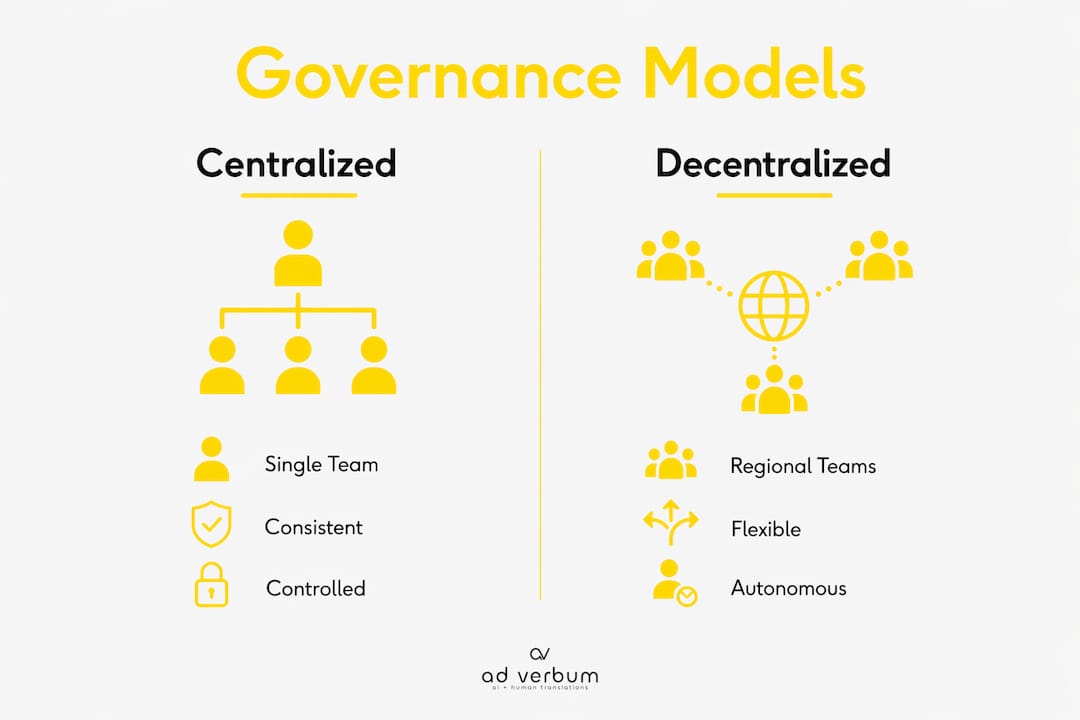
Centralized governance
In a centralized model, one global team controls all localization activity. This produces consistent terminology, unified style guides, and a single point of accountability. The drawback is responsiveness. Local teams may experience delays because every decision routes through a central authority, and regional nuances can get lost in the process.

Centralized governance works well for organizations with a small number of target markets, tightly regulated content such as medical device documentation, or a strong need for audit trails across all language assets.
Decentralized governance
Decentralized governance gives regional teams direct control over localization decisions. Local autonomy improves cultural relevance but introduces the risk of inconsistent quality and duplicated effort across regions. Two regional teams may build separate glossaries for the same product, creating terminology conflicts that surface in the field.
This model suits organizations where market conditions vary sharply by region and where speed to market outweighs the need for global consistency.
Hybrid governance
Hybrid governance combines centralized strategy with local execution and is the most common model among large multinationals. A global team sets standards, manages Translation Memories ™ and Term Bases (TB), and owns QA frameworks. Regional teams execute within those guardrails and adapt content for local context. The model requires clear role definitions to avoid negotiation overhead between global and local stakeholders.
Governance model | Decision authority | Consistency | Local agility | Best fit |
Centralized | Global team | High | Low | Regulated sectors, small market count |
Decentralized | Regional teams | Low | High | Fast-moving consumer markets |
Hybrid | Shared | Medium-high | Medium-high | Scaling multinationals |
Pro Tip: If your organization is expanding into three or more new markets in a single year, start with a hybrid model from day one. Retrofitting governance after regional teams have built independent workflows costs significantly more time than designing shared standards upfront.
What are the critical roles within a localization team?
Overlapping or unclear responsibilities increase turnaround times and reduce quality consistency, making role definition one of the highest-leverage decisions in building a localization team. Each role carries a distinct function, and gaps between them create the friction that delays projects.
The core roles in a functioning localization team are:
Localization Manager / Project Manager. Owns the end-to-end workflow, manages vendor relationships, tracks deadlines, and coordinates across Product, Engineering, and Marketing. This role is the operational center of localization project management.
Translator. Produces the initial target-language output. Subject-matter expertise matters here. A translator working on a medical device manual needs clinical vocabulary, not just linguistic fluency.
Editor / Reviewer. Checks the translation for accuracy, style consistency, and adherence to the client’s Term Base. The editor catches errors the translator may normalize through familiarity.
QA Specialist. Runs formal quality checks aligned to standards such as ISO 17100 and ISO 18587. This role verifies that the output meets both linguistic and technical requirements, including tag integrity in software strings and formatting compliance in regulated documents.
Terminology Manager. Maintains the Term Base and Translation Memory. Without this role, terminology drifts across projects and markets, which is a direct compliance risk in sectors like Life Sciences or Legal.
Localization Engineer. Handles file preparation, format conversion, and tool integration. This role prevents technical errors from entering the linguistic workflow.
Subject-Matter Expert (SME) Reviewer. Validates domain accuracy in high-stakes content. In regulated industries, an SME reviewer is not optional. A legal scholar reviewing a contract translation catches meaning errors that a general linguist would miss.
Pro Tip: In smaller teams, one person often covers multiple roles. That is acceptable as long as the functions remain distinct. A translator who also self-edits without a separate review step is a quality risk, not an efficiency gain. Separate the functions even when the same person performs them at different stages.
For teams working on technical document localization, the Localization Engineer and SME Reviewer roles carry disproportionate weight because format errors and domain inaccuracies in technical content can have direct safety or compliance consequences.
How do workflows and collaboration practices influence team effectiveness?
Moving from sequential hand-offs to integrated workflows is the single most effective change a localization team can make to reduce bottlenecks. In a hand-off model, content moves from Product to Localization to QA in discrete batches. Each transfer introduces a waiting period, and errors discovered late in the chain require rework across multiple stages.
Integrated workflows involving Product, Engineering, and Marketing teams improve localization quality and reduce bottlenecks compared to traditional hand-off approaches. The practical difference is that localization professionals participate in content planning, not just content delivery.
Four practices that define effective collaborative workflows:
Early localization involvement. Localization Managers join product planning cycles to flag untranslatable strings, character limits, and cultural constraints before content is finalized. This eliminates a class of rework that only appears at the translation stage.
Regular cross-functional check-ins. Regular communication and feedback loops among translators, editors, QA, and project managers reduce turnaround times and maintain consistency. Weekly syncs between the localization team and the Product team catch scope changes before they cascade into translation errors.
Shared terminology governance. A centrally maintained Term Base, accessible to all team members and updated after each project, prevents terminology drift. This is especially critical in regulated industries where a single mistranslated term can trigger a compliance failure.
Structured feedback loops. Post-project reviews that capture errors by type and stage allow teams to identify whether quality issues originate in translation, editing, or QA. Without this data, teams repeat the same errors across projects.
The shift from hand-off to integrated workflow also changes the role of the Localization Manager. That role moves from coordinator to strategic partner, which is a meaningful change in how localization project management operates within the broader organization.
How do you scale localization team structures for growing organizations?
Scaling localization teams requires adjusting governance and team structures as organizational complexity and market reach increase. A model that works for three markets will not serve twenty markets without structural changes.
The scaling challenge is not primarily a headcount problem. It is a governance and process problem. As new markets are added, the number of language pairs, regulatory requirements, and cultural contexts multiplies. Without deliberate structural adaptation, quality degrades and costs rise faster than output.
Scaling phase | Typical structure | Key challenge | Recommended adaptation |
1–3 markets | Centralized, small team | Limited bandwidth | Standardize TM and TB early |
4–10 markets | Centralized with regional reviewers | Coordination overhead | Introduce hybrid governance |
10+ markets | Hybrid or decentralized | Consistency vs. agility | Formalize global standards, delegate execution |
Regulated expansion | Hybrid with SME network | Compliance across jurisdictions | Add sector-specific QA layers |
Three structural adaptations consistently improve outcomes during scaling. First, formalize the Terminology Manager role before expanding to new markets. Terminology governance is far harder to retrofit than to build from the start. Second, define escalation paths clearly. In a hybrid model, regional teams need to know which decisions they own and which require global approval. Ambiguity at this boundary is the most common source of delays in scaling organizations. Third, invest in Translation Memory architecture early. A well-structured TM reduces translation volume as the content library grows, which directly controls cost and turnaround time.
For organizations in regulated sectors such as Life Sciences, Legal, or Defense, scaling also means adding jurisdiction-specific QA layers. The best practices for legal document translation in one market may not satisfy the regulatory requirements of another, and the team structure must account for that variation explicitly.
Key Takeaways
A well-defined localization team structure requires clear governance, distinct role assignments, and integrated workflows to deliver consistent quality at scale.
Point | Details |
Governance model determines structure | Choose centralized, decentralized, or hybrid based on market count and compliance requirements. |
Role clarity prevents delays | Overlapping responsibilities increase turnaround times; define each function separately even in small teams. |
Integrated workflows reduce bottlenecks | Involve localization professionals in planning cycles, not just delivery stages. |
Scaling requires structural adaptation | Adjust governance and formalize terminology management before expanding to new markets. |
Regulated sectors need SME oversight | Subject-matter expert reviewers are a quality and compliance requirement, not an optional addition. |
What I’ve learned from watching localization teams fail and succeed
The most common failure I see is not a technology problem or a budget problem. It is a governance problem that nobody named. A team operates for months under an informal centralized model, then adds regional teams without updating decision rights. Nobody knows who approves the final German glossary. The project stalls, the regional team builds its own terminology list, and six months later the organization has two conflicting Term Bases in the same language.
The fix is not complicated, but it requires a deliberate conversation that most teams avoid because it feels bureaucratic. Define who owns global standards. Define who executes locally. Write it down. Review it when you add a new market or a new content type.
The second pattern I see consistently is the undervalued Terminology Manager. Organizations invest in translation tools and project management platforms, then assign terminology governance to whoever has spare capacity. That is a structural error. Terminology drift is invisible until it causes a compliance failure or a customer-facing error. By then, the cost of correction far exceeds what a dedicated Terminology Manager would have cost.
Hybrid governance works in practice, but only when the boundary between global and local authority is explicit. The organizations that get the most out of hybrid models are the ones that document their governance structure as formally as they document their QA processes. AD VERBUM’s approach, embedding ISO 17100 and ISO 18587 aligned QA within an AI+HUMAN hybrid translation workflow, reflects exactly this principle. The structure is defined before the work begins, not discovered during it.
— Eric Brown
How AD VERBUM supports localization teams at every scale
AD VERBUM’s localization services are built around the same structural principles this article describes: defined governance, clear role separation, and integrated QA.
AD VERBUM’s AI+HUMAN hybrid translation workflow begins with ingesting client Translation Memories and Term Bases, then applies its proprietary LLM-based LangOps System to generate target-language output constrained by client terminology. Certified subject-matter experts review every output for technical accuracy and regulatory compliance. Final QA aligns to ISO 17100 and ISO 18587, with sector-specific layers for Life Sciences, Legal, Defense, and Finance. With 3,500+ expert linguists across 150+ languages and certifications audited by Bureau Veritas, AD VERBUM fits directly into scaling localization team structures that require both speed and audit-grade quality.
FAQ
What is localization team structure?
Localization team structure is the formal arrangement of roles, governance authority, and workflows that determines how a team plans, executes, and quality-checks multilingual content. It includes the governance model (centralized, decentralized, or hybrid) and the assignment of specific functions such as translation, editing, QA, and terminology management.
What are the main roles in a localization team?
The core roles are Localization Manager, Translator, Editor, QA Specialist, Terminology Manager, Localization Engineer, and Subject-Matter Expert Reviewer. Clear role definition prevents delays and quality inconsistencies across projects.
Which governance model is best for scaling organizations?
Hybrid governance is the preferred model for scaling multinationals because it balances global consistency with local execution flexibility. It requires explicit role definitions to avoid decision-making overhead between global and regional teams.
How does workflow integration improve localization quality?
Integrated workflows bring localization professionals into planning cycles rather than treating localization as a final delivery step. This approach reduces rework, catches untranslatable content early, and maintains terminology consistency across all markets.
When does a localization team need subject-matter expert reviewers?
SME reviewers are required whenever content carries regulatory, safety, or legal consequences, including medical device documentation, legal contracts, defense materials, and financial disclosures. In these contexts, linguistic accuracy alone is insufficient without domain-level validation.
Recommended