


Localization Investment Business Case: A Finance Guide

A localization investment business case is a structured financial justification that quantifies incremental revenue, customer retention gains, compliance risk reduction, and content velocity improvements to secure budget for localization programs. Decision-makers in regulated industries, including Life Sciences, Legal, and Finance, require this evidence-based framework to evaluate global market expansion over a 12–24 month horizon. The four core driver categories are revenue, retention, compliance, and content velocity. Each maps directly to measurable outcomes that finance teams can model, audit, and approve.
What metrics should a localization investment business case include?
Finance leaders approve localization budgets based on value cases over 12–24 months that cover four driver categories: revenue, retention, compliance, and content velocity. Each category requires its own formula, baseline, and accountable owner before a budget committee will act.
Revenue: incremental, not total
Localization ROI must measure incremental revenue, not total revenue. Total revenue conflates organic growth, pricing changes, and seasonal effects with the actual lift from localization. The correct calculation isolates the revenue attributable to newly localized markets or content, then discounts it using net present value (NPV) at approximately 8% to reflect the time cost of capital.

Retention: churn and lifetime value
Retention metrics track churn reduction and customer lifetime value (LTV) gains per locale. A localized product reduces friction for non-English-speaking customers, which directly lowers voluntary churn. Retention improvements compound ROI over 12–36 months, particularly in SaaS and high-LTV products, making them a stronger long-term argument than first-year conversion gains.
Compliance: cost avoidance
Compliance cost avoidance quantifies the savings from preventing regulatory rework, legal escalations, and failed audits. Track the average cost of a compliance incident per locale, multiply by the estimated incident reduction rate, and present that figure as avoided cost. This metric resonates with legal and risk officers who control significant portions of regulated-industry budgets.
Content velocity: cycle time and throughput
Content velocity measures how quickly localized content reaches market and how much rework it requires. AI-assisted workflows reduce cycle times significantly and increase localized publishing throughput. Faster time-to-market means earlier revenue recognition, which improves NPV calculations and strengthens the financial model.
Pro Tip: Build a single spreadsheet model with one tab per driver category. Finance teams trust transparent, inspectable models far more than summary slides. Show every formula and assumption explicitly.
Metric category | Formula structure | Primary audience |
Incremental revenue | (New locale revenue × conversion rate) × NPV factor | CFO, VP Finance |
Retention gain | (Churn reduction % × LTV per customer) × locale size | CMO, Customer Success |
Compliance cost avoidance | Incident cost × estimated reduction rate | General Counsel, Risk |
Content velocity | (Cycle time saved × output volume) × hourly cost | COO, Operations |
How does compliance risk shape the business case in regulated industries?
In regulated industries, risk avoided is as important as revenue gained when building a localization business case. A pharmaceutical company facing a failed EU MDR submission due to mistranslated Instructions for Use carries financial exposure that dwarfs the cost of a professional localization program. That exposure belongs in the business case as a quantified risk line, not a footnote.
Executives in regulated sectors prioritize tracking compliance incidents and legal escalations by locale. Specific metrics to include are:
Support ticket volume segmented by locale and language
Legal escalation frequency tied to documentation errors
Regulatory rework cycles and their average cost per submission
Audit findings attributed to translation or localization failures
Time spent by compliance staff correcting localized content
Standardized localization processes reduce all five metrics. When you replace ad hoc translation with a governed workflow aligned to ISO 17100 and ISO 18587, you create an auditable chain of custody for every document. That auditability satisfies regulators and reduces the probability of costly rework cycles.
Governance mechanisms matter as much as the metrics themselves. A phased localization plan assigns accountable owners to each locale, defines escalation paths for terminology disputes, and sets review cadences for regulatory updates. Without those controls, even a well-funded localization program generates inconsistent output that creates new compliance exposure. For organizations managing regulatory document localization, governance is the difference between a defensible audit trail and a liability.
Pro Tip: Ask your legal team for the three most expensive compliance incidents from the past two years. If any involved documentation errors in a non-English market, those figures belong in your business case as concrete risk data.
How do you build a finance-aligned localization business case step by step?
A credible business case starts with a clearly defined business problem, not a translation volume target. The problem statement should name the specific market, the revenue or risk gap, and the 12–24 month outcome the organization wants to achieve.
Follow this sequence:
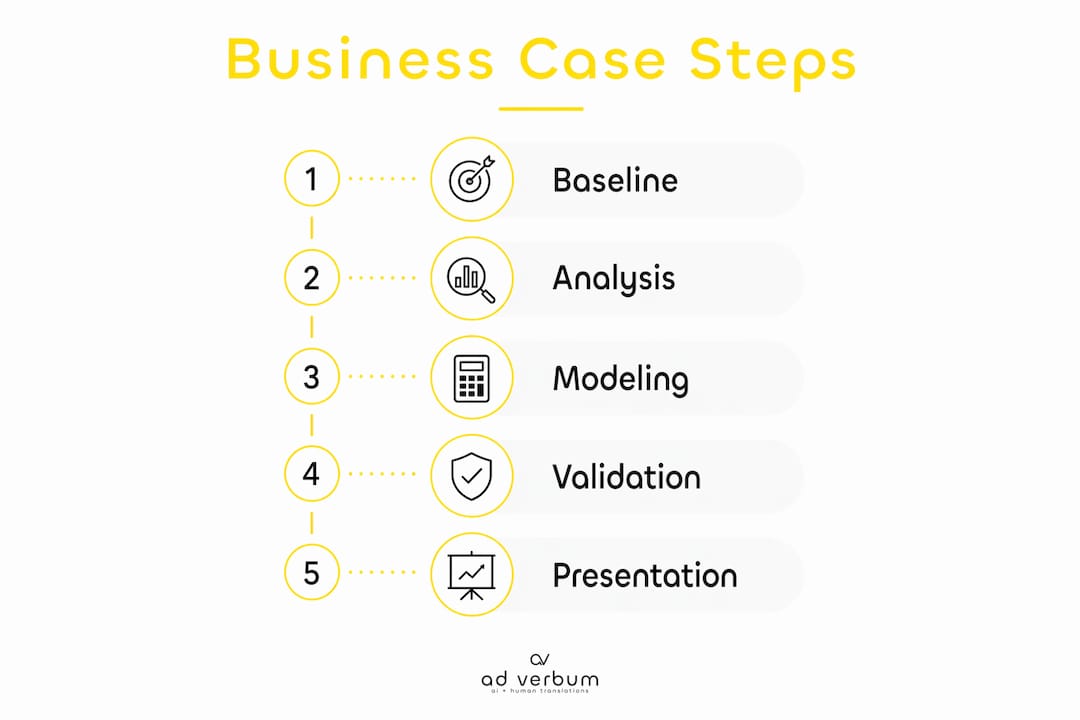
Define the business problem. State the gap: a target market where conversion rates lag, a locale generating disproportionate support costs, or a regulatory submission process with recurring rework.
Map driver categories to company goals. Align each of the four drivers (revenue, retention, compliance, velocity) to an existing corporate objective. Finance teams approve investments that connect to goals already in the annual plan.
Establish baseline metrics. Measure current performance per locale before any intervention. Baselines are the reference point for every ROI calculation. Without them, you cannot prove causation.
Design the pilot. Select one or two locales for initial investment. A pilot limits financial exposure, generates real data, and builds internal credibility before a full-scale commitment.
Model phased value delivery. Present a 24-month cash flow projection showing when each driver category begins generating returns. Include payback period and internal rate of return (IRR) alongside NPV.
Assign accountable owners. Each metric needs a named owner and a review cadence. Phased localization plans with defined governance structures have materially better budget approval outcomes than undifferentiated program proposals.
Pro Tip: Present your model with a sensitivity table showing outcomes at 50%, 100%, and 150% of projected performance. Finance teams respect scenario planning. It signals that you understand risk, not just upside.
Localization ROI must account for all program costs, including tooling, engineering integration, and ongoing maintenance, not just per-word translation fees. A business case that understates costs will lose credibility the moment finance runs its own numbers.
Phase | Timeline | Key deliverable | Success metric |
Baseline | Months 1–2 | Metrics dashboard per locale | Baseline data locked |
Pilot | Months 3–6 | Localized content live in 1–2 markets | Incremental revenue and ticket volume |
Scale | Months 7–18 | Full program rollout | NPV positive, compliance incidents down |
Governance | Months 19–24 | Standardized process, audit trail | IRR meets hurdle rate |
How can organizations prove that localization caused the results?
Attribution is the hardest problem in localization measurement. Revenue and retention improve for many reasons simultaneously, and finance teams will challenge any claim that conflates correlation with causation.
Language-based A/B testing, market comparison, and pre/post launch analyses are the three methods that provide directional evidence of localization’s specific contribution. Each has strengths and limitations:
A/B testing by language. Show identical audiences the same content in their native language versus a control language. Measure conversion rate, session depth, and support contact rate. This method requires sufficient traffic volume to reach statistical significance.
Comparative market analysis. Compare two markets with similar demographics where only one received localized content. Revenue and retention differences between the markets provide directional evidence. This approach works well when A/B testing is not technically feasible.
Pre/post launch comparison. Measure performance in a single market before and after localization goes live. Adjust for seasonality and concurrent campaigns. This method is the easiest to execute but the hardest to defend against alternative explanations.
Common pitfalls include attributing all post-launch growth to localization, ignoring concurrent product changes, and failing to control for seasonal demand shifts. Mitigate these risks by documenting all concurrent initiatives during the measurement window and applying a conservative attribution percentage, typically 30–60%, to the observed lift.
Pro Tip: Run your A/B test for at least eight weeks before drawing conclusions. Short windows over-index on novelty effects and produce inflated conversion numbers that collapse in the following quarter.
For organizations building multilingual content strategies alongside localization programs, integrating SEO performance data by language adds another attribution layer that finance teams find credible.
Key Takeaways
A localization investment business case succeeds when it quantifies four distinct value drivers, assigns accountable owners to each metric, and presents phased financial projections that finance teams can audit and stress-test.
Point | Details |
Four driver categories | Model revenue, retention, compliance cost avoidance, and content velocity separately. |
Incremental revenue only | Measure the lift from localization, not total market revenue, to avoid overstating returns. |
Compliance risk as a value driver | Quantify avoided legal escalations and rework costs; these often exceed revenue gains in regulated sectors. |
Phased implementation | A pilot-then-scale approach generates real data, builds credibility, and improves budget approval rates. |
Attribution discipline | Use A/B tests, market comparisons, or pre/post analyses to separate localization impact from other growth factors. |
Why most localization business cases fail before they reach the CFO
I have reviewed localization proposals from organizations across Life Sciences, Legal, and Defense. The ones that fail share a common flaw: they treat localization as a cost center seeking justification rather than a growth program seeking investment. That framing shapes every number in the model, and finance teams read it immediately.
The proposals that succeed do three things differently. First, they open with a business problem the CFO already cares about, not a translation volume target. Second, they present compliance risk as a quantified financial exposure, not a qualitative concern. Third, they show a phased model where the pilot pays for itself before the full program begins. That structure removes the binary risk of a large upfront commitment.
The other failure mode is underestimating the total cost of the program. Organizations routinely budget for translation fees and ignore tooling, engineering integration, terminology governance, and ongoing maintenance. When finance runs its own cost estimate and finds a gap, the entire business case loses credibility. Present the full cost picture first, and let the ROI model carry the argument.
Localization ROI compounds over time. Retention gains, brand trust in new markets, and organic referral growth all increase as localized content matures. A 24-month model that shows compounding returns is far more persuasive than a first-year payback calculation. Build the long view into the model from the start.
— Eric Brown
AD VERBUM’s role in building and executing localization programs
Organizations in regulated industries need a localization partner that can deliver measurable outcomes and maintain an auditable process from day one.

AD VERBUM’s AI+HUMAN hybrid translation combines a proprietary LLM-based LangOps System with review by 3,500+ subject-matter expert linguists, including medical professionals, engineers, and legal scholars. The workflow ingests client Translation Memories and Term Bases first, generates output constrained by client terminology, then routes every document through certified expert review and QA aligned to ISO 17100 and ISO 18587. Turnaround runs 3x to 5x faster than traditional workflows, which directly improves content velocity metrics in your business case. AD VERBUM holds ISO 9001, ISO 13485, ISO 27001, ISO 42001, and AQAP2110 certifications, all independently audited by Bureau Veritas, giving regulated-industry clients the audit trail their compliance teams require.
FAQ
What is a localization investment business case?
A localization investment business case is a structured financial document that quantifies the expected returns from a localization program across four driver categories: revenue, retention, compliance cost avoidance, and content velocity. It uses NPV modeling over a 12–24 month horizon to support budget approval.
How do you calculate localization ROI accurately?
Calculate localization ROI at the program level, including tooling, engineering, and maintenance costs, and measure incremental revenue per locale rather than total market revenue. Apply an NPV discount rate of approximately 8% to future cash flows to reflect the time cost of capital.
Why is compliance risk a financial metric in regulated industries?
Compliance risk translates directly into quantifiable costs: regulatory rework fees, legal escalation expenses, and audit remediation time. In regulated sectors, avoided compliance costs frequently match or exceed projected revenue gains, making them a primary value driver in any localization business case.
What is the best way to prove localization caused revenue growth?
Language-based A/B testing, comparative market analysis, and pre/post launch performance comparisons each provide directional evidence that localization drove specific results. Apply a conservative attribution percentage to observed lift and document all concurrent initiatives to defend the analysis against alternative explanations.
How long does it take to see a return on localization investment?
Localization ROI compounds over 12–36 months as retention improves, brand trust builds, and organic market growth accelerates. A well-structured pilot can show positive incremental returns within the first six months, while full program ROI typically materializes between months 12 and 24.
Recommended

