


Localization as a Revenue Enabler in Regulated Industries

How localization drives revenue in regulated industries
Localization is a direct revenue enabler when it is integrated with product-market fit, marketing, and compliance. It does not generate revenue independently. As Nimdzi frames it, localization accelerates conversion and engagement that already exist in a market. Without a functioning go-to-market strategy behind it, localization produces no measurable return.
In regulated industries, the stakes are higher. Pharmaceutical, legal, financial services, and defense organizations face jurisdiction-specific documentation requirements, data sovereignty obligations, and audit trails. Localization that ignores those constraints creates compliance exposure, not growth. The revenue case depends on getting both right simultaneously.
Key mechanisms through which localization enables revenue growth:
Conversion lift: Adapting landing pages, sign-up flows, and product UI to local language and regulatory context raises conversion rates measurably at each funnel stage.
Revenue per visitor: Localized experiences improve monetization efficiency beyond conversion alone.
Retention and lifetime value: Customers who receive localized onboarding, support, and documentation churn less and expand more.
Market entry velocity: Compliant, localized content reduces regulatory review cycles and accelerates launch timelines.
What localization actually covers in regulated sectors
Localization, in the industry’s standard terminology, goes well beyond translation. It encompasses language adaptation, UI restructuring, currency and date formatting, local regulatory compliance, and content tailored to market-specific legal requirements. The scope of a localization strategy includes technical adaptation, regulatory alignment, and customer experience design, not just word-for-word conversion.
For regulated industries specifically, localization must also satisfy:
Auditability: Every translated document needs a traceable revision history for regulatory submissions and inspections.
Terminology governance: Controlled vocabularies enforced through Translation Memories ™ and Term Bases (TB) prevent inconsistency across product labels, clinical documents, or legal filings.
Quality assurance alignment: Processes must conform to standards such as ISO 17100 (translation services), ISO 9001 (quality management), and ISO 27001 (information security).
Data sovereignty: Sensitive documentation cannot pass through uncontrolled public cloud infrastructure without creating GDPR or HIPAA exposure.
Reframing localization as a growth investment rather than a cost center is the first shift executives need to make. The ROI measurement framework that supports that reframe tracks incremental revenue per locale, not translation output volume.
How to build a localization strategy that generates revenue
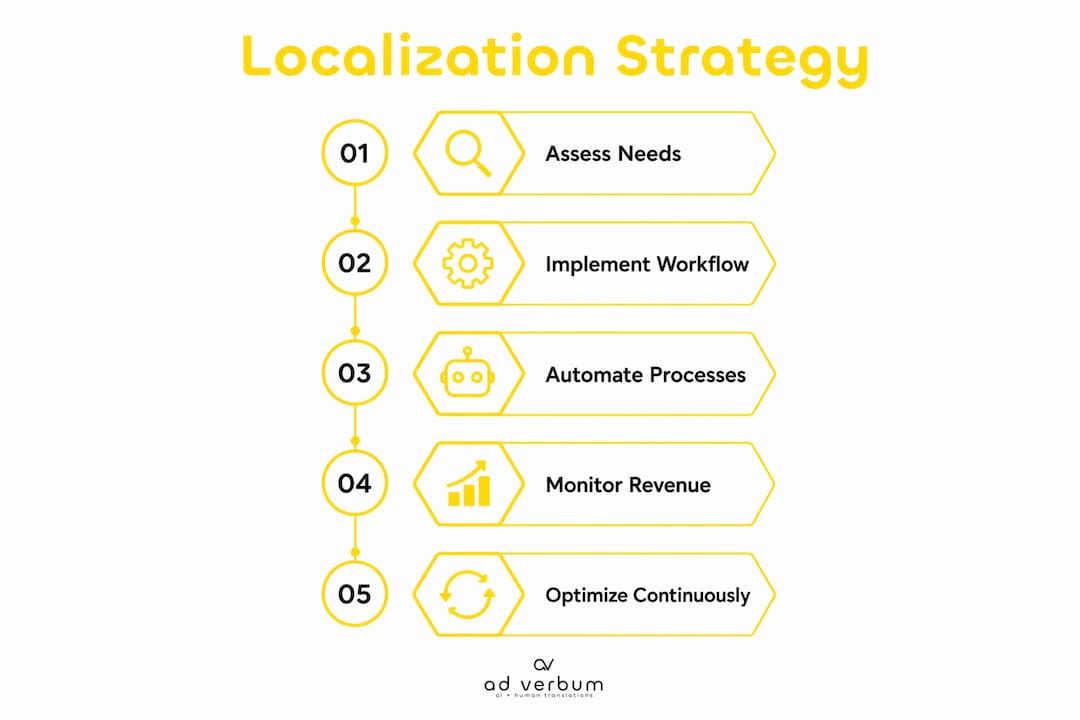
Conduct market research tied to compliance and revenue potential. Identify which markets show existing inbound traffic or sales signals, then map the regulatory requirements for each. Germany, France, and Japan each carry distinct documentation obligations for medical devices, financial products, or defense contracts.
Apply a tiered market model. Start with Tier 1 markets where revenue potential is highest and regulatory pathways are clearest. A tiered expansion approach begins with localized landing pages and marketing ads before committing to full product and support localization. This limits downside risk while validating demand.
Integrate AI+HUMAN hybrid translation and compliance workflows from day one. Retrofitting audit trails and terminology governance after launch costs more than building them in. Regulated documentation requires subject-matter expert review, not just machine output.
Measure incremental revenue at the locale level. Track revenue by locale, not total country revenue. Isolating the localized user experience’s impact is what enables precise ROI attribution and secures continued investment from leadership.
Iterate based on locale-level data. If conversion lifts are not materializing, the issue is usually market selection or product positioning, not translation quality. Adjust the tier model accordingly.
Maintain continuous QA and documentation traceability. Localization in regulated sectors is not a one-time project. Regulatory updates, product revisions, and label changes require ongoing process discipline.
Pro Tip: Treat localization as infrastructure, not a campaign. Continuous localization, supported by automated workflows and TM reuse, compounds ROI by accelerating speed to market and reducing per-word costs over time.
What regulated decision criteria should govern your localization program
Before committing budget, executives need to evaluate several factors that are specific to compliance-bound environments:
Regulatory mapping: Identify which ISO certifications, local data protection laws, and sector-specific standards apply in each target market. A medical device company entering the EU faces MDR requirements; a financial services firm entering Japan faces FSA documentation obligations.
Technical readiness: Assess whether your content infrastructure supports localization workflows, including TM integration, version control, and audit logging.
Market segmentation by revenue and risk: Not every market warrants the same investment. Tier markets by addressable revenue, competitive intensity, and regulatory complexity.
Operational maturity: Automated workflows protect margins and reduce time to market. The more mature the process, the faster each subsequent locale generates return.
Break-even modeling per locale: Calculate the payback period before approving spend. Business case data shows Year 1 ROI at 34% for the Germany example, with projected cumulative ROI exceeding 350% over time, and break-even typically occurring within 4–8 months for well-structured programs.
What localization ROI looks like in practice
The Germany example from published localization business case data illustrates the revenue trajectory clearly. A SaaS company with 5,000 monthly German visitors at a 1.5% conversion rate generated roughly 11 paid accounts per month pre-localization. Post-localization, at steady state, conversion reached 3.5%, producing 62 paid accounts monthly. Year 1 blended revenue, accounting for the ramp period, came to $22,319. Year 2 projected at $64,280.

Market | Year 1 ARR | Year 2 ARR | Year 3 ARR |
Germany | — | — | — |
France | — | — | — |
Spain | — | — | — |
Total | — | — | — |
Key outcomes from structured localization programs:
Conversion rates can more than double in localized markets within the first year
Payback periods as short as 7–8 months when localization is paired with SEO and paid acquisition.
Retention improvements that compound lifetime value well beyond initial conversion gains.
Regulatory compliance maintained throughout, enabling uninterrupted market access.
For regulated industries, the localization impact on sales extends to trust signals in legal and merchant agreements, where mistranslated terms create liability and erode customer confidence.
Common failure modes and how to avoid them
Most localization programs that underperform share the same root causes:
Measuring translation output instead of locale revenue. Word counts and delivery timelines tell you nothing about market performance. Tracking metrics at the translation level obscures ROI and makes it impossible to justify continued investment.
Treating localization as translation only. Without aligned marketing, product positioning, and customer support in the target language, a localized product still fails to convert.
Over-localizing before validating demand. Spending heavily on technical documentation for a market with minimal traffic is a common budget error. Start with landing pages and ads; scale only after data confirms the market.
Ignoring compliance and auditability requirements. In regulated sectors, a localization program that cannot produce an audit trail is a liability. Terminology inconsistencies in clinical or legal documents carry real regulatory risk.
No locale-level revenue tracking. Without this, leadership cannot distinguish between a market that needs more time and one that needs to be deprioritized.
Pro Tip: Set up locale-level revenue dashboards before launch, not after. Automated workflows tied to locale performance data let you reallocate budget to high-performing markets within weeks, not quarters.
Where AD VERBUM fits in regulated localization programs
AD VERBUM is built specifically for the conditions that make localization difficult in regulated industries: audit requirements, terminology governance, data sovereignty, and subject-matter complexity. With 25+ years serving Life Sciences, Legal, Finance, Defense, and Manufacturing sectors, the firm’s workflow is designed around compliance, not adapted to it after the fact.
The AI+HUMAN hybrid translation workflow follows a fixed sequence: client TM and TB assets are ingested first, the proprietary LangOps LLM generates output constrained by that terminology, a certified subject-matter expert reviews for technical accuracy and regulatory compliance, and QA is aligned to ISO 17100, ISO 18587, and sector requirements including MDR. Every step produces a traceable record.
AD VERBUM’s certification stack covers ISO 9001, ISO 17100, ISO 18587, ISO 13485, ISO 27001, ISO 42001, ISO 14001, and AQAP2110, all independently audited by Bureau Veritas. The infrastructure runs on private EU-hosted servers with no reliance on public cloud tooling for core processing, which directly addresses GDPR and HIPAA data handling requirements.
Statistic: AD VERBUM delivers 3x to 5x faster turnaround than traditional translation workflows, with full audit-ready traceability maintained throughout.
AD VERBUM fits best when the content is regulated, the documentation requires an audit trail, terminology consistency is non-negotiable, and data cannot leave a controlled environment. For executives evaluating regulatory document localization processes, those conditions describe most of the work.
Cost-benefit analysis of localization in regulated industries
The cost structure for a regulated localization program has two components: one-time setup costs (internationalization engineering, TM build, initial translation, tooling) and ongoing costs (updates, new content, QA cycles). Published business case data puts a three-language European program at roughly $50,000 in Year 1 total cost, with ongoing costs dropping sharply in subsequent years.
The benefit side compounds. Year 1 returns are modest because of the revenue ramp period. Years 2 and 3 are where the economics become compelling, as operational costs fall while revenue from established locales continues growing. Retention improvements, which reduce churn and extend customer lifetime value, add a layer of return that pure conversion modeling understates.
For regulated industries, there is also a cost-avoidance dimension. A compliance failure in a localized market, whether a mistranslated drug label, an incorrect financial disclosure, or a defense document with uncontrolled terminology, carries remediation costs and regulatory penalties that dwarf any localization budget. The QA and auditability infrastructure that good localization requires is simultaneously a risk management investment.
Explore AD VERBUM’s localization services for regulated industries, including AI+HUMAN hybrid translation, ISO-aligned QA, and multilingual SEO.
Key Takeaways
Localization drives measurable revenue growth in regulated industries when it is integrated with marketing, product fit, and compliance frameworks from the start.
Point | Details |
Localization enables, not causes, revenue | It accelerates conversion and retention when paired with marketing and product-market fit. |
Measure revenue per locale | Tracking incremental revenue by locale, not translation output, is what proves ROI to leadership. |
Year 1 ROI: 34% (Germany example) | Break-even typically occurs within 4–8 months for well-structured programs; cumulative ROI can exceed 350% over time. |
Compliance is structural, not optional | Auditability, terminology governance, and ISO-aligned QA protect both regulatory standing and revenue continuity. |
AD VERBUM fits regulated programs | Its AI+HUMAN hybrid translation, Bureau Veritas-audited certifications, and EU-hosted infrastructure address the specific controls regulated localization requires. |
Recommended

